The 1973–74 Australian region cyclone season was the third most active tropical cyclone season in the Australian Region.
| 1973–74 Australian region cyclone season | |
|---|---|
 Season summary map | |
| Seasonal boundaries | |
| First system formed | 17 November 1973 |
| Last system dissipated | 23 March 1974 |
| Strongest storm | |
| Name | Pam |
| • Maximum winds | 205 km/h (125 mph) (10-minute sustained) |
| • Lowest pressure | 928 hPa (mbar) |
| Seasonal statistics | |
| Tropical lows | 19 |
| Tropical cyclones | 19 |
| Severe tropical cyclones | 10 |
| Total fatalities | >101 |
| Total damage | Unknown |
| Related articles | |
Season summary
edit
Systems
editSevere Tropical Cyclone Ines
edit| Category 3 severe tropical cyclone (Australian scale) | |
| Category 1 tropical cyclone (SSHWS) | |
  | |
| Duration | November 17 – November 24 |
|---|---|
| Peak intensity | 150 km/h (90 mph) (10-min); 970 hPa (mbar) |
On November 17, Ines formed offshore the Top End. Moving westward, the cyclone passed north of Bathurst and Melville islands. Thereafter, Ines curved southwestward and intensified into a 130 km/h (80 mph) cyclone while nearing Troughton Island. The storm made landfall in Kimberley, Western Australia on November 19. Ines slowly weakened after moving inland and dissipated on November 24.[1]
Tropical Cyclone Annie
edit

Severe Tropical Cyclone Beryl
edit| Category 3 severe tropical cyclone (Australian scale) | |
| Category 1 tropical cyclone (SSHWS) | |
  | |
| Duration | November 26 – December 4 |
|---|---|
| Peak intensity | 130 km/h (80 mph) (10-min); 973 hPa (mbar) |
Beryl formed just south of the Lesser Sunda Islands on November 26. The cyclone strengthened, peaking with winds of 125 km/h (80 mph) on December 1. Three days later, Beryl made landfall near Carnarvon, Western Australia and quickly dissipated. Minor wind damage was reported.[3]
Tropical Cyclone Natalie–Lottie
edit| Category 1 tropical cyclone (Australian scale) | |
| Tropical storm (SSHWS) | |
  | |
| Duration | December 1 – December 2 |
|---|---|
| Peak intensity | 65 km/h (40 mph) (10-min); 995 hPa (mbar) |
Cyclone Lottie struck Fiji's Southern Lau Group on December 10. High seas caused the ship Uluilakeba to capsize killing more than 85 people.[4][5]
Severe Tropical Cyclone Cecily
edit| Category 3 severe tropical cyclone (Australian scale) | |
| Category 1 tropical cyclone (SSHWS) | |
 | |
| Duration | December 11 – December 19 |
|---|---|
| Peak intensity | 130 km/h (80 mph) (10-min); 973 hPa (mbar) |
The next system, Cecily, developed near the Cocos Islands on December 11. Cecily moved south-southwestward and peaked with winds of 125 km/h (80 mph). On December 19, the cyclone dissipated.[6]
Tropical Cyclone Una
edit| Category 2 tropical cyclone (Australian scale) | |
| Tropical storm (SSHWS) | |
 | |
| Duration | December 15 – December 20 |
|---|---|
| Peak intensity | 100 km/h (65 mph) (10-min); 988 hPa (mbar) |
Una formed southwest of Solomon Islands on December 15. It struck Queensland before dissipating on December 20.
Severe Tropical Cyclone Deidre–Delinda
edit| Category 3 severe tropical cyclone (Australian scale) | |
| Category 1 tropical cyclone (SSHWS) | |
  | |
| Duration | December 20 – December 25 (Crossed 80°E) |
|---|---|
| Peak intensity | 150 km/h (90 mph) (10-min); 964 hPa (mbar) |
Cyclone Deidre developed in the vicinity of the Cocos Islands on December 20. Moving generally west-southwestward across the Indian Ocean, it crossed the 80°E on December 25.[7]
Tropical Cyclone Erica
edit
Tropical Cyclone Fiona–Gwenda
edit
Tropical Cyclone Vera
edit| Category 2 tropical cyclone (Australian scale) | |
| Tropical storm (SSHWS) | |
 | |
| Duration | January 18 – January 20 (Crossed 160°E) |
|---|---|
| Peak intensity | 95 km/h (60 mph) (10-min); 986 hPa (mbar) |
On January 18, Cyclone Vera developed offshore Queensland. After moving northeastward, it then curved to the southeast. On January 20, Vera crossed 160°E and entered the South Pacific basin.
Tropical Cyclone Wanda
edit| Category 2 tropical cyclone (Australian scale) | |
| Tropical storm (SSHWS) | |
  | |
| Duration | January 20 – January 25 |
|---|---|
| Peak intensity | 95 km/h (60 mph) (10-min); 997 hPa (mbar) |
This cyclone existed from 24 January to 27 January 1974 and led to extensive flooding over southeast Queensland. Although this tropical cyclone was relatively weak, it dropped enormous quantities of rain on south-eastern Queensland and north-eastern New South Wales over the Australia Day (26–27 January) weekend, resulting in some of the worst flooding seen in a century. The Queensland state capital, Brisbane, fared particularly badly, with fourteen lives lost and parts of the city submerged under 2 metres of the Brisbane River. In northern New South Wales, a further two fatalities were reported. The cyclone's final toll: 16 dead, over 300 injured; 56 homes destroyed, a further 1,600 submerged; 8000 people left homeless.[10]
Severe Tropical Cyclone Pam
edit| Category 5 severe tropical cyclone (Australian scale) | |
| Category 2 tropical cyclone (SSHWS) | |
  | |
| Duration | February 4 – February 8 |
|---|---|
| Peak intensity | 205 km/h (125 mph) (10-min); 928 hPa (mbar) |
During 4 February Severe Tropical Cyclone Pam moved south-westwards into the Australian region as a Category 5 severe tropical cyclone, with peak 10-minute sustained wind speeds estimated at 205 km/h (125 mph).[11] Over the next couple of days, Pam passed about 500 km (310 mi) to the east of Brisbane, as it gradually weakened and recurved south-eastwards.[11][12] The system was last noted during 7 February as it moved back into the South Pacific basin.[11]
Tropical Cyclone Yvonne
edit| Category 2 tropical cyclone (Australian scale) | |
| Tropical storm (SSHWS) | |
 | |
| Duration | February 8 – February 14 |
|---|---|
| Peak intensity | 100 km/h (65 mph) (10-min); 990 hPa (mbar) |
Cyclone Yvonne developed on February 8 and struck the Cape York Peninsula.
Severe Tropical Cyclone Helen
edit
Severe Tropical Cyclone Zoe
edit| Category 3 severe tropical cyclone (Australian scale) | |
| Category 1 tropical cyclone (SSHWS) | |
  | |
| Duration | March 6 – March 14 |
|---|---|
| Peak intensity | 140 km/h (85 mph) (10-min); 968 hPa (mbar) |
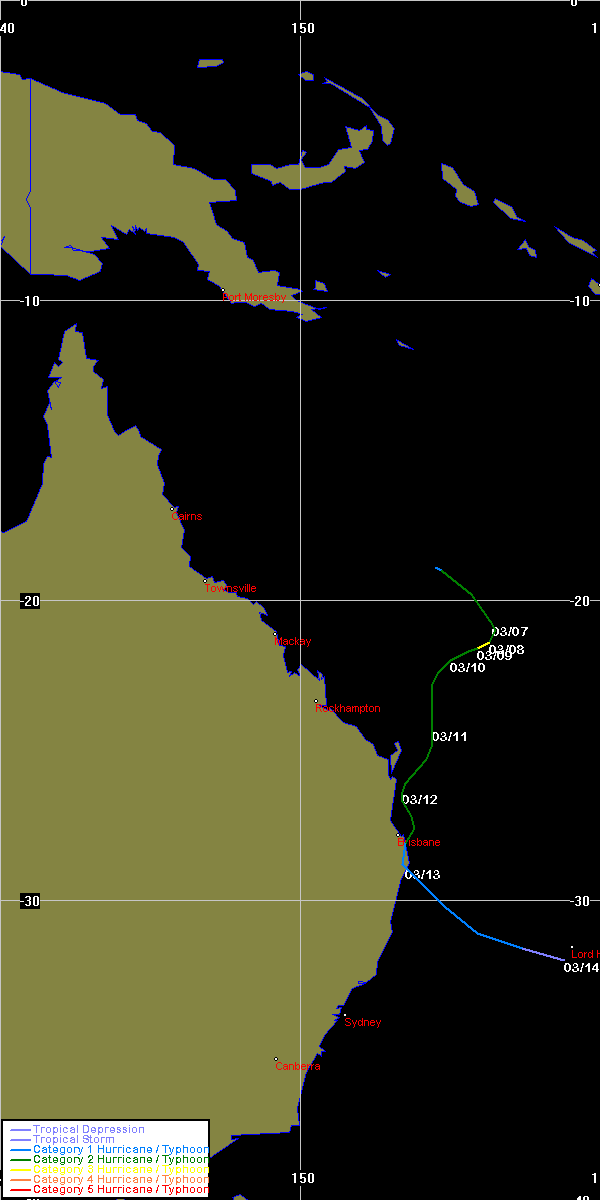
Cyclone Zoe was named and detected on 9 March 1974 when it was northeast of Brisbane. In the following days it moved steadily southward[13] and interacted with an already-exiting trough in the easterlies to produce sustained and very heavy rainfall all along the coast from Brisbane south almost to Sydney. In the four days between 10 and 13 March, Brisbane received 419.4 millimetres (16.51 in)[14] and some places in the Northern Rivers region of New South Wales received as much as 700 millimetres (28 in).[15] With catchments already saturated by heavy January rains, record flooding occurred on the Richmond River,[16] which reached a height of 12.17 metres (39.9 ft).
Severe Tropical Cyclone Isobel
edit
Severe Tropical Cyclone Jessie
edit

Tropical Cyclone Jenny
edit

Tropical Cyclone Alice
edit
See also
edit
References
edit- ↑ Severe Tropical Cyclone Ines (Report). Melbourne, Victoria: Bureau of Meteorology. Retrieved July 18, 2014.
- ↑ Tropical Cyclone Annie (Report). Melbourne, Victoria: Bureau of Meteorology. Retrieved July 18, 2014.
- ↑ Tropical Cyclone Beryl (Report). Melbourne, Victoria: Bureau of Meteorology. Retrieved July 18, 2014.
- ↑ "Fiji Times". Archived from the original on 2014-05-08. Retrieved 2013-04-27.
- ↑ Joeli Kalgouta, "The Only Survivor", Liahona, October 2004.
- ↑ Tropical Cyclone Cecily (PDF) (Report). Melbourne, Victoria: Bureau of Meteorology. Retrieved July 18, 2014.
- ↑ Severe Tropical Cyclone Deidre (Report). Melbourne, Victoria: Bureau of Meteorology. Retrieved July 18, 2014.
- ↑ Tropical Cyclone Erica 29/12/1973 to 05/01/1974 (PDF) (Report). Melbourne, Victoria: Bureau of Meteorology. Retrieved July 18, 2014.
- ↑ Severe Tropical Cyclone Fiona–Gwenda (Report). Melbourne, Victoria: Bureau of Meteorology. Retrieved July 18, 2014.
- ↑ Bureau of Meteorology (1992). Climate of Queensland, Commonwealth of Australia ISBN 0-644-24331-7
- 1 2 3 1974 Tropical Cyclone PAM (1974030S15182) (Report). International Best Track Archive for Climate Stewardship. Retrieved March 28, 2020.
- ↑ Tropical Cyclone Pam (Report). Australian Bureau of Meteorology. Retrieved March 28, 2020.
- ↑ Cyclone Zoe
- ↑ Brisbane Highest Daily Rainfall-March
- ↑ March 1974 flood
- ↑ Going to Venice