
The Congregation Shearith Israel (Hebrew: קהילת שארית ישראל, romanized: Kehilat She'arit Yisra'el, lit. 'Congregation Remnant of Israel'), often called The Spanish and Portuguese Synagogue, is an Orthodox Jewish synagogue located at 2 West 70th Street, at Central Park West, on the Upper West Side of Manhattan in New York City, New York, United States.
| Congregation Shearith Israel | |
|---|---|
Hebrew: קהילת שארית ישראל | |
 Congregation Shearith Israel at Central Park West | |
| Religion | |
| Affiliation | Orthodox Judaism |
| Rite | Spanish and Portuguese (Western Sephardic) |
| Synagogue | |
| Leadership |
|
| Status | Active |
| Location | |
| Location | 2 West 70th Street, Upper West Side, Manhattan, New York City, New York |
| Country | United States |
  Location within Manhattan | |
| Coordinates | 40°46′29.5″N 73°58′38.3″W / 40.774861°N 73.977306°W |
| Architecture | |
| Architect | Arnold Brunner |
| Type | Synagogue |
| Style | Neoclassical |
| Established | 1654 (as a congregation) |
| Completed | 1897 |
Direction of façade | East |
| Website | |
| shearithisrael | |
Established in 1654 in New Amsterdam by Jews who arrived from Dutch Brazil, it is the oldest Jewish congregation in the United States.[1] Until 1825, when Jewish immigrants from Germany established a congregation, it was the only Jewish congregation in New York City.
The Orthodox congregation follows the Sephardic rite, and has occupied its current Neoclassical building since 1897.[2]
Founding and synagogue buildings
editThe first group of Spanish and Portuguese Jews were twenty-three refugees from Dutch Brazil, who arrived in New Amsterdam in September 1654. After being initially rebuffed by the Director of New Netherland, Peter Stuyvesant, Jews were given official permission to settle in the colony in 1655. This year marks the founding of the Congregation Shearith Israel. Although they were allowed to stay in New Amsterdam, they faced discrimination and were not given permission to worship in a public synagogue for some time (throughout the Dutch period and into the British). The Congregation did, however, make arrangements for a cemetery beginning in 1656.[This paragraph needs citation(s)]
It was not until 1730 that the Congregation was able to build a synagogue of its own; it was built on Mill Street (now South William Street) in lower Manhattan.[citation needed] The Mill Street synagogue was said to have had access to a nearby spring which it used as a mikveh for ritual baths.[3] Before 1730, as noted on a 1695 map of New York, the congregation worshipped in rented quarters on Beaver Street and subsequently on Mill Street. Since 1730, the Congregation has worshipped in five synagogue buildings:
- Mill Street, 1730
- Mill Street rebuilt and expanded, 1818
- 60 Crosby Street, 1834
- 19th Street, 1860
- West 70th Street, 1897 (present building)
The current building was extensively refurbished in 1921.[4]
Founding major Jewish institutions
editAs the American Reform Judaism made headway in the late 19th century, many rabbis critical of the Reform movement sought ways to strengthen traditional synagogues. Shearith Israel and its rabbi, Henry Pereira Mendes, were at the fore of these efforts. Rabbi Mendes cofounded the American Jewish Theological Seminary (JTS) in 1886 in order to train traditional rabbis. The school held its first classes at Shearith Israel. In JTS' earliest days, it taught and researched rabbinics similarly as was done in traditional yeshivas, in contrast to the Reform Hebrew Union College.[This paragraph needs citation(s)]
Twelve years later, in 1896, Mendes was acting president of JTS. He promoted the formation[5] of the Union of Orthodox Jewish Congregations of America (commonly known as the OU, the Orthodox Union). This synagogue umbrella group provided an alternative to the Reform Union of American Hebrew Congregations (now the Union for Reform Judaism).[This paragraph needs citation(s)]
As JTS grew, it needed better financing and a full-time head. The seminary moved to its own building, and Mendes was replaced by Solomon Schechter. However, Schechter developed a less traditional approach, which became the basis for Conservative Judaism (called Masorti outside North America). Initially, there was considerable cooperation between the Orthodox and Conservative groups, but the divide became clearer over time.[This paragraph needs citation(s)]
Schechter formed the United Synagogue of America (now the United Synagogue of Conservative Judaism, or USCJ) to promote synagogue affiliation with his conservative ideology.[6]
Shearith Israel remains aligned with the Orthodox tradition.[7] It eventually repudiated its association with JTS. In a sense, Shearith Israel helped create three of the largest and most significant Jewish religious organizations in the United States: JTS, the OU, and USCJ. Shearith Israel remains a member only of the Orthodox Union.[This paragraph needs citation(s)]
Synagogues
editThe Congregation Shearith Israel is the oldest Jewish congregation in the United States,[8][9] and, until 1825, it was the only synagogue in New York City.[10] Several early synagogues existed, with the earliest on Beaver Street, according to a map drawn in 1695, and, by 1700, another on Mill Street where the purpose-built Mill Street Synagogue was constructed in 1730.[10] In 1834, the congregation moved to a synagogue on Crosby Street, and in 1860 it moved to the Nineteenth Street Synagogue.[11] Finally, in 1897, it took its current incarnation in the Seventieth Street Synagogue, which was built by architect Arnold Brunner, with interior design and stained glass by Louis Comfort Tiffany.[11]
 The Mill Street Synagogue, detail from the section "Religious Buildings of New York" in A Plan of the City and Environs of New York by David Grim, 1813.
 King's Handbook of New York City, Moses King, 1892, p. 410. Original held and digitised by the British Library.
 1970 Israeli stamp celebrating Congregation Shearith Israel.
 "Order of Service," published by the executive committee of Congregation Shearith Israel on Thanksgiving, 1905, commemorating the 250th anniversary of the settlement of Jews in America.
 The earliest American Ketubbah (Jewish Marriage Contract), New York: 1751. The only known illustrated 18th century American Ketubah, and one of the most significant surviving documents of early American Jewish history.
 Congregation Shearith Israel today.

_5_WEST_19TH_STREET.jpg)


Historic Burial Grounds
editThe Jews first applied for the purchase of a burial ground in July 1655, and then again in February 1656, at which time it was granted. According to Oppenheim it was located at "the New Bowery [St. James Place] and Chatham Square".[12]
There are multiple inactive landmarked cemeteries in New York City for Congregation Shearith Israel, with its only current active burial site in Queens. The first, and oldest, also known as Chatham Square Cemetery, located at 55 St. James Place in Lower Manhattan, was established in 1682, and remained active until 1828.[13] It contains the remains of early Spanish and Portuguese Jewish settlers and American Revolutionary War veterans. A second cemetery was established on West 11th Street in 1805 and a third, on West 21st Street, in 1829.[13]
1656-1833 | First Cemetery of Congregation Shearith Israel
edit Entrance to Shearith Israel Graveyard. Gallery credit: Oleg Yunakov / CC BY-SA 4.0.
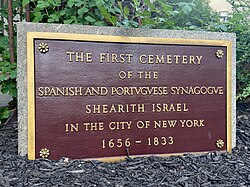 The First Cemetery of the Spanish and Portuguese synagogue Shearith Israel in the City of New York 1656–1833.
 Overview of the cemetery
 The first Jewish cemetery in the U.S., consecrated in the year 1656 when its Lower Manhattan location was "outside the city."


1805-1829 | Second Cemetery of Congregation Shearith Israel
edit The Second Cemetery of the Spanish and Portuguese Synagogue Shearith Israel in the City of New York 1805–1829.
 View of the Second Cemetery of Congregation Shearith Israel.
 Back wall of the second cemetery. Credit: Oleg Yunakov / CC BY-SA 4.0.
 Individual gravestones in the second cemetery. Credit: Oleg Yunakov / CC BY-SA 4.0.


1829-1851 | Third Cemetery of Congregation Shearith Israel
edit Entrance to the third cemetery. Gallery credit: Oleg Yunakov / CC BY-SA 4.0.
 The Third Cemetery of the Spanish and Portuguese Synagogue Shearith Israel in the City of New York 1829–1851.
 Overview of the third cemetery.
 Monuments and gravestones in the third cemetery.


Clergy
editRabbis
editThe following individuals have served as rabbi of Congregation Shearith Israel:
Order Name Start year End year Notes 1 Benjamin Wolf [14] 2 Gershom Mendes Seixas Not ordained: Hazzan of the Congregation and an ardent American patriot; he moved the Congregation to Philadelphia after the British occupied the city during the American Revolutionary War. 3 Moses L. M. Peixotto Not ordained[15] 4 Isaac B. Seixas 1828 1839 [15] 5 Jacques Judah Lyons 1839 1877 6 Henry S. Jacobs 1874 1876 7 Henry Pereira Mendes 1877 1920 8 David de Sola Pool 1907 1919 Hired as assistant rabbi in 1907, and left in 1919. A year later, Mendes retired, and the synagogue went through a succession of candidates until he returned in 1921. Herbert Goldstein was announced as rabbi, but did not actually take the pulpit. Reverend Joseph Corcos was appointed interim rabbi.[16][4] 1921 1955 9 Louis B. Gerstein 1956 1988 10 Marc D. Angel 1969 2007 11 Hayyim Angel 1995 2013 12 Meir Soloveichik 2013 present
Parnasim
editNotable parnasim include Luis Moises Gomez, Edgar J. Nathan Jr, Israel Baer Kursheedt, and Alvin Deutsch (1997–2001).[17]
Hazanim
editNotable hazanim include Gershom Mendes Seixas (1768–1776 and 1784–1816), Isaac Touro (1780), Jacques Judah Lyons (1839–1877), Abraham Lopes Cardozo (1946–1986),[18] Daniel Halfon (1978–1980) and Albert Gabbai (1983–1986).
Prominent members
edit- Jacob Baiz – merchant and Central American diplomat
- Mark Blumenthal – physician, served as trustee of Shearith Israel
- Albert Cardozo – Justice of the New York Supreme Court
- Benjamin N. Cardozo – Justice of the Supreme Court of the United States, 1932–1937
- Philip J. Joachimsen – lawyer and Judge of the New York Marine Court
- Judith Kaye – Chief Judge of New York, 1993–2008
- Emma Lazarus – poet
- Commodore Uriah P. Levy – the first Jewish Commodore of the United States Navy
- Theodore W. Myers – New York City Comptroller
- Edgar J. Nathan – Manhattan Borough President and justice of the New York Supreme Court
- Selig Newman – Polish-born Hebraist and educator
- Mordecai Manuel Noah – American playwright, sheriff, diplomat, and journalist
- Isaac Pinto – prepared the first Jewish prayer book published in America, which was also the first English translation of the Siddur
- Jack Rudin – real estate developer
- Arthur Tracy – singer and actor
Gallery
edit The synagogue's third cemetery (1829–1851) is on West 21st Street near the Avenue of the Americas
- The Mill Street synagogue, detail from the section "Religious Buildings of New York" in A Plan of the City and Environs of New York by David Grim
- Temple Shearith Israel, 5 West 19th Street, 1893
 Landmark plaques
 Signatures of Michael Michaels and Gershom Mendes Seixas on Shearith Israel's "Shechita book", at Penn Libraries[19]

_by_David_Shankbone_crop.jpg)

See also
edit


- First Shearith Israel Graveyard
- Jewish history in Colonial America
- List of New York City Designated Landmarks in Manhattan from 59th to 110th Streets
- National Register of Historic Places listings in Manhattan from 59th to 110th Streets
- Oldest synagogues in the United States
- Sephardic Jews in the United States
- Touro Synagogue
References
editCitations
edit- ↑ Marcus, Jacob R. (1951). Early American Jewry: The Jews of New York, New England, and Canada, 1649–1794. Vol. I. Philadelphia: Jewish Publication Society. pp. 3, 20–23.
- ↑ "Congregation Shearith Israel: Building Report". International Survey of Jewish Monuments. Archived from the original on February 17, 2007. Retrieved April 3, 2007.
- ↑ Dyer, Albion Morris (1895). "Points in the First Chapter of New York Jewish History". Publications of the American Jewish Historical Society. American Jewish Historical Society. pp. 54–55.
- 1 2 "New York Happenings". The American Israelite. October 6, 1921. pp. P2. Retrieved August 13, 2020 – via Newspapers.com
 .
. - ↑ "The Orthodox Union Story, chs. 5–6". Ou.org. Archived from the original on August 21, 2011. Retrieved October 15, 2011.
- ↑ From the Beginning... Archived January 13, 2009, at the Wayback Machine
- ↑ Gilson, Grace (November 28, 2025). "Oldest Jewish congregation in US launches Manhattan kosher food pantry on Thanksgiving". The Times of Israel. Retrieved March 19, 2026.
- ↑ Hershkowitz, Leo (2005). "By Chance or Choice: Jews in New Amsterdam 1654" (PDF). American Jewish Archives. 57: 1–13.
- ↑ Hershkowitz, Leo (October 5, 2013). "History, Herstory, Ourstory: Asser Levy in New Amsterdam". Jewish Currents. Retrieved June 6, 2019.
- 1 2 "Congregational History | Congregation Shearith Israel- Manhattan Orthodox Synagogue". May 19, 2022. Retrieved February 11, 2026.
- 1 2 "Synagogue Buildings | Congregation Shearith Israel- Manhattan Orthodox Synagogue". May 19, 2022. Retrieved February 11, 2026.
- ↑ Oppenheim, Samuel (1909). "The Early History of the Jews in New York, 1654-1664. Some New Matter on the Subject". Publications of the American Jewish Historical Society (18). The Johns Hopkins University Press: 19.
- 1 2 "Cemeteries | Congregation Shearith Israel- Manhattan Orthodox Synagogue". May 19, 2022. Retrieved February 11, 2026.
- ↑ Phillips, N. Taylor (1897). "The Congregation Shearith Israel An Historical Review". American Jewish Historical Quarterly. American Jewish Historical Society. pp. 126–129.
- 1 2 "SEIXAS – JewishEncyclopedia.com". www.jewishencyclopedia.com. Retrieved August 14, 2020.
- ↑ "The Rev. Dr. Herbert S. Goldstein has been called the to Spanish and Portuguese Synagog..." The American Israelite. November 24, 1921. pp. P2. Retrieved August 14, 2020 – via Newspapers.com .
- ↑ "ALVIN DEUTSCH Obituary (1932–2021) New York Times". Retrieved April 12, 2022.
- ↑ De Sola Pool, David and Tamar (1955). An Old Faith in the New World: Portrait of Shearith Israel, 1654–1954. New York, NY: Columbia University Press. pp. 158–186.
- ↑ "Footprints Written Work: Shehitot u-vedikot". Footprints. Retrieved March 30, 2022.
Sources
edit- Brockmann, Jorg; Harris, Bill (2002). One Thousand New York Buildings. New York: Black Dog & Leventhal. ISBN 978-1-57912-237-9. OCLC 48619292 – via Google Books.
External links
edit Media related to Congregation Shearith Israel at Wikimedia Commons
- Official website
