
The common flatwing (Austroargiolestes icteromelas) is a very common species of damselfly of the subfamily Argiolestinae in the family Argiolestidae.[4][5] It is also known as an Australian flatwing.
| Common flatwing | |
|---|---|
 | |
| Male | |
 | |
| Female | |
Scientific classification  | |
| Kingdom: | Animalia |
| Phylum: | Arthropoda |
| Clade: | Pancrustacea |
| Class: | Insecta |
| Order: | Odonata |
| Suborder: | Zygoptera |
| Family: | Argiolestidae |
| Genus: | Austroargiolestes |
| Species: | A. icteromelas |
| Binomial name | |
| Austroargiolestes icteromelas | |
 | |
| Synonyms[3] | |
| |

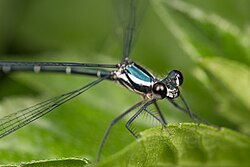
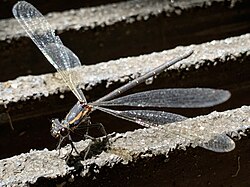
Both male and female common flatwings look similar, with a long and slender body about 43 mm in length, and a bright metallic-blue colour. They usually rest with their wings flat open, but females sometimes rest with wings folded up. Their antennae are very small, and their compound eyes are comparatively large. Common flatwings do not use their legs for walking, but for capturing other flying insects in the air, like all other dragonflies and damselflies. They can be found along streams and creeks, are seldom found near still water ponds, but are more likely to be found near slow running water. This species likes to rest within a few metres of a creek or stream, in a shaded area, sometimes resting in large groups among plants. They perch on leaves and, when disturbed, fly a short distance. Common flatwings tolerate people close to them.
Subspecies
editAustroargiolestes icteromelas has a two subspecies: Austroargiolestes icteromelas icteromelas, which has a pale mouth (labium) and is from southern and cooler parts, and Austroargiolestes icteromelas nigrolabiatus, which has a dark mouth and is from more northern and warmer regions.[5]
Distribution
editThe common flatwing is found in eastern Australia: in Australian Capital Territory, New South Wales, Queensland, and Victoria.
Etymology
editThe genus name Austroargiolestes combines the prefix austro- (from Latin auster, meaning “south wind”, hence “southern”) with Argiolestes, the name of a related genus. It refers to a southern representative of that group.[6]
The species name icteromelas is derived from Greek ἴκτερος (ikteros, "yellow") and μέλας (melas, "black"), referring to the yellow and black colour of the thorax.[2][6]
Gallery
edit Male
Male Male
Male Recently emerged female with wings held together
 Austroargiolestes icteromelas nigrolabiatus in Brisbane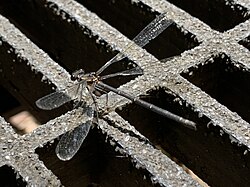
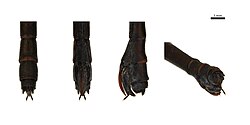 Tip of female tail
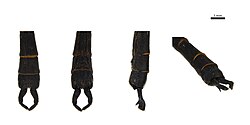 Tip of male tail
 Female wings
 Male wings

.jpg)

.jpg)
.jpg)
.jpg)
.jpg)
.jpg)
.jpg)
.jpg)
References
edit- ↑ Dow, R.A. (2017). "Austroargiolestes icteromelas". IUCN Red List of Threatened Species. 2017 e.T87531977A87534001. doi:10.2305/IUCN.UK.2017-1.RLTS.T87531977A87534001.en.
- 1 2 Selys-Longchamps, E. (1862). "Synopsis des Agrionines, troisième légion: Podagrion". Bulletin de la Classe des Science, Académie Royale de Belgique. 2. 14: 5–44 [40].
- ↑ Paulson, D.; Schorr, M.; Abbott, J.; Bota-Sierra, C.; Deliry, C.; Dijkstra, K.-D.; Lozano, F. "World Odonata List". OdonataCentral. University of Alabama. Retrieved 3 April 2026.
- ↑ "Species Austroargiolestes icteromelas (Selys, 1862)". Australian Faunal Directory. Australian Biological Resources Study. 2022. Retrieved 1 November 2024.
- 1 2 Theischinger, Günther; Hawking, John (2006). The Complete Field Guide to Dragonflies of Australia. Collingwood, Victoria, Australia: CSIRO Publishing. p. 52. ISBN 978-0-64309-073-6.
- 1 2 Endersby, Ian; Fliedner, Heinrich (2015). The Naming of Australia's Dragonflies. Eltham, Victoria, Australia: Busybird Publishing. ISBN 9781925260625.
External links
edit Media related to Austroargiolestes icteromelas at Wikimedia Commons
- Brisbane Insects
