
Camacinia othello is a species of dragonfly in the family Libellulidae[3] known commonly as the black knight.[4] It is native to Indonesia, Papua New Guinea, the Solomon Islands, and the Northern Territory and Queensland in Australia.[1]
| Camacinia othello | |
|---|---|
 | |
| Male in Cairns, Australia | |
 | |
| Female in Cairns, Australia | |
Scientific classification  | |
| Kingdom: | Animalia |
| Phylum: | Arthropoda |
| Clade: | Pancrustacea |
| Class: | Insecta |
| Order: | Odonata |
| Infraorder: | Anisoptera |
| Family: | Libellulidae |
| Genus: | Camacinia |
| Species: | C. othello |
| Binomial name | |
| Camacinia othello | |
 | |

It is a large dragonfly with a wingspan of 115 millimeters and an overall length of around 65 millimeters The adult male has dark markings on the forewing and hindwing covering around one third to one half of each wing. The markings on the female differ substantially, with a light brown stripe along the leading edge of each wing to just beyond the node, and light brown marks on each wingtip.[5]
Little is known about its habitat preferences and other characteristics.[1] There are twenty-seven records listed in the Atlas of Living Australia as of January, 2017.[4] It is not considered to be threatened.[1]
Etymology
editGallery
edit Male, dorsal view, Cairns
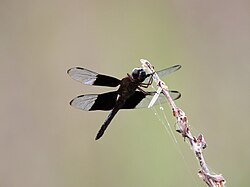 Male underside
 Male showing brownish body
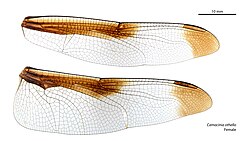 Female wings
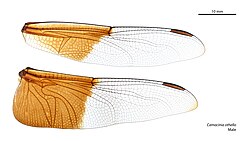 Male wings

_(32547236830).jpg)
_(16350003331)_(2).jpg)
.jpg)
.jpg)
References
edit- 1 2 3 4 Kalkman, V.J. (2020). "Camacinia othello". IUCN Red List of Threatened Species. 2020 e.T163911A83377915. doi:10.2305/IUCN.UK.2020-1.RLTS.T163911A83377915.en. Retrieved 20 November 2021.
- 1 2 Tillyard, R.J. (1908). "On some remarkable Australian Libellulinae. Part ii". Proceedings of the Linnean Society of New South Wales. 33: 637–649 [639] – via Biodiversity Heritage Library.
- ↑ "Species Camacinia othello Tillyard, 1908". Australian Faunal Directory. Australian Biological Resources Study. 2012. Retrieved 27 February 2017.
- 1 2 "Camacinia othello". Atlas of Living Australia. Archived from the original on 2016-02-06.
- ↑ Theischinger, Gunther; Hawking, John (2006). The Complete Field Guide to Dragonflies of Australia. Collingwood Vic.: CSIRO. p. 292. ISBN 0-643-09073-8.
- ↑ Endersby, Ian; Fliedner, Heinrich (2015). The Naming of Australia's Dragonflies. Eltham, Victoria, Australia: Busybird Publishing. ISBN 9781925260625.
- ↑ Endersby, Ian (2012). "Etymology of the Dragonflies (Insecta: Odonata) named by R.J. Tillyard, F.R.S." Proceedings of the Linnean Society of New South Wales. 134: 1–16.
