
Ptolemy XV Caesar[b] (/ˈtɒləmi/; Ancient Greek: Πτολεμαῖος Καῖσαρ, Ptolemaios Kaisar; 47 BC – late August 30 BC),[2] nicknamed Caesarion (Greek: Καισαρίων, Kaisaríōn, "Little Caesar"), was the last pharaoh of the Ptolemaic Kingdom of Egypt, reigning with his mother Cleopatra VII from 44 BC to 30 BC. He nominally reigned as sole pharaoh for a few days after his mother's death, although Alexandria had already fallen and Caesarion remained in hiding until his execution by Octavian, who would become the first Roman emperor as "Augustus".
| Caesarion | ||||||||||||||||||||||||||||||||||||||||||||||||||||||||||||||||||||||||||||||||||||||||||||||||||
|---|---|---|---|---|---|---|---|---|---|---|---|---|---|---|---|---|---|---|---|---|---|---|---|---|---|---|---|---|---|---|---|---|---|---|---|---|---|---|---|---|---|---|---|---|---|---|---|---|---|---|---|---|---|---|---|---|---|---|---|---|---|---|---|---|---|---|---|---|---|---|---|---|---|---|---|---|---|---|---|---|---|---|---|---|---|---|---|---|---|---|---|---|---|---|---|---|---|---|
| Theos Philopator Philometor | ||||||||||||||||||||||||||||||||||||||||||||||||||||||||||||||||||||||||||||||||||||||||||||||||||
 Granite head identified as Caesarion, hosted in Bibliotheca Alexandrina Antiquities Museum, Egypt | ||||||||||||||||||||||||||||||||||||||||||||||||||||||||||||||||||||||||||||||||||||||||||||||||||
| Reign | 2 September 44 BC – late August 30 BC | |||||||||||||||||||||||||||||||||||||||||||||||||||||||||||||||||||||||||||||||||||||||||||||||||
| Coregency | Cleopatra VII | |||||||||||||||||||||||||||||||||||||||||||||||||||||||||||||||||||||||||||||||||||||||||||||||||
| Predecessor | Cleopatra VII and Ptolemy XIV | |||||||||||||||||||||||||||||||||||||||||||||||||||||||||||||||||||||||||||||||||||||||||||||||||
| Successor | Octavian (as Roman emperor)[a] | |||||||||||||||||||||||||||||||||||||||||||||||||||||||||||||||||||||||||||||||||||||||||||||||||
| ||||||||||||||||||||||||||||||||||||||||||||||||||||||||||||||||||||||||||||||||||||||||||||||||||
| Father | Julius Caesar | |||||||||||||||||||||||||||||||||||||||||||||||||||||||||||||||||||||||||||||||||||||||||||||||||
| Mother | Cleopatra VII | |||||||||||||||||||||||||||||||||||||||||||||||||||||||||||||||||||||||||||||||||||||||||||||||||
| Born | 47 BC Ptolemaic Kingdom | |||||||||||||||||||||||||||||||||||||||||||||||||||||||||||||||||||||||||||||||||||||||||||||||||
| Died | Late August 30 BC (aged 16–17)[2] Alexandria, Ptolemaic Kingdom | |||||||||||||||||||||||||||||||||||||||||||||||||||||||||||||||||||||||||||||||||||||||||||||||||
| Dynasty | Ptolemaic dynasty | |||||||||||||||||||||||||||||||||||||||||||||||||||||||||||||||||||||||||||||||||||||||||||||||||


Caesarion was the eldest son of Cleopatra, and was the only known biological son of Julius Caesar, after whom he was named. He was the last sovereign member of the Ptolemaic dynasty, and the last pharaoh of Ancient Egypt, ending more than 3000 years of traditional kingship.
Early life
edit
Caesarion was born in Egypt in 47 BC. An Egyptian demotic stele recovered from the Serapeum in Memphis, records his birth on 23 June 47 BC.[5][6] He was conceived during Julius Caesar's extended residence in Egypt between September 48 BC and January 47 BC.[7] During this period, Caesar intervened in the Alexandrian War, militarily supporting Cleopatra's claim to the Ptolemaic throne against her brother and rival, Ptolemy XIII.[8]
In late 46 BC, Cleopatra traveled to Rome at the invitation of Julius Caesar, bringing her infant son Caesarion.[9] During their time in Italy, Cleopatra and her son resided as official guests in Caesar's private villa, the Horti Caesaris.[10][11] Some sources documented that Caesarion bore a physical resemblance to Julius Caesar.[12][13] Mark Antony later testified before the Roman Senate that Caesar had privately acknowledged the boy as his biological son to his closest associates.[14] However, Caesar never officially or legally recognized Caesarion as his legitimate heir under Roman law.[15] One of Caesar's supporters, Gaius Oppius, wrote a pamphlet which attempted to prove that Caesar could not have fathered Caesarion.[16] In 46 BC, Caesar dedicated the Temple of Venus Genetrix in the Forum Julium, honoring his family's mythological ancestor.[17] Inside the temple, he placed a gilded statue of Cleopatra.[18]
Julius Caesar was assassinated on 15 March 44 BC. When his final will was read, Caesarion was completely omitted from the document.[19] Instead, Caesar posthumously adopted his grandnephew, Octavian, naming him as his primary heir.[19]

Following Caesar's assassination, Cleopatra fled the city with the two-year-old Caesarion in mid-April 44 BC, returning to Alexandria.[20] Shortly after their return to Egypt, Cleopatra's brother and nominal co-ruler, Ptolemy XIV, died.[21] On 2 September 44 BC, at the age of three, Caesarion was officially proclaimed King of Egypt; although Cleopatra retained absolute autocratic authority.[22]
Caesarion was assigned the royal epithets Theos Philopator Philometor ("The God Who Loves His Father and Mother").[23] She utilized religious iconography, styling herself as the goddess Isis/Venus and presenting Caesarion as son Horus/Eros.[24] The earliest extant physical depictions of Caesarion are found on Cypriot coinage minted in 44 BC, which portray him as an infant held in his mother's arms.[25]
Cleopatra commissioned the construction of a birth house at the Temple complex of Montu in Armant. The temple's decorative reliefs depicted the divine birth of Caesarion.[26]
Pharaoh
edit
Caesarion's formal co-regency with Cleopatra VII was recorded via double-dating systems in official state documentation.[27][28]
In 34 BC, Antony granted further eastern lands and titles to Caesarion and his own three children with Cleopatra in the Donations of Alexandria. Caesarion was proclaimed to be a god, a son of [a] god, and "King of Kings".[29] This grandiose title was "unprecedented in the management of Roman client-king relationships" and could be seen as "threatening the 'greatness' of the Roman people".[29] Antony also declared Caesarion to be Caesar's true son and heir. This declaration was a direct threat to Octavian (whose claim to power was based on his status as Julius Caesar's grandnephew and adopted son). These proclamations partly caused the fatal breach in Antony's relations with Octavian, who used Roman resentment over the Donations to gain support for war against Antony and Cleopatra.[30]
Death
edit
After the defeat of Mark Antony and Cleopatra at the Battle of Actium in 31 BC, Cleopatra seems to have groomed Caesarion to take over as "sole ruler without his mother".[32] She may have intended to go into exile, perhaps with Antony, who may have hoped that he would be allowed to retire peacefully as Lepidus had. Caesarion reappears in the historical record in 30 BC, when Octavian invaded Egypt and searched for him. Cleopatra may have sent Caesarion, 17 years old at the time, to the Red Sea port of Berenice for safety, possibly as part of plans for an escape to India.[33] Plutarch does say that Caesarion was sent to India, but also that he was lured back by false promises of the kingdom of Egypt:
Caesarion, who was said to be Cleopatra's son by Julius Caesar, was sent by his mother, with much treasure, into India, by way of Ethiopia. There Rhodon, another tutor like Theodorus, persuaded him to go back, on the ground that [Octavian] Caesar invited him to take the kingdom.[34]
Octavian captured the city of Alexandria on 1 August 30 BC, the date that marks the official annexation of Egypt to the Roman Republic. Eleven days later on 12 August 30 BC, Mark Antony and Cleopatra died, traditionally said to be by suicide.[35]
Though Octavian may have temporarily considered permitting Caesarion to succeed his mother and rule Egypt (though now a smaller and weaker kingdom), he is supposed to have had Caesarion executed at age 17 in Alexandria in late August, possibly on 29 August 30 BC (the beginning of the Egyptian new year). According to Plutarch, he followed the advice of his companion Arius Didymus, who said "Too many Caesars is not good"[36] (a pun on a line in Homer).[37][38] Surviving information on the death of Caesarion is scarce.[37] Octavian then assumed absolute control of Egypt. The year 30 BC was considered the first year of the new ruler's reign according to the traditional chronological system of Egypt.[35]
Depictions
edit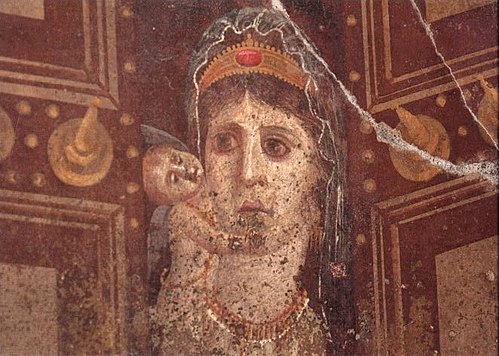 This mid-1st century AD Roman wall painting in Pompeii, Italy, showing Venus holding a cupid is most likely a depiction of Cleopatra VII of Ptolemaic Egypt as Venus Genetrix, with her son Caesarion as the cupid[39][40][41]
 One of two statues of the falcon god Horus behind a smaller depiction of Caesarion at the Temple of Edfu in Edfu, Upper Egypt[42]


Few images of Caesarion survive. He is thought to be depicted in a partial statue found in the harbour of Alexandria in 1997 and is also portrayed twice in relief, as an adult pharaoh, with his mother on the Temple of Hathor at Dendera. His infant image appears on some bronze coins of Cleopatra.[44]
Egyptian names
edit
In addition to his Greek name and nicknames, Caesarion also had a full set of royal names in the Egyptian language:[45]
In popular culture
editIn Cleopatra, he is played at various ages by Loris Loddi, Del Russel and Kenneth Nash.
In the HBO TV series Rome, a highly fictionalised Caesarion is shown as being, in fact, the son of the (fictional) Roman legionary Titus Pullo. He is also shown to have survived the fall of Egypt, relocating to Rome together with his biological father.
See also
editNotes
edit- ↑ The Ptolemaic Kingdom was annexed by the Roman Republic in 30 BC and hence the office of pharaoh ceased to exist. However, due to the pharaoh's central position in Egyptian religion, the local people recognized Augustus and all subsequent Roman emperors as pharaohs for the sake of continuity; no emperor ever bore or recognized the title. See Roman pharaoh
- ↑ Later full name: Ptolemy Caesar Theos Philopator Philometor (Greek: Πτολεμαῖος Καῖσαρ Θεὸς Φιλοπάτωρ Φιλομήτωρ).[3][4]
References
edit- ↑ Leprohon, Ronald J. (2013). The Great Name: Ancient Egyptian Royal Titulary. SBL Press. p. 178. ISBN 978-1-58983-736-2. Retrieved 4 January 2024.
- 1 2 Bennett, Chris. "Ptolemy XV Caesarion". Tyndale House. Retrieved 21 January 2025.
- ↑ RE Ptolemaios 37
- ↑ Oxford Classical Dictionary, "Ptolemy XV Caesar"
- ↑ Sullivan, Richard D. (1990). Near Eastern Royalty and Rome, 100-30 BC. University of Toronto Press. p. 271. ISBN 978-0-8020-2682-8.
- ↑ Capponi, Livia (14 March 2005). Augustan Egypt: The Creation of a Roman Province. Routledge. p. 188. ISBN 978-1-135-87369-1.
- ↑ Field, Jacob F. (23 April 2026). The Roman Empire: A History in 9 Chapters: a new accessible and entertaining history for anyone obsessed with the Roman Empire. Headline. ISBN 978-1-0354-2449-8.
- ↑ Carmichael, A. J. Cleopatra, Last Queen of Egypt. AJ CARMICHAEL.
- ↑ The Encyclopedia Americana: A Library of Universal Knowledge. Encyclopedia Americana Corporation. 1918. p. 80.
- ↑ Roller, Duane W. (2011). Cleopatra: A Biography. Oxford University Press. p. 116. ISBN 978-0-19-982996-5.
- ↑ Uglow, J.; Hendry, M. (8 March 2005). The Palgrave Macmillan Dictionary of Women's Biography. Springer. p. 135. ISBN 978-0-230-50577-3.
- ↑ River, Charles (4 May 2025). Legends of the Ancient World: The Life and Legacy of Julius Caesar. Charles River Editors. ISBN 978-1-4753-3038-0.
- ↑ Sergeant, Philip Walsingham (1909). Cleopatra of Egypt, Antiquity's Queen of Romance. Hutchinson. p. 86.
- ↑ Cawthorne, Nigel (2005). Julius Caesar. Haus Publishing. p. 77. ISBN 978-1-904950-11-0.
- ↑ Ellis, Ralph (4 November 2010). Cleopatra to Christ: Jesus was descended from the Ptolemaic royal line of Egypt. Edfu Books. p. 26. ISBN 978-1-905815-24-1.
- ↑ Strauss, Barry (21 March 2023). The War That Made the Roman Empire: Antony, Cleopatra, and Octavian at Actium. Simon and Schuster. p. 40. ISBN 978-1-9821-1668-2.
- ↑ Jones, Prudence (2006). Cleopatra. Haus Publishing. p. 45. ISBN 978-1-904950-25-7.
- ↑ Shakespeare, William; Farrell, Tony (2004). Antony and Cleopatra. Nelson Thornes. p. 9. ISBN 978-0-7487-8602-2.
- 1 2 Barca, Natale (1 June 2023). Before Augustus: The Collapse of the Roman Republic. Casemate. p. 294. ISBN 978-1-63624-233-0.
- ↑ The Chronicle. 1904. p. 87.
- ↑ GEORGE, HENRY. THE LAST PHARAOH: Cleopatra's War for Egypt, Rome, and History Itself. Abdul Ahad Ansari.
- ↑ King, Arienne (10 July 2018). "Caesarion". World History Encyclopedia.
- ↑ Vagi, David L. (2000). Coinage and History of the Roman Empire, C. 82 B.C.--A.D. 480: History. Taylor & Francis. p. 53. ISBN 978-1-57958-316-3.
- ↑ Kleiner, Diana E. E. (1 July 2009). Cleopatra and Rome. Harvard University Press. p. 85. ISBN 978-0-674-03966-7.
- ↑ Rowan, Clare (2019). From Caesar to Augustus (c. 49 BC–AD 14): Using Coins as Sources. Cambridge University Press. p. 91. ISBN 978-1-107-03748-9.
- ↑ The Nile.
- ↑ d'Alexandrie, Société archéologique (1910). Bulletin (in French). Société de publications egyptiennes. p. 32.
- ↑ Sear, David R. (1998). The History and Coinage of the Roman Imperators 49-27 BC. Spink. p. 299. ISBN 978-0-907605-98-0.
- 1 2 Meyer Reinhold (2002). Studies in Classical History and Society. US: Oxford University Press. p. 58.
- ↑ Burstein, Stanley Mayer (2007). The Reign of Cleopatra. University of Oklahoma Press. p. 29.
- ↑ Roller, Duane W. (2010). Cleopatra: A Biography. Oxford: Oxford University Press. pp. 178–179. ISBN 9780195365535.
- ↑ Duane W. Roller, Cleopatra: A Biography, Oxford University Press US, 2010, pp. 70–73 [ISBN missing]
- ↑ Gray-Fow, Michael (April 2014). "What to Do With Caesarion". Greece & Rome. Second Series. 61 (1): 62. doi:10.1017/S0017383513000235. JSTOR 43297487. S2CID 154911628. Retrieved 25 October 2022.
- ↑ Plutarch, Life of Antony. As found in the Loeb Classical Library, Plutarch's Lives: With an English Translation by Bernadotte Perrin. Volume 9. p. 321.
- 1 2 Hölbl, Günther (2013). A History of the Ptolemaic Empire. Routledge. p. 250. ISBN 978-1-135-11983-6.
- ↑ Draycott, Jane (2023). Cleopatra's Daughter: From Roman Prisoner to African Queen. Liveright Publishing. ISBN 978-1-324-09260-5.
- 1 2 Powell, Anton (2013). Hindsight in Greek and Roman History. Classical Press of Wales. p. 194. ISBN 978-1-910589-12-0.
- ↑ David Braund et al, Myth, History and Culture in Republican Rome: Studies in Honour of T.P. Wiseman, University of Exeter Press, 2003, p. 305. The original line was "ουκ αγαθόν πολυκοιρανίη" ("ouk agathon polukoiranie"): "too many leaders are not good", or "the rule of many is a bad thing". (Homer's Iliad, Book II. vers 204–205) In Greek "ουκ αγαθόν πολυκαισαρίη" ("ouk agathon polukaisarie") is a variation on "ουκ αγαθόν πολυκοιρανίη" ("ouk agathon polukoiranie"). "Καισαρ" (Caesar) replacing "κοίρανος", meaning leader.
- ↑ The wall-painting of Venus Genetrix is similar in appearance to the now-lost statue of Cleopatra erected by Julius Caesar in the Temple of Venus Genetrix, within the Forum of Caesar. The owner of the House at Pompeii of Marcus Fabius Rufus, walled off the room with this painting, most likely in immediate reaction to the execution of Caesarion on orders of Augustus in 30 BC, when artistic depictions of Caesarion would have been considered a sensitive issue for the ruling regime.
- ↑ Roller, Duane W. (2010). Cleopatra: A Biography. Oxford: Oxford University Press. p. 175. ISBN 978-0195365535.
- ↑ Walker, Susan (2008). "Cleopatra in Pompeii?". Papers of the British School at Rome. 76: 35–46, 345–348. doi:10.1017/S0068246200000404. S2CID 62829223.
- ↑ Fletcher, Joann (2008), Cleopatra the Great: The Woman Behind the Legend, New York: Harper, pp. 219, image plates and caption between 246–247, ISBN 978-0-06-058558-7
- ↑ Stuart, Reginald; L, Poole (1883). BMC Greek (Ptolemies) / Catalogue of Greek coins: the Ptolemies, kings of Egypt. The Trustees. p. 122.
- ↑ Sear. Greek Coins and Their Values. Vol. II.
- ↑ Clayton, Peter (1994). Chronicle of the Pharaohs. p. 213. ISBN 0500050740.
External links
edit- Ptolemy XV Caesarion (Archived 4 October 2018 at the Wayback Machine) – entry in historical sourcebook by Mahlon H. Smith