
British Transport Hotels (BTH) was the hotels and catering business of the nationalised railway system in Great Britain.
History
editOrigins of the company
editBritain's private railway companies pioneered the concept of the railway hotel, initially at locations such as London Euston and Birmingham Curzon Street where hotels were opened at the start of trunk railway operation in 1839. Most of the railway companies followed suit, and by 1913 there were 93 railway owned hotels. After grouping, the policies of the 'big four' railway companies differed considerably: the LMS and LNER, which had the longest routes, were the most enthusiastic.
| Company | Hotels | Bedrooms | Guests |
|---|---|---|---|
| LMS | 26 | 2,429 | 748,765 |
| LNER | 17 | 2,328 | 449,355 |
| GWR | 4 | 336 | 136,307 |
| SR | 2 | 224 | 75,000 |
The Hotels Executive (1948–53)
edit
At the nationalisation of transport in Great Britain on 1 January 1948, and the establishment of the British Transport Commission, hotels and catering came under the control of BTC's Railway Executive. However, on 1 July 1948 they were separated from direct railway control and placed under British Transport Commission's Hotels Executive, chaired by Lord Inman, who was later succeeded by Sir Harry Methven. At this point the Hotels Executive acquired 55 hotels and 400 station refreshment rooms, along with various golf courses, tennis courts, laundries, wine cellars, bottling stores and even a farm (at St Ives in Cornwall).
British Transport Hotel and Catering Services (1953–63)
editThe Conservative government elected in 1951 sought to alter the structure of the British Transport Commission and its subsidiaries. One consequence was that the Hotels Executive was abolished on 19 August 1953, and the BTC took direct control, establishing a "Hotel and Catering Services Division" to run them. Sir Harry Methven, the last Chairman of the Hotels Executive, became a member of the BTC.
British Transport Hotels Ltd (1963–83)
editIn 1962 the BTC was abolished, and its rail businesses were transferred to the newly established British Railways Board. The BRB Chairman, Richard Beeching, argued for the retention of the hotels within the BRB's rail portfolio, and BTH Ltd was established to manage them. The intention was to give BTH a high degree of autonomy, including bringing in outside expertise in the hotel business to the BTH board. The Railways Act 1968 empowered BTH to expand beyond the railway estate, and the company considered opening a number of new hotels. In the event only one such hotel was opened – the Old Course at St Andrews – in 1968, before the Conservative government elected in 1970 stopped further expansion. The remainder of the hotel estate was rationalised: the 34 hotels inherited by BTH had been reduced to 29 by 1979.
The end (1983–84)
editThis section needs additional citations for verification. (December 2024) |
Following the victory of the Conservative Party at the 1979 general election, led by Prime Minister Margaret Thatcher, and the deteriorating economic situation, pressure was put on nationalised industries such as British Rail to consider asset disposal. It was not long before the BTH hotels were under review. The management at the time, led by Peter Land, tried to establish a viable structure for a management buyout, which would have kept the group more or less intact and would have delivered a smooth transfer to the private sector. As Peter Land notes in his book Sauce Supreme, politics rendered this plan impossible and the hotels were sold by open tender, realising a much lower value for the UK taxpayer than the management buyout would have done.[1] By 1984, the disposal was complete and the history of BTH was at an end.
List of hotels in 1948
editThis section needs additional citations for verification. (December 2024) |
The British Transport Commission took over the following hotels from the big four railway companies in 1948:
| Name | Location | Subsequent history |
|---|---|---|
| From the Great Western Railway | ||
| Fishguard Bay Hotel | Fishguard | (sold 1950, closed 2020) |
| Grand Pump Room Hotel | Bath | (sold 1956, now demolished) |
| Great Western Royal Hotel | Paddington, London | (sold 1983, still operating, now known as Hilton London Paddington) |
| Manor House Hotel | Moretonhampstead, Devon | (sold 1983, still operating, now known as Bovey Castle) |
| Tregenna Castle Hotel | St Ives, Cornwall | (sold 1983, still operating) |
| From the London, Midland and Scottish Railway | ||
| Adelphi Hotel | Liverpool | (sold 1983, still operating) |
| Caledonian Hotel | Edinburgh | (sold 1981, still operating, at the former Caledonian Railway's Princes Street station) |
| Central Hotel | Glasgow | (sold 1983, still operating, now known as the voco Grand Central Hotel) |
| Crewe Arms Hotel | Crewe | (sold 1952, closed 2021) |
| Dornoch Hotel | Dornoch | (sold 1965, still operating) |
| Euston Hotel | London | (closed and demolished 1963) |
| Exchange Hotel | Liverpool | (closed 1971) |
| Gleneagles Hotel | Auchterarder | (sold 1981, still operating) |
| Highland Hotel | Strathpeffer | (sold 1958, still operating) |
| Lochalsh Hotel | Kyle of Lochalsh | (sold 1983, still operating) |
| Midland Hotel | Bradford | (closed 1975, reopened 1993) |
| Midland Hotel | Derby | (sold 1983, still operating) |
| Midland Hotel | Manchester | (sold 1983, still operating) |
| Midland Hotel | Morecambe | (sold 1952, subsequently closed. Reopened in 2008) |
| North Stafford Hotel | Stoke-on-Trent | (sold 1953, still operating) |
| Park Hotel | Preston | (sold 1950, closed) |
| Queen's Hotel | Birmingham | (closed 1965) |
| Queen's Hotel | Leeds | (sold 1984, still operating) |
| St Enoch Hotel | Glasgow | (closed and demolished 1974) |
| Station Hotel | Ayr | (sold 1951, closed 2012) |
| Station Hotel | Dumfries | (sold 1972, still operating) |
| Station Hotel | Holyhead | (closed 1951, demolished late 1970s.) |
| Station Hotel | Inverness | (sold 1983, still operating - now named the Royal Highland Hotel) |
| Station Hotel | Perth | (sold 1983, operated until 2022 as Radisson Blu Perth) |
| Turnberry Hotel | Turnberry | (sold 1983, still operating) |
| Welcombe Hotel | Stratford-upon-Avon | (sold 1983, still operating) |
| From the London and North Eastern Railway | ||
| Cruden Bay Hotel | Port Erroll | (sold 1951, closed) |
| Felix Hotel | Felixstowe | (sold 1952, closed) |
| Grand Hotel | West Hartlepool | (sold 1983, still operating) |
| Great Eastern Hotel | Liverpool Street, London | (sold 1983, still operating, now known as Andaz Liverpool Street)[2] |
| Great Eastern Hotel | Parkeston Quay, Harwich | (closed 1963) |
| Great Northern Hotel | King's Cross, London | (sold 1983, still operating) |
| Great Northern Hotel | Peterborough | (sold 1983, still operating) |
| Great Northern Station Hotel | Leeds | (sold 1952, closed) |
| Great Northern Victoria Hotel | Bradford | (sold 1952, still operating) |
| North British Station Hotel | Glasgow | (sold 1984, still operating, now known as the Millennium Hotel) |
| North British Station Hotel | Edinburgh | (sold 1981, still operating, now known as the Balmoral Hotel) |
| Royal Hotel | Grimsby | (sold 1949, closed and demolished late 1960's.) |
| Royal Station Hotel | York | (sold 1983, still operating, now known as The Milner York) |
| Royal Station Hotel | Hull | (sold 1983, still operating) |
| Royal Station Hotel | Newcastle upon Tyne | (sold 1983, still operating) |
| Royal Victoria Station Hotel | Sheffield | (sold 1982, still operating, now known as the Crowne Plaza Royal Victoria) |
| Sandringham Hotel | Hunstanton | (sold 1950, closed) |
| Station Hotel | Aberdeen | (sold 1983, still operating) |
| Yarborough Hotel | Grimsby | (sold 1952, still operating) |
| Zetland Hotel | Saltburn-by-the-Sea | (sold 1976, closed) |
| From the Southern Railway | ||
| Charing Cross Hotel | Charing Cross, London | (sold 1983, still operating, now known as The Clermont London Charing Cross) |
| Craven Hotel | Charing Cross, London | (sold 1963, closed) |
| Grosvenor Hotel | Victoria, London | (sold 1983, still operating, now known as The Clermont London Victoria) |
| Knowle Hotel | Sidmouth | (sold 1951, closed) |
Gallery
edit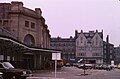 Station Hotel, Aberdeen
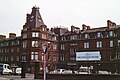 Station Hotel, Ayr
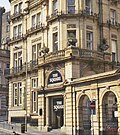 Midland Hotel, Bradford
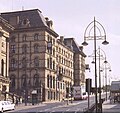 Victoria Hotel, Bradford
 Station Hotel, Dumfries
 North British Hotel, Edinburgh (now the Balmoral)
 St Enoch Hotel, Glasgow
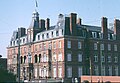 Grand Hotel, Hartlepool
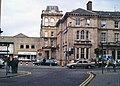 Station Hotel, Inverness (now the Royal Highland)
 Queen's Hotel, Leeds
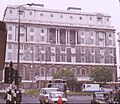 Adelphi Hotel, Liverpool (exterior)
 Adelphi Hotel, Liverpool (interior, 2014)
 Charing Cross Hotel, Charing Cross, London
 Great Northern Hotel, Kings Cross, London (before redevelopment)
 Great Eastern Hotel, Liverpool Street, London (now Andaz)
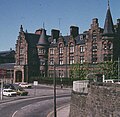 Station Hotel, Perth
 North Staffordshire Hotel, Stoke-on-Trent
 BTH table setting


_Edinburgh.jpg)


.jpg)


_Liv_St001_1.jpg)


References
edit- ↑ Peter Land, Sauce Supreme
- ↑ "Andaz London hotel".
- Carter, Oliver (1990). An illustrated history of British Railway Hotels: 1838-1983. St Michael's: Silver Link Publishing. ISBN 0-947971-36-X.
- Whitaker's Almanack (various dates)
- P. A. Land (Managing Director, British Transport Hotels, 1978–1983) Sauce Supreme (2010) - The annihilation of British Transport Hotels Ltd. Peter A. Land's memoirs regarding the final days of British Transport Hotels Ltd.
- Geoffrey Skelsey LVO, Famous Hotel Keepers for Over a Century: British Railway Hotels under State Ownership 1948-84 (in BackTrack vol 20, No 7, July 2006)