
Brachydiplax denticauda is a species of dragonfly in the family Libellulidae[4] known commonly as the palemouth.[5] It is native to Australia, Indonesia, Papua New Guinea, and the Solomon Islands.[6] It lives in habitat with still and slow-moving waters.[1]
| Palemouth | |
|---|---|
 | |
| Male Brachydiplax denticauda | |
.jpg) | |
| Female Brachydiplax denticauda | |
Scientific classification  | |
| Kingdom: | Animalia |
| Phylum: | Arthropoda |
| Clade: | Pancrustacea |
| Class: | Insecta |
| Order: | Odonata |
| Infraorder: | Anisoptera |
| Family: | Libellulidae |
| Genus: | Brachydiplax |
| Species: | B. denticauda |
| Binomial name | |
| Brachydiplax denticauda | |
 | |
| Synonyms[3] | |
| |

Males of this species are typical in colour for the genus,[1] being bright powder blue on both the thorax and abdomen. The labrum is pale cream, thus giving the species its common name of palemouth. In northern Australia, it is found coastal and adjacent inland in an arc from the southern Queensland border to Broome, Western Australia.[7]
Brief Description
editThis species is small in size with a wingspan of 40 to 60 millimeters. Brachydiplax denticauda usually has six antenodal crossveins in the fore-wing and five in the hind-wing whereas the very similar Brachydiplax duivenbodei has seven antenodal crossveins in the fore-wing and six in the hind-wing.[8] Though brightly coloured, the males often go unnoticed by an observer once they land on a lily pad or similar place.[8]
Etymology
editThe genus name Brachydiplax is derived from the Greek βραχύς (brakhys, "short"), combined with Diplax, a genus name derived from the Greek δίς (dis, "twice") and πλάξ (plax, "flat and broad"). The name refers to the relationship of the genus to Diplax.[9]
The species name denticauda is derived from the Latin dens ("tooth") and cauda ("tail"), referring to the teeth on the appendages of the male.[2][9]
Gallery
edit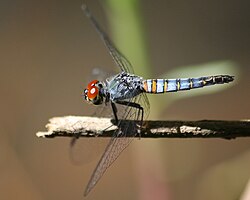 Female
 Mature male
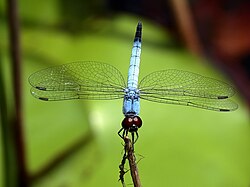 An adult male Palemouth has a pale blue tail with a black tip
 Male puts his tail in the air in an obelisk position that is not vertical
 Male from behind showing a creamy yellow mark on the outside of his eye rim
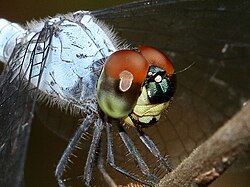 Close-up of head highlighting the pale mouth
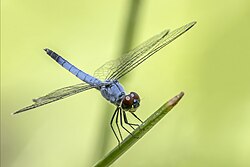 Male
Male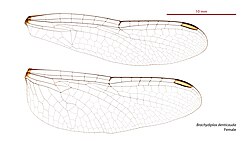 Female wings
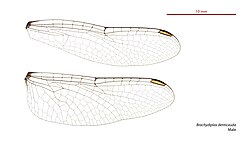 Male wings
_0118.jpg)

_(23867332788).jpg)

.jpg)

_male_Cattana.jpg)
.jpg)
.jpg)
References
edit- 1 2 3 Kalkman, V.J. (2020). "Brachydiplax denticauda". IUCN Red List of Threatened Species. 2020 e.T163899A83378624. doi:10.2305/IUCN.UK.2020-1.RLTS.T163899A83378624.en. Retrieved 19 November 2021.
- 1 2 Brauer, F. (1867). "Bericht über die von Hrn. Dir. Kaup eingesendeten Odonaten. (Schluss.)". Verhandlungen der Zoologisch-Botanischen Gesellschaft in Wien. 17: 287–302 [301] – via Biodiversity Heritage Library.
- ↑ Paulson, D.; Schorr, M.; Abbott, J.; Bota-Sierra, C.; Deliry, C.; Dijkstra, K.-D.; Lozano, F. "World Odonata List". OdonataCentral. University of Alabama. Retrieved 23 April 2026.
- ↑ "Species Brachydiplax denticauda (Brauer, 1867)". Australian Faunal Directory. Australian Biological Resources Study. 2012. Retrieved 28 February 2017.
- ↑ "Brachydiplax denticauda". Atlas of Living Australia. Archived from the original on 2016-02-06.
- ↑ Watson, J.A.L.; Theischinger, G.; Abbey, H.M. (1991). The Australian Dragonflies: A Guide to the Identification, Distributions and Habitats of Australian Odonata. Melbourne: CSIRO. p. 278. ISBN 0-643-05136-8.
- ↑ Theischinger, Gunther; Endersby, Ian (2009). Identification Guide to the Australian Odonata (PDF). Department of Environment, Climate Change and Water NSW. p. 207. ISBN 978-1-74232-475-3.
- 1 2 Theischinger, Gunther; Hawking, John (2006). The Complete Field Guide to Dragonflies of Australia. Collingwood Vic.: CSIRO. p. 270. ISBN 0-643-09073-8.
- 1 2 Endersby, Ian; Fliedner, Heinrich (2015). The Naming of Australia's Dragonflies. Eltham, Victoria, Australia: Busybird Publishing. ISBN 9781925260625.
