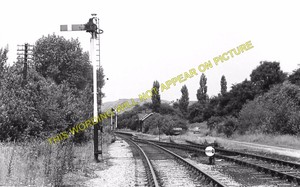
Bolsover Castle was one of two former railway stations that served the town of Bolsover,[a] in Derbyshire, England, between 1890 and 1981. It was built by the Midland Railway on the circuitous Barrow Hill to Pleasley West line,[1] known as the Doe Lea Branch, running for much of its length along the valley of the river Doe Lea.
Bolsover Castle | |||||
|---|---|---|---|---|---|
_railway_station.jpg) The station site, in the late 1950s/early 1960s | |||||
| General information | |||||
| Location | Bolsover, Borough of Bolsover, England | ||||
| Coordinates | 53°13′56″N 1°18′31″W / 53.23222°N 1.30861°W | ||||
| Grid reference | SK 462 706 | ||||
| Platforms | 1 | ||||
| Other information | |||||
| Status | Disused | ||||
| History | |||||
| Original company | Midland Railway | ||||
| Post-grouping | London, Midland and Scottish Railway; British Railways | ||||
| Key dates | |||||
| 1 September 1890 | Opened as Bolsover | ||||
| 28 July 1930 | Timetabled passenger service withdrawn | ||||
| 25 September 1950 | Renamed Bolsover Castle | ||||
| 1 November 1962 | Goods service withdrawn | ||||
| 16 August 1981 | Last miners' welfare special ran | ||||
| 1985-99 | Station demolished | ||||
| |||||

History
editThe station was opened without ceremony on 1 September 1890 as Bolsover.[2][3] It initially provided a service of three trains each way between Mansfield and Chesterfield, taking about an hour from end to end.[4][5]
The line was single tracked between Seymour Junction and Pleasley West[6][7]. Accordingly, the station had a single platform and typical Midland Railway country building that was very similar to those at Clowne and Barlborough and Glapwell.[8][9]
In 1897, the Doe Lea Viaduct was opened, straddling the Doe Lea Branch for a short distance to the south of the station.
Normal passenger traffic along the Doe Lea Branch dwindled over the years and finally ceased on 28 July 1930.[2][3][10] An unadvertised service continued to call at the station until 14 August 1931 and pre-war excursions continued until at least 27 July 1939.[2][3] Records show that a half-day excursion service called at Bolsover on 26 July 1949, on its way to Bridlington and Scarborough.[3] The last steam train to use the line was an enthusiasts' special on 16 October 1965.[8][11] This train also traversed the Clowne Branch.
British Railways renamed the station Bolsover Castle on 25 September 1950, to help distinguish it from the Lancashire, Derbyshire and East Coast Railway's station, which became Bolsover South.[2][3][12] Goods facilities were withdrawn from the station on 1 November 1962.[13]
Although regular passenger traffic ceased in 1930 and the line was severed as a through route shortly thereafter by the closure of Rowthorn Tunnel, occasional specials continued to call at the station. A special was run to Chesterfield in connection with the Silver Jubilee celebrations in Queen's Park on 28 July 1977.[2][3][14] This had been on the initiative of the headmaster of Bolsover Church of England Junior School, as there were insufficient buses to take all the children to the event.[15] Thereafter, there were annual August excursions from 1978 until 1981, organised by Bolsover Miners' Welfare, when trains of at least nine coaches ran to Scarborough.[3][8] Another source claims that the last charter from Bolsover Castle was a nine-coach train to London Liverpool Street, via Chesterfield, on 15 November 1980, organised by Bolsover Secondary School's Parent-Teacher Association.[3] [14] [16]
When Glapwell Colliery closed in 1974, the line south of the station became redundant, although it was not lifted until 1978.[citation needed]


| Preceding station | Disused railways | Following station | ||
|---|---|---|---|---|
| Staveley Town Line and station closed |
Midland Railway Doe Lea Branch |
Palterton and Sutton Line and station closed | ||
Stationmasters
edit- Job Frederick Fisher 1890-1891
- W. Hackett 1891-1892[17]
- Herbert Mason Read 1892-1893[17] (afterwards station master at Watnall)
- Richard Grice 1893-1896[17] (formerly station master at Killamarsh, later station master at Darfield)
- William Henry Johnson 1896[17]-1899[18] (later station master at Ullesthorpe)
- Herbert H. Willis 1899-1902[18]
- John Daniel Neale 1902-1904[18] (later station master at Shipley Gate)
- John William Palmer 1904[18] (formerly station master at Glapwell)
- Harry York 1904-1908[18] (formerly station master at Attercliffe Road, later station master at Worthington)
- George H. Dewey 1908[18]-1911 (formerly station master at Worthington, later station master at Burton Joyce)
- Samuel Palfreyman 1911-1920[19] (later station master at Swinton)
- Ernest C. Beckley 1921-1924
- G.P. Kirland ca. 1940.
The site today
edit
By 20 July 2013, all tracks through Bolsover Castle station site had been lifted, but the trackbed was intact. The station itself was demolished some years ago. A business park had been developed immediately west of the station site. One occupant is a firm providing road-rail vehicles, such as track welding lorries fitted with retractable rail wheels. A length of track with dummy overhead wires, presumably for training and clearance testing purposes, has been installed in their depot in plain view from public areas.[citation needed]
The branch between Bolsover Castle and the bottom of Rylah Hill, between Palterton and junction 29 of the M1, is now a public bridleway known as the Stockley Trail.[20]
The Doe Lea Line south from Seymour Junction to the site of the former Markham Colliery (now known as the Bolsover Branch) has been mothballed as it runs through the new Markham Vale Enterprise Zone at junction 29A of the M1 motorway.[21]
Possible future
editThe line from Foxlow Junction to Oxcroft Disposal Point, through Seymour Junction, has been lifted. It has been protected from breach or encroachment, as there remains the possibility of opencasting in the area; for example, UK Coal (now Coalfield Resources) expressed an interest in 2005 in extracting c. 530,000 tons near Mastin Moor.[22]
Notes
edit- ↑ The other station was Bolsover South.
References
editCitations
edit- ↑ Kay 1998, Sheet 12.
- 1 2 3 4 5 Butt 1995, p. 38.
- 1 2 3 4 5 6 7 8 Quick 2009, p. 92.
- ↑ "The service in 1890". Old Miner.
- ↑ Hurst 1987, p. 76.
- ↑ Anderson & Cupit 2000, p. 42.
- ↑ Kaye 1988, p. 27.
- 1 2 3 Hurst 1987, p. 79.
- ↑ Howard Anderson 1973, p. 157.
- ↑ Hurst 1987, p. 77.
- ↑ DVD 2004.
- ↑ Clinker 1988, p. 156, note 437.
- ↑ Clinker 1988, p. 15.
- 1 2 Croughton, Kidner & Young 1982, p. 49.
- ↑ Hall, Peter. "Excursions from Bolsover Castle (1977-1981)". Railway Correspondence & Travel Society. Retrieved 17 April 2026.
- ↑ Anderson & Cupit 2000, p. 45.
- 1 2 3 4 "1881-1898 Coaching". Midland Railway Operating, Traffic and Coaching Depts: 857. 1881. Retrieved 20 February 2021.
- 1 2 3 4 5 6 "1899-1908 Coaching: Piece 1027". Midland Railway Operating, Traffic and Coaching Depts: 436. 1899. Retrieved 20 February 2021.
- ↑ "A token of esteem". Derbyshire Times and Chesterfield Herald. England. 8 May 1920. Retrieved 28 February 2021 – via British Newspaper Archive.
- ↑ "Stockley Trail". Derbyshire County Council. Retrieved 15 May 2013.
- ↑ "Markham Vale". Sheffield City Region Enterprise Zone. 2012. Archived from the original on 5 June 2013. Retrieved 15 May 2013.
- ↑ "UK Coal plc; Annual Report & Accounts 2005" (PDF) (PDF). UK Coal. 2 March 2006. p.19. Archived from the original (PDF) on 27 December 2013. Retrieved 15 May 2013.

Sources
edit- Anderson, Paul; Cupit, Jack (2000). An Illustrated History of Mansfield's Railways. Clophill: Irwell Press. ISBN 978-1-903266-15-1.
- Butt, R. V. J. (October 1995). The Directory of Railway Stations: details every public and private passenger station, halt, platform and stopping place, past and present (1st ed.). Sparkford: Patrick Stephens Ltd. ISBN 978-1-85260-508-7. OCLC 60251199. OL 11956311M.
- Clinker, C. R. (1988) [1978]. Clinker's Register of Closed Passenger Stations and Goods Depots in England, Scotland and Wales 1830–1980 (2nd ed.). Bristol: Avon-Anglia Publications & Services. ISBN 978-0-905466-91-0. OCLC 655703233.
- Croughton, Godfrey; Kidner, R. W.; Young, Alan (1982). Private and Untimetabled Railway Stations, Halts and Stopping Places. The Oakwood Press. ISBN 978-0-85361-281-0. OCLC 10507501.
- Howard Anderson, P. (1973). Forgotten Railways: The East Midlands. Newton Abbott: David & Charles. ISBN 978-0-7153-6094-1.
- Hurst, Geoffrey (1987). The Midland Railway Around Nottinghamshire, Volume 1. Worksop: Milepost Publications. ISBN 978-0-947796-05-1.
- Midland Railway System Maps (The Distance Diagrams), volume 2: Leeds to Leicester and branches; Derby to Manchester and branches; Cheshire Lines (1909-1923 ed.). Teignmouth: Peter Kay. 1998. ISBN 978-1-899890-17-0.
- Kaye, A.R. (1988). North Midland and Peak District Railways in the Steam Age, Volume 2. Chesterfield: Lowlander Publications. ISBN 978-0-946930-09-8.
- DVD (2004). East Midlands Steam. Bradford: Marsden Rail. Marsden Rail 26.
- Quick, Michael (2009) [2001]. Railway passenger stations in Great Britain: a chronology (4th ed.). Oxford: Railway & Canal Historical Society. ISBN 978-0-901461-57-5. OCLC 612226077.
Further reading
edit- Kingscott, Geoffrey (2007). Lost Railways of Derbyshire. Newbury: Countryside Books. ISBN 978-1-84674-042-8.
External links
edit- The station on a navigable 1949 OS map NPEmap.org.uk
- The station on overlain OS maps National Library of Scotland
- The station and line on overlain OS maps RailMapOnline.com
- Bolsover railway structures Signalboxes.com
- The station, line and mileages RailwayCodes.org.uk
- The line and station Richard's Bygone Times
- The station, staff and tickets OldMiner.co.uk
- One of the station's former signs English Heritage
- The station in its early years eBay.com
- The station in its later years eBay.com
- The station in its later years Ipernity.com