
Bell is a lunar impact crater that is located on the far side of the Moon, just past the western limb. It lies in an area of terrain that is marked by many small craters, a number of which are satellite craters of Bell listed in the table below. Bell lies within two crater diameters of Laue to the north, and to the west of the smaller Helberg.[3]
 LRO image | |
| Coordinates | 21°59′N 96°32′W / 21.98°N 96.53°W |
|---|---|
| Diameter | 86.33 km (53.64 mi)[1] |
| Depth | Unknown |
| Colongitude | 97° at sunrise |
| Formation | Nectarian[2] ? |
| Eponym | Alexander G. Bell |
On the lunar geologic timescale, Bell is catalogued as from the Nectarian period, but may instead be Pre-Nectarian or Early Imbrian.[2] The outer wall of Bell has been worn, eroded, and somewhat reshaped by subsequent impacts. The satellite crater Bell Q lies across the southwest rim, and smaller craterslie across the rim to the north and the east. The interior floor is relatively level, and marked by the crater Bell E which is offset to the east of the midpoint.[4]: 54 The flat floor is most likely due to lava infiltrating the ground from below, but not breaching the surface.[5]
This crater was named after Scottish-American inventor Alexander G. Bell (1847–1922).[6] Prior to formal naming by the International Astronomical Union in 1970,[1] Bell was called Crater 182.[7]
Satellite craters
editBy convention these features are identified on lunar maps by placing the letter on the side of the crater midpoint that is closest to Bell.
| Bell[4]: 293 | Latitude | Longitude | Diameter |
|---|---|---|---|
| E | 22.0° N | 95.8° W | 15 km |
| J | 19.9° N | 94.0° W | 18 km |
| K | 18.3° N | 95.1° W | 18 km |
| L | 19.7° N | 95.8° W | 23 km |
| N | 19.5° N | 96.9° W | 18 km |
| Q | 20.7° N | 97.2° W | 23 km |
| T | 21.9° N | 98.9° W | 52 km |
| Y | 25.4° N | 96.7° W | 23 km |
Gallery
edit Lunar Orbiter 4 image
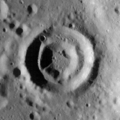 The concentric crater Bell E

.png)
References
edit- 1 2 "Bell". Gazetteer of Planetary Nomenclature. USGS Astrogeology Research Program.
- 1 2 Byrne, Charles J. (2008). The Far Side of the Moon. Springer. pp. 174–175, 182. ISBN 978-1-4899-8806-5.
- ↑ "LAC 54" (PDF). Gazeteer of Planetary Nomenclature. Retrieved 2026-06-03.
- 1 2 Bussey, B.; Spudis, P. (2004). The Clementine Atlas of the Moon. New York: Cambridge University Press. ISBN 978-0-521-81528-4.
- ↑ Beals, C. S.; Tanner, R. W. (March 1975). "Crater Frequencies on Lava-Covered Areas Related to the Moon's Thermal History". Earth, Moon, and Planets. 12: 63. Bibcode:1975Moon...12...63B. doi:10.1007/BF02626334.
- ↑ Menzel, D. H.; et al. (1971). "Report on Lunar Nomenclature by the Working Group of Commission 17 of the IAU". Space Science Reviews. 12 (2): 136–186. Bibcode:1971SSRv...12..136M. doi:10.1007/BF00171763. S2CID 122125855.
- ↑ "Lunar Farside Chart (LFC-1A)]" (2nd ed.). Lunar and Planetary Institute. October 1967. Retrieved 2026-06-03.
Sources
edit- Price, Fred W. (1988). The Moon Observer's Handbook. Cambridge University Press. ISBN 978-0-521-33500-3.
- Rükl, Antonín (1990). Atlas of the Moon. Kalmbach Books. ISBN 978-0-913135-17-4.
- Wlasuk, Peter T. (2000). Observing the Moon. Springer. ISBN 978-1-85233-193-1.