
Baloch clothing, or Balochi clothing (Balochi: بلۏچ گد, romanized: Balòč gòd) is a historical and contemporary aspect of Baloch heritage and deep association between the traditional dress and ethnic identity.[1]
The clothing of the Baloch people consists of various styles of kameez and shalwar, turban, shoes, and head scarfs. Balochi embroidery decorations on dresses is a tradition in Baloch culture including Balochi cap, jackets, belts, purse, shoulder bags, and various other items.[2]

History
editDress code and personal upkeep are particularly high among the cultural values of the Baloch people. The Baloch dress resemble the ancient Parthian equivelant. Surprisingly, no significant changes can be observed in the Balochi dress since ancient history.[3]
Baloch clothing is derived from Parthian clothing, especially Baloch men's pants[4] are very wide like Parthian pants, but narrow near the hem, and twisting causes folds in it.[5][6][7]
The Baloch have worn their traditional clothing since ancient times, and this clothing was spread beyond the borders of Balochistan by ancient dynasties. The similarity of the clothing of Baloch men with other geographical regions such as India is as a result of the power of the Iranian ancient dynasties.[8]
Balochi needlework, is a type of Balochi handicrafts which is used on Balochi women's clothing—in some sources—the beginning of this art is 100 to 200 years prior to Islam, and the available evidence indicates that this method of sewing has been common among the Baloch people since the beginning of Islam, and in the Ilkhanate era—especially the Timurid and Safavid eras—has reached its peak.[9]
Baloch men's dress
editBaloch men wear a dress named jameh or jamak. It consists of two parts; one is upper body clothing and the other is a loose skirt reaching to the knee. The trouser (shalwar) is approximately 2.2 m wide.[10]
The men's shalwar kameez consists of a very baggy shalwar troser[11] which uses large lengths of cloth.[12] The kameez is also loose,[13] which traditionally is long with long sleeves.[14]
Chakan doz is a hand-embroidered hat of the nobles, this type of hat is made of fabric on which needlework is done.[15]
Shawl (شال) is a woolen coat worn in winter.[16]
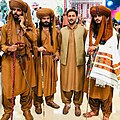 A group of Baloch men wearing traditional Baloch male dress
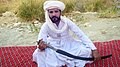 Man wearing Baloch tradition cloth
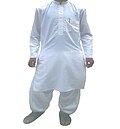 Traditional Baloch white shalwar kameez
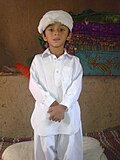 Baloch child in Balochi male clothes
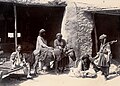 Baloch men in shalwar kameez, Quetta c. 1867
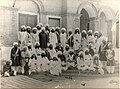 Tribal elders, April 1896
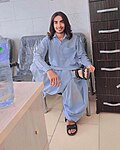 Baloch man in traditional Baloch men's clothes
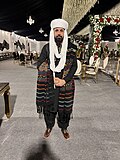 A Baloch man in traditional Balochi men's clothes


Balochi women's dress
editThe female Baloch suit consists of the head scarf, long dress, and a shalwar (pajamak). Traditional Baloch women wear loose dresses which are Balochi needlework and embroidered in local designs which include Balochi silk-thread chain-stitch embroidery.[17]
Mahtab Norouzi was an Baloch Iranian master artisan, she was known for her textiles and women's clothing.[18][19][20]
- Serig: A kind of large rectangular scarf that is decorated with embroidery
- Footwear: Traditional women's footwear use four types of shoes, namely sawas, mochi, katuk, and takkul.
- Balochi embroidery alone has 118 different basic designs.[21]
- Baloch women use a large scarf to cover their heads called a sareg.[22]
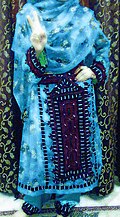 Baloch women's traditional dress
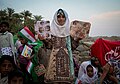 Baloch girl with other children in Sistan-Baluchestan
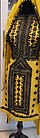 Baloch dress with traditional Baloch embroidery
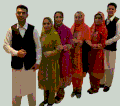 Illustration of Baloch traditional dress
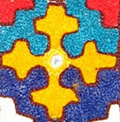 Baloch embroidery
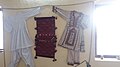 Traditional Balochi dresses hanging to dry
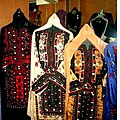 Needlework of Baloch women's clothes
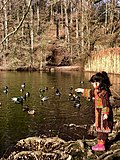 Baloch girl in Baloch dress next to a lake
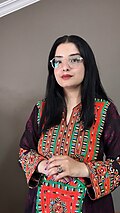 Baloch women in traditional Baloch dress
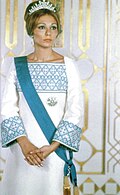 Farah Pahlavi, wearing Balochi needlework by Mahtab Norouzi
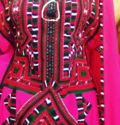 Traditional Baloch women's dress
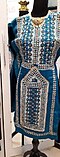 Traditional Baloch needlework dress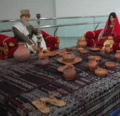
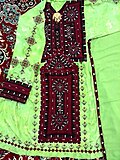 Green traditional Baloch women's dress
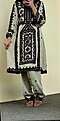 Siah Dozi, wearing the traditional dress Baloch women
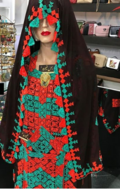 Baloch women's dress on a mannequin
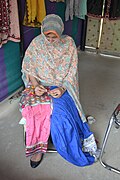 Pakistani Baloch women engaged in needlework
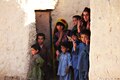 Children in Quetta wearing local embroidery designs
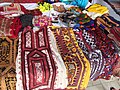 Traditional Balochi dresses for sale
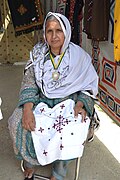 Elderly Baloch women in traditional dress

.jpg)


Ornaments and jewelry
editGold ornaments such as necklaces and bracelets are an important aspect of Baloch women's traditions and among their most favoured items of jewelry are called dorr, heavy earrings that are fastened to the head with gold chains so that the heavy weight will not cause harm to the ears. They usually wear a gold brooch (tasni) that is made by local jewelers in different shapes and sizes and is used to fasten the two parts of the dress together over the chest.[23]
Balochi ornaments are used for head and hair, ears, hands and feet[24]
- Broch (بروچ): An ornament tied in the front breast pocket[25]
- Earrings (در): Usually worn on the ears and nose[25]
- Pulu (پلۏ) and puluk (پلۏک): An ornament placed in the nostril with a clip[25]
- Haar (هر) and toq (توق): A necklace and bracelet respectively
- Sangah (سانگہ) or tali (تلی): Both used as rings
- Mundrik (مندریک): Rings put on fingers[25]
- Armlets (باهوبند): Jewelry put on arms
- Roch (روچ): An ornament hung on the chest
- Gab (گب): A silver bangle
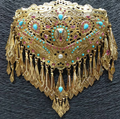 Senjak or tasni
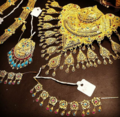 Baloch jewelry for sale
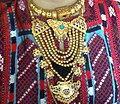 Baloch women's golden necklace
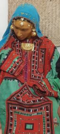 Baloch woman wearing various Baloch ornaments
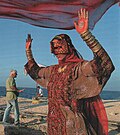 Baloch woman outdoors wearing Baloch jewelry
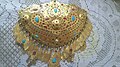 Baloch brooch


Turban
edit


Shoes and bags
editSawas is balochi shoes that is woven with wild date from the leaves of a desert shrub.[28] Traditional Baloch wear shoes referred to as chawats.[29] the production of this footwear has created large local home-based industry.[30]
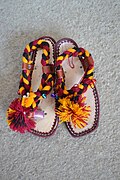 Balochi sawas shoes
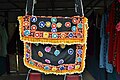 Baloch thela bag
 Baloch chawat, traditional footwear


See also
edit

References
edit- ↑ Rehman Khan, F. and Malghani, M. and Ayyaz, S., "Construction of Baloch Ethnic Identity through Ethnolinguistic Awareness and Cultural Dynamics", Clark, pp. 440 (2005). Retrieved 2 January 2024.
- ↑ Siddiq, M. and Kakar, B., "Hand Embellished Fabrics – An Adoptable Potential to Empower Household Women in Balochistan", University of Balochistan, 2017. Retrieved 2 January 2024.
- ↑ "The Baloch race. A historical and ethnological sketch". 1904.
 This article incorporates text from this source, which is in the public domain.
 - ↑ Matin, Payam (2004). Iranian clothing (in Persian). دفتر پژوهشهاى فرهنگى. p. 72. ISBN 9789699149009.
- ↑ Afshar, Iraj (1992). Balochistan and its ancient civilization (in Persian). سازمان چاپ و انتشارات وزارت فرهنگ و ارشاد اسلامى،. pp. 405 & 406.
- ↑ Ahmady, Kameel (2004). From Border to Border. Avaye Buf. p. 101. ISBN 9788794295314.
- ↑ Nasseri, Abdollah (1980). فرهنگ مردم بلوچ [The Culture of the Baloch People] (in Persian). S.n.]،. p. 168.
- ↑ Ahmady, Kameel (2013). From Border to Border Research Study on Identity and Ethnicity in Iran. Avaye Buf. p. 100. ISBN 9788794295314.
- ↑ Heidari, Zahra (2016-11-13). "سوزندوزی بلوچ، هنری ریشهدار در تاریخ" [Baloch embroidery, an art rooted in history]. ایسنا (ISNA) (in Persian). Retrieved 2022-03-11.
- ↑ "Clothing of the Baluch in Persia". Encyclopædia Iranica.
- ↑ Postans, Thomas (1843) Personal Observations on Sindh: The Manners and Customs of Its Inhabitants; and Its Productive Capabilities
- ↑ "Baloch Culture.Net". Archived from the original on 2015-08-28. Retrieved 2015-08-06.
- ↑ Nadiem, Ihsan. H. [(2007) Balochistan: land, history, people
- ↑ DostPakistan.pk but now can also be knee length.
- ↑ Afshar, Iraj (1992). Balochistan and its ancient civilization (in Persian). سازمان چاپ و انتشارات وزارت فرهنگ و ارشاد اسلامى،. pp. 405 & 406.
- ↑ Afshar, Iraj (1992). Balochistan and its ancient civilization (in Persian). سازمان چاپ و انتشارات وزارت فرهنگ و ارشاد اسلامى،. pp. 405 & 406.
- ↑ Peter J. Claus, Sarah Diamond, Margaret Ann Mills (2003) South Asian Folklore: An Encyclopedia : Afghanistan, Bangladesh, India, Nepal, Pakistan, Sri Lanka
- ↑ "استاد سوزندوزي بلوچ درگذشت" [The master of Baloch needlework died]. ایسنا (ISNA) (in Persian). 2012-07-14. Retrieved 2022-03-10.
- ↑ "مهتاب نوروزی، مشهورترین سوزن دوز بلوچ درگذشت" [Mahtab Norouzi, the most famous Baloch needlewoman, has died]. BBC News فارسی (in Persian). 2012-07-15. Retrieved 2022-03-10.
- ↑ "Norouzi Dress Design" [Pakistan First Time Balochi Design Present a Nourouzi Design]. zarnisha. 2023-06-22. Retrieved 2023-06-22.
- ↑ Pakistan Year Book, Volume 20 (1992)
- ↑ "Music of Makran: Traditional Fusion from Coastal Balochistan" (PDF). Indiana University Bloomington. Archived from the original (PDF) on June 5, 2024. Retrieved December 31, 2023.
- ↑ "Baloch Society & culture". Baask.com. Archived from the original on 16 September 2011. Retrieved 7 September 2010.
- ↑ Nasseri, Abdollah (1980). The culture of the Baloch people (in Persian). S.n.]،. p. 143-144.
- 1 2 3 4 Dashti, Naseer (2007). In a Baloch Perspective. Asaap Publications. pp. 7–10. ISBN 9789699149009.
- ↑ "Music of Makran: Traditional Fusion from Coastal Balochistan" (PDF). Indiana University Bloomington. Archived from the original (PDF) on June 5, 2024. Retrieved December 31, 2023.
- ↑ Balochistan Through the Ages: Tribes (1979)
- ↑ Breseeg, Taj Mohammad (2001). Baloch Nationalism Its Origin And Development. Routledge. p. 227. ISBN 969407309X.
- ↑ Balochistan Through the Ages: Tribes (1979)
- ↑ Baloch, Mumtaz A.; Ali, Imdad; Baloch, Hamid Ali (20 December 2017). "WHAT IS BALOCHISTAN'S COTTAGE INDUSTRY WORTH? A SOCIO- ECONOMIC PROFILE OF THE ČAWAŢ (CHAWAT) MANUFACTURING BUSINESS IN QUETTA, BALOCHISTAN". University of Balochistan. 9 (1): 76–91.
External links
edit Media related to Baloch clothing at Wikimedia Commons
