
Austrogomphus bifurcatus, also known as Austrogomphus (Pleiogomphus) bifurcatus, is a species of dragonfly of the family Gomphidae,[3] commonly known as the dark hunter.[4] It inhabits streams and rivers in northern Queensland, Australia.[5][6]
| Dark hunter | |
|---|---|
 | |
| male, near Cairns | |
Scientific classification  | |
| Kingdom: | Animalia |
| Phylum: | Arthropoda |
| Clade: | Pancrustacea |
| Class: | Insecta |
| Order: | Odonata |
| Infraorder: | Anisoptera |
| Family: | Gomphidae |
| Genus: | Austrogomphus |
| Subgenus: | Pleiogomphus |
| Species: | A. bifurcatus |
| Binomial name | |
| Austrogomphus bifurcatus | |
 | |

Austrogomphus bifurcatus is a medium-sized, black and yellow dragonfly.[4]
Etymology
editThe genus name Austrogomphus combines the prefix austro- (from Latin auster, meaning “south wind”, hence “southern”) with Gomphus, a genus name derived from Greek γόμφος (gomphos, “peg” or “nail”), alluding to the clubbed shape of the abdomen in males.[7]
The species name bifurcatus is derived from the Latin bis ("twice") and furcatus ("forked" or "branched"), referring to the distinctly forked appendages.[2][7]
Gallery
edit Female Dark hunter North Queensland
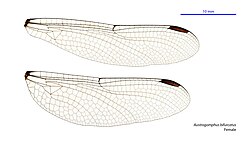 Female wings
 Male wings

.jpg)
.jpg)
See also
editReferences
edit- ↑ Dow, R.A. (2017). "Austrogomphus bifurcatus". IUCN Red List of Threatened Species. 2017 e.T14277253A59256683. doi:10.2305/IUCN.UK.2017-1.RLTS.T14277253A59256683.en. Retrieved 19 November 2021.
- 1 2 Tillyard, R.J. (1909). "On some rare Australian Gomphinae, with descriptions of new species". Proceedings of the Linnean Society of New South Wales. 34: 238–255 [244] – via Biodiversity Heritage Library.
- ↑ "Species Austrogomphus (Pleiogomphus) bifurcatus Tillyard, 1909". Australian Faunal Directory. Australian Biological Resources Study. 2012. Retrieved 13 February 2017.
- 1 2 Theischinger, Günther; Hawking, John (2006). The Complete Field Guide to Dragonflies of Australia. Collingwood, Victoria, Australia: CSIRO Publishing. p. 174. ISBN 978-0-64309-073-6.
- ↑ Theischinger, Gunther; Endersby, Ian (2009). Identification Guide to the Australian Odonata. Department of Environment, Climate Change and Water NSW. p. 202. ISBN 978-1-74232-475-3.
- ↑ Watson, J.A.L.; Theischinger, G.; Abbey, H.M. (1991). The Australian Dragonflies: A Guide to the Identification, Distributions and Habitats of Australian Odonata. Melbourne: CSIRO. p. 278. ISBN 0-643-05136-8.
- 1 2 Endersby, Ian; Fliedner, Heinrich (2015). The Naming of Australia's Dragonflies. Eltham, Victoria, Australia: Busybird Publishing. ISBN 9781925260625.

Wikimedia Commons has media related to Austrogomphus bifurcatus.