
The Atami Jinsha Tetsudo (Jap. for Atami man(powered) vehicle railway) was a 9.5 miles (15.3 km) long 2 feet (610 mm) manpowerered narrow gauge railway in the province of Izu, Japan which was operated around 1900.
_(14575320877).jpg)
The initially 7 miles (11 km) long handcar line was opened in 1895[1] and connected the coastal towns Atami and Yoshihama on the Izu Peninsula. The train crew comprised two men and a boy. The men, muscular coolies, pushed the car on the up-grades and jumped on the rear platform for a ride when the car was coasting on a level or down-grade. The boy rode on the front platform, and it was his duty to blow a horn as a warning at hills and curves, and to manipulate the brakes. The fare, including tips for the crew, on the road was equivalent to 21 cents per round trip.[2] The line was expanded by 2.5 miles (4.0 km) to Odawara in 1896.[1]
In 1907 the track was re-gauged to 3 ft 6 in (1,067 mm), and steam locomotives were introduced.[3] The line closed in 1923 as a result of the Great Kanto earthquake.[1]
Photographs
edit Hand Tram-Car Atami
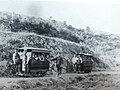 Passenger transport
 Steam locomotive No 1 after re-gauging in 1907


References
edit- 1 2 3 Shizuoka Prefecture Railway Stations: Tookaidoo Main Line (Atami City~Shinjohara).
- ↑ An odd Japanese car. In: The Street Railway Review. Vol. 10, No. 12, 15 December 1900, p. 720.
 This article incorporates text from this source, which is in the public domain.
 - ↑ Dan Free: Early Japanese Railways 1853-1914: Engineering Triumphs That Transformed Meiji-era Japan. Tuttle Publishing, 27.11.2012.