
Alexander Hatrick (29 August 1857 – 30 July 1918) was a New Zealand merchant, shipowner, tourism entrepreneur and mayor.

Hatrick was born in Smythesdale, Colony of Victoria on 29 August 1857, the 2nd of 10 children of Scottish parents Alexander Hatrick, a carpenter, and Margaret Sinclair. In 1875, aged 17, he and 4 friends from Ballarat, went to the West Coast, but soon settled in Whanganui. He worked in a foundry until 1880, when he went into partnership with his brother-in-law, Lewis Walker, for about 4 years as grain, produce and provisions merchants, in Ridgway St. He moved the business to Taupo Quay as a sole trader, then built a warehouse on the corner of the Quay and Hill Streets, with branches in Auckland, Wellington, Waitara, Pipiriki, Raetihi, Sydney and Melbourne. It later had a motor department (by 1918 the largest in the country). He was also managing director of the Spiral Pipe Company and had interests in other businesses. On 2 January 1888 he married Catherine Juliet Carr in Dunedin. He became a member of the Harbour Board in 1887, was a Borough Councillor from 1890 and Mayor from 1897 to 1904, during which time the council took over the gas works, took water from Okehu, the opera house, extended the town and he was president of the Beautifying Society,[1][2] of which he was a joint founder in 1910.[3]
Hatrick was ill for about 18 months, before dying of a seizure. He left a widow,[2] who died on 30 November 1949, and was survived by 2 sons, Alexander[4] and Ronald (died 1964),[5] and 4 daughters, Winifred the eldest,[6] Margaret Smith, Katherine and Alexa, his youngest,[7] who died on 21 February 1945.[8] He was buried at Aramoho Cemetery.[9]

Most buildings belonging to Hatrick have been demolished. His house in Ingestre Street became a plumbing depot, his 1910 house[10] on St John’s Hill[11] was demolished to build Alexa Place subdivision in the 1970s[10] and his offices on the corner of St Hill Street and Taupo Quay[12] are now a car park for the Trafalgar Square Shopping Centre, built in 1987.[13][14][15] Little remains of the Sedgebrook works and slipway in Whanganui East,[16] which was working between at least 1897[17] and 1926.[18] A 2-storey office and crew accommodation building of about 1904 remains on Taupo Quay[10] and has Class B protection.[19]
Shipping and tourism
edit
Trans-Tasman sailing ships
editIn December 1888 Walker & Hatrick bought the former Brunner Coal Co, St. Kilda, to run to and from Newcastle.[20] She was a 189GT, 3 masted schooner, 127.3 ft (38.8 m) x 22 ft (6.7 m) x 10.1 ft (3.1 m), built by J. Fullerton, Merksworth Works, Paisley in 1868 and sold that November to a Melbourne firm.[21] Hatrick sold her in 1903 to buy a larger ship.[22] By 1929 St Kilda had been abandoned on Bishop Island.[21]
The larger ship was Alexa, named after Hatrick's youngest daughter,[7] a 343GT, steel, barquentine, 143 ft (44 m) x 26 ft (7.9 m) x 10.5 ft (3.2 m), originally named Voorberg, launched in July 1904 by Verstock & Co, Martenshoek. She left London on 10 August 1904,[23] but was delayed until 8 March 1905 in reaching Whanganui.[24] She was sold to On Chong & Co, Sydney in 1912.[25] She was the last square-rigged sail ship registered in Australia, when she caught fire on 30 January 1929 at Butaritari.[26]
In September 1911, when she was beached at Whanganui,[27] Hatrick bought another Dutch, steel, barquentine, Carla, and her cargo of 450 tons of coal at a wreck auction for £290.[28] He refloated and renamed her as Wanganui. She was 341GT, 134.2 ft (40.9 m) x 26.2 ft (8.0 m) x 10.7 ft (3.3 m), launched on 13 February 1902,[29] also by Verstock, as the Vorlichter.[30] He sold her in 1916[31] and she was again sold in Auckland in 1922,[32] converted to a hulk in August 1924[33] and used by the Northern Steamship Company until February 1948, when she was stripped and scuttled outside of Cuvier Island.[34]
Whanganui River services
edit
Hatrick opened the Whanganui River as a tourist route after others had failed, got his first river boat, the paddle-steamer Wairere in late 1891 and a government mail contract for the 55 mi (89 km) to Pipiriki from 1892. By April 1892 he had a contract with Thomas Cook & Son to carry tourists and on 24 May Wairere started a weekly mail, passenger and cargo service to Pipiriki, joined in 1894 by the Manuwai (400 passengers) and in 1897 by the Ohura (145 passengers).
.jpg)
In July 1901 Hatrick bought Pipiriki House, the only accommodation there, and in 1902 replaced part of it with a tourist hotel. At the end of 1903 cables were laid so his ships could be winched over the fastest rapids to reach another 89 mi (143 km) to Taumarunui, which was then the terminus of the railway from Auckland. Hatrick & Co launched a houseboat at Taumarunui on 6 April 1904,[35][36] named Makere.[37] It took over 4 weeks to lower her down 35 mi (56 km) of the Whanganui River,[38] for use by December 1904[39] at the mouth of the Ōhura River, 30 mi (48 km) from Taumarunui and 60 mi (97 km) from Pipiriki.[40] She was 98 ft (30 m) x 22 ft (6.7 m),[41] with 36 berths on the lower deck and electric light.[1] He could then provide a 3-day service from Whanganui or Taumarunui, with overnight stops at Pipiriki House and the houseboat. In 1916 complaints were made about lack of maintenance of the river and Hatrick threatened to suspend services.[42] After pressure in 1925 to end a subsidy, equivalent to £2 per passenger,[43] in 1927 the River Trust decided that maintenance of the top 12 mi (19 km) from Te Maire to Taumarunui could be cut, as the river fell 144 ft (44 m), through 38 rapids[44] and new roads were being built.[45] The houseboat was moved downstream, to a channel dredged for it at the mouth of the Retaruke River,[46][47] with a slipway for its maintenance.[48] The river was narrow enough for planks to connect the boat to both banks.[49][50] From 1929 services to Taumarunui ended[51] and by 1932 the river was unnavigable beyond Kirikau[52] and boats ran only between Whanganui and the houseboat,[53] which caught fire and sank in 1933.[54] By 1944 the river was too shallow for steamers to go beyond Hipango Park.[55]
Pipiriki House burnt down on 10 March 1909, but within 11 months Hatrick had replaced it with one of the most up-to-date tourist hotels in New Zealand, which burnt down in 1959.[56] By December 1911 he had 12 large vessels and 7 smaller boats on the river, with workshops in Whanganui and Taumarunui.[1] The foundry and workshop in Wanganui were on the Shakespeare’s Cliff side of the river from about 1904. When A Hatrick & Co was re-organised in 1928, the riverboat services continued as Wanganui River Service Ltd, managed by Ronald Hatrick. The company closed in 1958.[10] By 1963 the Waireka was alone and only able to travel a short distance up the river.[57]
He complained that forestry was making the river less attractive and reducing summer water flows. In June 1908 the Lands Department decided 19,000 acres (7,700 ha) should be protected.[58]
In the early 1880s PWD had barges on the river to clear snags, with a houseboat for their engineers at Pipiriki. They reached to within 12 mi of Pipiriki when Whanganui businessmen set up a company to take over the work with Tuhua. The company failed and no further work was done until Hatrick got a 4-year £2,000 contract for a weekly mail service to Pipiriki from April 1892.[59]
Fleet
edit
- Manuwai 1894 built by Yarrow, Poplar, stern wheel paddle steamer, assembled in Whanganui, sold to Waikato 1920, for 400 passengers
- Moa a launch[60]
- Ohura launched 22 July 1897 to serve about 14 mi (23 km) of the Tāngarākau River,[61] 77 ft (23 m) x 12 ft (3.7 m) x 1 ft (0.30 m) 13 mph (21 km/h),[62] for 200 passengers,[60] capsized 1940 with loss of 3 crew,[63] used as a barge until 1950s and left near Cobham Bridge[64]
- Ongarue launched on 5 January 1904, a 60 ft (18 m) launch,[65] for 65 passengers[60]
- Otunui by Yarrow, 1908, 60 ft (18 m) x 8 ft (2.4 m) x 3.7 ft (1.1 m) 4-cylinder 40 hp (30 kW) oil engine 10 kn (19 km/h; 12 mph),[58] 80 passengers[60] She may have sunk in 1949,[66] but was relicensed in 1950.[67] She was sold in 1961 as Tangahoe. In 1972 she was driven on to a shingle bed near Pipiriki in a storm, but rebuilt as a diesel passenger ship, but then moved to the Waikato and in 1982 to Lake Ōkataina, with paddle wheels added. In 1984 she moved back to the Whanganui, then back to the Waikato in 1988. In 2002 she was refitted, but damaged by fire in 2003. She was rebuilt and went to Paeroa in 2006, Lake Whakamaru and was at the Waimarino Adventure Park, Tauranga 2009-2015.[66] She then served Bridge to Nowhere and in 2026 was moved to Whanganui.[68]
- Parinui a launch[60] with a 5 hp (3.7 kW) engine, built for the Tāngarākau River[69]
- Taniwha was built for Taumarunui River Services 30 hp (22 kW) Ailsa Craig engine, 10 kn (19 km/h; 12 mph), 54 ft (16 m) x 5.4 ft (1.6 m)[58]
- Wai-iti by Yarrow, launched on 12 April 1901 by Ryan & Co, Auckland,[70] the first tunnel boat in the country, 40 ft (12 m) x 8 ft (2.4 m), with 14 hp (10 kW),[71] or 10 hp (7.5 kW), Union oil engine, driving tunnel propellers,[72] 60 ft (18 m) x 8.5 ft (2.6 m), sank in 1924,[73] passengers and crew were rescued[74]
- Waimarie by Yarrow, 1899 100.2 ft (30.5 m) x 16 ft (4.9 m) bought in 1902 and renamed from Aotea, 300 passengers, returned to service in 2000
- Waione launched on 25 January 1902,[75] with seats for 100, powered by two triple expansion tube engines, driving 4 propellers, 2 in each tube,[76] for 300 passengers,[60] used as a barge until 1950s and left near Cobham Bridge[64]
- Waiora launched on 10 December 1904 as a steam launch for Pipiriki to Taumarunui,[77] for 87 passengers[60] which could be brought close in to the bank and boarded on a plank[78]
- Waireka a launch,[60] built in 1909,[79] which could also be brought close in to the bank[80] She was sold in the 1950s[81] and has since been used on several waterways, including Lake Ōhakuri. In 2023 she was returned to Whanganui for repairs.[82]
- Wairere launched on 18 November 1891,[83] at a cost of £4,500 100 ft (30 m) x 14 ft (4.3 m)[59] for 250 passengers[60]
- Wairua by Yarrow, launched on 10 December 1904 as a steam launch for Pipiriki to Taumarunui,[77] for 87 passengers.[60] with a 66 hp (49 kW) Simpson & Strickland compound engine, replaced by a Thornycroft oil engine in 1913, converted to a pontoon in 1938, salvaged in 1987, re-launched in March 2006 and fitted with a 90 hp (67 kW) Gardner 6LW-20[84]
- Wakanui a launch[60] laid up about 1937[85]
- Wakapai made her first trip on 27 December 1905.[86] From 1928,[87] she and Ohura replaced Wairere on the Pipiriki service and her steam engine was replaced by a 75 hp (56 kW) Thorneycroft diesel,[88] for 100 passengers,[60] ran aground in a rapid near Ranana in 1951.[89]
 Taumarunui landing in 1923
 Ohura in 1905
 Ohura in Ngaporo Rapid about 1908
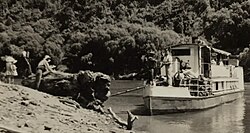 Ongarue picking up mail about 1930
 Ongarue with cream cans about 1930
 Otunui skipper Kora
 Otunui between 1913 and 1921
 Parinui about 1900
 Waireka in 1909. Wairere behind
 Waireka in 1921
 Wairere at Pipiriki about 1910
 Wairua about 1910
 Wairua in 2013
 Wakapai in the Big Paparoa rapids
 Wakapai about 1930


.jpg)


References
edit
- 1 2 3 Beaglehole, Diana. "Alexander Hatrick". Dictionary of New Zealand Biography. Ministry for Culture and Heritage. Retrieved 5 February 2012.
- 1 2 "Obituary. Wanganui Chronicle". 1 August 1918.
- ↑ "Kowhai park. Wanganui Chronicle". 21 August 1942.
- ↑ "Death of former Wanganui mayoress. Wanganui Chronicle". 1 December 1949.
- ↑ "Link With Wanganui River Steamers. Evening Post,". 2 May 1964.
- ↑ "Bain-Hatrick. Wanganui Chronicle". 25 April 1912.
- 1 2 "A good record. Wanganui Chronicle". 10 July 1916.
- ↑ "Deaths. Auckland Star". 22 February 1945.
- ↑ "Personal. Wanganui Herald". 2 August 1918.
- 1 2 3 4 "Hatrick's Building" (PDF). Whanganui District Council. March 2010.
- ↑ "Some pretty types of modern domestic architecture from Wanganui". kura.aucklandlibraries.govt.nz. 7 August 1912. Retrieved 14 June 2026.
- ↑ "Hatrick and Company Ltd in 1910s". natlib.govt.nz. Retrieved 14 June 2026.
- ↑ admin. "About Us". Trafalgar Square. Retrieved 14 June 2026.
- ↑ "Kevs Wanganui Photo History". www.facebook.com. Retrieved 14 June 2026.
- ↑ "Whanganui History Online". www.facebook.com. 13 October 2024. Retrieved 14 June 2026.
- ↑ "1 Taupo Quay". Google Maps. February 2024. Retrieved 14 June 2026.
- ↑ "Wanganui Herald". 19 June 1897.
- ↑ "Wanganui Chronicle". 9 July 1926.
- ↑ "Whanganui District Plan Archaeological sites" (PDF). 4 June 2016.
- ↑ "Wanganui. New Zealand Times". 21 December 1888.
- 1 2 "St Kilda". clydeships. Retrieved 13 June 2026.
- ↑ "Local and general. Wanganui Chronicle". 17 December 1903.
- ↑ "By telegraph. Wanganui Chronicle". 10 October 1904.
- ↑ "Arrival of the Alexa. Wanganui Herald". 8 March 1905.
- ↑ "Shipping. Wanganui Herald". 2 November 1912.
- ↑ "The barquentine Alexa. The Advertiser Sat 16 Feb 1929".
- ↑ "Stranded On The New Zealand Coast". kura.aucklandlibraries.govt.nz. 28 September 1911. Retrieved 14 June 2026.
- ↑ "The Carla. Wanganui Herald". 25 September 1911.
- ↑ "Stichting Maritiem Historische Data - Schip". www.marhisdata.nl. Retrieved 21 July 2025.
- ↑ "Dismasted. Wanganui Chronicle". 24 September 1912.
- ↑ "Barquentine Wanganui sold. Evening Post". 19 May 1916.
- ↑ "Barquentine Wanganui sold. Otago Daily Times". 25 November 1922.
- ↑ "The Register of Australian and New Zealand Shipping 1925-1926". Issuu. 10 June 2014. Retrieved 13 June 2026.
- ↑ "Wanganui". nzmaritimeindex.org.nz. Archived from the original on 19 January 2022. Retrieved 21 July 2025.
- ↑ "Local and general. Wanganui Chronicle". 8 April 1904.
- ↑ "Wanganui Herald". 7 April 1904.
- ↑ "A houseboat in course of construction at Taumarunui". kura.aucklandlibraries.govt.nz. 28 April 1904. Retrieved 14 June 2026.
- ↑ "The "Houseboat" on the Wanganui. Wanganui Herald". 3 December 1904.
- ↑ "Special time-table notice. Wanganui Herald". 15 December 1904.
- ↑ "River houseboat. Wanganui Chronicle". 3 August 1927.
- ↑ "House-Boat on The Wanganui. Wanganui Herald". 5 May 1904.
- ↑ "Wanganui river trust. Wanganui Herald". 7 August 1916.
- ↑ "Upper river service. Wanganui Chronicle". 29 September 1925.
- ↑ "The river service. Wanganui Chronicle". 7 February 1927.
- ↑ "The river service. Wanganui Chronicle". 29 November 1927.
- ↑ "Floating down. Wanganui Chronicle". 6 September 1927.
- ↑ "The Wanganui River. Wanganui Chronicle". 28 May 1928.
- ↑ "Homes vacated. New Zealand Herald". 23 March 1933.
- ↑ "Thousands of travellers from all parts of the world have spent a night at the famous houseboat on the Wanganui River. The stream shown here is a tributary. Manawatu Times". 9 October 1929.
- ↑ "a houseboat moored against the bank. Timaru Herald". 22 April 1933.
- ↑ "The Wanganui River. Wanganui Chronicle". 4 September 1928.
- ↑ "Liquor on boats. Wanganui Chronicle". 7 June 1932.
- ↑ "Dominion". 16 December 1932.
- ↑ "Houseboat burned. Wanganui Chronicle". 28 August 1933.
- ↑ "Last of her kind. Wanganui Chronicle". 29 December 1944.
- ↑ "Pipiriki House Reduced To Heap Of Ashes. Evening Post". 25 May 1959.
- ↑ "When The Wanganui Was A Great River Highway. Evening Post". 27 April 1963.
- 1 2 3 "How The March Of Progress Affected The River Steamers. Evening Post". 17 August 1963.
- 1 2 "River history. Wanganui Chronicle". 28 September 1916.
- 1 2 3 4 5 6 7 8 9 10 11 12 "A Hatrick & Co. Timetable". natlib.govt.nz. 1912. Retrieved 12 June 2026.
- ↑ "Our river steamer. Wanganui Chronicle". 23 July 1897.
- ↑ "Advance Wanganui. Wanganui Chronicle". 21 July 1897.
- ↑ "Wanganui river steamer tragedy: loss of three members of the crew". kura.aucklandlibraries.govt.nz. 22 May 1940. Retrieved 12 June 2026.
- 1 2 "The Waione". Sarjeant Gallery Whanganui. Archived from the original on 1 December 2023. Retrieved 12 June 2026.
- ↑ "The river service. Wanganui Herald". 5 January 1904.
- 1 2 "MPV Otunui". www.paddlesteamers.info. Retrieved 14 June 2026.
- ↑ "Wanganui licensing committee. Wanganui Chronicle". 8 June 1950.
- ↑ Tweed, Mike. "Historic paddleboat moves closer to river". NZ Herald. Retrieved 14 June 2026.
- ↑ "Wanganui river traffic extension. Wanganui Herald". 22 December 1903.
- ↑ "The 'Wai-Iti', Light Draught Vessel". kura.aucklandlibraries.govt.nz. 13 July 1901. Retrieved 12 June 2026.
- ↑ "Taranaki Herald 23 April 1901".
- ↑ "Wai-Iti, Hatrick and Co., Wanganui, funnel boat". kura.aucklandlibraries.govt.nz. 15 February 1902. Retrieved 12 June 2026.
- ↑ "River boat sinks. New Zealand Herald". 20 May 1924.
- ↑ "River boat on the Wanganui strikes submerged rock and sinks: mishap to the Wai-iti". kura.aucklandlibraries.govt.nz. 19 June 1924. Retrieved 12 June 2026.
- ↑ "Uo-river tourist traffic. Wanganui Herald". 25 January 1902.
- ↑ "The Waione. Wanganui Herald". 24 January 1902.
- 1 2 "Local and general. Wanganui Herald". 10 December 1904.
- ↑ "The launch Waiora in 1930s". natlib.govt.nz. Retrieved 12 June 2026.
- ↑ "Auckland Star". 25 February 1909.
- ↑ "MV Waireka on the Whanganui River in about 1940". kura.aucklandlibraries.govt.nz. Retrieved 12 June 2026.
- ↑ "River rapids runner returns. Waimarino Bulletin". 23 June 1987.
- ↑ Ellis, Moana; Reporter, Local Democracy (29 August 2023). "Homecoming: Historic riverboat to sail once again on Whanganui River". RNZ. Retrieved 14 June 2026.
- ↑ "The new river steamer. Wanganui Chronicle". 19 November 1891.
- ↑ "Our History | MV Wairua". www.motorvesselwairua.co.nz. Retrieved 12 June 2026.
- ↑ "Museum fleet. Evening Post". 19 April 1939.
- ↑ "New river steamer. Auckland Star". 27 December 1905.
- ↑ "Fire on steamer. Wanganui Chronicle". 28 August 1928.
- ↑ "Gelignite discovered. Wanganui Chronicle". 14 May 1929.
- ↑ "River Steamer Goes Aground. Evening Post". 2 February 1951.