
Albap (Korean: 알밥; lit. 'roe rice') is a type of bibimbap made with one or more kinds of roe, most commonly flying fish (commonly Cheilopogon agoo) roe, and served in a sizzling hot ttukbaegi (earthenware) or dolsot (stone pot).[1][2][3] It is a dish of Korean origin that is found in Japanese restaurants in South Korea, but not in Japan.
 Albap served in dolsot (stone pot) | |
| Type | Bibimbap |
|---|---|
| Place of origin | Korea |
| Associated cuisine | Korean cuisine |
| Main ingredients | bap, roe, vegetables, kimchi, seaweed flakes. |
| Korean name | |
| Hangul | 알밥 |
| RR | albap |
| MR | albap |
| IPA | al.bap̚ |

Gallery
edit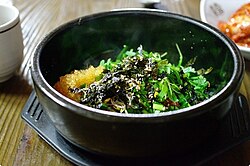 Albap served in ttukbaegi (earthenware)
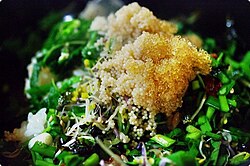 Albap (closeup, before mixed)
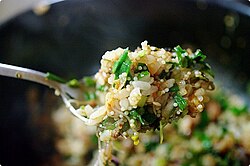 A spoonful of albap (closeup, mixed)


See also
editReferences
edit- ↑ Crawford, Matthew C. (25 April 2014). "To the end of the line". The Korea Herald. Retrieved 22 May 2017.
- ↑ Steinberg, Kaitlin (12 June 2014). "Korean Al-Bap: A Party in a Hot Stone Bowl". Houston Press. Retrieved 22 May 2017.
- ↑ Cabral, Javier (18 August 2016). "Why Korean Sushi Is Better Than Japanese". Munchies. VICE. Retrieved 22 May 2017.
External links
edit | This Korean cuisine–related article is a stub. You can help Wikipedia by adding missing information. |