
Agyrtacantha dirupta is a species of dragonfly in the family Aeshnidae,[4] commonly known as the trifid duskhawker.[5] It has been found from the Maluku Islands through Australia to the Pacific.[5][6]
| Trifid duskhawker | |
|---|---|
Scientific classification  | |
| Kingdom: | Animalia |
| Phylum: | Arthropoda |
| Clade: | Pancrustacea |
| Class: | Insecta |
| Order: | Odonata |
| Infraorder: | Anisoptera |
| Family: | Aeshnidae |
| Genus: | Agyrtacantha |
| Species: | A. dirupta |
| Binomial name | |
| Agyrtacantha dirupta | |
 | |
| Synonyms[3] | |
| |

Agyrtacantha dirupta is a large, dark dragonfly with green, brown and black colour variations. It inhabits still and brackish water. Adults are nomadic and fly at dusk.[7]
Etymology
editThe genus name Agyrtacantha combines the Greek ἀγύρτης (agyrtēs, "imposter" or "charlatan"), referring to confusion surrounding its earlier classification, with ἄκανθα (akantha, "thorn" or "spine"), referring to the spines at the tip of the female abdomen.[8]
The species name dirupta is derived from the Latin dirumpo ("to break apart" or "rupture"), possibly referring to the unexpected discovery of this species far from the previously known range of the genus Triacanthagyna.[8]
Gallery
edit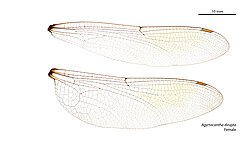 Female wings
.jpg)
See also
editReferences
edit- ↑ Dow, R.A. (2017). "Agyrtacantha dirupta". IUCN Red List of Threatened Species. 2017 e.T83304709A83373261. doi:10.2305/IUCN.UK.2017-1.RLTS.T83304709A83373261.en. Retrieved 20 November 2021.
- ↑ Karsch, F. (1889). "Neue Aeschniden der indo-australischen Region". Entomologische Nachrichten (in German). 15. Dresden: 236–239 [236] – via Biodiversity Heritage Library.
- ↑ Paulson, D.; Schorr, M.; Abbott, J.; Bota-Sierra, C.; Deliry, C.; Dijkstra, K.-D.; Lozano, F. "World Odonata List". OdonataCentral. University of Alabama. Retrieved 13 April 2026.
- ↑ "Species Agyrtacantha dirupta (Karsch, 1889)". Australian Faunal Directory. Australian Biological Resources Study. 2012. Retrieved 8 February 2017.
- 1 2 Theischinger, Günther; Hawking, John (2006). The Complete Field Guide to Dragonflies of Australia. Collingwood, Victoria, Australia: CSIRO Publishing. p. 152. ISBN 978-0-64309-073-6.
- ↑ Theischinger, Gunther; Endersby, Ian (2009). Identification Guide to the Australian Odonata. Department of Environment, Climate Change and Water NSW. p. 190. ISBN 978-1-74232-475-3.
- ↑ Watson, J.A.L.; Theischinger, G.; Abbey, H.M. (1991). The Australian Dragonflies: A Guide to the Identification, Distributions and Habitats of Australian Odonata. Melbourne: CSIRO. ISBN 0-643-05136-8.
- 1 2 Endersby, Ian; Fliedner, Heinrich (2015). The Naming of Australia's Dragonflies. Eltham, Victoria, Australia: Busybird Publishing. ISBN 9781925260625.

 | This article related to Aeshnidae is a stub. You can help Wikipedia by adding missing information. |