
Submission declined on 13 August 2025 by AirshipJungleman29 (talk). This draft appears to be a duplicate of an existing article. Wikipedia does not permit multiple articles on the same topic.
Where to get help
How to improve a draft
You can also browse Wikipedia:Featured articles and Wikipedia:Good articles to find examples of Wikipedia's best writing on topics similar to your proposed article. Improving your odds of a speedy review To improve your odds of a faster review, tag your draft with relevant WikiProject tags using the button below. This will let reviewers know a new draft has been submitted in their area of interest. For instance, if you wrote about a female astronomer, you would want to add the Biography, Astronomy, and Women scientists tags. Editor resources
|  |
This draft's references do not show that the subject meets Wikipedia's criteria for inclusion. The draft requires multiple published secondary sources that:
Declined by Gheus 10 months ago.
| |
Submission declined on 12 June 2025 by Reconrabbit (talk). This draft provides insufficient context for those unfamiliar with the subject. Please see the guide to writing better articles for how to improve your writing. Declined by Reconrabbit 11 months ago. | |
Submission declined on 16 May 2025 by GoldRomean (talk). This draft reads like an essay or opinion piece. Wikipedia is not a place for original research or personal opinions. The draft should:
Declined by GoldRomean 12 months ago.
| |
 Comment: This is a translation of an article that is missing some context. Even a small amount added to the introductory paragraph that begins "The history of the term Acadia..." would be a major benefit to the reader, such as describing where in the world Acadia is. -- Reconrabbit 15:38, 12 June 2025 (UTC)
- Comment: Needs a copyedit. I am often confused when reading. Draft appears to try to define Acadia in many contexts and locations all over the world like some sort of list and gives impression that "Acadia" is something many seek to try to find the definition for, when it is just the name of many places. (Or maybe I'm just a bad reader.) GoldRomean (talk) 18:38, 16 May 2025 (UTC)
Acadia, a historical region in North America, derives its name from a term first used in 1524 by Italian explorer Giovanni da Verrazzano, possibly inspired by the idyllic Greek region of Arcadia or Indigenous terms like the Mi'kmaq -akadie ("fertile land") or Maliseet-Passamaquoddy quoddy ("fertile place"). Its geographical scope has varied, initially referring to areas like the Delmarva Peninsula, Virginia, or North Carolina, and later encompassing the Bay of Fundy and Gulf of Saint Lawrence. The name evolved through exploration, cartography, and cultural shifts, reflecting both European and Indigenous influences, and remains significant in historical, genealogical, and cultural contexts.[1]
History
editTheory of Greek origin
editThe name Acadia was supposedly used for the first time in the form Arcadia in 1524 by the Italian explorer Giovanni da Verrazzano, in the service of Francis I of France.[2][1]
The toponym "Acadia" has been subject to varying interpretations regarding its geographical reference. According to The Canadian Encyclopedia, it denoted the Delmarva Peninsula near Washington, United States,[3] while Samuel Arsenault suggests it referred to Virginia or North Carolina.[4] The term does not appear on a 1529 map by Verrazzano's brother but is mentioned in a 1524 report to the King of France, where Giovanni da Verrazzano named the region "Arcadia" for the beauty of its trees.[4] Jean Daigle notes that these trees likely evoked the Greek region of Arcadia, known as an idyllic setting in poetry.[5] Some scholars suggest Verrazzano may have been inspired by Jacopo Sannazaro's 1504 poem L'Arcadie, which describes the Naples region.[6]
 Portrait of Giovanni da Verrazano.
 Portrait of Jacopo Sannazaro after Titian.
 Opera Omnia (complete works) by Jacopo Sannazaro.
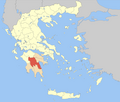 Arcadia, Greece.
 Landscape of Greek Arcadia.

.JPG)


Theory of indigenous origin
editThe origin of the name "Acadia" is debated among historians. Some question whether Giovanni da Verrazzano's use of the term relates to its modern usage.[2] The name may derive from the Mi'kmaq term -akadie, meaning "fertile land,"[2] as seen in place names like Shunacadie and Shubenacadie. Alternatively, it could stem from algatig, a Mi'kmaq word for "camping place," or quoddy, a Maliseet-Passamaquoddy term meaning "fertile place."[7] Similar-sounding toponyms exist in New Brunswick and Nova Scotia.[7] However, Bona Arsenault argues that Verrazzano's brief three-day visit to the continent makes a Mi'kmaq or Maliseet origin less likely.[7][1]
From Arcadia to Acadia
editAs exploration progressed, the location and boundaries of Acadia became more defined, encompassing areas such as the Bay of Fundy and the Gulf of Saint Lawrence.[4] However, a 1556 map identifies a region called Norumbega, corresponding to the present-day Canadian Maritime provinces.[8]
 The Dauphin map from 1543, illustrating a land belonging to the Bretons.
 Map of Norembergue and Virginia, by Cornelius van Wytfliet (between 1597 and 1607).
 Anonymous map of the land of Bacalaos, dating from 1530.


In 1566, Venetian cartographer Bolognino Zaltieri first identified Acadia on a map, adapted from Paolo Forlani's 1565 map, placing "Larcadia" near present-day New Jersey, possibly referencing the Hudson River and Lake George.[8] By 1601, geographer Guillaume Levasseur used the term "Coste de Cadie," locating it further north across present-day New Brunswick and Maine.[8] Acadia was officially established in 1604 on Sainte-Croix Island. However, Marc Lescarbot's 1612 map omits the name, instead identifying locations like the Norembergue River, Canada, Gaspésie, and the lands of the Etchemins and Souriquois.[9] Samuel de Champlain's maps from 1612 and 1632 also exclude the toponym, favoring "Souriquois," though "Acadye" appears on a 1613 map.[9] In 1621, Scotland conquered Acadia, and a 1625 map replaced French toponyms, renaming Acadia as New Scotland, the Souriquois lands as Caledonia, and the northern colony as Alexandria.[9] Saint John Island was first mapped in 1632.[9] French toponyms reappeared in the 1660s on maps by Pierre du Val (1664–1677) and Johannes Blaeu (1662), both using "Accadie."[9] According to Nicolas Landry and Nicole Lang, the "r" in Arcadie may have been dropped due to increasing interactions with the Mi'kmaq.[2]
 Map by Samuel de Champlain from 1612.

In 1703, Guillaume Delisle's map defined Acadia as a territory around the Bay of Fundy, extending to the Penobscot River, and divided between the Etchemins and Souriquois peoples. It was bordered to the north by Gaspésie, encompassing the north and east of present-day New Brunswick,[10] corresponding to the former seigneury of Nicolas Denys.[10] Henri Chatelain's 1719 map replicated these boundaries.[10]
Acadia in the 18th century
editOfficial uses
editAfter France ceded part of Acadia to Great Britain in 1713, the definition of Acadia became contentious. France began limiting the term "Acadia" to the peninsular region, excluding the continental areas still under its control.[11] Great Britain, however, considered Acadia to have ceased existing after 1713, using different names for the French-controlled territories.[12] France discontinued the use of "Acadia" after ceding the remaining territory to Great Britain in 1763.[12]
Cadie and Petite Cadie
editIn Quebec, "Cadie" or "Petite Cadie" refers to a town or region inhabited by Acadians, likely derived from "Acadie." The term, though historically used, was popularized by historians including Raymond Casgrain, Antoine Bernard, Robert Rumilly, Napoléon Bourassa, and Eugène Achard.[13] Additionally, "Cadie" is an alternate name for Acadiana, a region in Louisiana.[14]
Acadia in the 20th century
editAccording to Adrien Bérubé
edit


In 1979, geographer Adrien Bérubé[15] proposed four definitions of Acadia based on historical, genealogical, linguistic, and political perspectives. Historical Acadia encompasses the Bay of Fundy coastline, or more broadly, the region from the Saint Croix River to the Bay of Chaleur, including the southern islands of the Gulf of Saint Lawrence, corresponding to the Maritime Provinces, eastern Maine, and the Gaspé Peninsula. Genealogical Acadia, also known as the Acadia of the diaspora, refers to regions that received Acadian families during the Deportation of the Acadians, including the Atlantic Provinces, Quebec, Saint Pierre and Miquelon, New England, Louisiana, the Caribbean, French Guiana, the Falkland Islands, and France.[15][16]
The third definition, functional or operational Acadia, encompasses the Maritime Provinces of Canada, commonly referred to as "Maritime Acadia." The term "Atlantic Acadia" is also used, reflecting efforts by the Acadian community in Newfoundland and Labrador to gain recognition. This definition focuses on the use of the French language and enables a more data-driven analysis, such as through Statistics Canada data.[17]
The fourth definition, prospective Acadia, includes all francophone counties and parishes in New Brunswick, claimed in the 1970s by the Parti acadien for the establishment of an Acadian province. This territory is sometimes called "New Acadia."[17]
Contemporary and ideological definitions of Acadia
editGeographers have advanced multiple frameworks to conceptualize the definition of Acadia.[18] Allan Rayburn focuses on its historical boundaries, while R.A. Leblanc emphasizes the distribution of Acadians following the Deportation of the Acadians. C. Williams defines Acadia as a "mental map," reflecting public perception, noting that anglophones typically base their understanding on historical criteria, whereas francophones align it with the distribution of the French language.[18] J.-C. Vernex highlights diverse perceptions of Acadia, varying even between neighboring towns.[18] Adrien Bérubé analyzed 46 counties in Eastern Canada using 48 socio-economic criteria, concluding that eight counties in the Maritime Provinces share greater similarity with eastern Quebec than other Maritime regions, indicating the homogeneity of these Acadian counties.[12]
In 1994, Cécyle Trépanier, after conducting interviews across the Maritime Provinces, revised Adrien Bérubé's four definitions of Acadia and proposed three additional ones. She redefined genealogical Acadia as not limited to descendants of the Deportation of the Acadians survivors or tied to a specific territory.[19] Operational Acadia, described as an "unofficial Acadia," was seen by 49% of respondents as comprising isolated areas in the Maritimes, regardless of French language use.[19] Prospective Acadia was considered unlikely, with little interest in independence.[19] Trépanier's additional definitions include "felt and lived Acadia," where 45% of Acadians view Acadia as a sense of identity and connection to their homeland,[19] independent of residence, genealogy, or history; "perplexing Acadia," where 5% of respondents could not define Acadia; and "folkloric Acadia," a tourist-oriented image, exemplified by the Village Historique Acadien near Caraquet, depicting Acadian life from 1770 to 1939.[19]
In a 1996 article, Cécyle Trépanier argued that "Maritime Acadia" is a myth and proposed six distinct Acadias. "Tortured Acadia" refers to Cape Breton, where Acadians faced over a century of servitude, limited access to French language services, and minimal political representation.[20] "Silent Acadia" describes western Nova Scotia, where Acadians, feeling inferior, show little effort to develop their economy or preserve their culture. "Solidarity Acadia," also known as the Évangéline Region, is where Acadians, despite being a minority, have resisted anglicization, fostered cooperation, and promoted their culture.[20] "Timid Acadia" in southeastern New Brunswick is characterized by low political engagement, limited historical awareness, and minimal French language presence.[20] "Pretentious Acadia" on the Acadian Peninsula features Acadians who take pride in their culture, history, and language, often drawing comparisons to Quebecers.[20] Lastly, "Brayon Acadia" in Madawaska reflects a population with a strong regional identity and sense of distinctiveness.[20]
Use of the name "Acadie"
editGeographer Adrien Bérubé identifies four visions of Acadia corresponding to distinct ideologies: historical Acadia, genealogical Acadia, operational Acadia (comprising francophone communities in the Atlantic Provinces), and prospective Acadia (limited to New Brunswick).[21] He suggests that the use of terms derived from Acadie or Acadien—whether as nouns, adjectives, singular, plural, masculine, feminine, with or without qualifiers, in French, English, or Latin, and as demonyms, place names, brand names, or corporate names—typically aligns with one of these four ideologies.[22][16]
The Université de Moncton has consistently declined to adopt the name Université d'Acadie.[22][23] In the 1980s, the renaming of the Conseil économique acadien to Conseil économique du Nouveau-Brunswick sparked significant controversy.[22] The newspaper L'Évangéline, after its closure, was succeeded by Le Matin du Nouveau-Brunswick, which later became Le Matin, aligning with the operational ideology of Acadia, as described by geographer Adrien Bérubé. In contrast, Bérubé associates the newspaper L'Acadie Nouvelle with the ideology of prospective Acadia.[22]
The use of "Acadie" in street names is frequently linked to the historical ideology of Acadia, often initiated by local scholars in the United States and France.[22] In Trois-Rivières, Quebec, Boulevard des Acadiens reflects the region's Acadian genealogy.[22] In New Brunswick, the name often carries a political dimension, though place names in the southeast are commonly bilingual.[22]
The name Acadia is commonly used in English-speaking contexts, often reflecting historical or cultural associations, as in the cases of Acadia University and Acadia National Park.[22] It is also employed for its perceived commercial appeal, as seen in business names such as Acadian and Acadian Lines.[22] The term appears in various sectors, including genealogical and cultural contexts, such as the Acadian Festival in Madawaska, Maine, where usage is not always in French.[22]
In genealogical contexts, the term Acadie or its derivatives often refer to specific localities rather than the historical region as a whole. In Quebec, for example, there are approximately thirty places known as "Petites Cadies," and some locations are named "Acadie."[22] The existence of multiple "Acadias" reflects the dispersion of Acadian communities across various territories, necessitating organization within distinct jurisdictions. In 1980, a conference held at Université Sainte-Anne was titled Rencontre jeunesse des trois Acadies.[22]
The use of the name Acadie and its derivatives varies according to ideological frameworks, being generally more discretionary in operational ideologies and more emphasized in prospective ideologies.[22]
 The Acadie ferry in Belle-Île-en-Mer, France.
 A Pontiac Acadian
 Acadia National Park


See also
editReferences
edit- 1 2 3 "Origine du mot «Acadie»" [Origin of the word "Acadie]. CyberAcadie (in French). Archived from the original on 2017-01-03. Retrieved 2025-07-18.
- 1 2 3 4 Landry, Nicolas; Lang, Nicole (2001). Histoire de l'Acadie [History of Acadia] (in French). Sillery: Les éditions du Septentrion. p. 9. ISBN 2-89448-177-2.
- ↑ Johnson, Marc. "Acadie". L'encyclopédie canadienne. Archived from the original on January 14, 2010.
- 1 2 3 Arsenault 2011, pp. 11–12
- ↑ Daigle, Jean (1980). Les Acadiens des Maritimes : études thématiques [The Acadians of the Maritimes: thematic studies] (in French). Moncton: Centre d'études acadiennes, Université de Moncton. p. 18.
- ↑ Leblanc, Joël (2004). "Acadie : l'odyssée se poursuit" [Acadia: the odyssey continues]. Québec Science (in French). 42 (7): 22.
- 1 2 3 Arsenault, Bona; Alain, Pascal (2004). Histoire des Acadiens [History of the Acadians] (in French). Saint-Laurent: Fides. pp. 17–19.
- 1 2 3 Arsenault 2011, pp. 13–15
- 1 2 3 4 5 Arsenault 2011, pp. 15–18
- 1 2 3 Arsenault 2011, pp. 19–20
- ↑ Bujold, Stéphan (2009). "L'Acadie? Quoi ça? Les Acadiens? Qui ça? Esquisse d'un territoire indéfini et d'un peuple éparpillé" [Acadia? What's that? The Acadians? Who are they? Sketch of an undefined territory and a scattered people]. Cahiers [Notebooks] (in French). Société historique acadienne. p. 41.
- 1 2 3 Bérubé 1987, p. 202
- ↑ Hébert, Pierre-Maurice (1994). Les Acadiens du Québec [The Acadians of Quebec] (in French). Montréal: Éditions de L'Écho. p. 90. ISBN 2-920312-32-4.
- ↑ Brasseaux, Carl A. (1992). Acadian to Cajun: Transformation of a People, 1803-1877. University Press of Mississippi. ISBN 978-0878055838.
- 1 2 Arsenault, Samuel; Lamarche, Rodolphe; Daigle, Jean (1993). "Les géographes et l'aménagement des structures spatiales" [Geographers and the planning of spatial structures]. L'Acadie des Maritimes : études thématiques des débuts à nos jours [Acadia in the Maritimes: thematic studies from its beginnings to the present day] (in French). Moncton: Centre d'études acadiennes, Université de Moncton. p. 104. ISBN 2-921166-06-2.
- 1 2 Thibeault, Jimmy; Poplyansky, Michael; St-Pierre, Stéphanie; White, Chantal (2020). "Paroles et regards de femmes en Acadie" [Women's voices and perspectives from Acadia] (PDF). Presses de l'Université Laval (in French).
- 1 2 Bérubé 1987, p. 206
- 1 2 3 Bérubé 1987, p. 201
- 1 2 3 4 5 Trépanier, Cécyle (1994). "À la recherche de l'Acadie et des perceptions identitaires des Acadiens des provinces maritimes du Canada" [At the research of Acadia and Canada maritime province Acadians' identitary perceptions]. Études canadiennes (in French). 20 (37): 181‑195.
- 1 2 3 4 5 Trépanier, Cécyle (2009). "Le mythe de « l'Acadie des Maritimes »" [The myth of "Acadia in the Maritimes"]. Géographie et cultures (in French) (17).
- ↑ Bérubé 1987, pp. 202–208
- 1 2 3 4 5 6 7 8 9 10 11 12 13 Bérubé 1987, pp. 208–220
- ↑ "L'Université de Moncton réitère qu'elle ne changera pas de nom" [Université de Moncton reiterates it will not change its name]. Radio-Canada (in French). 2017-06-16. Retrieved 2025-07-18.
Bibliography
edit- Arsenault, Samuel (2011). "L'Acadie: un toponyme à usages multiples" [Acadia: a place name with multiple uses]. L'Acadie des origines [The Origins of Acadia] (in French). Sudbury: Prise de parole. pp. 11–28.
- Ganong, William F. (1901). "A Monograph of the Evolution of the Boundaries of the Province of New Brunswick". Proceedings and Transactions of the Royal Society of Canada. VII. Royal Society of Canada.
- Bérubé, Adrien (1987). "De l'Acadie historique à la Nouvelle-Acadie: les grandes perceptions contemporaines de l'Acadie" [From Historic Acadia to New Acadia: Contemporary Perceptions of Acadia]. Les Acadiens : état de la recherche (in French). Quebec: Conseil de la vie française en Amérique: 202. ISSN 0382-0262.