
The French overseas collectivity of Saint Pierre and Miquelon does not have an official flag, but an unofficial flag based on the islands' official coat of arms is commonly flown by locals (Emoji: 🇵🇲). French law neither authorises nor prohibits the use of the unofficial flag by local officials, and it has appeared on official documents and in front of government buildings alongside the French flag. The unofficial flag has also been flown by civilian vessels as a civil ensign.
 | |
| Use | Unofficial flag   |
|---|---|
| Proportion | 2:3 |
| Adopted | c. 1980s |
| Design | A blue field charged with a yellow silhouette of the Grande Hermine; on the hoist, the flag of the Basque Country, the ermine canton of the flag of Brittany, and the flag of Normandy arranged vertically |
| Designed by | André Paturel |
The design of the unofficial flag features a sailing ship (Grande Hermine) and a hoist with the flags of the Basque Country, Brittany, and Normandy – the three regions from which many of Saint Pierre and Miquelon's inhabitants originate. A local resident, André Paturel, created the flag in the 1980s with the islands' coat of arms as his basis. The coat of arms itself was inspired by a 1947 revenue stamp and designed in the 1960s by another local, Léon Joner.
History
editThe first permanent settlers from France came to the islands in the late 17th century.[1] Following the establishment of the French First Republic during the French Revolution, the French tricolour was raised in Saint Pierre and Miquelon, as was recorded by French diplomat and historian François-René de Chateaubriand in 1793:[2]
Amid an economic crisis in 1908, protesters in the capital Saint-Pierre carried the flag of the United States while marching through the commune. The protesters viewed the U.S. flag as a symbol of freedom, while their opponents viewed it as a rejection of the French metropole. The intention of the gesture was debated in both houses of the French Parliament.[2] The debate over the matter in the French Senate concluded with the passing of a motion to increase a grant to Saint Pierre and Miquelon by $4,000.[3]
In the 1960s, Léon Joner of Saint-Pierre designed Saint Pierre and Miquelon's official coat of arms based on a 1947 revenue stamp issued by local authorities. Later, in the 1980s, another local, André Paturel, was inspired by an idea from Jean-Paul Dunan to simplify the coat of arms into a flag. After a few minor modifications, Paturel completed his design, which has since become a widely-used but unofficial symbol of Saint Pierre and Miquelon.[4]
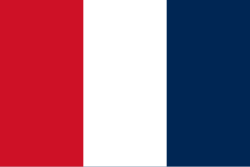 The flag of France in 1793
 The flag of the United States in 1908
.svg)


Design and symbolism
editThe elements of the unofficial flag of Saint Pierre and Miquelon reflect the archipelago's history and people. The flag is a blue field charged with a yellow silhouette of the Grande Hermine, the sailing ship that French explorer Jacques Cartier was on when he first reached the island of Saint Pierre on 15 June 1536. Most of Saint Pierre and Miquelon's residents trace their ancestry back to the Basque Country, Brittany or Normandy, so the flag's hoist accordingly features those three regions' flags arranged vertically (the Ikurrina, the ermine canton of the Gwenn ha Du, and the Norman flag, respectively).[4][5]
 Flag of the Basque Country
(Ikurrina) Flag of Brittany
(Gwenn ha Du)


.png)
Status and use
edit.JPG)
The unofficial flag of Saint Pierre and Miquelon is displayed throughout the territory by both private citizens and public officials. It is commonly used as a civil ensign by civilian vessels. Local historian Marc Albert Cormier describes the flag as having "quasi-legal" status, noting its appearance on official documents and on flagpoles alongside the French flag.[2]
There is no legislative or regulatory text in France in regard to what flags may be displayed on public buildings. French law only requires that the French flag take precedence over other flags and be flown in front of town halls on certain days of the year. As such, the unofficial flag of Saint Pierre and Miquelon flies below the French flag in front of the Territorial Council building. However, the town halls of the territory's two municipalities, Saint-Pierre and Miquelon-Langlade, only fly the French flag.[4]
The unofficial flag of Saint Pierre and Miquelon has an emoji (🇵🇲) that is often used by Basques on social media because it features the Basque flag, which does not have an emoji of its own.[4]
References
edit- ↑ Aldrich, Robert; Connell, John (31 January 1992). France's Overseas Frontier. Cambridge University Press. p. 33. ISBN 978-0-521-39061-3. Retrieved 24 April 2026.
- 1 2 3 Cormier, Marc Albert (8 August 2009). "Le drapeau français aux îles Saint-Pierre et Miquelon" [The French flag in the islands of Saint Pierre and Miquelon]. GrandColombier.com (in French). Retrieved 24 April 2026.
- ↑ Cormier, Marc Albert, ed. (8 October 2008) [19 December 1908]. "1908: Admiral Aube is Needed at St. Pierre Miquelon to Preserve the Peace". GrandColombier.com (in French). Retrieved 25 April 2026.
- 1 2 3 4 Louis, Ninnog (10 January 2025). "De petit timbre à émoji à succès, l'épopée insolite du drapeau de Saint-Pierre et Miquelon" [From a small stamp to a successful emoji, the unusual saga of the flag of Saint Pierre and Miquelon]. France Info (in French). Retrieved 25 April 2026.
- ↑ Aizpurua, Lucas (9 August 2021). "Du Pays Basque dans le drapeau de Saint-Pierre et Miquelon" [From the Basque Country to the flag of Saint Pierre and Miquelon]. Radio France (in French). Retrieved 25 April 2026.
External links
edit Media related to Flags of Saint-Pierre and Miquelon at Wikimedia Commons
- Saint Pierre and Miquelon (France) at Flags of the World
