
This article needs more citations. (January 2018) |
Following the independence of Nauru, the flag of Nauru (Nauruan: anidenin Naoero) was raised for the first time. The flag, chosen in a local design competition, was adopted on independence day, 31 January 1968. The design symbolically depicts Nauru's geographical position, with a star just south of the Equator.
 | |
| Use | State flag and civil ensign  |
|---|---|
| Proportion | 1:2 |
| Adopted | 31 January 1968 |
| Design | A blue field with a thin yellow horizontal stripe across the centre and a large white twelve-pointed star directly below the stripe on the hoist side. |

Proportions and symbolism
editThe flag reflects the geographical location of the island nation.
The narrow gold stripe with a width of 1⁄12 of the length of the flag represents the Equator.[1][2] The stripe along with the star signifies the location of the island in the Pacific Ocean one degree south of the Equator.[3] The separation of the blue flag cloth into two equal parts recalls the saga, that the first inhabitants were to have been brought to Earth from two boulders.[citation needed]
Nauru itself is symbolised by a white 12-pointed star. The twelve points on the star represent the island's twelve original tribes.[1] The following twelve tribes are:[4]
- Deiboe
- Eamwidara
- Eamwit
- Eamwitmwit
- Eano
- Eaoru
- Emangum
- Emea
- Irutsi
- Iruwa
- Iwi
- Ranibok
The blue signifies the Pacific Ocean,[1] while the white colour of the star represents phosphate,[3] a former major natural resource of the country.
Construction sheet
edit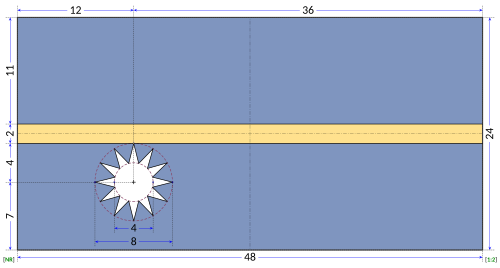 Flag construction sheet
.svg)
Creation and adoption
editThe flag was created by a resident employed by the Australian flag manufacturer Evans. It was officially adopted on 31 January 1968. Unlike some flags of Pacific nations (e.g., that of Tuvalu), Nauru's flag has evoked little controversy.[citation needed]
Other flags of Nauru
edit| Flag | Date | Use | Description |
|---|---|---|---|
 |
1969–present | Flag of the Nauru Pacific Line | A blue field with a large white twelve-pointed star in the centre with an anchor inside the star.[5] |
.svg) |
1924 | Proposed flag for Nauru | A white field with a blue field with 15 five-pointed stars in the canton.[6] |
Historical flags of Nauru
edit| Flag | Date | Use | Description |
|---|---|---|---|
 |
1888–1899 | When Germany took control of the island in 1888, it was administered by German New Guinea Company, whose flag was flown in the island.[3] | A white field with the German tricolour on the canton and defaced with a black lion with a red fleur-de-lys. |
 |
1899–1914 | In 1899, the German Imperial Government took over the administration of German New Guinea through the Imperial Colonial Office, the flag of which was flown until the conquest of the colony during the First World War.[3] | A German tricolour with the coat of arms in white circle. |
.svg) |
1914–1942 | Flag used during Australian occupation of Nauru (1914–1920) and period as League of Nations mandate under Australian administration. New Zealand and the United Kingdom were co-mandatories under the Nauru Island Agreement but their flags were not used.[7] | A Blue Ensign defaced with the seven-point Commonwealth Star in the lower hoist quarter and the five stars of the Southern Cross in the fly half. |
.svg) |
1942–1945 | Flag of Nauru under the Japanese occupation of Nauru during World War II.[3] | A white field with a red disc in the centre. |
|
1945–1968 | Flag used following restoration of Australian control in 1945 and subsequent period as a UN Trust Territory under Australian administration from 1946.[3] | A Blue Ensign defaced with the seven-point Commonwealth Star in the lower hoist quarter and the five stars of the Southern Cross in the fly half. |
|
1968–present | Current flag of Nauru adopted on 31 January 1968 following its independence from the trusteeship.[3] | A blue field with a thin yellow horizontal stripe across the centre and a large white twelve-pointed star directly below the stripe on the hoist side. |
See also
edit- Coat of arms of Nauru
- Nauru graph, named after its resemblance to the 12-pointed star on the flag
References
edit- 1 2 3 "The Nauruan Flag". Government of the Republic of Nauru. Retrieved 11 January 2018.
- ↑ "Nauru". Flag of the World. Retrieved 25 May 2021.
- 1 2 3 4 5 6 7 "Flag of Nauru - A Brief History" (PDF). Flagmakers. Retrieved 11 January 2018.
- ↑ "Tribes of Nauru". Government of the Republic of Nauru. Retrieved 8 April 2021.
- ↑ "Nauru Shipping Companies". www.fotw.info. Retrieved 17 November 2022.
- ↑ "Nauru Historical Flags". www.fotw.info. Retrieved 17 November 2022.
- ↑ "Written Replies to Questions put by Judges". Certain Phosphate Lands in Nauru (Nauru v. Australia). Government of Nauru. 19 November 1991. p. 503.
Since the Mandate of 17 December 1920, through the United Nations Trusteeship until 31 January 1968, Australia always had, and exercised, the full power of administration over Nauru. The Australian flag, to the exclusion of the Union Jack and the New Zealand flag, flew over the Territory throughout this period.
| This Nauru-related article is a stub. You can help Wikipedia by adding missing information. |