
The national flag of Cape Verde (officially Cabo Verde) consists of five horizontal bands of blue, white, red, white, and blue, in a 6:1:1:1:3 ratio. A circle of ten yellow five-pointed stars — representing the ten islands that make up the country – is charged on the hoist (left) side of the flag, centred on the red band. The current Cape Verdean flag was adopted on 25 September 1992, replacing the flag that was adopted when the country became independent on 5 July 1975.
.svg) | |
| Use | National flag and ensign    |
|---|---|
| Proportion | 2:3 |
| Adopted | 25 September 1992 |
| Design | Five unequal-sized horizontal bands of blue, white, red, white, and blue (6:1:1:1:3), with a circle of ten yellow five-pointed stars charged on the hoist side, centred on the red band |
| Designed by | Pedro Gregório |
Cape Verde's first flag had two horizontal bands of yellow and green, with a vertical red band on the hoist side charged with a black five-pointed star framed by ears of corn and a sea shell. Like the flag of Guinea-Bissau, it was based on the flag of the African Party for the Independence of Guinea and Cape Verde (PAIGC), which fought for the independence of both countries from Portugal. The current flag was introduced to symbolise Cape Verde's transformation from a socialist state to a multi-party democracy.
Design and symbolism
edit
The flag of Cape Verde is defined in the country's constitution as five unequal-sized horizontal bands, of which the outermost bands are blue, the bands adjacent to them are white, and the central band is red. The width (height) of the top and bottom blue bands are equal to one half and one quarter of the flag's width, respectively, while the red and white bands are equal to one twelfth (i.e. the ratio is 6:1:1:1:3). The flag is charged on the hoist side with a circle of ten yellow five-pointed stars, the centre of which is located at the intersection of a horizontal line in the middle of the red band and a vertical line positioned three-eighths of the flag's length from the hoist.[1][2][3] The constitution does not mention a width-to-length ratio for the flag, but the Cape Verdean government published a graphical guide in 2009 to standardise the display of national symbols, and in it a 2:3 ratio is used.[3] A 2:3 ratio is also used on the Cape Verdean government's website.[1]
The Cape Verdean government gives the following significance to the flag's symbols: blue represents the sky and sea; white and red represent the Cape Verdeans' desire for peace and efforts in nation-building, respectively; and the ten stars represent the archipelago's ten islands, arranged in a circle to symbolise unity.[1]
.svg)
| Colour | Pantone | CMYK | RGB |
|---|---|---|---|
| Blue | 287 C | 100, 89, 8, 2 | 0, 56, 147 |
| White | White | 0, 0, 0, 0 | 255, 255, 255 |
| Red | 186 C | 12, 100, 100, 3 | 207, 32, 39 |
| Yellow | 116 C | 4, 15, 98, 0 | 247, 209, 22 |
History
editPortuguese settlers who arrived in 1462 were the first recorded inhabitants of Cape Verde.[5] The islands were under Portuguese colonial rule until independence was granted on 5 July 1975, following the Carnation Revolution in Portugal proper and the end of the Portuguese Colonial War elsewhere in Lusophone Africa.[6] The first Cape Verdean national flag was hoisted the same day the country became independent, but it was not until 19 April 1976 that the flag became official by law.[7]
Cape Verde's first flag was based on that of the African Party for the Independence of Guinea and Cape Verde, or PAIGC, which led the country's one-party post-colonial government.[6] Featuring the pan-African colours, it consisted of two horizontal bands of yellow and green, with a vertical red band on the hoist side charged with a black five-pointed star framed by ears of corn and a sea shell. Black symbolised the peoples of Africa "and their hope for dignity, liberty, and peace"; red the blood of those who fought for Cape Verde's independence and development; yellow the nation's culture and well-being; and green the agricultural sector and hope.[7]
In the 1991 two-party election, the liberal Movement for Democracy defeated the African Party for the Independence of Cape Verde (PAICV), which had succeeded the PAIGC in 1980 as the country's sole ruling party.[8][9] The following year, a contest was held to design a new national flag to symbolise Cape Verde's break with its socialist past.[7][8] The winning design was created by architect Pedro Gregório, whose stated reason for participating was to create a flag that would not be mistaken for that of another nation, as the existing flag had been for Guinea-Bissau.[10] The constitution was subsequently amended and the current national flag became official on 25 September 1992.[1][7]

 Flag of Cape Verde (1975–1992)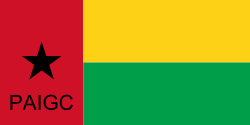

.svg)


References
editCitations
edit- 1 2 3 4 5 Government of Cape Verde 2019.
- 1 2 Government of Cape Verde 2010.
- 1 2 3 Government of Cape Verde 2009, pp. 1096–1099.
- ↑ Government of Cape Verde 2009, p. 1097.
- ↑ Halter 2013, p. 269.
- 1 2 Newitt 2026, pp. 194–195.
- 1 2 3 4 Smith 2001.
- 1 2 Newitt 2026, p. 200.
- ↑ Gachnang 2026.
- ↑ Gregório 2012.
Works cited
edit- "Bandeira" [Flag] (in Portuguese). Government of Cape Verde. 2019. Retrieved 27 June 2026.
- "Boletim Oficial: I Série, Número 48" [Official Bulletin: Series I, Number 48] (PDF) (in Portuguese). Government of Cape Verde. 21 December 2009. Retrieved 27 June 2026.
- "Constitution of the Republic of Cabo Verde" (PDF). Government of Cape Verde. 2010. Retrieved 27 June 2026.
- Halter, Marilyn (2013). "Cape Verdeans and Cape Verdean Americans, 1870–1940". In Barkan, Elliott Robert (ed.). Immigrants in American History: Arrival, Adaptation, and Integration, Volume 1. ABC-CLIO Publisher. ISBN 978-1-59884-219-7. Retrieved 28 June 2026.
- Gachnang, Laurent (30 March 2026). "The Political System of Cape Verde: An African Democracy Model". Cabo Verde. Retrieved 28 June 2026.
- Gregório, Pedro (1 October 2012). "A Bandeira de Cabo Verde e os Seus Significados" [The Flag of Cape Verde and Its Meanings]. Expresso das Ilhas (Interview) (in Portuguese). Archived from the original on 3 February 2019 – via Angolabelazebelo.com.
- Newitt, Malyn (2026). Cabo Verde and the Creole South Atlantic: A New History. Hurst Publishers. ISBN 978-1-80526-705-8. Retrieved 8 July 2026.
- Smith, Whitney (2 February 2001). "Flag of Cabo Verde". Encyclopædia Britannica. Encyclopædia Britannica, Inc. Retrieved 27 June 2026.
External links
edit Media related to Flags of Cape Verde at Wikimedia Commons
- Cabo Verde at Flags of the World
