
Where Is Gilgamesh? (Sorani Kurdish: گێلگامێش لە کوێیە؟) is a 2024 Kurdish[1] heist noir crime film noir based on the Epic of Gilgamesh,[2][3] directed by Karzan Kardozi.
| Where Is Gilgamesh? | |
|---|---|
 | |
| Sorani Kurdish | گێلگامێش لە کوێیە؟ |
| Directed by | Karzan Kardozi |
| Written by | Karzan Kardozi |
| Produced by | Karzan Kardozi |
| Starring | Barzan Yunis Goran Dlshad Ragash Kizhan Taha Mohamad |
| Cinematography | Lana Diyar |
| Distributed by | Kardozi Production |
Release date |
|
Running time | 90 minutes |
| Countries | Iraq, Kurdistan Region |
| Language | Kurdish |
Plot
editTablet V of the Epic of Gilgamesh is stolen from a museum by a group of smugglers. Govan, a museum security guard, attempts to recover the stolen artifact and prevent its illicit sale at an auction in City of London. In the process, he becomes entangled with a secretive society that adheres to ancient Mesopotamian beliefs dating back to the early Sumerian period.[4]
Cast
editProduction
editThe film was shot with a small crew of seven people with a budget of $9000, funded and produced by the director himself. The 29-day shoot took place entirely in Sulaymaniyah, Kurdistan Region. Many scenes were filmed inside the Sulaymaniyah Museum. The newly discovered Tablet V of the Epic of Gilgamesh, housed at the Museum, makes an appearance in the film.[5]
Karzan Kardozi
edit
Karzan Kardozi (Sorani Kurdish: کارزان کاردۆزی); born 2 May 1983)[6][7][8] is a Kurdish American film director,[9] writer[10] and producer,[9] best known for Where Is Gilgamesh?.
Kardozi was born in Sulaymaniyah, Kurdistan Region, and left with his family in 1999 due to war and conflict.[11] They settled in the United States, in Nashville, Tennessee, where Kardozi studied film directing. In 2010, Karzan graduated from Watkins College of Art, Design & Film with a BA in Film Directing and Cinematography, and in 2014 received Master in Film Production with Distinction from University of Central Lancashire. [12]
In 2015, Karzan went back to Kurdistan to make the documentary film I Want to Live,[13] about the lives of Kurdish refugees from Syria. The film was shot on a budget of $400. In 2023, Karzan made Where is Gilgamesh? as his first feature film.[14]
Early work
edit- A Walking Shadow (2007)
- A Day in the Country (2008)
- Greed Eats the Soul (2009)
- The Arcturian (2013)
- A Viewer on a Movie Projector (2014)
- Yilmaz Guney: Rebel with a Cause (2014)
- I Want To Live (2015)
Publications
edit- Kardozi, Karzan (2018). Yılmaz Güney (900 pages, Xazalnus)
- Kardozi, Karzan (2019). 100 Years of Cinema, 100 Directors, Vol 1: Lumière, Georges Méliès, Louis Feuillade (1076 pages, Xazalnus)
- Kardozi, Karzan (2019). 100 Years of Cinema, 100 Directors, Vol 2: D.W. Griffith, Charles Chaplin (1100 pages, Xazalnus)
- Kardozi, Karzan (2020). 100 Years of Cinema, 100 Directors, Vol 3: Buster Keaton, Robert Flaherty, Carl Dreyer (1250 pages, Xazalnus)
- Kardozi, Karzan (2020). 100 Years of Cinema, 100 Directors, Vol 4: Eric von Stroheim, Fritz Lang (1400 pages, Xazalnus)[15]
- Kardozi, Karzan (2024). 100 Years of Cinema, 100 Directors, Vol 5: Abel Gance, Jean Epstein (900 pages, Xazalnus)
- Kardozi, Karzan (2024). 100 Years of Cinema, 100 Directors, Vol 6: F.W. Murnau, G.W. Pabst (998 pages, Xazalnus)
- Kardozi, Karzan (2024). 100 Years of Cinema, 100 Directors, Vol 7: Ernst Lubitsch, Josef von Sternberg (1130 pages, Xazalnus)
- Kardozi, Karzan (2024). 100 Years of Cinema, 100 Directors, Vol 8: Kenji Mizoguchi (988 pages, Xazalnus)
- Kardozi, Karzan (2024). 100 Years of Cinema, 100 Directors, Vol 9: Akira Kurosawa (1178 pages, Xazalnus)
- Kardozi, Karzan (2024). 100 Years of Cinema, 100 Directors, Vol 10: Yasujiro Ozu (1148 pages, Xazalnus)
- Kurdistan +100: Stories from a Future State (Comma Press, 2023)[16][17]
Gallery
edit Front Side of the newly discovered Tablet V of the Epic of Gilgamesh. It dates back to the old Babylonian period, 2003–1595 BCE and is currently housed in the Sulaymaniyah Museum, Iraq.
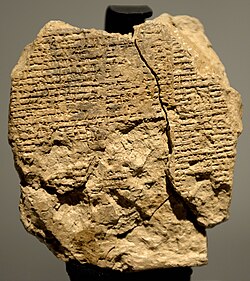 Reverse side of Tablet V of the Epic of Gilgamesh.


References
edit- ↑ "revolutionizing work for Kurdistan". Ideas Beyond Borders. 2 December 2022. Retrieved 11 September 2024.
- ↑ "Where Is Gilgamesh? Poster is Published". NRTTV. 22 August 2023. Retrieved 11 September 2024.
- ↑ "پۆستەری فیلمی کوردی". nrttv.com. Retrieved 2023-11-27.
- ↑ "Where Is Gilgamesh? Is Releases". Channel 8. 23 January 2024. Retrieved 1 December 2024.
- ↑ "The Epic of Gilgamesh Comes to the Silver Screen". Kurdistan Chronicle. Retrieved 2025-04-22.
- ↑ Casagrande, Orsola (2023). Kurdistan +100: Stories from a Future State. Comma Press. ISBN 9781912697366.
- ↑ Coleman, David (2014). The Bipolar Express: Manic Depression and the Movies. Rowman & Littlefield. ISBN 9780810891944.
- ↑ Holliday, Shabnam J. (2016). Political Identities and Popular Uprisings in the Middle East. Rowman & Littlefield International. ISBN 9781783484508.
- 1 2 "کارزان کاردۆزی". www.kurdcinama.com. Retrieved 2023-11-27.
- ↑ "Karzan Kardozi". Comma Press. Retrieved 2023-11-27.
- ↑ Seyder, Ferhad Ibrahim, ed. (2019). The Kurds before a regional transformation: rollback of independence efforts. Konfrontation und Kooperation im Vorderen Orient. Zürich: Lit Verlag. p. 107. ISBN 978-3-643-91037-0.
- ↑ Haylock, Bridget; Barrette, Catherine (2020). Traumatic Imprints: Performance, Art, Literature and Theoretical Practice. Brill. ISBN 9781848880856.
- ↑ "I Want to Live". MUBI.
- ↑ "Karzan Kardozi". IMDB. Retrieved 2024-03-02.
- ↑ "کارزان کاردۆزی دوو بەرگی دیکەی (سەد ساڵ سینەما، سەد دەرهێنەر) بڵاو دەکاتەوە". Politic Press. 2021-02-13. Retrieved 2024-03-02.
- ↑ Broomfield, M. (28 November 2023), "First Kurdish Sci-Fi Collection is Rooted in the Past", The Markaz Report, retrieved 2023-05-01
- ↑ ""Kurdistan + 100", edited by Orsola Casagrande and Mustafa Gündoğdu", Asian Review of Books, 2023, retrieved 2023-05-01
External links
edit | This article related to Iraqi film is a stub. You can help Wikipedia by adding missing information. |