
Vavilov is a prominent impact crater that is located to the west of the walled plain Hertzsprung. It is located on the far side of the Moon and cannot be viewed directly from the Earth. About a crater diameter to the northwest is the smaller Chaucer, and farther to the southwest is Sechenov.
 LRO WAC image | |
| Coordinates | 0°48′S 137°54′W / 0.8°S 137.9°W |
|---|---|
| Diameter | 98.22[1] km |
| Depth | Unknown |
| Colongitude | 139° at sunrise |
| Formation | Copernican[2] |
| Eponym | Nikolai I. Vavilov Sergei I. Vavilov |

The crater is named after Nikolai and Sergei Vavilov, brothers and prominent Soviet scientists. This designation was officially adopted by the International Astronomical Union in 1970.[1][3]
Description
editThis formation is dated to the Copernican period of the lunar geologic timescale.[2] It is a relatively young impact that still retains the faint remnants of a ray system. Just outside the rim is a shadowed area, with the rays beginning about one-third of a crater diameter distant. The faint rays extend for several crater diameters in all directions.[4]: 88
Vavilov is a well-defined feature that has undergone a minimum of erosion due to subsequent impacts. The outer rim is roughly circular, with a pair of slight outward bulges to the southeast. The inner walls of the rim display several terraces, particularly to the southeast.
The interior floor is roughly level, with a central ridge offset to the west of the midpoint, and some low hills in the southeast. Anorthosite with a very low mafic abundance[5] and the infrared spectrum of pure crystalline plagioclase have been identified on the central peak. The crystal plagioclase is also found on the northeast floor and north wall.[6] The region to the west on the outer rim are some of the highest areas near the equator on the Moon.
Satellite craters
editBy convention these features are identified on lunar maps by placing the letter on the side of the crater midpoint that is closest to Vavilov.
| Feature[4]: 314 | Latitude | Longitude | Diameter | Ref |
|---|---|---|---|---|
| Vavilov D | 0.1° S | 137.1° W | 96.2 km | WGPSN |
| Vavilov K | 5.2° S | 135.5° W | 25.59 km | WGPSN |
| Vavilov P | 3.4° S | 139.6° W | 22.71 km | WGPSN |
Gallery
edit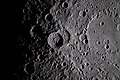 Artemis 2 image of Vavilov Crater.
.jpg)
See also
edit- 2862 Vavilov, asteroid
References
edit- 1 2 "Vavilov". Gazetteer of Planetary Nomenclature. USGS Astrogeology Research Program.
- 1 2 Kirchoff, Michelle R.; et al. (July 2013). "Ages of large lunar impact craters and implications for bombardment during the Moon's middle age". Icarus. 225 (1): 325–341. Bibcode:2013Icar..225..325K. doi:10.1016/j.icarus.2013.03.018. USGS epoch.
- ↑ "Moon Crater Named for Once-Disgraced Soviet Geneticist and Brother". The New York Times. December 3, 1968. p. 36. Retrieved 2026-05-05.
- 1 2 Bussey, B.; Spudis, P. (2004). The Clementine Atlas of the Moon. New York: Cambridge University Press. ISBN 978-0-521-81528-4.
- ↑ Lemelin, Myriam; et al. (May 2015). "Lunar central peak mineralogy and iron content using the Kaguya Multiband Imager: Reassessment of the compositional structure of the lunar crust". JRG Planets. 120 (5): 869–887. doi:10.1002/2014JE004778.
- ↑ Donaldson Hanna, K. L.; et al. (July 2014). "Global assessment of pure crystalline plagioclase across the Moon and implications for the evolution of the primary crust". Journal of Geophysical Research: Planets. 119 (7): 1516–1545. Bibcode:2014JGRE..119.1516D. doi:10.1002/2013JE004476.
Sources
edit- Andersson, L. E.; Whitaker, E. A. (1982). NASA Catalogue of Lunar Nomenclature. NASA RP-1097.
- Cocks, Elijah E.; Cocks, Josiah C. (1995). Who's Who on the Moon: A Biographical Dictionary of Lunar Nomenclature. Tudor Publishers. ISBN 978-0-936389-27-1.
- McDowell, Jonathan (July 15, 2007). "Lunar Nomenclature". Jonathan's Space Report. Archived from the original on 2012-02-08. Retrieved 2007-10-24.
- Menzel, D. H.; Minnaert, M.; Levin, B.; Dollfus, A.; Bell, B. (1971). "Report on Lunar Nomenclature by the Working Group of Commission 17 of the IAU". Space Science Reviews. 12 (2): 136–186. Bibcode:1971SSRv...12..136M. doi:10.1007/BF00171763. S2CID 122125855.
- Moore, Patrick (2001). On the Moon. Sterling Publishing Co. ISBN 978-0-304-35469-6.
- Price, Fred W. (1988). The Moon Observer's Handbook. Cambridge University Press. ISBN 978-0-521-33500-3.
- Rükl, Antonín (1990). Atlas of the Moon. Kalmbach Books. ISBN 978-0-913135-17-4.
- Webb, Rev. T. W. (1962). Celestial Objects for Common Telescopes (6th revised ed.). Dover. Reprint: ISBN 978-0-486-20917-3
- Whitaker, Ewen A. (1999). Mapping and Naming the Moon. Cambridge University Press. ISBN 978-0-521-62248-6.
- Wlasuk, Peter T. (2000). Observing the Moon. Springer. ISBN 978-1-85233-193-1.