
This article relies largely or entirely on a single source. (June 2019) |
Vasily Ivanovich Demut-Malinovsky (Russian: Василий Иванович Демут-Малиновский); 2 (13) March 1779 – 16 (28) July 1846 was a Russian sculptor whose works represent the quintessence of the Empire style.
Vasily Demut-Malinovsky | |
|---|---|
| Василий Иванович Демут-Малиновский | |
 Portrait by Gury Krylov, 1839 | |
| Born | March 2, 1779 |
| Died | July 16, 1846 (aged 67) Saint Petersburg, Russian Empire |
| Education | Member Academy of Arts (1807)[1] |
| Alma mater | Imperial Academy of Arts (1800)[1] |
| Known for | Sculpture |
| Awards |  [1] [1] [1] [1] |
Biography
editHe entered the Imperial Academy of Arts at the age of six and studied under Mikhail Kozlovsky for fifteen years. Upon the death of his teacher, he won a competition to design his tomb and departed for Rome to study with Canova. Success came to him with two colossal statues for the Kazan Cathedral in St Petersburg.[1]
In the aftermath of the Russian victory over Napoleon, Demut-Malinovsky executed a number of patriotic pieces, including a tomb and a large statue of Barclay de Tolly in Estonia. Later Alexander I assigned to him the task of preparing bas-reliefs symbolizing the Neva and the Volga for the Alexander Column on Palace Square.
Demut-Malinovsky also designed statuary and decorations for other St Petersburg churches, palaces, and public monuments, especially those designed by Carlo Rossi: the General Staff Building, the Bourse, the Admiralty, the Mining Institute, the Egyptian Gate, the Narva Gate, and the Mikhailovsky Palace.
Works
edit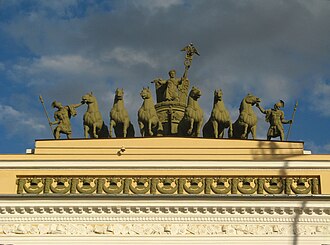 Sculptural composition on the arch of the General Staff Building
 Abduction of Proserpine
 Russian Scaevola
 Monument to Barclay de Tolly (Tartu)
 Bust of Mikhail Muravyov
 Bust of Alexander Suvorov


_01_by_shakko.jpg)

_by_shakko_01.jpg)
_by_shakko_01.jpg)
References
editBibliography
edit- С. Н. Кондаков (1915). Юбилейный справочник Императорской Академии художеств. 1764-1914 (in Russian). Vol. 2. p. 251.
External links
edit Media related to Vasily Demut-Malinovsky at Wikimedia Commons
 | This article about a Russian sculptor is a stub. You can help Wikipedia by adding missing information. |