
The Tokaido Shinkansen (Japanese: 東海道新幹線; lit. 'Eastern Sea Route new trunk line') is a Japanese high-speed rail line between Tokyo and Shin-Osaka. It is part of the nationwide Shinkansen network and, with the San'yō Shinkansen, forms a continuous high-speed corridor through the Taiheiyō Belt. The line is owned and operated by the Central Japan Railway Company (JR Central).
| Tokaido Shinkansen | |||||||||||||||||||||||||||||||||||||||||||||||||||||||||||||||||||||||||||||||||||||||||||||||||||||||||||||||||||||||||||||||||||||||||||||||||||||||||||||||||||||||||||||||||||||||||||||||||||||||||||
|---|---|---|---|---|---|---|---|---|---|---|---|---|---|---|---|---|---|---|---|---|---|---|---|---|---|---|---|---|---|---|---|---|---|---|---|---|---|---|---|---|---|---|---|---|---|---|---|---|---|---|---|---|---|---|---|---|---|---|---|---|---|---|---|---|---|---|---|---|---|---|---|---|---|---|---|---|---|---|---|---|---|---|---|---|---|---|---|---|---|---|---|---|---|---|---|---|---|---|---|---|---|---|---|---|---|---|---|---|---|---|---|---|---|---|---|---|---|---|---|---|---|---|---|---|---|---|---|---|---|---|---|---|---|---|---|---|---|---|---|---|---|---|---|---|---|---|---|---|---|---|---|---|---|---|---|---|---|---|---|---|---|---|---|---|---|---|---|---|---|---|---|---|---|---|---|---|---|---|---|---|---|---|---|---|---|---|---|---|---|---|---|---|---|---|---|---|---|---|---|---|---|---|---|
 | |||||||||||||||||||||||||||||||||||||||||||||||||||||||||||||||||||||||||||||||||||||||||||||||||||||||||||||||||||||||||||||||||||||||||||||||||||||||||||||||||||||||||||||||||||||||||||||||||||||||||||
 An N700S series train on the Tokaido Shinkansen | |||||||||||||||||||||||||||||||||||||||||||||||||||||||||||||||||||||||||||||||||||||||||||||||||||||||||||||||||||||||||||||||||||||||||||||||||||||||||||||||||||||||||||||||||||||||||||||||||||||||||||
| Overview | |||||||||||||||||||||||||||||||||||||||||||||||||||||||||||||||||||||||||||||||||||||||||||||||||||||||||||||||||||||||||||||||||||||||||||||||||||||||||||||||||||||||||||||||||||||||||||||||||||||||||||
| Native name | 東海道新幹線 | ||||||||||||||||||||||||||||||||||||||||||||||||||||||||||||||||||||||||||||||||||||||||||||||||||||||||||||||||||||||||||||||||||||||||||||||||||||||||||||||||||||||||||||||||||||||||||||||||||||||||||
| Status | Operational | ||||||||||||||||||||||||||||||||||||||||||||||||||||||||||||||||||||||||||||||||||||||||||||||||||||||||||||||||||||||||||||||||||||||||||||||||||||||||||||||||||||||||||||||||||||||||||||||||||||||||||
| Owner |  JR Central JR Central | ||||||||||||||||||||||||||||||||||||||||||||||||||||||||||||||||||||||||||||||||||||||||||||||||||||||||||||||||||||||||||||||||||||||||||||||||||||||||||||||||||||||||||||||||||||||||||||||||||||||||||
| Locale | Tokyo and the prefectures of Kanagawa, Shizuoka, Aichi, Gifu, Shiga, Kyoto, and Osaka | ||||||||||||||||||||||||||||||||||||||||||||||||||||||||||||||||||||||||||||||||||||||||||||||||||||||||||||||||||||||||||||||||||||||||||||||||||||||||||||||||||||||||||||||||||||||||||||||||||||||||||
| Termini | |||||||||||||||||||||||||||||||||||||||||||||||||||||||||||||||||||||||||||||||||||||||||||||||||||||||||||||||||||||||||||||||||||||||||||||||||||||||||||||||||||||||||||||||||||||||||||||||||||||||||||
| Stations | 17 | ||||||||||||||||||||||||||||||||||||||||||||||||||||||||||||||||||||||||||||||||||||||||||||||||||||||||||||||||||||||||||||||||||||||||||||||||||||||||||||||||||||||||||||||||||||||||||||||||||||||||||
| Color on map | Blue | ||||||||||||||||||||||||||||||||||||||||||||||||||||||||||||||||||||||||||||||||||||||||||||||||||||||||||||||||||||||||||||||||||||||||||||||||||||||||||||||||||||||||||||||||||||||||||||||||||||||||||
| Service | |||||||||||||||||||||||||||||||||||||||||||||||||||||||||||||||||||||||||||||||||||||||||||||||||||||||||||||||||||||||||||||||||||||||||||||||||||||||||||||||||||||||||||||||||||||||||||||||||||||||||||
| Type | High-speed rail | ||||||||||||||||||||||||||||||||||||||||||||||||||||||||||||||||||||||||||||||||||||||||||||||||||||||||||||||||||||||||||||||||||||||||||||||||||||||||||||||||||||||||||||||||||||||||||||||||||||||||||
| System | Shinkansen | ||||||||||||||||||||||||||||||||||||||||||||||||||||||||||||||||||||||||||||||||||||||||||||||||||||||||||||||||||||||||||||||||||||||||||||||||||||||||||||||||||||||||||||||||||||||||||||||||||||||||||
| Services | |||||||||||||||||||||||||||||||||||||||||||||||||||||||||||||||||||||||||||||||||||||||||||||||||||||||||||||||||||||||||||||||||||||||||||||||||||||||||||||||||||||||||||||||||||||||||||||||||||||||||||
| Operator | JR Central | ||||||||||||||||||||||||||||||||||||||||||||||||||||||||||||||||||||||||||||||||||||||||||||||||||||||||||||||||||||||||||||||||||||||||||||||||||||||||||||||||||||||||||||||||||||||||||||||||||||||||||
| Depots |
| ||||||||||||||||||||||||||||||||||||||||||||||||||||||||||||||||||||||||||||||||||||||||||||||||||||||||||||||||||||||||||||||||||||||||||||||||||||||||||||||||||||||||||||||||||||||||||||||||||||||||||
| Rolling stock | |||||||||||||||||||||||||||||||||||||||||||||||||||||||||||||||||||||||||||||||||||||||||||||||||||||||||||||||||||||||||||||||||||||||||||||||||||||||||||||||||||||||||||||||||||||||||||||||||||||||||||
| Daily ridership | 460,000 (FY2024)[1] | ||||||||||||||||||||||||||||||||||||||||||||||||||||||||||||||||||||||||||||||||||||||||||||||||||||||||||||||||||||||||||||||||||||||||||||||||||||||||||||||||||||||||||||||||||||||||||||||||||||||||||
| History | |||||||||||||||||||||||||||||||||||||||||||||||||||||||||||||||||||||||||||||||||||||||||||||||||||||||||||||||||||||||||||||||||||||||||||||||||||||||||||||||||||||||||||||||||||||||||||||||||||||||||||
| Opened | October 1, 1964 | ||||||||||||||||||||||||||||||||||||||||||||||||||||||||||||||||||||||||||||||||||||||||||||||||||||||||||||||||||||||||||||||||||||||||||||||||||||||||||||||||||||||||||||||||||||||||||||||||||||||||||
| Technical | |||||||||||||||||||||||||||||||||||||||||||||||||||||||||||||||||||||||||||||||||||||||||||||||||||||||||||||||||||||||||||||||||||||||||||||||||||||||||||||||||||||||||||||||||||||||||||||||||||||||||||
| Line length | 515.4 km (320.3 mi) | ||||||||||||||||||||||||||||||||||||||||||||||||||||||||||||||||||||||||||||||||||||||||||||||||||||||||||||||||||||||||||||||||||||||||||||||||||||||||||||||||||||||||||||||||||||||||||||||||||||||||||
| Number of tracks | 2 | ||||||||||||||||||||||||||||||||||||||||||||||||||||||||||||||||||||||||||||||||||||||||||||||||||||||||||||||||||||||||||||||||||||||||||||||||||||||||||||||||||||||||||||||||||||||||||||||||||||||||||
| Track gauge | 1,435 mm (4 ft 8+1⁄2 in) standard gauge | ||||||||||||||||||||||||||||||||||||||||||||||||||||||||||||||||||||||||||||||||||||||||||||||||||||||||||||||||||||||||||||||||||||||||||||||||||||||||||||||||||||||||||||||||||||||||||||||||||||||||||
| Electrification | Overhead line, 25 kV 60 Hz AC | ||||||||||||||||||||||||||||||||||||||||||||||||||||||||||||||||||||||||||||||||||||||||||||||||||||||||||||||||||||||||||||||||||||||||||||||||||||||||||||||||||||||||||||||||||||||||||||||||||||||||||
| Operating speed | 285 km/h (177 mph) | ||||||||||||||||||||||||||||||||||||||||||||||||||||||||||||||||||||||||||||||||||||||||||||||||||||||||||||||||||||||||||||||||||||||||||||||||||||||||||||||||||||||||||||||||||||||||||||||||||||||||||
| Signalling | Cab signalling | ||||||||||||||||||||||||||||||||||||||||||||||||||||||||||||||||||||||||||||||||||||||||||||||||||||||||||||||||||||||||||||||||||||||||||||||||||||||||||||||||||||||||||||||||||||||||||||||||||||||||||
| Train protection system | ATC-NS | ||||||||||||||||||||||||||||||||||||||||||||||||||||||||||||||||||||||||||||||||||||||||||||||||||||||||||||||||||||||||||||||||||||||||||||||||||||||||||||||||||||||||||||||||||||||||||||||||||||||||||
| Maximum incline | 2% | ||||||||||||||||||||||||||||||||||||||||||||||||||||||||||||||||||||||||||||||||||||||||||||||||||||||||||||||||||||||||||||||||||||||||||||||||||||||||||||||||||||||||||||||||||||||||||||||||||||||||||
| |||||||||||||||||||||||||||||||||||||||||||||||||||||||||||||||||||||||||||||||||||||||||||||||||||||||||||||||||||||||||||||||||||||||||||||||||||||||||||||||||||||||||||||||||||||||||||||||||||||||||||


Opened on October 1, 1964, shortly before the 1964 Summer Olympics in Tokyo, it was the first railway in the world built for regular operation at speeds above 200 km/h (120 mph) and became the model for later high-speed rail systems.[2][3] Operation passed from Japanese National Railways (JNR) to JR Central when JNR was privatized in 1987.
Three service types operate: the fastest Nozomi, the limited-stop Hikari, and the all-stations Kodama. Many Nozomi and Hikari trains continue west over the San'yō Shinkansen, some as far as Hakata. All passenger trains are 16-car electric multiple units, and the maximum operating speed is 285 km/h (177 mph). The fastest Tokyo–Shin-Osaka journey takes 2 hours 21 minutes.[1]
The Tokaido Shinkansen is one of the world's most intensively used high-speed lines. In fiscal 2024 it carried 168 million passengers, an average of 460,000 per day, over an average of 383 train services per day, including additional trains.[1] The March 2026 timetable permits up to 13 Nozomi trains per hour in the busiest periods; JR Central states that the line can handle as many as 18 trains per hour in total.[4][5][6]
In 2000, the line was designated a joint Historic Mechanical Engineering Landmark and IEEE Milestone by the American Society of Mechanical Engineers and the Institute of Electrical and Electronics Engineers.[2][7]
History
edit
Earlier proposals and planning
editThe line broadly follows the transport corridor of the conventional Tōkaidō Main Line, itself named after the historic Tōkaidō highway between the Kantō and Kansai regions. By the late 1930s, the Japanese government had proposed a standard-gauge dangan ressha (bullet train) railway from Tokyo to Shimonoseki. Construction was halted during World War II, although work on several tunnels was later incorporated into the Shinkansen route.[8]
After the war, rapid economic growth pushed the Tōkaidō Main Line to its capacity despite completion of electrification between Tokyo and Osaka in 1956. JNR established a feasibility committee in May 1956, and a Railway Technical Research Institute lecture the following year publicized the possibility of a three-hour Tokyo–Osaka railway journey.[9][3] JNR president Shinji Sogō and chief engineer Hideo Shima backed a separate, electrified 1,435 mm (4 ft 8+1⁄2 in) standard gauge double-track railway rather than adding another pair of 1,067 mm (3 ft 6 in) tracks to the existing line. The Cabinet approved the project in December 1958, and the Ministry of Transport authorized construction in April 1959.[9]
Construction and opening
editConstruction began at the east portal of the New Tanna Tunnel on April 20, 1959. The project used continuous welded rail, prestressed-concrete sleepers, grade separation throughout, cab signaling, and automatic train control. A test route near Kamonomiya opened in 1962, and full-line test operation began in July 1964.[9][10]
The initial cost estimate proved too low, and Sogō and Shima resigned before the project was completed. In May 1961 the World Bank lent JNR US$80 million, about 15 percent of the eventual project cost. The loan also served as external endorsement that the railway was a practical transport investment rather than an experimental project.[11][8] It was fully repaid in 1981.
The Tokaido Shinkansen opened on October 1, 1964. Hikari trains initially covered Tokyo–Shin-Osaka in four hours, while Kodama trains took five. Although the infrastructure and 0 series trains were designed for 210 km/h (130 mph), regular schedules were initially conservative while newly built embankments settled. On November 1, 1965, the planned 210 km/h schedules began, cutting the Hikari journey to 3 hours 10 minutes and the Kodama journey to four hours.[12]
Expansion in the JNR era
editPassenger demand increased quickly. Hikari trains were lengthened to 16 cars in 1969, and Kodama trains followed in 1972. The opening of the San'yō Shinkansen to Okayama in March 1972 and Hakata in March 1975 created through high-speed services across western Honshū. The original Tokaido service pattern of one Hikari and one Kodama per hour had grown to five of each per hour by 1975.
New stations opened at Mishima in 1969 and, after privatization, at Shin-Fuji, Kakegawa, and Mikawa-Anjo in 1988. Infrastructure also expanded: the Oi depot connection opened in 1973, a second Shinkansen control center was completed in 1999 as a contingency facility, and repeated renewal closures in the 1970s and early 1980s addressed deterioration from unexpectedly heavy use.
The 100 series entered service in 1985, introducing double-deck Green and dining cars. In November 1986 the maximum operating speed rose from 210 to 220 km/h (140 mph), reducing the fastest journey to 2 hours 56 minutes. JNR was divided and privatized on April 1, 1987; JR Central assumed responsibility for the whole Tokaido Shinkansen, while JR West took over the San'yō Shinkansen.
JR Central era
editJR Central made higher speed and greater service frequency central to its early investment program. The lightweight 300 series and the new Nozomi service began on March 14, 1992. The maximum speed rose to 270 km/h (170 mph), and Tokyo–Shin-Osaka fell to 2 hours 30 minutes.[13] Hourly through Nozomi service to Hakata followed in 1993. JR West's 500 series entered through service in 1997, the 700 series in 1999, and the N700 series in 2007.
Shinkansen platforms at Shinagawa Station opened on October 1, 2003. The additional Tokyo-area stop relieved terminal pressure and accompanied a major timetable restructuring in which Nozomi replaced Hikari as the principal service. All trains could then operate at 270 km/h. The N700 series added body tilting and faster acceleration, reducing the fastest journey to 2 hours 25 minutes in 2007.[14]
On March 14, 2015, the maximum line speed increased to 285 km/h (177 mph) for N700A-type trains, the first increase in 23 years.[15] The 700 series left Tokaido service in March 2020, after which all scheduled trains could operate at 285 km/h. A revised timetable introduced that month cut the fastest journey to 2 hours 21 minutes and provided paths for up to 12 Nozomi trains per hour. The N700S entered service on July 1, 2020.[16]
The March 2026 timetable added a thirteenth hourly Nozomi path in selected high-demand periods, as well as additional early- and late-day services.[5] JR Central plans to introduce Grade of Automation 2 operation, in which the driver remains in the cab while acceleration and braking are automated, on some N700S services around 2028.[17]
Selected chronology
edit| Date | Development |
|---|---|
| December 19, 1958 | The Cabinet approves construction of the new Tokaido railway. |
| April 20, 1959 | Construction begins at the New Tanna Tunnel. |
| May 2, 1961 | The World Bank signs an US$80 million loan to JNR. |
| June 1962 | Test running begins on the Kamonomiya model line. |
| October 1, 1964 | Tokyo–Shin-Osaka opens with 0 series Hikari and Kodama trains. |
| November 1, 1965 | Full-speed schedules begin; fastest journey becomes 3 hours 10 minutes. |
| April 25, 1969 | Mishima Station opens. |
| March 15, 1972 | San'yō Shinkansen opens to Okayama; through service begins. |
| March 10, 1975 | San'yō Shinkansen reaches Hakata. |
| October 1, 1985 | 100 series enters service. |
| November 1, 1986 | Maximum speed rises to 220 km/h. |
| April 1, 1987 | JR Central assumes operation after JNR privatization. |
| March 13, 1988 | Shin-Fuji, Kakegawa, and Mikawa-Anjo stations open. |
| March 14, 1992 | 300 series Nozomi begins at 270 km/h. |
| November 29, 1997 | 500 series enters Tokaido through service; the early Nozomi that bypassed Nagoya and Kyoto is withdrawn. |
| March 13, 1999 | 700 series enters service. |
| October 1, 2003 | Shinagawa Station opens; all trains become capable of 270 km/h operation. |
| July 1, 2007 | N700 series enters service. |
| March 14, 2015 | Maximum speed rises to 285 km/h. |
| March 1, 2020 | 700 series completes Tokaido service. |
| July 1, 2020 | N700S begins commercial operation. |
| November 1, 2023 | Onboard trolley sales end; Green Car mobile ordering begins. |
| March 16, 2024 | All onboard smoking rooms close. |
| October 1, 2024 | The line marks its 60th anniversary. |
| March 14, 2026 | Timetable provides up to 13 Nozomi trains per hour in selected periods. |
Infrastructure
editRoute and track
editThe physical route length between Tokyo and Shin-Osaka is 515.4 km (320.3 mi), while the operating distance used for fares and railway accounting is 552.6 km (343.4 mi).[1][18] The difference results from the line's legal and fare-system origins as additional capacity for the Tōkaidō Main Line: fare distances generally follow the older railway even where the high-speed alignment is shorter.
The railway is double track, standard gauge, and fully grade-separated, with no level crossings or mixed operation with conventional trains. It is electrified throughout at 25 kV, 60 Hz AC by overhead catenary. Although the public power grid east of the Fuji River uses 50 Hz, frequency-converter substations allow the Shinkansen to use 60 Hz for its entire length. The main-line design used minimum curve radii of roughly 2,500 m (8,200 ft) and gradients of no more than 2 percent. These standards were much more generous than on the conventional railway but less favorable for very high speed than the 4,000 m (13,000 ft) or larger curves commonly adopted on later Shinkansen lines.
Unlike most later Shinkansen routes, the Tokaido line predominantly uses ballasted track. Its civil works comprise approximately 276.7 km (171.9 mi) of earthworks (54 percent), 170.1 km (105.7 mi) of steel and concrete bridges and viaducts (33 percent), and 68.6 km (42.6 mi) of tunnels (13 percent).[19] Continuous welded rail and concrete sleepers were used from the outset. Ballasted track was retained because it could be constructed quickly and adjusted as new embankments settled; slab track became the normal Shinkansen standard only with later routes.[10]
Signaling and traffic control
editThere are no lineside signals. Movement authority and permitted speed are displayed in the driving cab, and the automatic train control system applies the brakes if necessary. The original analog ATC-1 system was replaced by the digital ATC-NS system in March 2006. ATC-NS calculates a continuous braking profile rather than enforcing a succession of fixed speed steps, allowing trains to brake later and more smoothly while maintaining separation.[20]
The COMTRAC (Computer-Aided Traffic Control) system constructs and manages the working timetable, sets routes, tracks rolling-stock and crew assignments, and supports controllers during disruption. It entered service with the 1972 San'yō extension and has been replaced in successive generations.[21] Operations are directed from the Shinkansen General Control Center in Tokyo. A geographically separate second center can assume control if the principal center becomes unusable.[22]
Stations and platform arrangements
editThe line has 17 passenger stations and two signal facilities. At the six stations served by every train—Tokyo, Shinagawa, Shin-Yokohama, Nagoya, Kyoto, and Shin-Osaka—the normal arrangement provides two platform faces in each direction so that two trains can stand simultaneously and make same-direction connections. At most intermediate stations, platform loops lie outside a pair of platform-free through tracks, protecting waiting passengers from pressure waves produced by non-stop trains.
Local constraints created several exceptions. Mishima has one island platform between its two loops and the through tracks; Atami has side platforms directly on the main tracks because the railway is confined between steep terrain and the existing railway. Toyohashi and Maibara have an additional loop in one direction, while Gifu-Hashima has two loops in each direction. Platform barriers were first required where trains passed platform faces at speed. Their installation later expanded after rolling stock and door positions were standardized around 16-car formations. Shin-Osaka required wider-opening barriers because shorter San'yō Shinkansen trains also use the station.
| Layout | Stations |
|---|---|
| Two island platforms, four tracks | Shinagawa, Shin-Yokohama, Nagoya, Kyoto |
| Two side platforms and two platform-free through tracks | Odawara, Shin-Fuji, Shizuoka, Kakegawa, Hamamatsu, Mikawa-Anjo |
| Two side platforms, three loops, and two through tracks | Toyohashi, Maibara |
| Two side platforms, four loops, and two through tracks | Gifu-Hashima |
| Two side platforms on the main tracks | Atami |
| One island platform, two loops, and two through tracks | Mishima |
Depots and maintenance facilities
edit| Facility | Position | Function and connection |
|---|---|---|
| Ōi Depot | Between Tokyo and Shinagawa | Principal Tokyo terminal depot. Its branch joins the main line near Tamachi Station and faces Tokyo. |
| Mishima depot | Within Mishima Station | Stabling facility east of the station; access is from the Tokyo direction. |
| Hamamatsu Works | Between Hamamatsu and Toyohashi | Heavy-maintenance works reached by a branch about 3.5 km (2.2 mi) west of Hamamatsu. Movements can be made from either direction, although eastbound movements require reversal on the branch. |
| Nagoya depot | Between Nagoya and Gifu-Hashima | Stabling and servicing facility connected immediately west of Nagoya Station; access faces Tokyo. |
| Torikai Depot | Between Kyoto and Shin-Osaka | Large Osaka-area depot in Settsu, Osaka, connected about 7 km (4.3 mi) east of Shin-Osaka and facing that station. |
Inspection and maintenance work is concentrated during the nightly traffic closure. Historically, dedicated 922 and 923 series electric and track inspection trains, popularly called Doctor Yellow, measured track and overhead-line condition at line speed. JR Central's 923 series T4 set made its final inspection run on January 29, 2025; JR West's T5 set remains in use but is scheduled to retire in 2027. Its work is to be replaced by monitoring equipment fitted to commercial N700S sets.[23][24]
Natural-hazard resilience
edit
The line crosses several areas exposed to earthquakes, typhoons, intense rainfall, and winter snow. Earthquake detectors can cut traction power and command emergency braking. JR Central has strengthened viaduct columns, bridge piers, embankments, station canopies, and tunnel portals, and is installing derailment-prevention guards beside the rails. Approximately 887 km (551 mi) of guard installation had been completed by the end of fiscal 2024, with completion over the full route planned for fiscal 2028; lateral deviation stoppers are fitted to the rolling stock.[1]
Heavy snow around Sekigahara can accumulate beneath trains, freeze, and later detach as ice that scatters ballast. Because the original earthworks cannot safely accept large volumes of warm meltwater, trackside sprinklers use cold river water to keep snow wet and prevent it from being drawn into the underframe. The system began experimentally in 1967 and was subsequently extended through the snow-prone district.[25] Snowfall still requires temporary speed restrictions, and anti-scatter coverings are used over ballast well beyond the snow area because accumulated ice can fall from trains after they reach warmer districts.
Rainfall is a separate vulnerability because more than half the route is on earthworks. Rain gauges and measurements of soil moisture are used to impose speed restrictions or suspend service before embankments become unstable. After increasingly intense rainfall caused repeated disruption, JR Central changed its principal rainfall-control index in 2025 from 24-hour accumulated rain to an estimate of water held within the embankment, allowing restrictions to follow local ground conditions more closely.[26] JR Central uses planned suspensions when a typhoon or extreme rainfall is forecast, rather than continuing to dispatch trains into a disrupted section.
Operations
editTimetable and capacity
editExcept in the early morning and late evening, the railway uses a repeating hourly timetable. Scheduled and additional trains share the same pre-planned paths, allowing JR Central to vary the number of trains by date without rewriting the basic operating pattern. Following the March 2026 revision, selected peak hours can accommodate as many as 13 Nozomi services, in addition to Hikari and Kodama trains.[5] In fiscal 2024 the line averaged 383 trains per day including additional services; on the busiest travel dates the total is higher.[1]
Passenger service normally operates between 6:00 a.m. and midnight. The six-hour closure is used for inspection, ballast and rail work, overhead-line maintenance, and the movement of engineering equipment. When severe disruption extends passenger operation past midnight, trains may run more slowly to reduce nighttime noise and to protect shortened maintenance windows.
All trains are 16-car sets. This standardization, together with common performance and door locations, allows rolling stock to be exchanged between services at short notice and supports short headways. Through trains continue beyond Shin-Osaka under JR West operation, but a delayed train can be terminated or turned there to keep disruption from spreading between the Tokaido and San'yō lines.
Service types
editNozomi
editNozomi is the fastest and most frequent service. On the Tokaido line every Nozomi stops at Tokyo, Shinagawa, Shin-Yokohama, Nagoya, Kyoto, and Shin-Osaka, running non-stop for 316.5 km (196.7 mi) between Shin-Yokohama and Nagoya. The service began with two daily round trips in 1992, expanded to hourly San'yō through operation in 1993, and became the principal service in the 2003 timetable. Up to 13 Nozomi trains per hour can now operate during selected high-demand periods.[5] Some terminate at Nagoya or Shin-Osaka, while others continue to Okayama, Hiroshima, or Hakata.
During designated New Year, Golden Week, and Obon peaks, all Nozomi seats are sold as reserved seats. Holders of unreserved tickets may stand in ordinary-car aisles, subject to the operator's conditions, but no unreserved-seat cars are designated.[27]
Hikari
editHikari is the intermediate limited-stop service and has operated since the line opened. All Hikari trains call at the six Nozomi stations, then serve varying combinations of the other stations. The regular daytime pattern provides two trains per hour: one principally serving Odawara or Toyohashi and both Gifu-Hashima and Maibara, and another serving Shizuoka and Hamamatsu, with some also calling at Atami or Mishima. Shin-Fuji, Kakegawa, and Mikawa-Anjo are normally served only by Kodama.
Some Hikari trains terminate at Nagoya or Shin-Osaka. Others continue over the San'yō Shinkansen, generally making more stops west of Shin-Osaka than a Nozomi. This gives intermediate Tokaido stations a limited-stop link to Tokyo and provides connections at Maibara with trains toward the Hokuriku region.
Kodama
editKodama stops at all 17 stations. The normal daytime pattern has one Tokyo–Nagoya and one Tokyo–Shin-Osaka service per hour; together with stopping Hikari trains, this generally gives each intermediate station two trains per hour. Additional short workings operate in the early morning and evening for commuting, depot movements, and overnight stabling. Some weekday Kodama services have all ordinary-class cars unreserved.
Because faster trains overtake at intermediate stations, a complete Tokyo–Shin-Osaka Kodama journey takes about four hours despite the same 285 km/h rolling-stock capability. Onboard trolley sales on Kodama ended in 2012, earlier than on Nozomi and Hikari.
Travel times and speed
edit| Period | Time | Maximum speed | Service and principal rolling stock |
|---|---|---|---|
| October 1964–October 1965 | 4 hours | 210 km/h | Hikari, 0 series |
| November 1965–March 1985 | 3 hours 10 minutes | 210 km/h | Hikari, 0 series |
| March 1985–October 1986 | 3 hours 8 minutes | 210 km/h | Hikari, 0/100 series |
| November 1986–March 1988 | 2 hours 56 minutes | 220 km/h | Hikari, 0/100 series |
| March 1988–March 1992 | 2 hours 49 minutes | 220 km/h | Hikari, 100 series |
| March 1992–June 2007 | 2 hours 30 minutes | 270 km/h | Nozomi, 300/500/700 series |
| July 2007–March 2015 | 2 hours 25 minutes | 270 km/h | Nozomi, N700 series |
| March 2015–March 2020 | 2 hours 22 minutes | 285 km/h | Nozomi, N700A type |
| March 2020–present | 2 hours 21 minutes | 285 km/h | Nozomi, N700A/N700S |
The route's curves constrain the benefit of a higher absolute top speed. Body tilting on N700-family trains permits higher speed through 2,500 m (8,200 ft) curves, while high acceleration and the continuous braking profiles of ATC-NS reduce time lost between restrictions. The Tokyo–Shin-Yokohama section is particularly slow because it passes through dense urban development and includes a curve of about 500 m (1,600 ft) near Musashi-Kosugi Station. Conversely, the relatively straight Maibara–Kyoto section has been used for high-speed testing; the experimental 300X reached 443 km/h (275 mph) there in 1996.[10]
Punctuality and disruption management
editJR Central reported an average delay of 1.4 minutes per train in fiscal 2024, including disruption caused by natural hazards.[6] High uniformity of rolling stock, complete separation from slower trains and road traffic, and the absence of junctions on the route help sustain close headways. Controllers ordinarily avoid holding a Shinkansen for a late conventional-line connection beyond a limited period because one delayed departure can affect many following trains.
Weather remains the most frequent source of widespread delay. The largest delay recorded on the route followed the 2000 Tōkai floods, when trains were dispatched into worsening rainfall around Nagoya and became trapped at multiple points; one Tokyo-bound Nozomi arrived 22 hours 21 minutes late.[28] Subsequent disruption plans emphasize stopping dispatches before the affected section fills with trains and providing a controlled recovery timetable after inspection.
Stations and service patterns
editDistances in the table are measured from Tokyo. The operating distance is the distance used for fares; the actual distance follows the physical alignment. Service patterns are simplified because individual Hikari stopping patterns vary by train.[1][4]
Legend: ● all trains stop; ▲ some trains stop; | all trains pass

The six all-train stations are the two termini and the four principal metropolitan intermediate stations. Shin-Yokohama was initially a Kodama stop, and both Shin-Yokohama and Shinagawa had some passing trains until March 2008. A single early-morning Nozomi passed Nagoya and Kyoto from the service's introduction in 1992 until November 1997; the practice became known as the "Nagoya skip" (名古屋飛ばし, Nagoya tobashi). Mishima was added in 1969, and Shin-Fuji, Kakegawa, and Mikawa-Anjo in 1988. Shinagawa, opened in 2003, is the newest station.
JR Central reported the following average daily entries and exits for fiscal 2024: Tokyo 194,244; Shinagawa 75,403; Shin-Yokohama 71,690; Odawara 22,528; Atami 10,226; Mishima 28,877; Shin-Fuji 8,852; Shizuoka 40,326; Kakegawa 8,377; Hamamatsu 25,862; Toyohashi 14,944; Mikawa-Anjo 3,621; Nagoya 140,616; Gifu-Hashima 5,927; Maibara 10,805; Kyoto 83,475; and Shin-Osaka 169,417.[29]
Rolling stock
editCurrent fleet
editAll scheduled trains use 16-car electric multiple units owned by JR Central or JR West. The fleet is interchangeable among Nozomi, Hikari, and Kodama duties; the service name no longer implies a particular train type.
- N700A type: rebuilt original N700 series sets and purpose-built N700A sets. The N700 entered service on July 1, 2007, and the production N700A on February 8, 2013.
- N700S series: in service since July 1, 2020. Both JR Central and JR West operate the type on the Tokaido Shinkansen.
The N700 family combines a 285 km/h (177 mph) Tokaido maximum speed with body tilting, high acceleration, and regenerative braking. The N700S uses silicon-carbide power electronics and a lighter traction system. JR Central states that it uses about 7 percent less energy than the N700A and can stop about 5 percent sooner during an earthquake; a battery self-propulsion system allows a train to move at low speed if overhead power is lost.[16] Standard formations have three Green Cars and thirteen ordinary cars. Depending on internal layout and accessible-space provision, current trains seat 1,318 or 1,314 passengers.[1]
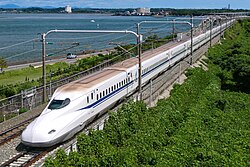 N700A series in September 2021
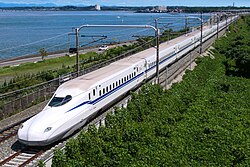 N700S series

Fleet evolution
edit| Type | Tokaido service | Formation | Tokaido maximum | Principal change |
|---|---|---|---|---|
| 0 series | 1964–1999 | 12, later 16 cars | 210 km/h, later 220 km/h | Original fleet; buffet and dining cars were used in successive formations |
| 100 series | 1985–2003 | 16 cars | 220 km/h | Introduced double-deck Green and dining cars |
| 300 series | 1992–2012 | 16 cars | 270 km/h | Lightweight AC-motor train developed for the original Nozomi |
| 500 series | 1997–2010 | 16 cars | 270 km/h on the Tokaido line | JR West through-service fleet; capable of 300 km/h on the San'yō line |
| 700 series | 1999–2020 | 16 cars | 270 km/h | Lower energy use and improved interior comfort; basis of the later N700 |
| N700/N700A | 2007–present | 16 cars | 285 km/h | Body tilting, higher acceleration, improved braking, and standard 2 hours 25 minutes Nozomi journey |
| N700S | 2020–present | 16 cars | 285 km/h | Modular traction equipment, battery-assisted emergency movement, and further energy reduction |
The 0 series had the longest Tokaido career, lasting 35 years. It established the basic 3.4 m-wide body, 2+3 ordinary seating, and high-capacity 16-car formation that shaped later rolling stock. The 100 series added more passenger accommodation but retained conventional traction motors. The 300 series eliminated double-deck cars and concentrated on low mass and speed, while the 500 series's narrow, rounded body was optimized for 300 km/h operation west of Shin-Osaka. The 700 series balanced aerodynamic performance with a wider interior and lower cost.
Introduction of the N700 allowed substantially faster curve negotiation without raising the line's overall speed limit. Existing N700 sets were later modified to most N700A braking and control standards and identified as the N700A type. Withdrawal of the 700 series in March 2020 left a fleet with uniform 285 km/h performance, enabling the higher-frequency timetable introduced that month.
Representative specifications illustrate the transition from heavy steel trains with direct-current traction motors to lightweight aluminum trains with three-phase alternating-current traction.[12][1] Values varied among subseries and formations.
| Type | 0 series | 100 series | 300 series | 500 series | 700 series | N700 family |
|---|---|---|---|---|---|---|
| First built | 1964 | 1985 | 1992 | 1997 | 1999 | 2007 |
| Typical 16-car mass | 967 t | 839–852 t | 711 t | 688 t | 708 t | about 713 t |
| Body | Steel | Aluminum alloy | ||||
| Formation output | 11.84 MW | 11.04 MW | 12.00 MW | 17.60 MW | 13.20 MW | 17.08 MW |
| Powered/trailer cars | 16M | 12M4T | 10M6T | 16M | 12M4T | 14M2T |
| Traction motors | Direct-current commutator | Three-phase induction | ||||
 0 series at Odawara in 1989
 100 series in 2003
 300 series in 2008
 500 series in 2008
 700 series in 2008


Non-revenue vehicles
editTrack and electrical inspection fleets have included the 922 series T1, T2, and T3 sets and the 923 series T4 and T5 sets. JR Central's T4 was withdrawn in January 2025; JR West's T5 is the last dedicated inspection train to use the route and is scheduled for withdrawal in 2027. Specialized rescue, rail-grinding, ballast-cleaning, and materials trains also operate during the overnight closure.
Retired In service
Passenger accommodation and onboard services
editClasses and seating
editOrdinary cars use 2+3 seating, while the three Green Cars use wider 2+2 seating and are entirely reserved. Ordinary accommodation is divided between reserved and unreserved cars, although the number of each varies by service and all Nozomi seats are reserved during designated peak periods. N700S trains provide a power outlet at every seat; on earlier N700A sets, outlets are principally at window seats and at the ends of the saloon. All trains have toilets in odd-numbered cars, and car 11 has multipurpose and wheelchair-accessible facilities.[30]
From October 1, 2026, selected N700S services are scheduled to offer Supreme Class, priced above Green Car accommodation. Two fully enclosed cabins are installed in each equipped set: a two-person cabin in car 7 and a one-person cabin in car 10. Each has individually adjustable lighting, climate, seat, and audio settings, dedicated Wi-Fi, and an onboard welcome service. JR Central also plans semi-private Supreme Class seating from fiscal 2027.[31] This is an announced service change and is not part of the accommodation available before October 2026.
Business and communications services
editCar 7 is designated the S Work Car on Nozomi, Hikari, and Kodama trains. It is intended for passengers working while traveling and permits activities such as online meetings that would be discouraged in ordinary quiet cars. Some three-seat rows have their middle seat blocked and fitted with partitions, creating pairs sold as S Work P Seats. N700S sets also contain paid business booths in the deck between cars 7 and 8; fitting of the existing N700S fleet was completed in fiscal 2024.[14]
Free Shinkansen Free Wi-Fi is provided in every train and at all 17 stations. The onboard connection uses public mobile networks and can therefore slow or disconnect in tunnels and heavily used areas.[32] The original paid onboard wireless-LAN service, introduced in 2009 over the train radio system, was superseded after free Wi-Fi was fitted throughout the fleet in 2020. JR Central and JR West trainsets use different arrival chimes: since July 21, 2023, JR Central sets have used an arrangement of Aini Ikō (会いにいこう; lit. 'Let's Go Meet'), while JR West sets retain Ii Hi Tabidachi Nishi e.[33]
Food, smoking, and baggage
editDining cars and buffets were once prominent features of the route. The 0 series carried buffet counters, and later 0 and 100 series formations included full dining cars; these disappeared as shorter journeys, more frequent service, and platform retail changed passenger demand. Trolley sales continued on Nozomi and Hikari until October 31, 2023. JR Central cited increased purchases before boarding, demand for quieter cars, and future labor shortages. Green Car passengers can instead order a limited range of products by scanning a seat-side code, while vending-machine provision at stations was expanded.[34]
Smoking was permitted throughout the original trains. Non-smoking cars were introduced in 1976 and expanded gradually. The N700 series, introduced in 2007, prohibited smoking at seats but provided enclosed smoking rooms; the departure of the 700 series in 2020 ended smoking at seats. All onboard smoking rooms closed on March 16, 2024, and their space is being used to carry emergency drinking water for prolonged stops away from stations.[35][36]
Since May 2020, a passenger carrying baggage whose three dimensions total more than 160 cm and no more than 250 cm must reserve a seat with an oversized-baggage area. The reservation has no surcharge, but a passenger who brings such baggage without one can be charged a handling fee and directed to another storage location. Strollers, sports equipment, and musical instruments are exempt from the size rule, although the reserved space itself still requires a reservation.[37]
Tickets and fares
editTravel normally requires both a basic-fare ticket and a Shinkansen limited-express ticket.[38] The basic fare is calculated using the 552.6 km (343.4 mi) operating distance, which follows the corresponding Tōkaidō Main Line fare distance rather than the 515.4 km (320.3 mi) physical route. Limited-express charges depend on the station pair, accommodation, reservation status, and travel date. Reserved seats have off-peak, regular, peak, and super-peak seasonal rates; a reserved Nozomi seat also carries a supplement over the corresponding Hikari or Kodama charge. Green Car and, from October 2026, Supreme Class accommodation require their respective class charges.
JR Central and JR West's reservation products include the Express Reservation membership service and the app-based SmartEX service. They allow online booking and changes and can associate a reservation with an accepted IC card for gate entry. Discounted products are subject to train, purchase-period, and change restrictions.[39] Commuter passes branded FREX and student FREX Pal are available for many journeys of up to roughly 200 operating kilometers, with longer exceptions from the Tokyo-area stations to Hamamatsu.
The Japan Rail Pass covers Hikari and Kodama services. A pass holder may use Nozomi only after buying a separate, journey-specific Nozomi Mizuho Ticket before boarding; the pass and supplement must be used together.[40]
Ridership and economic role
editThe line carried 168 million passengers in fiscal 2024, averaging 460,000 per day.[1] JR Central states that more than 7.2 billion journeys had been made since opening. Average daily train service grew from 60 trains at opening to 383, including additional trains, in fiscal 2024.[41] Demand fell sharply during the COVID-19 pandemic and subsequently recovered, although annual totals and the mixture of business and leisure travel changed.
The railway is the principal source of JR Central's transport income. In fiscal 2024, Tokaido Shinkansen revenue accounted for approximately 93 percent of the company's non-consolidated transport operating revenue.[1] This concentration makes renewal and disruption on the line material both to the operator and to intercity travel along the Tōkaidō corridor.
The Shinkansen competes principally with air travel between the Tokyo and Osaka regions and with airlines on longer through journeys to western Japan. JR West's published comparison put the rail-to-air share between Tokyo and Osaka prefectures at 77:23 in fiscal 2023, up from 65:35 in fiscal 2005.[42] The opening of the Shinkansen caused the former Tokyo–Nagoya air service to lose traffic and it was suspended in 1982. Between Nagoya and Osaka, Shinkansen services also compete with Kintetsu limited express trains, which are slower but serve central Osaka at Osaka-Namba Station.
Route geography
editFrom Tokyo the line runs south beside the conventional railway through Shinagawa, then turns southwest across the Tama River and the northern part of Yokohama. West of Shin-Yokohama it crosses the Sagami River and approaches the Hakone mountains via Odawara. The route passes through the New Tanna Tunnel to Atami and Mishima rather than following the coastal alignment of the conventional Tōkaidō Main Line.
The railway then skirts the southern foot of Mount Fuji, reaching Shin-Fuji before turning west across the densely settled Shizuoka plain. It follows the general Pacific corridor through Shizuoka, Kakegawa, Hamamatsu, and the north side of Lake Hamana, then crosses eastern Aichi Prefecture through Toyohashi and Mikawa-Anjo to Nagoya. Much of this middle section is on embankment, with frequent river bridges and views of tea fields and Mount Fuji in clear weather.
West of Nagoya, the line crosses the lowlands of the Kiso Three Rivers and turns northwest to Gifu-Hashima. It reaches the snow-prone pass at Sekigahara, descends to Maibara near Lake Biwa, and turns southwest through tunnels and cuttings toward Kyoto. The final section crosses the Katsura River and the northern Osaka urban area before terminating at Shin-Osaka. The route passes through Tokyo and seven prefectures: Kanagawa, Shizuoka, Aichi, Gifu, Shiga, Kyoto, and Osaka.[1]
Proposed and canceled stations
editKanagawa Prefecture and local municipalities continue to promote a station near the former Sagami Line Kurami station site in Samukawa, between Shin-Yokohama and Odawara. The prefectural proposal links construction to the release of Tokaido Shinkansen capacity after the Chūō Shinkansen opens; it is not an approved JR Central construction project.[43]
Shizuoka Prefecture has separately promoted a station serving Shizuoka Airport, beneath which the line passes between Shizuoka and Kakegawa. A 2016 prefectural statement said the government sought agreement with JR Central, while a May 2026 prefectural FAQ said the airport-station proposal was not a condition for allowing construction of the Chūō Shinkansen.[44][45]
The Minami-Biwako project at Rittō, between Maibara and Kyoto, advanced to preliminary construction before being canceled in 2007. A change in the Shiga governorship, local opposition to the cost, and a court decision invalidating Rittō's financing prevented completion.[46]
See also
edit- Chūō Shinkansen, a high-speed maglev route under construction between Tokyo and Nagoya
- History of rail transport in Japan
- High-speed rail in Japan
References
edit- 1 2 3 4 5 6 7 8 9 10 11 12 "Fact Sheets 2025" (PDF). Central Japan Railway Company. May 2025. pp. 6, 21. Retrieved July 14, 2026.
- 1 2 "#211 Tokaido Shinkansen". Landmarks. American Society of Mechanical Engineers. Retrieved July 14, 2026.
- 1 2 Shima, Hideo (October 1994). "Birth of The Shinkansen—A Memoir" (PDF). Japan Railway & Transport Review. Tokyo: East Japan Railway Culture Foundation. pp. 45–48. Retrieved July 14, 2026.
- 1 2 "Timetable". Central Japan Railway Company. Retrieved July 14, 2026.
- 1 2 3 4 2026年3月ダイヤ改正について [March 2026 timetable revision] (PDF) (Press release) (in Japanese). Central Japan Railway Company. December 12, 2025. Retrieved July 14, 2026.
- 1 2 "Tokaido Shinkansen—Don't Leave Japan Without It". Central Japan Railway Company. Retrieved July 14, 2026.
- ↑ "Milestones: Tokaido Shinkansen (Bullet Train), 1964". Engineering and Technology History Wiki. IEEE. Retrieved July 14, 2026.
- 1 2 Schreiber, Mark (September 27, 2014). "Shinkansen at 50: Fast Track to the Future". The Japan Times. Retrieved July 14, 2026.
- 1 2 3 "Japanese National Railways: Tokaido Shinkansen" (in Japanese). World Bank. Retrieved July 14, 2026.
- 1 2 3 Sato, Yoshihiko (March 1998). "The Mechanism of Railway Tracks". Japan Railway & Transport Review (15): 38–45. Retrieved July 14, 2026.
- ↑ "World Bank's Loans to Japan". World Bank. Retrieved July 14, 2026.
- 1 2 Son, Byung-Keun (March 2001). "Japan's Rail Technology Development from 1945 to the Future". Japan Railway & Transport Review (27): 4–13. Retrieved July 14, 2026.
- ↑ Morimura, Tsutomu; Seki, Masaaki (2005). "The Course of Achieving 270 km/h Operation for Tokaido Shinkansen—Part 1: Technology and Operations Overview". Proceedings of the Institution of Mechanical Engineers, Part F: Journal of Rail and Rapid Transit. 219 (1): 21–26. doi:10.1243/095440905X8781. S2CID 108811723.
- 1 2 "Tokaido Shinkansen: Constant Effort to Enhance Service" (in Japanese). Central Japan Railway Company. Retrieved July 14, 2026.
- ↑ "Top Speed of Nozomi Bullet Trains to Hit 285 kph". The Japan Times. December 20, 2014. Retrieved July 14, 2026.
- 1 2 "Integrated Report 2025" (PDF). Central Japan Railway Company. 2025. pp. 47–48. Retrieved July 14, 2026.
- ↑ "Integrated Report 2024" (PDF). Central Japan Railway Company. 2024. pp. 25–26. Retrieved July 14, 2026.
- ↑ "Operating Area". Central Japan Railway Company. Retrieved July 14, 2026.
- ↑ Miwa, Masahiko (October 2012). "Introduction of Overseas Technologies to JR East Track Maintenance". Japan Railway & Transport Review (62): 16–31. Retrieved July 14, 2026.
- ↑ Takami, Toshiaki; Nagasawa, Kazuhiro (2009). The New ATC System of the Tokaido Shinkansen. International Symposium on Speed-up, Safety and Service Technology for Railway and Maglev Systems. Japan Society of Mechanical Engineers. Retrieved July 14, 2026.
- ↑ Ashiya, Masanori (2021). "Railway Traffic Management Systems by Machine Learning: Recovery from Traffic Timetable Disruption by Hybrid AI". Hitachi Review. Hitachi. Retrieved July 14, 2026.
- ↑ "Corporate Governance". Central Japan Railway Company. Retrieved July 14, 2026.
- ↑ ドクターイエロー(T4編成)の引退について [Retirement of Doctor Yellow set T4] (PDF) (Press release) (in Japanese). Central Japan Railway Company. June 13, 2024. Retrieved July 14, 2026.
- ↑ 500系新幹線&「ドクターイエロー」T5編成の引退について [Retirement of the 500 series Shinkansen and Doctor Yellow set T5] (Press release) (in Japanese). West Japan Railway Company. June 22, 2026. Retrieved July 14, 2026.
- ↑ Saitō, Masao (1971). 東海道新幹線の雪氷害とその対策 [Snow and ice damage on the Tokaido Shinkansen and countermeasures]. Seppyo (in Japanese). 33 (3): 169–186. doi:10.5331/seppyo.33.169.
- ↑ 「雨に弱い」返上へ東海道新幹線の基準変更 [Tokaido Shinkansen changes standards to overcome vulnerability to rain]. The Asahi Shimbun (in Japanese). July 14, 2025. Retrieved July 14, 2026.
- ↑ "All Seats on Nozomi Trains Are Reserved During Major Peak Periods". Central Japan Railway Company. Retrieved July 14, 2026.
- ↑ [東海豪雨]残された課題・新たなる取り組み [Tokai floods: Remaining issues and new initiatives] (PDF) (Report) (in Japanese). Ministry of Land, Infrastructure, Transport and Tourism. 2001. p. 37. Retrieved July 14, 2026.
- ↑ 移動等円滑化取組報告書(鉄道駅)2024年度 [Accessibility initiatives report (railway stations), fiscal 2024] (PDF) (in Japanese). Central Japan Railway Company. 2025. Retrieved July 14, 2026.
- ↑ "Shinkansen Perfect Guide: Tickets and Tips". Central Japan Railway Company. Retrieved July 14, 2026.
- ↑ "Supreme Class". Central Japan Railway Company. Retrieved July 14, 2026.
- ↑ "JR-Central Free Wi-Fi Service". Central Japan Railway Company. Retrieved July 14, 2026.
- ↑ 「会いにいこう」キャンペーン夏の展開について [Summer development of the Aini Ikō campaign] (PDF) (Press release) (in Japanese). Central Japan Railway Company. June 29, 2023. Retrieved July 14, 2026.
- ↑ 東海道新幹線の新しい車内サービスの展開について [New onboard services on the Tokaido Shinkansen] (PDF) (Press release) (in Japanese). Central Japan Railway Company. August 8, 2023. Retrieved July 14, 2026.
- ↑ 東海道新幹線 車内喫煙ルームの廃止について [Closure of smoking rooms on the Tokaido Shinkansen] (PDF) (Press release) (in Japanese). Central Japan Railway Company. October 17, 2023. Retrieved July 14, 2026.
- ↑ 東海道新幹線 車内喫煙ルームの廃止日について [Date for closing smoking rooms on the Tokaido Shinkansen] (PDF) (Press release) (in Japanese). Central Japan Railway Company. January 26, 2024. Retrieved July 14, 2026.
- ↑ "Luggage Information". Central Japan Railway Company. Retrieved July 14, 2026.
- ↑ "Types of Tickets". Central Japan Railway Company. Retrieved July 14, 2026.
- ↑ "Tokaido Sanyo Kyushu Shinkansen Online Reservation Service". Central Japan Railway Company. Retrieved July 14, 2026.
- ↑ "Special Ticket for Nozomi with Japan Rail Pass". Central Japan Railway Company. Retrieved July 14, 2026.
- ↑ "Shinkansen Railway Operations" (in Japanese). Central Japan Railway Company. Retrieved July 14, 2026.
- ↑ データで見るJR西日本2025 [JR West in Data 2025] (PDF) (in Japanese). West Japan Railway Company. October 2025. pp. 47–48. Retrieved July 14, 2026.
- ↑ 東海道新幹線新駅の誘致 [Campaign for a new Tokaido Shinkansen station] (in Japanese). Kanagawa Prefectural Government. May 22, 2026. Retrieved July 14, 2026.
- ↑ 平成28年2月県議会定例会知事提案説明要旨4-2-4 [Governor's policy statement to the February 2016 regular prefectural assembly, section 4-2-4] (in Japanese). Shizuoka Prefectural Government. February 2016. Retrieved July 14, 2026.
- ↑ 新幹線空港新駅やリニアの駅ができないから工事の着手を認めていないのですか [Is work being withheld because no Shinkansen airport station or maglev station will be built?] (in Japanese). Shizuoka Prefectural Government. May 25, 2026. Retrieved July 14, 2026.
- ↑ "Shinkansen Station in Shiga Canceled". The Japan Times. October 29, 2007. Retrieved July 14, 2026.
Further reading
edit- Hood, Christopher P. (2006). Shinkansen: From Bullet Train to Symbol of Modern Japan. Routledge. ISBN 978-0-415-32052-8.
- Semmens, Peter (1997). High Speed in Japan: Shinkansen—the World's Busiest High-Speed Railway. Platform 5. ISBN 978-1-872524-88-7.
- Shima, Hideo (October 1994). "Birth of the Shinkansen—A Memoir" (PDF). Japan Railway & Transport Review. No. 3. East Japan Railway Culture Foundation. pp. 45–48.
