
Casiopea (カシオペア, Kashiopea) is a Japanese jazz fusion band formed in 1976 by guitarist Issei Noro and bassist Tetsuo Sakurai. After lineup changes the following year that added keyboardist Minoru Mukaiya, Casiopea made their major‑label debut with their self‑titled album in 1979, and drummer Akira Jimbo joined in 1980.
Casiopea | |
|---|---|
.jpg) Casiopea (as Casiopea 3rd) performing at the 21st Economics Jazz in Indonesia, 2015 | |
| Background information | |
| Also known as | Casiopea 3rd (2012–2022) Casiopea-P4 (2022–2025) |
| Origin | Tokyo, Japan |
| Genres | |
| Years active |
|
| Labels |
|
| Members |
|
| Past members |
|
| Website | casiopea |
During this period, they released more than a dozen albums before Sakurai and Jimbo left the band amid disputes over concurrent band memberships. In 1990, bassist Yoshihro Naruse and drummer Masaaki Hiyama joined, resulting in a second era marked by multiple drummer changes, with Jimbo returning as a supporting member in 1997. Noro suspended all band activities in 2006, leading to a six-year hiatus.
In 2012, the band resumed activities without Mukaiya rejoining and Kiyomi Otaka replacing him on keyboards. Renamed Casiopea 3rd for its third period, the group recorded its first album in eight years. After Jimbo left again in 2022, he was replaced by drummer Yoshinori Imai and the band entered its fourth period as Casiopea‑P4. Otaka left in 2025 and was replaced by keyboardist Jun Abe, and the band reverted to its original name.
History
edit1976–1989: First period
edit1974–1976: Early activities
edit.jpg)
In 1974, guitarist Issei Noro, a third-year student at Tokyo Metropolitan Tamagawa High School, and bassist Tetsuo Sakurai, a second-year at Keio Shiki Senior High School, met through a mutual friend and quickly became friends. The three began rehearsing together at a studio in Tokyo, aiming to emulate Beck, Bogert & Appice with a hard rock and funk-based sound. Occasionally, they included a vocalist in their band, but the core members, Noro and Sakurai, were flexible in their musical approach, causing the band's direction to gradually shift towards instrumental music with jazz elements.[1]
1976–1980: Debut and first albums
editEven though the band had been formed, the only two consistent members were Noro and Sakurai, leading them to use different names for each live show they performed. However, during an interview with a magazine, they were informed that the interview could not be published unless they had an official band name. Upon returning home, Noro consulted his mother, who suggested they choose a constellation. After opening a book on constellations, he selected Cassiopeia. However, when the band decided to adopt the name, the English version differed from the formal romanization. After being renamed Casiopea, Noro and Sakurai were joined by keyboardist Hidehiko Koike and drummer Tohru "Rika" Suzuki.[1] In 1976, the band entered the amateur band contest EastWest, sponsored by the Yamaha Corporation. In that contest, Noro won the Best Guitarist award, and the band advanced to the finals. However, after their first contest, Koike and Suzuki left the band to pursue commitments with other bands.
To replace Koike, Noro recruited Minoru Mukaiya, who was studying at Nemun Music Academy (now Yamaha Conservatory of Music) who was connected through a mutual friend.[2][3] To fill the drummer position left by Suzuki, the band held auditions, resulting in the recruitment of Takashi Sasaki.[1] They entered EastWest the following year, where the band won the Best Group award and Noro again won Best Guitarist.[4] Yoshihiro Naruse, who would later join the band, was a judge during the contest and praised them, even asking for an encore despite it being a competition.[5] As a result of their popularity, their demo tape caught the attention of Alfa Records, leading to Casiopea's debut in 1979.[6]
Casiopea debuted with their self-titled album on May 25, 1979. Noro was able to participate in the recording and production, with American recording engineer Al Schmitt, who had just arrived in Japan, serving as the engineer. Composer Jun Fukamachi, who was with Alfa and working on the album, went to New York City for the recording of Jun Fukamachi & The New York All Stars Live. Through this connection, they were able to have the Brecker Brothers and David Sanborn contribute to the album.[1]

.jpg)

.png)
Later that same year, on 15 November 1979, they released their first single, "I Love New York," which was used by Japan Airlines for their New York campaign at the request of Alfa Records. They followed this with their second album, Super Flight, released on 25 November 1979, showcasing strong performances in both the single and the album. Their signature songs "Take Me" and "Asayake" were introduced for the first time in this album.[3] However, due to differences in musical direction, Takashi Sasaki decided to leave the band, although he stayed on during the ensuing tour as they met drummer Akira Jimbo, a university student at Keio University.[1]
1980–1989: Lineup changes and heyday
editAkira Jimbo met Tetsuo Sakurai when Sakurai stood in for Keio University's big band. Impressed by his talent, Sakurai recommended him as Casiopea's next drummer, with Jimbo's first recording with the group being the 1980 live album Thunder Live.[7] Over approximately a decade, the band were successful both domestically and internationally while maintaining a stable lineup. Overseas audiences noted the group's incorporation of Japanese‑style melodies, and although the band initially targeted the U.S. market, songs made in Japan proved to resonate more strongly with international listeners.[3]
In 1981, the band released Eyes of the Mind, produced by American drummer Harvey Mason, his first collaboration with the group, and it was their first album recorded in the United States.[8] On 21 May 1982, they released Mint Jams, a live album compiled from performances recorded at Central Hall in Tokyo in February of that year.[9] The album was selected as best album of 1982 by the Japanese jazz magazines Adlib and Jazzlife, with Tower Records Japan describing Mint Jams as a landmark in Japan's jazz‑fusion history and one of the band's career‑defining works.[10] The band's albums began to attract attention overseas, prompting tours in the United States and Europe; guitarist Issei Noro credited Mint Jams with making their European tour possible. The members toured internationally and returned to Japan later that year to record 4×4 with international musicians including Lee Ritenour, Don Grusin, Nathan East, and Harvey Mason.[11]
In 1989, Casiopea's contract with their record label ended and the band prepared to transfer to a new label, prompting a stop to band activities, including album production and national touring, as members pursued side projects. During the hiatus, Tetsuo Sakurai and Akira Jimbo formed Shambara, recording and touring with other musicians.[12] Issei Noro and Minoru Mukaiya objected to their simultaneous membership in Shambara and Casiopea, arguing it would hinder Casiopea's planned restart. Sakurai and Jimbo insisted they could balance both bands, but after the dispute remained unresolved they left Casiopea and formed the duo Jimsaku.[13]
1990–2006: Second period and hiatus
edit
With only Issei Noro and Minoru Mukaiya remaining from Casiopea's original lineup, bassist Yoshihiro Naruse and drummer Masaaki Hiyama joined the group, replacing Sakurai and Jimbo, respectively. The band's second period became more experimental as the band sought to avoid stagnation, with Noro crediting Naruse's arrival with transforming the sound of the rhythm section.[14] The band resumed live performances and touring in 1990, though Hiyama left two years later due to illness and was replaced by drummer Noriaki Kumagai.[15] The band continued with this lineup from 1992 until 1996, when Kumagai departed and the band became a trio.[16] Drummer Kozo Suganuma played with them for a time, but in 1997, Akira Jimbo returned as a supporting member, and by the following year, Jimbo had performed at all of their scheduled performances.[17]
By the late 1990s, the members had begun pursuing solo projects. Mukaitani began producing a railway simulator as part of his train hobbies, Naruso worked as a member of the band Beast Kingdom, and Noro recorded his first solo album. Noro and Naruso discussed taking a hiatus from the music college where they both taught, due to the overwhelming demands on their time.[15] In 2006, wanting to stop touring and play less with Casiopea, Noro decided to suspend all group activities, effectively putting the band on hiatus. He later commented that his activity in Casiopea had begun to take a toll on him because of the pressure to produce a large volume of songs in diverse styles. Although he considered disbanding the group, his management advised presenting the break as a hiatus in case of the band's resumption of activities.[14]
2012–2022: Return and third period (Casiopea 3rd)
edit
Although all the members were pursuing their own paths and Noro believed that the disbandment marked the end of Casiopea, the 2011 Tōhoku earthquake and tsunami inspired him to restart the band to uplift people's spirits through music in the wake of the disaster.[18] In April 2012, Noro announced that Casiopea would be active again, although Minoru Mukaiya had left the band and was replaced by keyboardist Kiyomi Otaka. Alongside Noro and Otaka, bassist Yoshihiro Naruse and drummer Akira Jimbo rejoined the band; Jimbo was credited as a supporting member but treated as a full member.[19] The band adopted the name Casiopea 3rd and also announced that they would perform for the first time since their hiatus at Tokyo Jazz 2012 and would be releasing their first best-of album.[20] On 9 October 2013, they were appointed by the Japan Audio Society as an Ototen ambassador, the association’s first time naming one in recognition of its long-running contribution to the audio industry.[21]
Throughout the 2010s, Casiopea 3rd resumed releasing albums, releasing Ta・Ma・Te・Box in 2013, their first in eight years, which reached number 18 on the Oricon Albums Chart and topped the jazz & classical chart.[22] They released their second album, A・So・Bo, two years later.[23] They would continue with I・Bu・Ki in 2016 and A・Ka・Ri in 2018.[19] On 15 April 2020, Casiopea released the Blu-ray/DVD Celebrate 40th for their 40th anniversary, later embarking on the Casiopea 3rd Heartful Tour in October while also broadcasting online.[24][25] In February 2022, Akira Jimbo announced that he would leave Casiopea 3rd; his final appearances were on the April and May 2022 Billboard Tour.[26]
2022–2025: Fourth period (Casiopea-P4)
editIn July 2022, Issei Noro announced that drummer Yoshinori Imai would replace Akira Jimbo and the band would be renamed from Casiopea 3rd to Casiopea-P4.[27] They released their 35th album, New Topics, soon after, with Imai's younger age motivating the band to record for the first time in three years.[28] They released their 36th album, Right Now, in 2024 to mark the band's 45th anniversary, with all members contributing compositions to the album, including an unreleased piece.[29][30] In December 2024, prior to performances in Osaka and Tokyo, the band announced that they would be holding their final concert with Kiyomi Otaka as their keyboardist, as she chose to leave the band.[31] A month prior to the final concert, the band had contacted pianist Jun Abe to see if he wanted to join as a replacement, which he accepted prior to the announcement.[32]
2025–present: Fifth period
editIn May 2025, Casiopea, now using their original first name, introduced Jun Abe as a member during a series of performances.[32][33] Noro said in an interview with Daily Sports that he reverted to his original name after Otaka's decision to leave and to refresh the band's image. They released their 37th album, True Blue, under their original name on 27 August 2025.[34]
Musical style and influence
editUpon the release of their self-titled album, the band was assigned the catchphrase "thrills, speed, super technique," which later became synonymous with their musicality and playing style. As the years progressed, Noro began incorporating more musicality into the band's pieces and reduced the emphasis on technique compared to their early years, largely due to the introduction of accurate music programs on computers.[7] The band does not record demos, as Noro writes the charts and the members rehearse for a few weeks before recording. Final ideas are developed on the day of recording, as Noro felt demos constrained the music and preferred ideas made during group performance.[35] According to The Nikkei, although many bands competed for attention during the fusion boom in Japan, Casiopea managed to secure lasting popularity through their technique and dynamic performances.[35]
In Indonesia, Casiopea’s influence helped spark a brief jazz fusion boom marked by the formation of several jazz-rock and fusion groups, including Krakatau, Karimata, and Emerald Band. The wave of fusion music played a key a role in shaping Indonesia’s burgeoning Pop Kreatif genre (referred to colloquially as Indonesian city pop) in the mid-1980s.[36] Krakatau and Casiopea once matched at the same stage at the 21st Economics Jazz at Gadjah Mada University.[37] Another example of Casiopea’s impact was the formation of the jazz-fusion ensemble Indonesia 6, which drew extensively from the band’s musical style.[38]
Band members
edit
Current members
Former members
|
Supporting members
|
Timeline
edit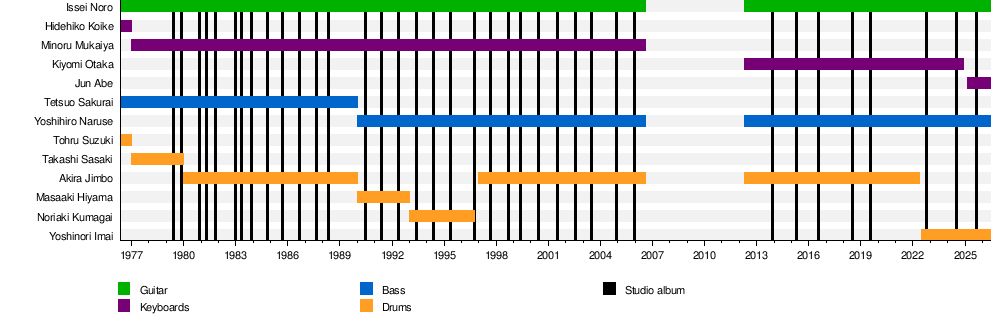
Discography
edit- Casiopea (1979)
- Super Flight (1979)
- Make Up City (1980)
- Eyes of the Mind (1981)
- Cross Point (1981)
- 4x4 (1982)
- Photographs (1983)
- Jive Jive (1983)
- Down Upbeat (1984)
- Halle (1985)
- Sun Sun (1986)
- Platinum (1987)
- Euphony (1988)
- The Party (1990)
- Full Colors (1991)
- Active (1992)
- Dramatic (1993)
- Answers (1994)
- Freshness (1995)
- Flowers (1996)
- Light and Shadows (1997)
- Be (1998)
- Material (1999)
- Bitter Sweet (2000)
- Main Gate (2001)
- Inspire (2002)
- Places (2003)
- Marble (2004)
- Signal (2005)
- Ta・Ma・Te・Box (2013)
- A・So・Bo (2015)
- I・Bu・Ki (2016)
- A・ka・ri (2018)
- Panspermia (2019)
- New Topics (2022)
- Right Now (2024)
- True Blue (2025)
References
edit- 1 2 3 4 5 Ikegami, Naoshi (14 August 2022). "【Part1】野呂一生が語るCASIOPEAのアルファ・イヤーズ". Otonano (in Japanese).
- ↑ Matsumura, Nobuhito (16 March 2016). "音楽プロデューサー・向谷実(3)カシオペア結成、インストの先駆けに" [Music Producer Minoru Mukaiya (3) Founder of Casiopea, Pioneering Instrumental Band]. Sankei Shimbun (in Japanese).
- 1 2 3 "元カシオペアの向谷実さん 音楽と鉄道が人生の両輪" [For former Casiopea player Minoru Mukaitani, music and railways are two wheels of life]. The Nikkei (in Japanese). 6 June 2025.
- ↑ "鉄道音楽家、ミュージシャン 向谷実さん 線路と音楽に人生のせて(3)". The Nikkei (in Japanese). 4 June 2025.
- ↑ Yashiro, Takuya; Yamaura, Masahiko (21 October 2019). "第166回 ベーシスト 鳴瀬喜博氏【前半】". Musicman (in Japanese).
- ↑ "1/1は日本を代表するフュージョンバンド・カシオペアのリーダー野呂一生の誕生日【大人のMusic Calendar】". Nippon Broadcasting System News Online (in Japanese). 1 January 2017.
- 1 2 "野呂一生 CASIOPEA 3rd The organization 40th anniversary インタビュー". Billboard Japan (in Japanese). 9 December 2015.
- ↑ Kumagai, Yoshihiro (3 October 2018). "向谷 実 アルバム『THE GAMES-East Meets West 2018』リリースインタビュー". Billboard Japan (in Japanese). p. 1.
- ↑ "Reminiscence Vol.434". AuDee (in Japanese). 27 May 2021.
- ↑ "カシオペア『CASIOPEA』『MINT JAMS』ALFA期の人気タイトル2作品がバーニー・グランドマンのカッティング/カラー盤アナログにて復刻". Tower Records Japan (in Japanese). 4 July 2025.
- ↑ Ikegami, Naoshi (21 August 2024). "【Part2】野呂一生が語るCASIOPEAのアルファ・イヤーズ". Otonato (in Japanese).
- ↑ "30周年のジンサクが新作 神保彰と櫻井哲夫のユニット". The Nikkei (in Japanese). 23 July 2021.
- ↑ "JIMSAKU、脱力で生まれた新たな響き 24年ぶりの新作アルバム". The Asahi Shimbun (in Japanese). 14 October 2021.
- 1 2 "第165回 ミュージシャン 野呂一生氏【後半】". Musicman (in Japanese). 2 October 2019.
- 1 2 "第166回 ベーシスト 鳴瀬喜博氏【後半】". Musicman (in Japanese). 5 November 2019.
- ↑ "熊谷徳明氏のドラム教室における映像活用" (in Japanese). 3 July 2018.
- ↑ "【Report】2022 Billboard Live Tour「A.J.FINAL」@Billboard Live東京(d:神保 彰[CASIOPEA 3rd])". Rhythm & Drums Magazine (in Japanese). 29 May 2022.
- ↑ "カシオペア×インスピリッツ、野呂一生の世界観堪能". Nikkan Sports (in Japanese). 23 April 2018.
- 1 2 Haru, Kazane (n.d.). "特集:CASIOPEA 3rd~日本を代表する現在進行系のフュージョン・グループ". Billboard Japan (in Japanese).
- ↑ "カシオペアが東京JAZZで6年ぶり活動再開&向谷実が脱退". Music Natalie (in Japanese). April 20, 2012.
- ↑ "カシオペア、「音展大使」第1号に任命". Oricon (in Japanese). 9 October 2013.
- ↑ "カシオペア、8年ぶりとなるオリジナルアルバム『TA・MA・TE・BOX』がジャズ・クラシック部門で1位を獲得". Barks (in Japanese). 27 November 2013.
- ↑ "カシオペアのスキルフルな演奏を間近で体感するという"アソビ" 4/26、ビルボードライブ東京公演レポート公開!". Billboard Japan (in Japanese). 30 April 2015.
- ↑ "コロナウイルスに負けるな! CASIOPEA 3rd野呂一生、ギター講座を配信". Billboard Japan (in Japanese). 10 April 2020.
- ↑ "<ライブレポート>CASIOPEA 3rd、ビルボードライブで行われた【Heartful Tour】最終日を生配信 カシオペアの今と昔を辿るステージ". Billboard Japan (in Japanese). 6 October 2020.
- ↑ "【Report】2022 Billboard Live Tour「A.J.FINAL」@Billboard Live東京(d:神保 彰[CASIOPEA 3rd])". Rhythm & Drums Magazine (in Japanese). 29 May 2022.
- ↑ Fukushima, Tsuyoshi (20 November 2022). "イケメン超絶ドラマーが憧れだった伝説の「カシオペア」に新加入「神社の境内で口説かれた」". Encount (in Japanese).
- ↑ "カシオペア野呂一生が語る、若い才能が加入した4期の化学反応とCASIOPEA-P4の新作『NEW TOPICS』". Mikiki (in Japanese). 11 October 2022.
- ↑ "CASIOPEA-P4、ニューアルバム『RIGHT NOW』をリリース". Barks (in Japanese). 3 July 2024.
- ↑ "【インタビュー】CASIOPEA-P4、「新しい作品こそが最高傑作」という揺るがぬミュージシャンシップ". Barks (in Japanese). 31 July 2024.
- ↑ "CASIOPEA:デビュー45周年ツアーファイナル東京公演が来年3月放送・配信 WOWOWが3カ月連続特集を発表 1988年のワールドツアー映像も". Mainichi Shimbun (in Japanese). 15 December 2024.
- 1 2 "【インタビュー】再生するCASIOPEA、安部潤と刻む『TRUE BLUE』の航海". Barks (in Japanese). 26 August 2025.
- ↑ "デビュー46年 野呂一生らのバンド「カシオペア」に安部潤が加入「10代の頃から憧れのバンド…嬉しい」". Sports Nippon (in Japanese). 20 February 2025.
- ↑ "新生CASIOPEA・野呂一生 デビュー46年 新メンバー迎え元の名義に 音色の変化も吉". Daily Sports (in Japanese). 27 August 2025.
- 1 2 "フュージョン界をけん引するカシオペアが40周年". The Nikkei (in Japanese). 14 August 2019.
- ↑ Spd, Dicky Harisman (2023-12-13). "Masa Keemasan Musik Dunia Era 80an, di Indonesia pun Berkembang Pesat hingga Muncul Musik Pop Kreatif". Desk Jabar (in Indonesian). Retrieved 2025-01-08.
- ↑ "Krakatau Reunion Berbagi Panggung dengan Casiopea dari Jepang". VOA Indonesia (in Indonesian). 2015-10-12. Retrieved 2025-01-09.
- ↑ "Dari kahitma ke indonesia 6". Tempo (in Indonesian). 30 January 1988. Retrieved 2025-02-07.
External links
edit- Official website
- CASIOPEA discography at MusicBrainz
- Casiopea discography at Discogs