
A general election was held in Spain on 20 November 2011 to elect the members of the 10th Cortes Generales under the Spanish Constitution of 1978. All 350 seats in the Congress of Deputies were up for election, as well as 208 of 266 seats in the Senate.
 | |||||||||||||||||||||||||||||||||||||||||||||||||||||||||||||||||||||||||||||||||||||||||||||||||||||
20 November 2011
| |||||||||||||||||||||||||||||||||||||||||||||||||||||||||||||||||||||||||||||||||||||||||||||||||||||
All 350 seats in the Congress of Deputies and 208 (of 266) seats in the Senate 176 seats needed for a majority in the Congress of Deputies | |||||||||||||||||||||||||||||||||||||||||||||||||||||||||||||||||||||||||||||||||||||||||||||||||||||
|---|---|---|---|---|---|---|---|---|---|---|---|---|---|---|---|---|---|---|---|---|---|---|---|---|---|---|---|---|---|---|---|---|---|---|---|---|---|---|---|---|---|---|---|---|---|---|---|---|---|---|---|---|---|---|---|---|---|---|---|---|---|---|---|---|---|---|---|---|---|---|---|---|---|---|---|---|---|---|---|---|---|---|---|---|---|---|---|---|---|---|---|---|---|---|---|---|---|---|---|---|---|
| Opinion polls | |||||||||||||||||||||||||||||||||||||||||||||||||||||||||||||||||||||||||||||||||||||||||||||||||||||
| Registered | 35,779,491  2.0% 2.0% | ||||||||||||||||||||||||||||||||||||||||||||||||||||||||||||||||||||||||||||||||||||||||||||||||||||
| Turnout | 24,666,441 (68.9%) 4.9 pp 4.9 pp | ||||||||||||||||||||||||||||||||||||||||||||||||||||||||||||||||||||||||||||||||||||||||||||||||||||
| |||||||||||||||||||||||||||||||||||||||||||||||||||||||||||||||||||||||||||||||||||||||||||||||||||||


| |||||||||||||||||||||||||||||||||||||||||||||||||||||||||||||||||||||||||||||||||||||||||||||||||||||
| |||||||||||||||||||||||||||||||||||||||||||||||||||||||||||||||||||||||||||||||||||||||||||||||||||||
.jpg)
.jpg)
.jpg)


.jpg)
The second term of Prime Minister José Luis Rodríguez Zapatero was quickly overshadowed by the impact of the Great Recession in Spain, aggravated by the Spanish property bubble's crash that led to a real estate crisis. Unemployment reached record highs as public deficit and bond yields soared, with the popularity of Zapatero's government and his ruling Spanish Socialist Workers' Party (PSOE) plummeting after being forced to U-turn in economic policy and adopt tough spending cuts and austerity measures, as well as a 2011 constitutional reform introducing a balanced budget amendment. Concurrently, the curtailment of the Catalan Statute of Autonomy by the Constitutional Court of Spain in 2010 sparked protests and helped fuel pro-independence sentiment in the region. Despite the economic outlook, the government still attempted to push through some measures in its social agenda, such as a liberalization of abortion laws.
Growing discontent saw a general strike in September 2010, an air traffic controllers' strike in December 2010 (which led to the first use of emergency powers since 1975), and the onset of the anti-austerity movement in Spain in May 2011. This, together with consistent opinion polling leads for the opposition People's Party (PP) under Mariano Rajoy—who had survived a plot to overthrow him during a 2008 party congress—materialized in the PSOE's collapse in the 2011 local and regional elections. Zapatero renounced seeking a third term in office, with the first deputy prime minister, Alfredo Pérez Rubalcaba, being selected as PSOE candidate unopposed. Mounting political and economic pressure forced Zapatero to call a snap election for November 2011, five months ahead of schedule. During this period, separatist group ETA announced a permanent ceasefire and subsequent cessation of all armed operations, turning the election into the first since the Spanish transition to democracy without ETA activity.[1]
Under falling voter turnout, the election resulted in the PSOE being swept out from power in the worst defeat for a sitting government in Spain up until that time since 1982, losing 4.3 million votes and scoring its worst result in a general election ever since the first democratic election in 1977.[2] In contrast, Rajoy's PP won an absolute majority in a landslide, being his party's best historic result as well as the second largest and, to date, last single-party majority in a nationwide Spanish election.[3] Also for the first time in a general election, the PSOE failed to come out on top in both Andalusia and Catalonia, with the nationalist Convergence and Union emerging victorious in the later, whereas the abertzale left Amaiur achieved a major breakthrough in both the Basque Country and Navarre.[4] United Left saw a turnaround of its electoral fortunes with its first remarkable increase in fifteen years,[5] whereas centrist Union, Progress and Democracy exceeded expectations with over one million votes, five seats and just short of the five percent threshold required for being recognized a parliamentary group in Congress.[6][7]
Background
editThe 2008 general election brought a second consecutive victory for the Spanish Socialist Workers' Party (PSOE) which won 169 (just seven short of an overall majority).[8] Declining to form a coalition or seek confidence and supply agreements with smaller parties, José Luis Rodríguez Zapatero was re-elected as prime minister of Spain on the second ballot of investiture and went on to form the going on to form the first female-majority cabinet in Spain's history.[9][10] By then, however, the Spanish economy was already showing signs of fatigue and slowing after a decade of growth.[11]
The defeat of the opposition People's Party (PP) led some internal factions and conservative media to question Mariano Rajoy's leadership.[12][13] After fending off a challenge from the Madrilenian president, Esperanza Aguirre,[14] Rajoy was re-elected at the July 2008 PP congress,[15] but the internal crisis continued for months amid several political scandals.[16][17] In early 2009, El País revealed an alleged plot by the Madrid regional government to spy on Aguirre's political rivals.[18][19][20] Soon after, the National Court of Spain opened a judicial probe into the Gürtel case, which implicated the PP—especially its Madrid and Valencia branches—in a bribery, money laundering, and tax evasion scheme.[21][22] Investigations were delayed due to the examining magistrate, Baltasar Garzón, being tried for violating lawyer-client privilege through wiretapping,[23] while criticism over a hunting trip with him led formed justice minister Mariano Fernández Bermejo to resign.[24] The PP victories in the 2009 Galician and European Parliament elections helped reassert Rajoy's authority within his party amid voters' growing economic concerns.[25][26]

The impact of the Great Recession in Spain dominated Zapatero's second term, with early criticism focused on his delay in acknowledging the crisis and acting sooner.[27][28][29] Worsening forecasts and rising fuel prices pushed the government to approve a first stimulus package based on tax rebates and the removal of the wealth tax,[11][30] while a truck drivers' strike erupted in June 2008.[31][32] The crash of the Spanish property bubble triggered a real estate crisis, and the July 2008 bankruptcy of Martinsa-Fadesa in July 2008 became Spain's largest corporate default.[33][34] A second stimulus package followed in August, including further tax deductions, the opening up of the services sector, red tape cuts for small and medium enterprises (SMEs), and simplified environmental plan requirements.[35][36] The bankruptcy of Lehman Brothers in September deepened the global financial crisis and caused historic losses for the Madrid Stock Exchange.[37][38] By the end of 2008, Spain had entered recession,[39] with inflation and unemployment rising sharply.[40] The Spanish government's €50-billion "Plan E" public works program[41][42] failed to meet its goals and drew criticism for unsustainable spending.[43][44] A banking crisis forced the state to bailout several failing savings banks,[45][46][47] with the FROB being established to manage restructuring.[48] In 2009, economy and finance minister Pedro Solbes was replaced by Elena Salgado,[49] and further austerity measures—including tax hikes (such as a rise in the VAT) and cuts in non-essential spending—were introduced to contain the growing public deficit.[50][51][52]
Zapatero's government initially tried to avoid cutting social security and welfare state policies.[27][53] However, a ballooning deficit,[54] unemployment levels unseen since the 1993 crisis,[55] and fears of contagion from the Greek government-debt crisis (which threatened a euro area crisis),[56][57] forced a change of course. On 12 May 2010, Zapatero announced emergency measures aimed at preventing a possible default and bailout,[58] including cuts to civil servants' wages and dependency spending, a pension freeze and the removal of birth allowances.[59][60] A labour reform followed, introducing incentives to youth employment, decentralizing of collective bargaining, and reducing severance payments for layoffs.[61][62] These U-turns caused approval ratings for both Zapatero and the PSOE to collapse,[63][64] and a general strike was called against the reforms.[65][66] Zapatero attempted to regain political initiative with a major cabinet reshuffle in October 2010,[67] but his government had to deal with an air traffic controllers' strike in December, which led to a state of alarm (the first since the Spanish transition to democracy).[68] Rising bond yields and threats to Spain's credit ratings prompted further measures,[69][70][71] including the partial privatizations of AENA and the State Lotteries, higher tobacco taxes, limits on unemployment benefits, and a tax cut for SMEs.[72][73] A pension reform saw the compulsory retirement age rising from 65 to 67 years.[29][74] Growing discontent with austerity culminated in the 15-M Movement in May 2011, also known as "the indignant ones" (Spanish: indignados),[27] which would spark protests, demonstrations and occupations in Spain in the ensuing years.[75][76]

Domestically, the government also faced public outrage after the hijacking of the fishing trawler Alakrana to piracy off the coast of Somalia in October 2009.[77] It approved a new abortion law based on a time limits-scheme (allowing abortion without conditions up to the 14th week and up to the 22nd week in cases of pregnancy complications), while also removing parental consent for minors aged 16–17.[27][78] During this period, the government passed a new regional financing model, a sustainable economy law (which included the controversial Sinde Law on internet copyright infringements), and a major Criminal Code reform that introduced harsher penalties for terrorism, sex crimes and real-estate corruption.[79] In 2010, a Constitutional Court ruling that curtailed the Catalan Statute of Autonomy—following a PP appeal—sparked protests in the region, fueling a sovereigntist movement and, ultimately, pro-independence sentiment.[80][81] Economic hardship also contributed to the fall of the tripartite government in the 2010 Catalan election and the victory of Convergence and Union under Artur Mas.[82][83]
The activity of the ETA group saw an attack on the EITB offices in 2008,[84] and the Burgos and Palma Nova bombings in 2009,[85][86] although police operations dealt severe blows to the group's capabilities.[27][87] ETA's first murder of a French policeman in March 2010 also became its last,[88][89] as the organization announced a ceasefire in September 2010,[90] declaring it permanent in January 2011.[91] A judicial investigation uncovered a tip-off during the 2006 ceasefire that had delayed the dismantling of an ETA extortion network (the so-called Faisán case); the opposition PP tried to link the case to the interior minister, Alfredo Pérez Rubalcaba, but only two police officers were ultimately tried and convicted.[92][93] Concurrently, the Supreme and the Constitutional courts banned several parties with alleged ties to ETA and the outlawed Batasuna,[94] including the Communist Party of the Basque Homelands;[95] the Basque Nationalist Action,[96] several groups formed to contest the 2009 Basque election (D3M and Askatasuna),[97] as well as Sortu in March 2011.[98] The Constitutional Court allowed the abertzale left to contest the 2011 local elections under the Bildu banner,[99] which achieved a major electoral breakthrough.[100]
On 2 April 2011, Zapatero announced that he would not seek a third term as prime minister,[101] but his initial plan to hold a party primary to choose a successor was scrapped following the PSOE's heavy defeats in the 2011 local and regional elections.[102] Defence minister and likely contender Carme Chacón withdrew from the race in favour of Rubalcaba,[103] who became the party's prime ministerial candidate unopposed.[104] The final months of Zapatero's term were marked by a constitutional reform in the summer of 2011 introducing a balanced budget amendment,[105] and by his decision to bring forward the general election to 20 November in response to mounting political and economic pressure.[106]
Overview
editUnder the 1978 Constitution, the Spanish Cortes Generales were conceived as an imperfect bicameral system.[107][108] The Congress of Deputies held greater legislative power than the Senate, having the ability to grant or withdraw confidence from a prime minister and to override Senate vetoes by an absolute majority.[109] Nonetheless, the Senate retained a limited number of specific functions—such as ratifying international treaties, authorizing cooperation agreements between autonomous communities, enforcing direct rule, regulating interterritorial compensation funds, and taking part in constitutional amendments and in the appointment of members to the Constitutional Court and the General Council of the Judiciary—which were not subject to override by Congress.[110]
Date
editThe term of each chamber of the Cortes Generales—the Congress and the Senate—expired four years from the date of their previous election, unless they were dissolved earlier.[111] The election decree was required to be issued no later than 25 days before the scheduled expiration date of parliament and published on the following day in the Official State Gazette (BOE), with election day taking place 54 days after the decree's publication.[112] The previous election was held on 9 March 2008, which meant that the chambers' terms would have expired on 9 March 2012. The election decree was required to be published in the BOE no later than 14 February 2012, setting the latest possible date for election day on 8 April 2012.
The prime minister had the prerogative to propose the monarch to dissolve both chambers at any given time—either jointly or separately—and call a snap election, provided that no motion of no confidence was in process, no state of emergency was in force and that dissolution did not occur before one year after a previous one.[113] Additionally, both chambers were to be dissolved and a new election called if an investiture process failed to elect a prime minister within a two-month period from the first ballot.[114] Barring this exception, there was no constitutional requirement for simultaneous elections to the Congress and the Senate.[115] Still, as of 2026, there has been no precedent of separate elections taking place under the 1978 Constitution.
As the Great Recession took its hold in Spain, prime minister José Luis Rodríguez Zapatero rejected several demands from the opposition PP to call a snap election in 2009 and 2010,[116][117][118] as well as following the PSOE's heavy defeat in the May 2011 local and regional elections, assuring that it would be held when due in March 2012.[119][120] However, on 29 July 2011, Zapatero announced that he had opted for the next general election to be held on 20 November of that same year, justifying it so that "a new government can take charge of the economy in 2012, fresh from the balloting".[106] Behind the scenes, it was said that the decision was the result of PSOE candidate Alfredo Pérez Rubalcaba's desire to avoid further political erosion due to the worsening economic indicators.[121]
The Cortes Generales were officially dissolved on 27 September 2011 with the publication of the corresponding decree in the BOE, setting election day for 20 November and scheduling for both chambers to reconvene on 13 December.[122]
Electoral system
editVoting for each chamber of the Cortes Generales was based on universal suffrage, comprising all Spanish nationals over 18 years of age with full political rights, provided that they had not been deprived of the right to vote by a final sentence, nor were legally incapacitated.[123][124] Amendments earlier in 2011 required non-resident citizens to apply for voting, a system known as "begged" voting (Spanish: Voto rogado).[125][126]
The Congress of Deputies had a minimum of 300 and a maximum of 400 seats, with electoral provisions fixing its size at 350. Of these, 348 were elected in 50 multi-member constituencies corresponding to the provinces of Spain—each of which was assigned an initial minimum of two seats and the remaining 248 distributed in proportion to population—using the D'Hondt method and closed-list proportional voting, with a three percent-threshold of valid votes (including blank ballots) in each constituency. The remaining two seats were allocated to Ceuta and Melilla as single-member districts elected by plurality voting.[127] The use of this electoral method resulted in a higher effective threshold depending on district magnitude and vote distribution.[128]
As a result of the aforementioned allocation, each Congress multi-member constituency was entitled the following seats:[129]
| Seats | Constituencies[d] |
|---|---|
| 36 | Madrid(+1) |
| 31 | Barcelona |
| 16 | Valencia |
| 12 | Alicante, Seville |
| 10 | Málaga, Murcia |
| 8 | A Coruña, Asturias, Balearic Islands, Biscay, Cádiz(–1), Las Palmas |
| 7 | Granada, Pontevedra, Santa Cruz de Tenerife, Zaragoza |
| 6 | Almería, Badajoz, Córdoba, Gipuzkoa, Girona, Jaén, Tarragona, Toledo |
| 5 | Cantabria, Castellón, Ciudad Real, Huelva, León, Navarre, Valladolid |
| 4 | Álava, Albacete, Burgos, Cáceres, La Rioja, Lleida, Lugo, Ourense, Salamanca |
| 3 | Ávila, Cuenca, Guadalajara, Huesca, Palencia, Segovia, Teruel, Zamora |
| 2 | Soria |
208 Senate seats were elected using open-list partial block voting: voters in constituencies electing four seats could choose up to three candidates; in those with two or three seats, up to two; and in single-member districts, one. Each of the 47 peninsular provinces was allocated four seats, while in insular provinces—such as the Balearic and Canary Islands—the districts were the islands themselves, with the larger ones (Mallorca, Gran Canaria and Tenerife) being allocated three seats each, and the smaller ones (Menorca, Ibiza–Formentera, Fuerteventura, La Gomera, El Hierro, Lanzarote and La Palma) one each. Ceuta and Melilla elected two seats each. Additionally, autonomous communities could appoint at least one senator each and were entitled to one additional seat per million inhabitants.[131][132]
The law did not provide for by-elections to fill vacant seats; instead, any vacancies arising after the proclamation of candidates and during the legislative term were filled by the next candidates on the party lists or, when required, by designated substitutes.[133]
Outgoing parliament
editThe tables below show the composition of the parliamentary groups in both chambers at the time of dissolution.[134][135]
|
| ||||||||||||||||||||||||||||||||||||||||||||||||||||||||||||||||||||||||||||||||||||||||||||||||||||||||||||||||||||||||||||||||||||||||||||||||||||
Candidates
editNomination rules
editSpanish citizens with the right to vote could run for election, provided that they had not been criminally imprisoned by a final sentence or convicted—whether final or not—of offences that involved loss of eligibility or disqualification from public office (such as rebellion, terrorism or other crimes against the state). Additional causes of ineligibility applied to the following officials:[138]
- Members of the Spanish royal family and their spouses;
- Holders of a number of senior public or institutional posts, including the heads and members of higher courts and state institutions;[g] the Ombudsman; the State's Attorney General; high-ranking officials of government departments, the Office of the Prime Minister and other state agencies; government delegates in the autonomous communities; the chair of RTVE; the director of the Electoral Register Office; the governor and deputy governor of the Bank of Spain; the heads of official credit institutions; and members of electoral commissions and of the Nuclear Safety Council;
- Heads of diplomatic missions abroad;
- Judges and public prosecutors in active service;
- Members of the Armed Forces and law enforcement bodies in active service.
Other ineligibility provisions also applied to a number of territorial officials in these categories within their areas of jurisdiction, as well as to employees of foreign states and members of regional governments.[138]
Incompatibility rules included those of ineligibility, and also barred running in multiple constituencies or lists, holding office if the candidacy was later declared illegal (by a final ruling), and combining legislative roles (deputy, senator, and regional lawmaker) with each other or with:[139]
- A number of senior public or institutional posts, including the presidency of the National Commission on Markets and Competition; and leadership positions in RTVE, government offices, public authorities (such as port authorities, hydrographic confederations, or highway concessionary companies), public entities and state-owned or publicly funded companies;
- Any other paid public or private position, except university teaching.
Parties and lists
editThe electoral law allowed for parties and federations registered in the interior ministry, alliances and groupings of electors to present lists of candidates. Parties and federations intending to form an alliance were required to inform the relevant electoral commission within 10 days of the election call, whereas groupings of electors needed to secure the signature of at least one percent of the electorate in the constituencies for which they sought election, disallowing electors from signing for more than one list. Concurrently, parties, federations or alliances that had not obtained a mandate in either chamber of the Cortes at the preceding election were required to secure the signature of at least 0.1 percent of electors in the aforementioned constituencies.[140] Additionally, a balanced composition of men and women was required in the lists of candidates, so that candidates of either sex made up at least 40 percent of the total composition.[141]
Below is a list of the main parties and alliances which contested the election:


.jpg)
.jpg)
.jpg)
.jpg)
.jpg)
.jpg)

The Socialists' Party of Catalonia (PSC), Initiative for Catalonia Greens (ICV) and United and Alternative Left (EUiA) continued their Catalan Senate alliance without ERC, under the Agreement for Catalonia Progress name.[155][156] Concurrently, the new green Equo party allied itself with PSM–Nationalist Agreement (PSM–EN), Initiative Greens (IV) and Agreement for Majorca (ExM) in the Balearic Islands and with Sí Se Puede (SSP) and Socialists for Tenerife (SxTf) in the Santa Cruz de Tenerife constituency.[157][158][159]
Campaign
editTimetable
editThe key dates are listed below (all times are CET. The Canary Islands used WET (UTC+0) instead):[160]
- 26 September: The election decree is issued with the countersign of the prime minister, after deliberation in the Council of Ministers, ratified by the King.[161]
- 27 September: Formal dissolution of parliament and start of prohibition period on the inauguration of public works, services or projects.[161]
- 30 September: Initial constitution of provincial and zone electoral commissions with judicial members.
- 3 October: Division of constituencies into polling sections and stations.
- 7 October: Deadline for parties and federations to report on their electoral alliances.
- 10 October: Deadline for electoral register consultation for the purpose of possible corrections.
- 17 October: Deadline for parties, federations, alliances, and groupings of electors to present electoral lists.
- 19 October: Publication of submitted electoral lists in the Official State Gazette (BOE).
- 22 October: Deadline for non-resident citizens (electors residing abroad (CERA) and citizens temporarily absent from Spain) to apply for voting.
- 24 October: Official proclamation of validly submitted electoral lists.
- 25 October: Publication of proclaimed electoral lists in the BOE.
- 26 October: Deadline for the selection of polling station members by sortition.
- 3 November: Deadline for the appointment of non-judicial members to provincial and zone electoral commissions.
- 4 November: Official start of electoral campaigning.[162]
- 10 November: Deadline to apply for postal voting.
- 15 November: Start of legal ban on electoral opinion polling publication; deadline for CERA citizens to vote by mail.
- 16 November: Deadline for postal and temporarily absent voting.
- 18 November: Last day of electoral campaigning;[162] deadline for CERA voting.
- 19 November: Official election silence ("reflection day").
- 20 November: Election day (polling stations open at 9 am and close at 8 pm or once voters present in a queue at/outside the polling station at 8 pm have cast their vote); provisional vote counting.
- 23 November: Start of general vote counting, including CERA votes.
- 26 November: Deadline for the general vote counting.
- 5 December: Deadline for the proclamation of elected members.
- 15 December: Deadline for the reconvening of parliament (date determined by the election decree, which for the 2011 election was set for 13 December).[122][163]
- 14 January: Deadline for the publication of definitive election results in the BOE.
Party slogans
edit| Party or alliance | Original slogan | English translation | Ref. | |
|---|---|---|---|---|
| PSOE | « Pelea por lo que quieres » | "Fight for what you want" | [164] | |
| PP | « Súmate al cambio » | "Join the change" | [165] | |
| CiU | « La nostra força » | "Our strength" | [166][167] | |
| EAJ/PNV | « Euskadiren alde. Euskadi puede » | "For the Basque Country. The Basque Country can do it" | [168] | |
| Esquerra | « República del Sí » | "Republic of Yes" | [169] | |
| IU–LV | « Rebélate! » | "Rebel!" | [170] | |
| BNG | « A alternativa que te defende. O voto útil en Galiza » | "The alternative that defends you" & "The tactical vote in Galicia" | [171][172] | |
| UPyD | « Cada voto vale » | "Each vote counts" | [173] | |
| GBai | « Sí, tenemos futuro » « Bai, dadugu geroa » |
"Yes, we have a future" | [174][175] | |
| FAC | « Más Asturias, Mejor España » | "More Asturias, Better Spain" | [176] | |
| Amaiur | « Eraiki zubia » « Tendiendo puentes » |
"Bridging" | [177] | |
| Compromís–Q | « Som com tu » | "We are like you" | [178] | |
Debates
edit| Date | Organisers | Moderator(s) | P Present[p] S Surrogate[q] NI Not invited I Invited A Absent invitee | ||||||
|---|---|---|---|---|---|---|---|---|---|
| PSOE | PP | IU | CiU | PNV | Share | Ref. | |||
| 7 November | TV Academy | Manuel Campo Vidal | P Rubalcaba |
P Rajoy |
NI | NI | NI | 54.2% (12,006,000) |
[179] |
| 9 November | TVE | María Casado | S Jáuregui |
S Gallardón |
S Llamazares |
S Macias |
P Erkoreka |
11.5% (2,164,000) |
[180] |
- Opinion polls
| Debate | Polling firm/Commissioner | PSOE | PP | Tie | None |  |
|---|---|---|---|---|---|---|
| 7 November | Metroscopia/El País[181] | 41.0 | 46.0 | 6.0 | 6.0 | 1.0 |
| Sigma Dos/El Mundo[182] | 44.2 | 51.4 | – | – | 4.4 | |
| TNS Demoscopia/Antena 3[183] | 33.1 | 43.9 | – | 23.0 | – | |
| Invymark/laSexta[184][185] | 39.9 | 48.6 | 11.5 | – | – | |
| CIS[186] | 23.4 | 39.6 | 5.4 | 24.4 | 7.2 |
Opinion polls
edit
Voter turnout
editThe table below shows registered voter turnout during the election. Figures for election day do not include non-resident citizens, while final figures do.
| Region | Time (Election day) | Final | ||||||||||
|---|---|---|---|---|---|---|---|---|---|---|---|---|
| 14:00 | 18:00 | 20:00 | ||||||||||
| 2008 | 2011 | +/– | 2008 | 2011 | +/– | 2008 | 2011 | +/– | 2008 | 2011 | +/– | |
| Andalusia | 39.06% | 37.76% | −1.30 | 59.51% | 57.66% | −1.85 | 73.79% | 70.69% | −3.10 | 72.77% | 68.90% | −3.87 |
| Aragon | 42.40% | 39.54% | −2.86 | 61.39% | 57.44% | −3.95 | 76.79% | 72.57% | −4.22 | 75.92% | 70.99% | −4.93 |
| Asturias | 38.39% | 36.71% | −1.68 | 59.55% | 56.23% | −3.32 | 73.82% | 70.33% | −3.49 | 71.29% | 64.57% | −6.72 |
| Balearic Islands | 39.18% | 35.17% | −4.01 | 56.07% | 50.37% | −5.70 | 68.19% | 62.20% | −5.99 | 67.57% | 60.96% | −6.61 |
| Basque Country | 37.30% | 38.34% | +1.04 | 53.42% | 56.08% | +2.66 | 64.90% | 69.22% | +4.32 | 64.03% | 67.34% | +3.31 |
| Canary Islands | 30.65% | 28.03% | −2.62 | 49.86% | 45.95% | −3.91 | 67.61% | 63.72% | −3.89 | 65.87% | 59.60% | −6.27 |
| Cantabria | 42.66% | 40.44% | −2.22 | 65.17% | 61.53% | −3.64 | 78.35% | 75.37% | −2.98 | 76.38% | 71.56% | −4.82 |
| Castile and León | 41.83% | 38.12% | −3.71 | 63.94% | 59.33% | −4.61 | 79.60% | 75.08% | −4.52 | 77.66% | 71.29% | −6.37 |
| Castilla–La Mancha | 42.65% | 39.53% | −3.12 | 65.30% | 61.71% | −3.59 | 80.64% | 76.71% | −3.93 | 80.02% | 75.76% | −4.26 |
| Catalonia | 39.31% | 35.55% | −3.76 | 57.45% | 53.21% | −4.24 | 71.22% | 66.83% | −4.39 | 70.30% | 65.16% | −5.14 |
| Extremadura | 43.82% | 39.67% | −4.15 | 63.76% | 59.60% | −4.16 | 79.68% | 75.63% | −4.05 | 78.55% | 73.91% | −4.64 |
| Galicia | 35.60% | 32.87% | −2.73 | 60.73% | 57.28% | −3.45 | 75.46% | 71.82% | −3.64 | 70.48% | 62.21% | −8.27 |
| La Rioja | 45.81% | 41.88% | −3.93 | 65.08% | 59.73% | −5.35 | 80.77% | 75.88% | −4.89 | 79.29% | 72.78% | −6.51 |
| Madrid | 41.67% | 39.61% | −2.06 | 65.18% | 61.33% | −3.85 | 80.88% | 76.03% | −4.85 | 79.08% | 73.26% | −5.82 |
| Murcia | 45.74% | 42.50% | −3.24 | 67.46% | 63.36% | −4.10 | 80.47% | 75.53% | −4.94 | 79.58% | 74.11% | −5.47 |
| Navarre | 42.72% | 39.11% | −3.61 | 59.92% | 55.82% | −4.10 | 73.25% | 71.34% | −1.91 | 72.06% | 68.91% | −3.15 |
| Valencian Community | 47.57% | 43.95% | −3.62 | 66.74% | 62.73% | −4.01 | 79.66% | 75.50% | −4.16 | 78.84% | 74.18% | −4.66 |
| Ceuta | 31.87% | 26.63% | −5.24 | 49.81% | 42.50% | −7.31 | 64.75% | 55.05% | −9.70 | 63.32% | 53.16% | −10.16 |
| Melilla | 31.08% | 25.56% | −5.52 | 47.93% | 40.08% | −7.85 | 66.59% | 52.85% | −13.74 | 63.68% | 49.43% | −14.25 |
| Total | 40.46% | 37.88% | −2.58 | 60.95% | 57.65% | −3.30 | 75.35% | 71.71% | −3.64 | 73.85% | 68.94% | −4.91 |
| Sources[187] | ||||||||||||
Results
editCongress of Deputies
edit | ||||||
| Parties and alliances | Popular vote | Seats | ||||
|---|---|---|---|---|---|---|
| Votes | % | ±pp | Total | +/− | ||
| People's Party (PP)1 | 10,866,566 | 44.63 | +4.52 | 186 | +32 | |
| Spanish Socialist Workers' Party (PSOE) | 7,003,511 | 28.76 | −15.11 | 110 | −59 | |
| United Left–The Greens: Plural Left (IU–LV)2 | 1,686,040 | 6.92 | +3.00 | 11 | +9 | |
| Union, Progress and Democracy (UPyD) | 1,143,225 | 4.70 | +3.51 | 5 | +4 | |
| Convergence and Union (CiU) | 1,015,691 | 4.17 | +1.14 | 16 | +6 | |
| Amaiur (Amaiur)3 | 334,498 | 1.37 | +1.05 | 7 | +7 | |
| Basque Nationalist Party (EAJ/PNV) | 324,317 | 1.33 | +0.14 | 5 | −1 | |
| Republican Left (esquerra) | 256,985 | 1.06 | −0.10 | 3 | ±0 | |
| Equo (Equo) | 216,748 | 0.89 | New | 0 | ±0 | |
| Galician Nationalist Bloc (BNG) | 184,037 | 0.76 | −0.07 | 2 | ±0 | |
| Canarian Coalition–New Canaries (CC–NC–PNC)4 | 143,881 | 0.59 | −0.24 | 2 | ±0 | |
| Bloc–Initiative–Greens–Equo: Commitment Coalition (Compromís–Q)5 | 125,306 | 0.51 | +0.39 | 1 | +1 | |
| Animalist Party Against Mistreatment of Animals (PACMA) | 102,144 | 0.42 | +0.25 | 0 | ±0 | |
| Forum of Citizens (FAC) | 99,473 | 0.41 | New | 1 | +1 | |
| Blank Seats (EB) | 97,673 | 0.40 | +0.38 | 0 | ±0 | |
| Andalusian Party (PA)6 | 76,999 | 0.32 | +0.05 | 0 | ±0 | |
| Platform for Catalonia (PxC) | 59,949 | 0.25 | New | 0 | ±0 | |
| Regionalist Party of Cantabria (PRC) | 44,010 | 0.18 | New | 0 | ±0 | |
| Yes to the Future (GBai)7 | 42,415 | 0.17 | −0.07 | 1 | ±0 | |
| For a Fairer World (PUM+J) | 27,210 | 0.11 | +0.02 | 0 | ±0 | |
| Communist Party of the Peoples of Spain (PCPE) | 26,254 | 0.11 | +0.03 | 0 | ±0 | |
| Anti-capitalists (Anticapitalistas) | 22,289 | 0.09 | New | 0 | ±0 | |
| Pirates of Catalonia (Pirata.cat) | 21,876 | 0.09 | New | 0 | ±0 | |
| Communist Unification of Spain (UCE) | 15,869 | 0.07 | New | 0 | ±0 | |
| Humanist Party (PH) | 10,132 | 0.04 | ±0.00 | 0 | ±0 | |
| Spain 2000 (E–2000) | 9,266 | 0.04 | +0.01 | 0 | ±0 | |
| Internationalist Solidarity and Self-Management (SAIn) | 6,863 | 0.03 | +0.01 | 0 | ±0 | |
| Republicans (RPS) | 5,430 | 0.02 | New | 0 | ±0 | |
| Hartos.org (Hartos.org) | 3,820 | 0.02 | New | 0 | ±0 | |
| Pirate Party (Pirata) | 3,426 | 0.01 | New | 0 | ±0 | |
| Canarian Nationalist Alternative (ANC) | 3,180 | 0.01 | +0.01 | 0 | ±0 | |
| Spanish Phalanx of the CNSO (FE de las JONS) | 2,898 | 0.01 | −0.04 | 0 | ±0 | |
| Liberal Democratic Centre (CDL) | 2,848 | 0.01 | ±0.00 | 0 | ±0 | |
| Castilian Party (PCAS)8 | 2,431 | 0.01 | −0.01 | 0 | ±0 | |
| United for Valencia (UxV)9 | 2,210 | 0.01 | ±0.00 | 0 | ±0 | |
| Individual Freedom Party (P–LIB) | 2,065 | 0.01 | New | 0 | ±0 | |
| Regionalist Party of the Leonese Country (PREPAL) | 2,058 | 0.01 | +0.01 | 0 | ±0 | |
| Internationalist Socialist Workers' Party (POSI) | 2,007 | 0.01 | −0.02 | 0 | ±0 | |
| National Democracy (DN) | 1,867 | 0.01 | −0.04 | 0 | ±0 | |
| Regionalist Party for Eastern Andalusia (PRAO) | 1,784 | 0.01 | New | 0 | ±0 | |
| Caballas Coalition (Caballas) | 1,712 | 0.01 | New | 0 | ±0 | |
| XXI Convergence (C.XXI) | 1,443 | 0.01 | New | 0 | ±0 | |
| Unity of the People (UP) | 1,138 | 0.00 | ±0.00 | 0 | ±0 | |
| Convergence for Extremadura (CEx) | 1,090 | 0.00 | New | 0 | ±0 | |
| Andecha Astur (Andecha) | 1,087 | 0.00 | −0.01 | 0 | ±0 | |
| Citizens of Democratic Centre (CCD) | 1,074 | 0.00 | New | 0 | ±0 | |
| Citizens' Action for Málaga (ACIMA) | 966 | 0.00 | New | 0 | ±0 | |
| Family and Life Party (PFyV) | 829 | 0.00 | −0.04 | 0 | ±0 | |
| Death to the System (+MAS+) | 791 | 0.00 | New | 0 | ±0 | |
| Union of Independent Citizens of Toledo (UCIT) | 785 | 0.00 | New | 0 | ±0 | |
| Let us Give the Change (DeC) | 778 | 0.00 | New | 0 | ±0 | |
| Centre and Democracy Forum (CyD) | 720 | 0.00 | New | 0 | ±0 | |
| Regionalist Unity of Castile and León (URCL) | 709 | 0.00 | ±0.00 | 0 | ±0 | |
| Party for the Regeneration of Democracy in Spain (PRDE) | 678 | 0.00 | New | 0 | ±0 | |
| Internet Party (Internet) | 603 | 0.00 | New | 0 | ±0 | |
| Left Republican Party–Republicans (PRE–R) | 419 | 0.00 | New | 0 | ±0 | |
| Enough is Enough, Open Grouping of Political Parties (Basta Ya) | 380 | 0.00 | New | 0 | ±0 | |
| Constitutional and Democratic Party (PDyC) | 304 | 0.00 | New | 0 | ±0 | |
| The Greens–Green Group (LV–GV) | 293 | 0.00 | −0.12 | 0 | ±0 | |
| Democratic Hygiene (HD) | 206 | 0.00 | New | 0 | ±0 | |
| Socialists for Teruel (SxT) | 169 | 0.00 | New | 0 | ±0 | |
| Navarrese and Spanish Right (DNE) | 0 | 0.00 | New | 0 | ±0 | |
| Blank ballots | 333,461 | 1.37 | +0.26 | |||
| Total | 24,348,886 | 350 | ±0 | |||
| Valid votes | 24,348,886 | 98.71 | −0.65 | |||
| Invalid votes | 317,555 | 1.29 | +0.65 | |||
| Votes cast / turnout | 24,666,441 | 68.94 | −4.91 | |||
| Abstentions | 11,113,050 | 31.06 | +4.91 | |||
| Registered voters | 35,779,491 | |||||
| Sources[187][188][189][190] | ||||||
Footnotes:
| ||||||
Senate
edit | ||||||
| Parties and alliances | Popular vote | Seats | ||||
|---|---|---|---|---|---|---|
| Votes | % | ±pp | Total | +/− | ||
| People's Party (PP)1 | 29,363,775 | 46.31 | +5.90 | 136 | +35 | |
| Spanish Socialist Workers' Party (PSOE) | 16,469,470 | 25.97 | −11.25 | 48 | −40 | |
| United Left–The Greens: Plural Left (IU–LV)2 | 3,234,188 | 5.10 | +2.06 | 0 | ±0 | |
| Agreement for Catalonia Progress (PSC–ICV–EUiA) | 2,842,651 | 4.48 | −3.09 | 7 | −5 | |
| Convergence and Union (CiU) | 2,590,266 | 4.09 | +0.60 | 9 | +5 | |
| Union, Progress and Democracy (UPyD) | 1,060,766 | 1.67 | +0.68 | 0 | ±0 | |
| Amaiur (Amaiur)3 | 953,349 | 1.50 | +1.18 | 3 | +3 | |
| Basque Nationalist Party (EAJ/PNV) | 928,724 | 1.46 | +0.17 | 4 | +2 | |
| Republican Left (esquerra) | 665,554 | 1.05 | +1.01 | 0 | ±0 | |
| Galician Nationalist Bloc (BNG) | 593,076 | 0.94 | −0.10 | 0 | ±0 | |
| Blank Seats (EB) | 517,733 | 0.82 | +0.80 | 0 | ±0 | |
| Equo (Equo) | 516,150 | 0.81 | New | 0 | ±0 | |
| Animalist Party Against Mistreatment of Animals (PACMA) | 374,483 | 0.59 | +0.40 | 0 | ±0 | |
| Bloc–Initiative–Greens–Equo: Commitment Coalition (Compromís–Q)5 | 306,260 | 0.48 | +0.35 | 0 | ±0 | |
| Forum of Citizens (FAC) | 286,394 | 0.45 | New | 0 | ±0 | |
| Canarian Coalition–New Canaries–Canarian Nationalist Party (CC–NC–PNC)4 | 264,803 | 0.42 | −0.10 | 1 | ±0 | |
| Andalusian Party (PA)6 | 261,330 | 0.41 | +0.08 | 0 | ±0 | |
| Platform for Catalonia (PxC) | 139,925 | 0.22 | New | 0 | ±0 | |
| Regionalist Party of Cantabria (PRC) | 102,109 | 0.16 | New | 0 | ±0 | |
| Yes to the Future (GBai)7 | 96,978 | 0.15 | −0.11 | 0 | ±0 | |
| For a Fairer World (PUM+J) | 96,771 | 0.15 | −0.04 | 0 | ±0 | |
| Pirates of Catalonia (Pirata.cat) | 90,652 | 0.14 | New | 0 | ±0 | |
| Communist Party of the Peoples of Spain (PCPE) | 78,440 | 0.12 | +0.02 | 0 | ±0 | |
| Communist Unification of Spain (UCE) | 42,353 | 0.07 | New | 0 | ±0 | |
| Humanist Party (PH) | 35,693 | 0.06 | ±0.00 | 0 | ±0 | |
| Spain 2000 (E–2000) | 29,927 | 0.05 | +0.02 | 0 | ±0 | |
| Assembly for the Senate (ASRM) | 29,762 | 0.05 | New | 0 | ±0 | |
| Internationalist Solidarity and Self-Management (SAIn) | 24,505 | 0.04 | +0.01 | 0 | ±0 | |
| Liberal Democratic Centre (CDL) | 13,935 | 0.02 | +0.01 | 0 | ±0 | |
| Hartos.org (Hartos.org) | 13,395 | 0.02 | New | 0 | ±0 | |
| Castilian Party (PCAS)8 | 12,552 | 0.02 | −0.01 | 0 | ±0 | |
| Leonese People's Union (UPL) | 10,407 | 0.02 | −0.01 | 0 | ±0 | |
| Spanish Phalanx of the CNSO (FE de las JONS) | 10,028 | 0.02 | −0.04 | 0 | ±0 | |
| Regionalist Party of the Leonese Country (PREPAL) | 7,955 | 0.01 | ±0.00 | 0 | ±0 | |
| Individual Freedom Party (P–LIB) | 7,455 | 0.01 | New | 0 | ±0 | |
| Citizens' Action for Málaga (ACIMA) | 6,298 | 0.01 | New | 0 | ±0 | |
| United for Valencia (UxV)9 | 5,033 | 0.01 | ±0.00 | 0 | ±0 | |
| Internationalist Socialist Workers' Party (POSI) | 4,979 | 0.01 | −0.03 | 0 | ±0 | |
| Andecha Astur (Andecha) | 4,740 | 0.01 | ±0.00 | 0 | ±0 | |
| Convergence for Extremadura (CEx) | 4,564 | 0.01 | New | 0 | ±0 | |
| National Democracy (DN) | 4,563 | 0.01 | −0.03 | 0 | ±0 | |
| Regionalist Party for Eastern Andalusia (PRAO) | 3,921 | 0.01 | New | 0 | ±0 | |
| Regionalist Unity of Castile and León (URCL) | 3,612 | 0.01 | +0.01 | 0 | ±0 | |
| Let us Give the Change (DeC) | 3,250 | 0.01 | New | 0 | ±0 | |
| Caballas Coalition (Caballas) | 3,226 | 0.01 | New | 0 | ±0 | |
| Union of Independent Citizens of Toledo (UCIT) | 3,164 | 0.00 | New | 0 | ±0 | |
| Party for the Regeneration of Democracy in Spain (PRDE) | 3,153 | 0.00 | New | 0 | ±0 | |
| Citizens of Democratic Centre (CCD) | 2,730 | 0.00 | New | 0 | ±0 | |
| XXI Convergence (C.XXI) | 2,705 | 0.00 | New | 0 | ±0 | |
| Centre and Democracy Forum (CyD) | 2,462 | 0.00 | New | 0 | ±0 | |
| Unity of the People (UP) | 2,454 | 0.01 | +0.01 | 0 | ±0 | |
| Family and Life Party (PFyV) | 1,974 | 0.00 | −0.06 | 0 | ±0 | |
| Enough is Enough, Open Grouping of Political Parties (Basta Ya) | 1,892 | 0.00 | New | 0 | ±0 | |
| Socialist Party of Menorca–Nationalist Agreement (PSM–EN) | 1,733 | 0.00 | New | 0 | ±0 | |
| Republicans (RPS) | 1,116 | 0.00 | New | 0 | ±0 | |
| Feminist Initiative (IFem) | 1,115 | 0.00 | New | 0 | ±0 | |
| Left Republican Party–Republicans (PRE–R) | 940 | 0.00 | New | 0 | ±0 | |
| Navarrese and Spanish Right (DNE) | 903 | 0.00 | New | 0 | ±0 | |
| The Greens–Green Group (LV–GV) | 732 | 0.00 | −0.16 | 0 | ±0 | |
| Socialists for Teruel (SxT) | 446 | 0.00 | New | 0 | ±0 | |
| Blank ballots[r] | 1,264,947 | 5.36 | +3.30 | |||
| Total | 63,408,466 | 208 | ±0 | |||
| Valid votes | 23,578,950 | 96.30 | −1.41 | |||
| Invalid votes | 904,722 | 3.70 | +1.41 | |||
| Votes cast / turnout | 24,483,672 | 68.43 | −6.06 | |||
| Abstentions | 11,295,819 | 31.57 | +6.06 | |||
| Registered voters | 35,779,491 | |||||
| Sources[135][187][188][189][191][192] | ||||||
Footnotes:
| ||||||
Maps
edit Election results by constituency (Congress).
 Vote winner strength by constituency (Congress).
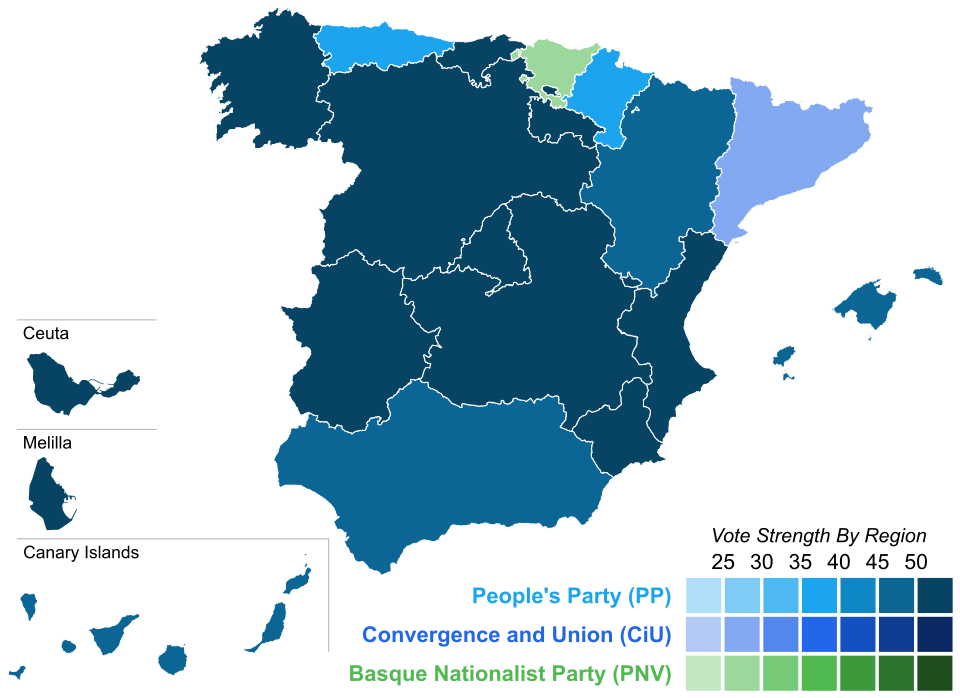 Vote winner strength by autonomous community (Congress).
Aftermath
editOutcome
editWith an overall voter turnout of 68.9%—the lowest in a decade—the Spanish Socialist Workers' Party (PSOE) suffered its worst ever defeat in a general election, while also scoring one of the worst electoral performances for a ruling party in Spain since the UCD collapse in the 1982 election. The People's Party (PP) was able to win an historic absolute majority with 186 out of 350 seats—the largest obtained by a party since 1982—after almost eight years in opposition. The PSOE went on to finish below first place in all but two provinces—Barcelona and Seville—while also losing both Andalusia and Catalonia, which up to that point had been carried by the PSOE in every general election. The 2011 Spanish election marked the continuation of a string of severe government election losses across European countries since the start of the 2008 financial crisis, including Iceland, Greece, Hungary, the United Kingdom, Ireland or Portugal.
Minoritary national parties, such as United Left (IU) and Union, Progress and Democracy (UPyD), benefitted greatly from the PSOE collapse, winning 11 and 5 seats respectively—2 and 1 in the previous parliament. This was the first time since the 1989 election than more than one of the smaller nationwide-contesting parties obtained more than 1 million votes in a general election, as well as enough seats to form parliamentary groups on their own right. The PSOE collapse also resulted in nearly all parties winning parliamentary presence in the Congress of Deputies increasing their vote shares—only Republican Left of Catalonia (ERC) and Geroa Bai (GBai) lost votes compared to 2008. The Basque Nationalist Party (PNV) lost 1 seat despite scoring higher than in 2008, but this came as a result of Amaiur's irruption, with 6 out of its 7 seats being elected in the Basque Country.
Convergence and Union (CiU), the party federation formed by Democratic Convergence of Catalonia (CDC) and Democratic Union of Catalonia (UDC), was elected to an historic general election victory in the region of Catalonia. The Socialists' Party of Catalonia (PSC), PSOE's sister party in the region—which had, up until that point, been the first Catalan political force in every general election held since 1977—scored a poor showing by finishing in second place with 27% of the vote. The 2011 election would be the last time both parties would dominate the Catalan political landscape in a general election; the next election, held on 20 December 2015, would see the alliance between CDC and UDC broken and the PSC being crushed to third place regionally by both the En Comú Podem alliance and ERC.
In terms of vote share, PSOE's electoral result, with 28.76%, would remain the worst electoral performance for a sitting Spanish government in a nationwide-held election since 1982 until the 2014 European Parliament election held two and a half years later, when the PP obtained 26.09% of the share, and in a general election until 2015—the PP obtaining 28.71%.
Government formation
edit| Investiture Congress of Deputies Nomination of Mariano Rajoy (PP) | ||
| Ballot → | 20 December 2011 | |
|---|---|---|
| Required majority → | 176 out of 350  | |
187 / 350 | ||
149 / 350 | ||
14 / 350 | ||
| Absentees | 0 / 350 | |
| Sources[193] | ||
Notes
edit- 1 2 Results for PP (39.9%, 154 deputies), PAR (0.2%, 0 deputies) and EU (0.0%, 0 deputies) in the 2008 Congress election.
- 1 2 Results for IU (3.8%, 2 deputies) and CHA (0.1%, 0 deputies) in the 2008 Congress election.
- 1 2 Results for EA (0.2%, 0 deputies) and Aralar (0.1%, 0 deputies) in the 2008 Congress election.
- ↑ The province of Guipúzcoa was officially renamed as "Gipuzkoa" on 7 July 2011.[130]
- ↑ 2 seats were vacant as a result of a lack of substitutes to replace the resigned Corina Porro (PP) and Cáceres Lino González (PSOE).
- ↑ PSOE legislators Artur Bagur and Margalida Font had been elected for the constituencies of Menorca and Ibiza within wider electoral alliances, and went into the Mixed Group as part of their election agreements.
- ↑ These comprised the Constitutional Court, the General Council of the Judiciary, the Supreme Court, the Council of State, the Court of Auditors and the Economic and Social Council.
- ↑ Results for PP (40.2%, 101 senators), PAR (0.2%, 0 senators) and EU (0.0%, 0 senators) in the 2008 Senate election.
- ↑ PSC–PSOE (8 senators), ERC (3 senators), ICV (1 senator) and EUiA (0 senators) contested the 2008 Senate election within the Entesa alliance.
- ↑ Results for IU (2.9%, 0 senators) and CHA (0.2%, 0 senators) in the 2008 Senate election.
- ↑ Results for CC–PNC (0.7%, 2 deputies) and NC–CCN (0.1%, 0 deputies) in the 2008 Congress election.
- ↑ Results for CC–PNC (0.4%, 1 senator) and NC–CCN (0.1%, 0 senators) in the 2008 Senate election.
- 1 2 Results for NaBai in the 2008 election.
- ↑ Results for EA (0.2%, 0 senators) and Aralar (0.1%, 0 senators) in the 2008 Senate election.
- 1 2 Results for Bloc–IdPV–EVEE in the 2008 election.
- ↑ Denotes a main invitee attending the event.
- ↑ Denotes a main invitee not attending the event, sending a surrogate in their place.
- ↑ The percentage of blank ballots is calculated over the official number of valid votes cast, irrespective of the total number of votes shown as a result of adding up the individual results for each party.
References
edit- ↑ "El Gobierno resalta que son las primeras elecciones sin atentados de ETA". eldiario.es (in Spanish). Madrid. Europa Press. 11 November 2011. Retrieved 10 July 2017.
- ↑ Fernández, Alberto (20 November 2011). "Rubalcaba bate la peor marca del PSOE en 30 años" (in Spanish). RTVE. Retrieved 11 July 2017.
- ↑ Hernanz, Miriam (20 November 2011). "Rajoy rompe el techo de Génova y logra la segunda mayoría más amplia de la democracia" (in Spanish). RTVE. Retrieved 11 July 2017.
- ↑ Martín Plaza, Ana (20 November 2011). "Rajoy logra para el PP una mayoría histórica con 186 diputados y el PSOE se hunde con 110" (in Spanish). RTVE. Retrieved 11 July 2017.
- ↑ Vallejo, Mario (20 November 2011). "IU multiplica sus diputados y sale de una "larga travesía del desierto" por el descalabro del PSOE" (in Spanish). RTVE. Retrieved 11 July 2017.
- ↑ Hernanz, Miriam (20 November 2011). "UPyD roza el grupo parlamentario al superar el millón de votos y obtener escaño por Valencia" (in Spanish). RTVE. Retrieved 11 July 2017.
- ↑ Rojo, Iratxe (20 November 2011). "El PP se lleva por delante al PSOE". El Mundo (in Spanish). Madrid. Retrieved 12 July 2017.
- ↑ Sciolino, Elaine; Burnett, Victoria (10 March 2008). "Socialists Re-elected in Spain, After a Bitter Campaign". The New York Times. Madrid. Retrieved 20 March 2026.
- ↑ Goodman, Al (11 April 2008). "Spain PM wins investiture vote". Madrid: CNN. Retrieved 20 March 2026.
- ↑ "Women outnumber men in new Zapatero government". France 24. 12 April 2008. Retrieved 20 March 2026.
- 1 2 Keeley, Graham (8 April 2008). "Spain turns to public works to save economy". The Guardian. Barcelona. Retrieved 20 March 2026.
- ↑ Máiquez, Miquel (31 May 2008). "Tres meses de vía crucis para Rajoy". 20 minutos (in Spanish). Retrieved 12 May 2025.
- ↑ Martín Plaza, Ana (6 September 2011). "Rajoy reconoce que su derrota tras el 11-M supuso momentos "amargos" en los que pensó irse" (in Spanish). RTVE. Retrieved 12 May 2025.
- ↑ Elordi Cué, Carlos (8 April 2008). "Aguirre amaga con presentarse". El País (in Spanish). Madrid. Retrieved 18 March 2022.
- ↑ Rojo, Iratxe (21 June 2008). "Rajoy, reelegido presidente del PP pese a no tener el apoyo del 21% de los compromisarios". El Mundo (in Spanish). Valencia. Retrieved 18 March 2022.
- ↑ "Rajoy pide unidad al PP ante la crisis de Madrid". El País (in Spanish). 26 January 2009. Retrieved 22 March 2026.
- ↑ Elordi Cué, Carlos (1 November 2009). "Rajoy no puede con ella". El País (in Spanish). Retrieved 22 March 2026.
- ↑ Mercado, Francisco (19 January 2009). "Un consejero de Aguirre monta un 'servicio secreto' con ex agentes". El País (in Spanish). Madrid. Retrieved 12 May 2025.
- ↑ "Mysterious spying scandal rocks Spanish opposition". Madrid: Trend News Agency. 28 January 2009. Retrieved 12 May 2025.
- ↑ "Court reopens spying case against Madrid government". El País. Madrid. 30 March 2011. Retrieved 20 March 2026.
- ↑ Tremlett, Giles (6 March 2009). "Spanish opposition party rocked by corruption scandal". The Guardian. Madrid. Retrieved 20 March 2026.
- ↑ "'Operación Gürtel': cronología de la investigación por corrupción". 20 minutos (in Spanish). 24 May 2018. Retrieved 12 May 2025.
- ↑ Zuber, Helene (20 January 2012). "Star Spanish Judge Garzón on the Defensive". Der Spiegel. Retrieved 12 May 2025.
- ↑ "Spanish justice minister resigns". BBC News. 23 February 2009. Retrieved 28 March 2026.
- ↑ Kingstone, Steve (2 March 2009). "Polls reshape Spain's regional landscape". Madrid: BBC News. Retrieved 22 March 2026.
- ↑ Brunsden, Jim (7 June 2009). "Popular Party defeats Socialists in Spain". Politico. Madrid. Retrieved 22 March 2026.
- 1 2 3 4 5 Sangrador-Vegas 2020.
- ↑ "Toda la oposición critica que Zapatero continúe sin admitir la 'crisis' económica". El Mundo (in Spanish). Madrid. EFE. 3 July 2008. Retrieved 20 March 2026.
- 1 2 "Spain's economic crisis". Reuters. 21 December 2011. Retrieved 20 March 2026.
- ↑ "Spain unveils $28.5bn stimulus plan". Al Jazeera English. 18 April 2008. Retrieved 20 March 2026.
- ↑ Keeley, Graham (11 June 2008). "Fuel protest: shortages, death and arrests hit Spain". The Guardian. Barcelona. Retrieved 20 March 2026.
- ↑ Bolaños, Alejandro (15 June 2008). "La huelga allana el camino a la crisis". El País (in Spanish). Madrid. Retrieved 20 March 2026.
- ↑ "Martinsa-Fadesa anuncia la mayor suspensión de pagos de la historia en España". El País (in Spanish). Madrid. 14 July 2008. Retrieved 20 March 2026.
- ↑ Espinoza, Javier (15 July 2008). "Party Is Over For Martinsa Fadesa". Forbes. Madrid. Retrieved 20 March 2026.
- ↑ Jiménez, Miguel (25 July 2008). "El Gobierno se da de bruces con la crisis". El País (in Spanish). Madrid. Retrieved 20 March 2026.
- ↑ Keeley, Graham (14 August 2008). "Europe: Zapatero tries urgent remedy for Spain's economy". The Guardian. Barcelona. Retrieved 20 March 2026.
- ↑ Kollewe, Julia (10 October 2008). "Markets crash: How panic spread around the globe". The Guardian. Retrieved 21 March 2026.
- ↑ Jiménez, Miguel (11 October 2008). "Desplome histórico de la Bolsa española". El País (in Spanish). Madrid. Retrieved 21 March 2026.
- ↑ "Spain officially in recession for first time in 15 years". France 24. Agence France-Presse. 12 February 2009. Retrieved 20 March 2026.
- ↑ "Unemployment soars over 17 percent". France 24. Agence France-Presse. 24 April 2009. Retrieved 20 March 2026.
- ↑ Keeley, Graham (27 November 2008). "Spain injects €11bn into struggling economy". The Times. Madrid. Retrieved 20 March 2026.
- ↑ "El Gobierno calcula que el Plan E contra la crisis ha inyectado 50.000 millones en la economía". El País (in Spanish). Madrid. 6 May 2009. Retrieved 20 March 2026.
- ↑ Doncel, Luis (30 August 2009). "Mucho empleo, pero poco productivo". El País (in Spanish). Madrid. Retrieved 21 March 2026.
- ↑ Keeley, Graham (25 November 2010). "Plan E failed, so Spain's search for an answer begins again". The Times. Madrid. Retrieved 21 March 2026.
- ↑ Moya, Elena (29 March 2009). "Spain launches a £8.4bn bailout to rescue a stricken savings bank". The Guardian. Retrieved 20 March 2026.
- ↑ Keeley, Graham (25 June 2009). "Spanish banks to get €90 billion bailout". The Times. Madrid. Retrieved 20 March 2026.
- ↑ Mars, Amanda (9 May 2012). "Parte de guerra: ocho entidades intervenidas o nacionalizadas en España". El País (in Spanish). Madrid. Retrieved 20 March 2026.
- ↑ "EU clears Spanish bank recapitalisation plan". Brussels: Reuters. 28 January 2010. Retrieved 20 March 2026.
- ↑ "Shuffle, shuffle". The Economist. Madrid. 8 April 2009. Retrieved 20 March 2026.
- ↑ Catan, Thomas (10 September 2009). "Spain Raises Taxes as Budget Crisis Deepens". The Wall Street Journal (in Spanish). Madrid. Retrieved 20 March 2026.
- ↑ "Taxing times". The Economist. Madrid. 10 September 2009. Retrieved 20 March 2026.
- ↑ "El Gobierno aumenta el IVA general al 18% y suprime la deducción de los 400 euros". El País (in Spanish). Madrid. 26 September 2009. Retrieved 23 September 2021.
- ↑ Tremlett, Giles (22 February 2010). "Spain braced for general strike as Zapatero tries to force labour law reform". The Guardian. Madrid. Retrieved 20 March 2026.
- ↑ "El déficit público se dispara por encima de lo previsto con un 11,4%". El País (in Spanish). Madrid. 29 January 2010. Retrieved 20 March 2026.
- ↑ Doncel, Luis (1 May 2010). "El paro de larga duración se dispara tras dos años de crisis". El País (in Spanish). Madrid. Retrieved 20 March 2026.
- ↑ Traynor, Ian (4 May 2010). "Spain's PM rejects debt crisis bailout rumours". The Guardian. Madrid. Retrieved 20 March 2026.
- ↑ Sills, Ben; Duarte, Esteban (6 May 2010). "Spain Pays Most Yield Since 2008 During Greek 'Fire'". Bloomberg News. Retrieved 20 March 2026.
- ↑ Tremlett, Giles; Moya, Elena (12 May 2010). "Spanish PM makes debt crisis U-turn with emergency cuts". The Guardian. Madrid. Retrieved 20 March 2026.
- ↑ Mortished, Carl (13 May 2010). "Spain unveils new austerity plan to cut deficit". The Times. Retrieved 20 March 2026.
- ↑ Garea, Fernando (13 May 2010). "Zapatero da un vuelco a su estrategia con un recorte de sueldos públicos sin precedentes". El País (in Spanish). Madrid. Retrieved 20 March 2026.
- ↑ Rainsford, Sarah (22 June 2010). "Spain's struggle for labour reform". Madrid: BBC News. Retrieved 20 March 2026.
- ↑ "Spain ratifies labour reforms to cut unemployment". BBC News. 22 June 2010. Retrieved 20 March 2026.
- ↑ Mallet, Victor (30 May 2010). "Poll adds to pressure on Zapatero". Financial Times. Madrid. Retrieved 20 March 2026.
- ↑ "Zapatero's endgame". The Economist. Madrid. 21 October 2010. Retrieved 20 March 2026.
- ↑ "Spain's unions call general strike over labour market reform". France 24. Agence France-Presse. 15 June 2010. Retrieved 20 March 2026.
- ↑ Ross-Thomas, Emma (29 September 2010). "Spain Holds First Strike Since 2002 as Europe Marches". Bloomberg News. Retrieved 20 March 2026.
- ↑ "Spain's PM Zapatero carries out major cabinet reshuffle". BBC News. 20 October 2010. Retrieved 21 March 2026.
- ↑ "Striking Spain air traffic controllers return to work". BBC News. 4 December 2010. Retrieved 11 May 2025.
- ↑ Oakley, David; Peel, Quentin; Tait, Nikki (26 November 2010). "Spain issues defiant warning to markets". Financial Times. London / Berlin / Brussels. Retrieved 20 March 2026.
- ↑ "Moody's threatens to cut Spain's ratings". El País. Madrid. 15 December 2010. Retrieved 20 March 2026.
- ↑ "Bond yields jump at last Spanish debt auction for the year". El País. Madrid. 16 December 2010. Retrieved 20 March 2026.
- ↑ Tremlett, Giles (1 December 2010). "Spain to part-privatise 'fat one' lottery as it tries to head off bailout". The Guardian. Madrid. Retrieved 20 March 2026.
- ↑ Chu, Henry (4 December 2010). "Spain unveils new round of budget cuts". Los Angeles Times. London. Retrieved 20 March 2026.
- ↑ Rainsford, Sarah (28 January 2011). "Spanish government reaches deal to raise retirement age". Madrid: BBC News. Retrieved 20 March 2026.
- ↑ Alcaide, Soledad (17 May 2011). "Movimiento 15-M: los ciudadanos exigen reconstruir la política". El País (in Spanish). Madrid. Retrieved 11 May 2025.
- ↑ "Spain's Indignados protest here to stay". BBC News. 15 May 2012. Retrieved 14 March 2026.
- ↑ "Somali pirates free crew of Spanish trawler 'after $3.3m ransom'". The Guardian. Associated Press. 17 November 2009. Retrieved 21 March 2026.
- ↑ "Spain approves abortion law changes". ABC News. 27 September 2009. Retrieved 20 March 2026.
- ↑ "By my laws they shall know me". El País. Madrid. 7 April 2011. Retrieved 21 March 2026.
- ↑ "Catalan protesters rally for greater autonomy in Spain". BBC News. 10 July 2010. Retrieved 20 March 2026.
- ↑ "De la sentencia del Estatuto a la Via Catalana". El País (in Spanish). Barcelona. 8 September 2013. Retrieved 12 May 2025.
- ↑ "CiU nationalists sweep to power in Catalan race". El País. Barcelona. 29 November 2010. Retrieved 20 March 2026.
- ↑ "Montilla bows out of PSC party leadership after crushing defeat". El País. Barcelona. 30 November 2010. Retrieved 20 March 2026.
- ↑ "Car bomb hits Basque TV station". The Guardian. Associated Press. 31 December 2008. Retrieved 21 March 2026.
- ↑ "Dozens injured in Spain car bomb blast". The Guardian. Associated Press. 29 July 2009. Retrieved 21 March 2026.
- ↑ Tremlett, Giles (30 July 2009). "Travel chaos after Mallorca car bomb kills two police officers". The Guardian. Madrid. Retrieved 21 March 2026.
- ↑ Whitfield 2015, pp. 8–10.
- ↑ Goodman, Al (17 March 2010). "French police officer killed in 'ETA shootout'". Madrid: CNN. Retrieved 21 March 2026.
- ↑ Menéndez, María (20 October 2011). "El último atentado mortal de ETA fue en marzo de 2010 con el asesinato de un policía francés" (in Spanish). RTVE. Retrieved 29 September 2025.
- ↑ "Basque separatist group Eta 'declares ceasefire'". BBC News. 5 September 2020. Retrieved 29 September 2025.
- ↑ Tremlett, Giles (10 January 2011). "Eta declares permanent ceasefire". The Guardian. Madrid. Retrieved 29 September 2025.
- ↑ "Who tipped off the ETA go-between?". El País. Madrid. 31 March 2011. Retrieved 21 March 2026.
- ↑ Pérez, Fernando Jesús (16 October 2013). "Basque police officers sentenced to 18 months in jail in ETA Faisán tip-off case". El País. Madrid. Retrieved 21 March 2026.
- ↑ "Las marcas de Batasuna". El Mundo (in Spanish). Madrid. EFE. 21 June 2012. Retrieved 29 September 2025.
- ↑ "El Tribunal Supremo acuerda la ilegalización del EHAK-PCTV" (in Spanish). Cadena SER. EFE. 18 September 2008. Retrieved 29 September 2025.
- ↑ "El Constitucional avala la ilegalización de ANV dictada por el Supremo". El País (in Spanish). Madrid. 29 January 2009. Retrieved 29 September 2025.
- ↑ Peral, María (13 February 2009). "El Tribunal Constitucional confirma la anulación de las listas de Askatasuna y D3M". El Mundo (in Spanish). Madrid. Agencias. Retrieved 29 September 2025.
- ↑ "El Supremo acuerda ilegalizar Sortu por solo dos votos de diferencia". El País (in Spanish). Madrid. 24 March 2011. Retrieved 29 September 2025.
- ↑ "El Constitucional da vía libre a Bildu para acudir a las elecciones". El País (in Spanish). 5 May 2011. Retrieved 29 September 2025.
- ↑ Tremlett, Giles (23 May 2011). "Basque separatists make breakthrough in Spanish elections". The Guardian. Madrid. Retrieved 21 March 2026.
- ↑ "Prime minister announces he is not to run for a third term". El País. Madrid. 3 April 2011. Retrieved 21 March 2011.
- ↑ Merino, Juan Carlos (25 May 2011). "Golpe de mano en el PSOE para sustituir a Zapatero como líder". La Vanguardia (in Spanish). Retrieved 12 April 2025.
- ↑ "Chacón withdraws from Socialist leadership race to avoid party split". El País. Madrid. 26 May 2011. Retrieved 21 March 2026.
- ↑ Sánchez, Santiago (9 July 2011). "Rubalcaba, tras 20 años gobernando, se estrena como candidato a presidente" (in Spanish). RTVE. Retrieved 13 April 2025.
- ↑ Tremlett, Giles (26 August 2011). "Spain changes constitution to cap budget deficit". The Guardian. Madrid. Retrieved 12 May 2025.
- 1 2 Tremlett, Giles (29 July 2011). "Spain prime minister calls early election for 20 November". The Guardian. Madrid. Retrieved 21 March 2026.
- ↑ Constitution (1978), art. 66.
- ↑ "Constitución española. Título III. De las Cortes Generales. Sinopsis artículo 66" (in Spanish). Congress of Deputies. Retrieved 11 October 2025, summarizing Constitution (1978), art. 66.
- ↑ Constitution (1978), arts. 90 & 99.
- ↑ Constitution (1978), arts. 74, 94, 122, 145, 155, 158–159 & 166–167.
- ↑ Constitution (1978), arts. 68–69.
- ↑ LOREG (1985), arts. 42 & 167.
- ↑ Constitution (1978), arts. 115–116.
- ↑ Constitution (1978), art. 99.
- ↑ "Constitución española. Título V. De las relaciones entre el Gobierno y las Cortes Generales. Sinopsis artículo 115" (in Spanish). Congress of Deputies. Retrieved 31 October 2025, summarizing Constitution (1978), art. 115.
- ↑ "Zapatero descarta elecciones anticipadas". Expansión (in Spanish). 2 July 2009. Retrieved 12 May 2025.
- ↑ ""Me cueste lo que me cueste", asegura Zapatero para anunciar más sacrificios". El País (in Spanish). Madrid. 15 July 2010. Retrieved 12 May 2025.
- ↑ "Zapatero: 'Que se prepare Rajoy para estar más tiempo en la oposición'". El Mundo (in Spanish). Madrid. 17 October 2010. Retrieved 12 May 2025.
- ↑ Díez, Anabel (18 May 2011). "Zapatero asegura que las elecciones generales serán en marzo de 2012 sea cual sea el resultado del 22-M". El País (in Spanish). Seville. Retrieved 12 May 2025.
- ↑ Sánchez, Manuel (23 May 2011). "Zapatero descarta adelantar las elecciones". El Mundo (in Spanish). Madrid. Agencias. Retrieved 12 May 2025.
- ↑ Pérez Giménez, Alberto (29 July 2011). "Zapatero adelanta al 20-N las elecciones ante la embestida de los mercados". El Confidencial (in Spanish). Retrieved 12 May 2025.
- 1 2 Royal Decree 1329/2011 (2011), arts. 1–2 & 5.
- ↑ LOREG (1985), arts. 2–3.
- ↑ Carreras de Odriozola & Tafunell Sambola 2005, p. 1077.
- ↑ LOREG (1985), art. 75.
- ↑ Reig Pellicer, Naiara (16 December 2015). "Spanish elections: Begging for the right to vote". cafebabel.co.uk. Archived from the original on 31 August 2021. Retrieved 17 July 2017.
- ↑ Constitution (1978), art. 68; LOREG (1985), arts. 162–164.
- ↑ Gallagher, Michael (30 July 2012). "Effective threshold in electoral systems". Dublin: Trinity College Dublin. Archived from the original on 30 July 2017. Retrieved 22 July 2017.
- ↑ Royal Decree 1329/2011 (2011), art. 3 & annex.
- ↑ Law 19/2011 (2011), art. 2 & final prov..
- ↑ Constitution (1978), art. 69; LOREG (1985), arts. 162 & 165–166.
- ↑ Carreras de Odriozola & Tafunell Sambola 2005, p. 1083.
- ↑ LOREG (1985), arts. 46, 48, 164, 166 & 170–171.
- ↑ Lozano, Carles. "Grupos Parlamentarios en el Congreso de los Diputados y el Senado". Historia Electoral.com (in Spanish). Retrieved 25 August 2025.
- 1 2 Lozano, Carles. "Composición del Senado 1977-2026". Historia Electoral.com (in Spanish). Retrieved 25 August 2025.
- ↑ "Grupos parlamentarios". Congress of Deputies (in Spanish). Retrieved 7 December 2020.
- ↑ "Grupos Parlamentarios desde 1977". Senate of Spain (in Spanish). Retrieved 8 July 2020.
- 1 2 Constitution (1978), art. 70; LOREG (1985), arts. 6 & 154.
- ↑ Constitution (1978), art. 67; LOREG (1985), arts. 6, 46 & 155–159.
- ↑ LOREG (1985), arts. 44 & 169.
- ↑ LOREG (1985), art. 44 bis.
- ↑ "Rubalcaba será proclamado candidato el 9 de julio al no tener rival en primarias". El Mundo (in Spanish). 13 June 2011. Retrieved 21 January 2019.
- 1 2 3 4 5 6 "ELECCIONES GENERALES. 20 de noviembre de 2011. Coaliciones válidamente constituidas ante la Junta Electoral Central" (PDF). congreso.es (in Spanish). Congress of Deputies. Archived from the original (PDF) on 22 January 2019. Retrieved 21 January 2019.
- ↑ "Coalición Extremeña apoya las listas del PSOE y añade a sus candidatos". ABC (in Spanish). 24 September 2011. Archived from the original on 22 December 2011. Retrieved 21 January 2019.
- ↑ "El PP aprueba la instauración de primarias para elegir a su líder" (in Spanish). RTVE. 20 June 2008. Retrieved 21 January 2019.
- ↑ "PP y UPN acuerdan ir juntos a las elecciones tres años después de su ruptura". El País (in Spanish). 8 September 2011. Retrieved 21 January 2019.
- ↑ "Rajoy sella la coalición PP-PAR en Aragón". El Mundo (in Spanish). 3 October 2011. Retrieved 21 January 2019.
- ↑ "El Partido Progresista Majorero se alía con el PP "por el bien de los intereses de Fuerteventura"". Crónicas de Lanzarote (in Spanish). 8 October 2011. Retrieved 21 January 2019.
- ↑ "PP y CCN acudirán conjuntamente a las elecciones en Canarias". 20 minutos (in Spanish). 10 October 2011. Retrieved 21 January 2019.
- ↑ "Rajoy y Monago firmarán en Madrid el acuerdo de coalición del PP con Extremadura Unida" (in Spanish). Europa Press. 30 October 2011. Retrieved 21 January 2019.
- ↑ "Duran se descarta como "muleta" de PP y PSOE". El País (in Spanish). 23 July 2011. Retrieved 4 February 2020.
- ↑ "Cayo Lara, elegido candidato de IU a la Presidencia del Gobierno" (in Spanish). Cadena SER. 10 September 2011. Retrieved 21 January 2019.
- ↑ "El nacionalismo canario se une de cara al 20-N". El País (in Spanish). 3 September 2011. Retrieved 21 January 2019.
- ↑ "Barkos liderará el "espíritu" de NaBai el 20-N en la nueva coalición Geroa Bai". El País (in Spanish). 30 September 2011. Retrieved 21 January 2019.
- 1 2 "El PSC i ICV volen reeditar l'Entesa al Senat". Ara (in Catalan). 10 August 2011. Retrieved 27 January 2019.
- 1 2 "Desaparece la Entesa, el último vestigio del tripartito". La Vanguardia (in Spanish). 19 September 2011. Retrieved 21 January 2019.
- ↑ "EQUO negocia con Sí se Puede y Por Tenerife concurrir juntos el 20-N". eldia.es (in Spanish). 8 September 2011. Retrieved 17 March 2019.
- ↑ "Equo presenta más de 80.000 firmas para presentarse en 43 provincias". El Mundo (in Spanish). 17 October 2011. Retrieved 17 March 2019.
- ↑ "Equo realiza los anuncios más limpios de la campaña electoral". El Mundo (in Spanish). 10 November 2011. Retrieved 17 March 2019.
- ↑ "Elecciones Generales 20 de noviembre 2011. Calendario Electoral" (PDF) (in Spanish). Central Electoral Commission. Retrieved 24 January 2026.
- 1 2 "Nuevo Gobierno a finales de diciembre". El País (in Spanish). Madrid. 26 September 2011. Retrieved 10 July 2017.
- 1 2 Royal Decree 1329/2011 (2011), art. 4.
- ↑ Constitution (1978), art. 68.
- ↑ ""Pelea por lo que quieres", lema de campaña del PSOE" (in Spanish). Europa Press. 20 October 2011. Retrieved 21 January 2019.
- ↑ "'Súmate al cambio', lema del Partido Popular para las elecciones del 20-N" (in Spanish). Cadena SER. 25 October 2011. Retrieved 21 January 2019.
- ↑ "Duran llama a "bombardear" las urnas con votos de CiU". La Vanguardia (in Spanish). 4 November 2011. Retrieved 21 January 2019.
- ↑ "Los carteles de Convergència y de Unió para las elecciones generales desde 1982". El Periódico de Catalunya (in Spanish). 17 December 2015. Retrieved 21 January 2019.
- ↑ "El PNV quiere ser la primera fuerza vasca en las Cortes Generales" (in Spanish). EiTB. 20 October 2011. Retrieved 21 January 2019.
- ↑ "Alfred Bosch: 'Volem la República del Sí'". esquerra.cat (in Catalan). Republican Left of Catalonia. 26 October 2011. Archived from the original on 1 April 2016.
- ↑ "IU anima a superar la "dicotomía" PP-PSOE con su lema "Rebélate!"". Público (in Spanish). 15 October 2011. Retrieved 21 January 2019.
- ↑ "El BNG apela directamente al voto útil para las elecciones del 20 de noviembre". El Mundo (in Spanish). 28 October 2011. Retrieved 21 January 2019.
- ↑ "Así será a campaña do Bloque para as eleccións xerais". Galicia Confidencial (in Galician). 28 October 2011. Retrieved 31 December 2019.
- ↑ "Para UPyD, 'Cada voto vale' y luchará por conseguir la confianza de los ciudadanos". Huelva24 (in Spanish). Retrieved 21 January 2019.
- ↑ "Geroa Bai centra su programa electoral en la crisis y en defender "un nacionalismo cívico e institucional"" (in Spanish). Europa Press. 2 November 2011. Retrieved 21 January 2019.
- ↑ "La heredera de Na-Bai". El Mundo (in Spanish). 28 October 2011. Retrieved 21 January 2019.
- ↑ "'Más Asturias, Mejor España', lema de Foro Asturias para conseguir representación en Madrid en las elecciones generales" (in Spanish). Europa Press. 28 July 2011. Retrieved 21 January 2019.
- ↑ "Amaiur o el 'puente' que aspira a conducir a la izquierda abertzale de nuevo al Congreso" (in Spanish). RTVE. 18 November 2011. Retrieved 21 January 2019.
- ↑ "Som com tu. Comença la campanya a les generals". tavernes.compromis.net (in Spanish). Coalició Compromís. 4 November 2011. Retrieved 21 January 2019.
- ↑ "El debate de Rajoy y Rubalcaba fue seguido por 12 millones de espectadores". El País (in Spanish). 8 November 2011. Retrieved 23 January 2019.
- ↑ "El debate a cinco no interesó". El Mundo (in Spanish). 10 November 2011. Retrieved 23 January 2019.
- ↑ "Rajoy gana el debate por la mínima". El País (in Spanish). 7 November 2011.
- ↑ "Rubalcaba da por hecho que Rajoy ganará las elecciones". El Mundo (in Spanish). 8 November 2011. Archived from the original on 8 April 2023.
- ↑ "Un 43,9% opina que Rajoy ganó el debate". Antena 3 (in Spanish). 8 November 2011.
- ↑ "Rubalcaba acorrala a Rajoy con su "programa oculto"". Público (in Spanish). 8 November 2011.
- ↑ "Todos los sondeos dan como ganador al líder del PP". El Plural (in Spanish). 8 November 2011.
- ↑ "Postelectoral Elecciones Generales 2011. Panel (2ª Fase)" (PDF). CIS (in Spanish). Retrieved 1 July 2017.
- 1 2 3 "Elecciones celebradas. Resultados electorales" (in Spanish). Ministry of the Interior. Retrieved 15 April 2022.
- 1 2 Lozano, Carles. "Elecciones Generales 20 de noviembre de 2011". Historia Electoral.com (in Spanish). Retrieved 25 August 2025.
- 1 2 "Acuerdo de 7 de diciembre de 2011, de la Junta Electoral Central, por el que se publica el resumen de los resultados de las elecciones al Congreso de los Diputados y al Senado convocadas por Real Decreto 1329/2011, de 26 de septiembre, y celebradas el 20 de noviembre de 2011, conforme a las actas de escrutinio general y de proclamación de electos remitidas por las correspondientes Juntas Electorales Provinciales y por las Juntas Electorales de Ceuta y de Melilla" (PDF). Official State Gazette (in Spanish) (297): 132560–132607. 10 December 2011. ISSN 0212-033X. Retrieved 19 October 2025.
- ↑ "Acuerdo de 9 de abril de 2012, de la Junta Electoral Central, por el que se corrigen errores en los resultados de las elecciones al Congreso de los Diputados incluidos en el Acuerdo de 7 de diciembre de 2011, por el que se publica el resumen de los resultados de las elecciones al Congreso de los Diputados y al Senado convocadas por Real Decreto 1329/2011, de 26 de septiembre, y celebradas el 20 de noviembre de 2011" (PDF). Official State Gazette (in Spanish) (120): 36600. 19 May 2012. ISSN 0212-033X. Retrieved 19 October 2025.
- ↑ "Resolución de 18 de enero de 2012, de la Junta Electoral Central, de corrección de errores en los resultados de las elecciones al Senado incluidos en el Acuerdo de 7 de diciembre de 2011, de la Junta Electoral Central, por el que se publica el resumen de los resultados de las elecciones al Congreso de los Diputados y al Senado convocadas por Real Decreto 1329/2011, de 26 de septiembre, celebradas el 20 de noviembre de 2011" (PDF). Official State Gazette (in Spanish) (27): 9449. 1 February 2012. ISSN 0212-033X. Retrieved 19 October 2025.
- ↑ Lozano, Carles. "Elecciones al Senado 2011". Historia Electoral.com (in Spanish). Retrieved 25 August 2025.
- ↑ Lozano, Carles. "Congreso de los Diputados: Votaciones más importantes". Historia Electoral.com (in Spanish). Retrieved 25 August 2025.
Bibliography
editLegislation
- Constitución Española (Constitution). Official State Gazette (in Spanish). 27 December 1978 [version as of 27 September 2011]. BOE-A-1978-31229. Retrieved 27 December 2016.
- Ley Orgánica 5/1985, de 19 de junio, del Régimen Electoral General (Organic Law 5/1985). Official State Gazette (in Spanish). 19 June 1985 [version as of 16 July 2011]. BOE-A-1985-11672. Retrieved 28 December 2016.
- Ley 19/2011, de 5 de julio, por la que pasan a denominarse oficialmente "Araba/Álava", "Gipuzkoa" y "Bizkaia" las demarcaciones provinciales llamadas anteriormente "Álava", "Guipúzcoa" y "Vizcaya" (Law 19/2011). Official State Gazette (in Spanish). 5 July 2011. BOE-A-2011-11606. Retrieved 9 April 2026.
- Real Decreto 1329/2011, de 26 de septiembre, de disolución del Congreso de los Diputados y del Senado y de convocatoria de elecciones (Royal Decree 1329/2011). Official State Gazette (in Spanish). 26 September 2011. BOE-A-2011-15160. Retrieved 1 April 2026.
Other
- Carreras de Odriozola, Albert; Tafunell Sambola, Xavier (2005) [1989]. Estadísticas históricas de España, siglos XIX-XX (PDF) (in Spanish). Vol. 1 (II ed.). Bilbao: Fundación BBVA. pp. 1072–1097. ISBN 84-96515-00-1. Archived from the original (PDF) on 24 September 2015.
- Whitfield, Teresa (December 2015). Special Report 384. The Basque Conflict and ETA. The Difficulties of an Ending (PDF) (Report). United States Institute of Peace. Retrieved 19 March 2025.
- Sangrador-Vegas, Begoña (2020). "PSOE (2004-2011): Social Reforms and the Beginning of the Economic Crisis". The Nation in Its Labyrinth: An Introduction to Contemporary Spain since 1898 (in Spanish). Madrid: Pressbooks. Retrieved 18 March 2026.
External links
edit Media related to Spanish general election, 2011 at Wikimedia Commons

.jpg)
.jpg)