
The Shrine of Baháʼu'lláh (Persian: آرامگاه حضرت بهاءاللّٰه, romanized: Ārāmgāh-i-Ḥaḍrat-i-Baháʼu'lláh; also known among Baháʼís as Persian: روضۀ مبارکه, romanized: Rawḍa-yi-Mubáraka, "the Blessed Shrine";[2] Arabic: مقام حضرة بهاء الله, romanized: Maqám Ḥaḍrat Baháʼu'lláh[3]) is the burial place of Baháʼu'lláh, the founder of the Baháʼí Faith. It is located at Bahjí, just north of Acre in northern Israel. Baháʼu'lláh died at the Mansion of Bahjí before dawn on 29 May 1892;[4] the Mansion and the Shrine are two physically separate buildings.[5] He was interred shortly after sunset on the day of his death in the northernmost room of the house of his son-in-law — a member of the Afnán family — the most northerly of three houses lying to the west of, and adjacent to, the Mansion.[6][5] The shrine is regarded by Baháʼís as the holiest site of their religion and as the Qiblih (point of adoration) toward which they face during obligatory prayer; the direction of prayer became fixed at the location of Baháʼu'lláh's remains upon his burial.[7][8]
 The Shrine of Baháʼu'lláh at Bahjí | |
 Interactive map of Shrine of Baháʼu'lláh[1] | |
| Location | Bahjí, Israel |
|---|---|
| Coordinates | 32°56′36″N 35°05′32″E / 32.94333°N 35.09222°E |
| Type | Baháʼí |
| Completion date | 1892 |
| Website | https://www.ganbahai.org.il |
The building has a central courtyard with a glass roof, surrounded by paths covered with Persian rugs; Baháʼu'lláh's remains lie in a small chamber at the northwest corner.[1] The shrine stands within a formal walled garden known as the Haram-i-Aqdas (Persian: حرم اقدس; "Most Holy Precincts"), formally designated by Shoghi Effendi in February 1953.[9] The site is administered by the Universal House of Justice as part of the Baháʼí World Centre and is open free of charge to visitors of all faiths.[10][11]
Following the death of ʻAbdu'l-Bahá in 1921, Mírzá Muhammad ʻAlí and his supporters seized the keys to the shrine on 30 January 1922; the keys were returned to Shoghi Effendi by the British Mandate authorities in February 1923.[7] Shoghi Effendi subsequently laid out the surrounding gardens; he proposed a future superstructure of ninety-five marble columns to enclose the building, which has not been constructed.[12] The gardens were closed to the general public from April 2023 to October 2025 following a municipal property-tax reclassification dispute, and reopened on 19 October 2025.[11]
The shrine, the Mansion of Bahjí, and the surrounding gardens were inscribed on the UNESCO World Heritage List in July 2008 as part of the Baháʼí Holy Places in Haifa and the Western Galilee.[13]
Architecture and features
editThe building
editThe Shrine of Baháʼu'lláh occupies a modest stone house that formed part of the cluster of smaller buildings lying to the west of, and adjacent to, the Mansion of Bahjí. The two structures are distinct: Baháʼu'lláh died in the Mansion in 1892 and was interred the same evening in the adjacent house, then belonging to his son-in-law.[5][7] The building in which he was interred is regarded by Baháʼís as the holiest site of their religion.
The exterior of the shrine is architecturally modest; unlike the ornate superstructure of the nearby Shrine of the Báb in Haifa, it carries no major external adornments beyond its entrance gate.[14] The building stands apart from the Mansion and is set within walled gardens; the Mansion itself, built in typical Ottoman Levantine style, serves as a museum and place of pilgrimage for Baháʼís.[14] Shoghi Effendi, who undertook the landscaping of the surrounding precincts from the 1930s onward, envisaged that the present structure would one day be enclosed within a "stately, befitting Mausoleum" of ninety-five marble columns; as of 2025 no construction of this future superstructure has begun.[12][9]
Interior
editThe interior of the shrine is organised around a central area that functions as an open garden roofed with glass. The glass roof was constructed by Ghulám-ʻAlíy-i-Najjár after the death of Baháʼu'lláh.[15] Paths through this central garden are covered with Persian rugs.[1]
The Inner Court — the formal portico giving access to the burial chamber — is described in period accounts as being furnished with a dazzling gilded chandelier, a marble floor, and stately oak doors bearing gold-leafed rosettes.[1] Beyond the Inner Court, the inner sanctuary itself is a roofed garden through which carpet-covered paths lead pilgrims to stand before what Baháʼí sources term the "Holy of Holies" — the room in the northwestern corner of the building where Baháʼu'lláh was laid to rest. Pilgrims may glimpse the burial chamber from this threshold; the innermost room is not entered.[1]
Opening off the central area are a number of side chambers designed for prayer and meditation.[14] Silence is observed throughout the shrine building; visitors are asked to remove their shoes before entering.[16][17]
Haram-i-Aqdas
editThe shrine stands within a formal walled garden known as the Haram-i-Aqdas (حرم اقدس, "Most Holy Precincts"). The name was formally designated by Shoghi Effendi in a cable of 9 February 1953, at which time the landscaping of the 13,000-square-metre area immediately surrounding the shrine was described as "virtually concluded".[9] The Haram-i-Aqdas constitutes the north-western quadrant of the broader Bahjí garden complex; Shoghi Effendi supervised its layout, while the Universal House of Justice subsequently completed the three remaining quadrants.[18]
The garden is divided into quadrants arranged like rays emanating from the shrine, and is furnished with ornaments, lights, and formal flower arrangements.[1] A circumambulation path encircles the shrine building within the precincts, and white-pebble walkways lead visitors through the formal planting.[14]
Access to the Haram-i-Aqdas is through a wrought-iron decorative gate known as "Collins Gate", presented as a gift by Amelia Collins, a Hand of the Cause and Vice-President of the International Baháʼí Council, and obtained by Shoghi Effendi in England.[19] The gate was erected in 1952 following the removal of obstructions that had previously prevented a formal approach to the shrine.[20] Shoghi Effendi described the newly opened approach as leading pilgrims "successively to the Holy Court, the outer and inner sanctuaries, the Blessed Threshold and the Holy of Holies."[20]
Religious significance
editThe Shrine of Baháʼu'lláh is regarded by Baháʼís as the holiest site of their religion and, in Baháʼí practice, serves as the Qiblih (point of adoration) — the direction toward which adherents turn during their daily obligatory prayer.[21] Shoghi Effendi referred to it in February 1953 as "the most holy spot in the Baháʼí world" and "the Qiblih of the Baháʼí world".[9] The practice is analogous to Muslims facing the Kaaba during daily prayer, or to Christians and Jews historically facing Jerusalem, though in Baháʼí teaching the sacred focus is the location of Baháʼu'lláh's remains rather than the building itself.
The designation of a fixed Qiblih emerged from the Baháʼí doctrine of progressive revelation. In his writings the Báb redirected the direction of prayer toward "He whom God shall make manifest", a future Manifestation of God whom Baháʼís identify as Baháʼu'lláh. The Báb's qiblih was therefore a person rather than a fixed geographical point: during Baháʼu'lláh's lifetime Baháʼís faced him wherever he resided, and the qiblih became a fixed location only upon his burial in 1892.[21] According to Baháʼí historical accounts, a tablet from Baháʼu'lláh explaining the matter is reported to have existed but was taken by Covenant-breakers.[22]
The institution of the Qiblih is established in the Kitáb-i-Aqdas, Baháʼu'lláh's book of laws, which states: "When ye desire to perform this [obligatory] prayer, turn ye towards the Court of My Most Holy Presence, this Hallowed Spot that God hath made the Centre round which circle the Concourse on High, and which He hath decreed to be the Point of Adoration for the denizens of the Cities of Eternity, and the Source of Command unto all that are in heaven and on earth; and when the Sun of Truth and Utterance shall set, turn your faces towards the Spot that We have ordained for you."[23]
Pilgrimage to the shrine is distinct from the two obligatory pilgrimages (ḥajj) prescribed in the Kitáb-i-Aqdas — to the House of Baháʼu'lláh in Baghdad and to the House of the Báb in Shiraz — which carry specific rites set out in two Tablets of Pilgrimage (Súriy-i-Ḥajj); both Houses are currently inaccessible and these rites cannot be performed.[24] Visitation of the shrine (ziyárat) draws on the broader Islamic tradition of shrine pilgrimage, particularly in Shíʻí devotion, but in Baháʼí practice it carries no prescribed ceremonies.[25][26] The shrine became the focal point of Baháʼí pilgrimage under ʻAbdu'l-Bahá after the death of Baháʼu'lláh; according to Walbridge, the practice "evolved, rather than having been established by a clear text".[26] During Baháʼu'lláh's lifetime believers visited him as guests; under ʻAbdu'l-Bahá the visit to the Shrines of Baháʼu'lláh and the Báb became the stated purpose of pilgrimage; and Shoghi Effendi later formalised the programme, initially lasting nineteen days.[26] After its election in 1963 the Universal House of Justice reduced the pilgrimage to nine days; pilgrims are generally taken to the Shrine of Baháʼu'lláh and the Shrine of the Báb within the first two days.[16]
The principal devotional text recited at the shrine is the Tablet of Visitation (Lawḥ-i-Ziyárat), a prayer compiled by Nabíl-i-Aʻzam from three tablets written by Baháʼu'lláh; ʻAbdu'l-Bahá approved its use at both the Shrine of Baháʼu'lláh and the Shrine of the Báb.[27] The Tablet of Visitation is also recited by Baháʼís at gatherings on the holy days associated with Baháʼu'lláh — the anniversary of his birth (12 November) and of his death (29 May) — irrespective of physical proximity to the shrine.[27] Visitors remove their shoes before entering; Baháʼís often prostrate themselves at the threshold of the burial chamber.[28] The shrine is open to people of all faiths, though on a more limited schedule than the surrounding gardens.[29]
A devotional tradition at the shrine, established during the ministry of ʻAbdu'l-Bahá, involved pilgrims carrying flowerpots from ʻAkká to the shrine in procession, with participants chanting prayers along the route. Youness Afroukhteh, who lived in ʻAkká during ʻAbdu'l-Bahá's ministry, describes ʻAbdu'l-Bahá leading these processions — "not unlike a General in the field." Upon arrival, water was carried in copper jugs from nearby springs to water the flowers while verses were recited.[30]
History
editBackground and early occupation
edit.jpg)
The area was originally a garden planted by Sulayman Pasha, the ruler of Acre, for his daughter Fatimih, who gave it the name Bahjí.[8] Later the area was further developed by ʻAbdu'llah Pasha; in 1831, when Ibrahim Pasha besieged Acre, he used the property as his headquarters.[8] The property was noted for its gardens and a pond fed by an aqueduct. It subsequently passed into the possession of a Christian family, the Jamals.[8]
In 1870 ʻUdi Khammar, a wealthy Christian merchant from Acre who also originally owned the House of ʻAbbúd, bought land from the Jamals close to the mansion of ʻAbdu'llah Pasha and built the Mansion of Bahji over an earlier and smaller building that ʻAbdu'llah Pasha had constructed for his mother.[31][8][7] ʻUdi Khammar placed an Arabic inscription over the door in 1870 which reads: "Greetings and salutation rest upon this Mansion which increaseth in splendour through the passage of time. Manifold wonders and marvels are found therein, and pens are baffled in attempting to describe them."[32] ʻUdi Khammar had built the Mansion for his family, and when he died was buried in a tomb in the south-east corner of the wall directly around the building.[8][33] In 1879 an epidemic broke out in the area, causing the inhabitants to flee, and the building became vacant.
Mansion of Bahjí
edit
Baháʼu'lláh's son ʻAbdu'l-Bahá first rented, and then purchased, the Mansion for his father and the Baháʼí holy family to live in. Baháʼu'lláh moved from Mazra'ih to Bahjí in September 1879 and resided in the building until his death.[8][34] In 1890 the Cambridge orientalist Edward Granville Browne met Baháʼu'lláh in the Mansion; after the meeting he wrote his description of Baháʼu'lláh that became widely cited in later accounts of the Faith.[7]
Baháʼu'lláh died in the Mansion before dawn on 29 May 1892.[4] His remains were not interred there but in an adjacent house — the house of his son-in-law Sayyid ʻAlí Afnán, husband of Baháʼu'lláh's daughter Furúghiyyih Khánum, the most northerly of three houses lying to the west of and adjacent to the Mansion.[6][5][7] According to the account in God Passes By, "Baháʼu'lláh was accordingly laid to rest in the northernmost room of the house which served as a dwelling-place for His son-in-law, the most northerly of the three houses lying to the west of, and adjacent to, the Mansion. His interment took place shortly after sunset, on the very day of His ascension."[6] That room became the Shrine of Baháʼu'lláh and is regarded by Baháʼís as the Qiblih toward which they turn in obligatory prayer.[21] The Mansion, a distinct and separate building, is preserved as a historic site and place of pilgrimage where the room in which Baháʼu'lláh died may be visited.[35]
Custodianship dispute and recovery
editFollowing the death of ʻAbdu'l-Bahá in 1921, control of the Holy Places at Bahjí became contested. During the years of his ministry ʻAbdu'l-Bahá had maintained access to the Shrine despite opposition from his half-brother Mírzá Muhammad ʻAlí and his supporters, who occupied the adjacent Mansion and whom the main body of Baháʼís regard as Covenant-breakers for having rejected ʻAbdu'l-Bahá's authority. ʻAbdu'l-Bahá obtained a small tea-house near the Shrine so that he could visit his father's tomb in greater serenity, rented an adjoining building to serve as a pilgrim house, and appointed a Baháʼí loyal to himself as caretaker of the Shrine.[7][36] The tea-house was particularly significant as the place where ʻAbdu'l-Bahá received the first group of Western pilgrims to the Holy Land, in the winter of 1898–1899.[36]
After ʻAbdu'l-Bahá's death, Mírzá Muhammad-ʻAlí moved to assert legal custody over the Shrine and the keys were seized on 30 January 1922.[7][36] The Governor of Acre ordered the keys to be retained by the civil authorities and a guard was posted.[36] In February 1923 the British Mandate authorities decided the case in Shoghi Effendi's favour and the keys were returned to him.[7][36]
According to Rúhíyyih Rabbani, the Mansion of Bahjí meanwhile fell into serious disrepair while occupied by Mírzá Muhammad-ʻAlí and his supporters. By November 1927 the roof was in danger of collapse; Shoghi Effendi refused to carry out repairs unless the occupants vacated.[37] On 27 November 1929 Mírzá Muhammad-ʻAlí and his supporters were finally forced to abandon the building.[7][35] Shoghi Effendi immediately began a programme of restoration, having the roof, woodwork, frescoes, and stencilled decoration repaired; he furnished the building with Persian rugs sent by Baháʼís in Iran, illuminations in the calligraphy of Mishkín-Qalam, and photographs and documents of historical significance.[38] Before the building was opened to the wider public, Shoghi Effendi invited the British High Commissioner for Palestine, General Sir Arthur Wauchope, to tour the restored Mansion and presented the case that it should be preserved as a place of pilgrimage and an historical museum.[38] By April 1932 the Mansion was opened to non-Baháʼí visitors as well as pilgrims.[35] In the same year Shoghi Effendi wrote to the District Commissioner for Haifa, Edward Keith-Roach, affirming "the sacredness of the Mansion at Bahjí, which forms an integral part of the Shrine of Baháʼu'lláh."[39] Complete ownership of the Mansion was only secured in 1957.[7]
In the 1950s, Shoghi Effendi set out plans for a future superstructure that would surround the whole area and include a platform with 95 marble columns, each 6 metres high.[12] No construction of this superstructure has taken place; it remains a future aspiration described by Shoghi Effendi as "a befitting Mausoleum destined to enshrine the Dust of the Founder of God's Most Holy Faith."[20]
Development of the precincts
editWhen Shoghi Effendi assumed the Guardianship in 1921, the land immediately surrounding the Shrine and Mansion of Bahjí was largely held by supporters of Mírzá Muhammad-ʻAlí, who had occupied it for more than two decades. Shoghi Effendi had sought government requisition of this land as early as 1931 but was unable to proceed at that time, as the asking price was over ten times the market value and the authorities declined to intervene.[36]
In 1952 Shoghi Effendi was able to acquire over 145,000 square metres of land surrounding the Tomb and Mansion — land that had originally belonged to the Mansion property but had been held by opponents of the Baháʼí leadership for several decades.[36] In the same year, supporters who still occupied a house within the precincts instituted legal proceedings against the Guardian, challenging his authority to demolish the building. Shoghi Effendi appealed to Israel's Prime Minister and Minister of Foreign Affairs; the government intervened and removed the case from the jurisdiction of the civil courts on the grounds that the matter was a religious one.[40][20] Letters from the Prime Minister's Office and from the Director-General of the Ministry of Foreign Affairs confirmed that the dispute had been resolved and thanked Shoghi Effendi for his "wise and benevolent attitude".[41] The demolition was authorised and immediately followed by landscaping of the approaches to the Shrine, the erection of a decorative wrought-iron gate, and embellishment of the surroundings.[20]
The gate, known as "Collins Gate" after its donor Amelia Collins, a Hand of the Cause and Vice-President of the International Baháʼí Council, was obtained by Shoghi Effendi in England.[19][42]
Beginning in October 1952 Shoghi Effendi undertook landscaping of the 13,000-square-metre area immediately surrounding the Shrine.[7] In a cable dated 9 February 1953 he announced the formal designation of this inner sanctuary as the Haram-i-Aqdas (حرم اقدس, "Most Holy Precincts"), describing the work as "virtually concluded" and noting that it was to be embellished with illumination and stately portals, "presaging the rearing at a future date of a magnificent mausoleum."[9] The Haram-i-Aqdas constitutes the north-western quadrant of the wider garden complex, laid out in four quadrants in the form of rays emanating from the Shrine.[7]
In 1957 Shoghi Effendi secured an expropriation order, on the grounds of their proximity to a sacred place of pilgrimage, for the last houses occupied by Mírzá Muhammad-ʻAlí's supporters adjacent to the Mansion.[43] The occupants contested the order before the Supreme Court of Israel, lost their appeal, and were obliged to leave.[43] On the anniversary of Baháʼu'lláh's death in June 1957, Shoghi Effendi cabled the Baháʼí world announcing the resolution of the long-running dispute over occupation of the precincts of the shrine.[36] He had wished to supervise the demolition of these houses personally but died in November 1957 before returning to the Holy Land. When, in fulfilment of his plan, the houses were pulled down shortly after his passing, the formal garden he had laid out in front of them was found to have been so accurately measured that it "could be continued — rolled out like a carpet — with complete accuracy right over the place where they had stood and up to the very wall of the Mansion."[43] The remaining three quadrants of the wider garden layout were subsequently completed by the Universal House of Justice.[7]
Israeli state recognition
editFollowing the establishment of the State of Israel in 1948, one of the early acts of the new Israeli authorities, while the War of Independence was still being fought, was to place a notice on the Shrine of Baháʼu'lláh — which Rúhíyyih Rabbani notes was "much more isolated than the Shrines in Haifa" — designating it a Lieu Sainte ("Holy Place").[44] The tax-exempt status of the Baháʼí holdings, which Shoghi Effendi had secured from the British Mandate authorities through years of negotiation, was accepted by the new Israeli government on the basis already established before 1948.[45]
The 1952 court case brought by Mírzá Muhammad-ʻAlí's supporters over the demolition of a house adjoining the Shrine was resolved by the Israeli government's removal of the case from civil jurisdiction as a religious matter. A separate Department for the Baháʼí Faith was established in the Ministry of Religious Affairs in December 1953, with a letter from the Minister assuring the Guardian that "full protection will be given to the Holy Places as well as to the World Centre of the Baháʼí Faith."[46]
Tax dispute and closure (2018–2025)
editIn late 2018 the Municipality of Acre revoked the property tax exemption for approximately 80 percent of the Bahjí complex, reclassifying it from a place of worship to a tourism site and issuing an annual tax demand of approximately NIS 7 million (approximately USD 1.9 million).[47] The municipality's representative acknowledged at an appeals committee hearing that the new boundary between sacred and regular space had been drawn without consulting the Baháʼí community or any expert in Baháʼí practice.[47] The Baháʼí World Centre contested the reclassification, arguing that the entire garden constitutes a "house of prayer" in which meditative walking is a form of worship; this position was supported by expert witness Professor Moshe Sharon of the Hebrew University of Jerusalem.[47] After the internal appeal was dismissed, the Baháʼí World Centre appealed to the Administrative Court and, in April 2023, closed the gardens to the general public, permitting entry to Baháʼí pilgrims only.[47][11]
The closure, which lasted approximately two and a half years, disrupted the site's customary pattern of welcoming approximately 200,000 visitors annually and caused economic consequences for tour guides, restaurateurs, and merchants in Acre's Old City.[11] The dispute was ultimately resolved through intervention by Israel's Prime Minister's Office and the Ministry of Finance; the municipality's reclassification of the site as a tourism venue was reversed, and the gardens reopened to the public on 19 October 2025 with admission remaining free of charge.[11]
World Heritage Site
editThe Shrine of Baháʼu'lláh and the surrounding gardens at Bahjí were inscribed on the UNESCO World Heritage List in July 2008 as part of the serial property "Baháʼí Holy Places in Haifa and the Western Galilee" (property reference 1220).[13][48] The serial nomination comprises eleven separate component parts at Haifa and in the Western Galilee, of which the Bahjí component — the Shrine of Baháʼu'lláh, the Mansion, and their associated gardens — is the largest by area; the others include the Shrine of the Báb and its terraced gardens in Haifa, the Mansion of Mazra'ih, the House of ʻAbbúd and the House of ʻAbdu'lláh Pasha in Acre, and several associated buildings.[49]
The 2008 inscription followed a referral the previous year in which the World Heritage Committee, in Decision 31 COM 8B.41, had returned the nomination to Israel to reconsider the scope of the property and to put in place stronger protection for the buffer zones before resubmission.[50] Revised buffer zones were established before the property was resubmitted, and the ICOMOS advisory-body evaluation submitted to the Committee in 2008 assessed the integrity and authenticity of the proposed property and recommended inscription on these revised terms.[51]
The property was inscribed under two criteria. Under criterion (iii), the two shrines — as the most holy places of the Baháʼí Faith visited by thousands of pilgrims each year — were judged to "provide an exceptional testimony to, and are powerful communicators of, the strong cultural tradition of Baháʼí pilgrimage".[48] Under criterion (vi), the shrines were described as "tangible places of great meaning for one of the world's religions".[48] The Committee's Statement of Outstanding Universal Value also notes that the property demonstrates integrity linked to the history and spiritual home of the Baháʼí Faith, and authenticity as a tangible expression of its body of doctrine and beliefs.[48]
Day-to-day stewardship of the property — including conservation, restoration, and visitor management — is the responsibility of the Baháʼí World Centre, while Israel, as State Party to the World Heritage Convention, carries the formal reporting obligation and submits periodic State of Conservation reports to the World Heritage Committee.[51][49] The Bahjí component lies approximately 3 km north of the Old City of Acre, itself inscribed on the World Heritage List in 2001.[52]
Visiting
editThe Shrine and the surrounding gardens are open to people of all faiths and backgrounds without charge.[29] The shrine interior is open for self-guided visits on a more limited schedule than the gardens; current opening hours are published by the Baháʼí World Centre–operated Baháʼí Gardens website.[17] The Mansion of Bahjí is similarly accessible to general visitors at posted times.[17]
This general access is distinct from Baháʼí pilgrimage, which takes the form of a structured nine-day programme administered by the Baháʼí World Centre and is open by registration to Baháʼís only; non-Baháʼí visitors are welcome at the site but do not undertake the formal pilgrimage.[16][29]
Visitors are asked to dress modestly, with clothing covering the shoulders and reaching the knees.[17] Shoes must be removed before entering the shrine building.[16] Photography is permitted throughout the gardens and on the exterior, but is not permitted inside the shrine buildings.[17] Silence is maintained inside the shrine. The gardens are closed on Baháʼí holy days and on Yom Kippur, and may also be closed in inclement weather.[17]
The site administration provides accessibility arrangements for visitors with disabilities, including paved or flagstone routes suitable for wheelchairs, tactile access to garden ornaments, guides trained to support lip-reading, and accessible restrooms; advance contact is requested in order to tailor the visit.[53] For Baháʼí pilgrims, the Universal House of Justice's Office of Pilgrimage has stated that pilgrims using wheelchairs are accommodated where possible — including entry to the Shrines themselves — though the upper floors of certain Holy Places (the Mansion of Bahjí, the House of ʻAbbúd, the House of ʻAbdu'lláh Pasha in Acre, and Baháʼu'lláh's room at the Mansion of Mazra'ih) cannot be reached by wheelchair owing to narrow and steep stairs.[54]
Before its closure in April 2023 the site drew approximately 200,000 visitors annually.[11] Following a dispute over the site's tax classification that led to the closure of the gardens to the general public, the site reopened on 19 October 2025 after intervention by Israel's Prime Minister's Office.[11]
Image gallery
edit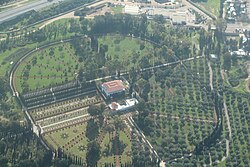 Aerial view (2022)
 Gardens near the Shrine of Baháʼu'lláh
 Baháʼí gardens at Bahjí
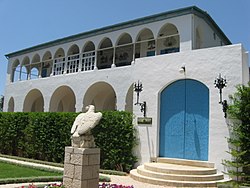 Mansion of Bahjí
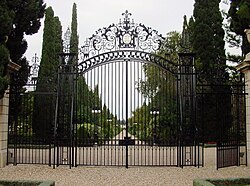 Collins Gate at the entrance of the pathway towards the shrine
 The Mansion (left) and the Shrine (right)
 Main entrance to the Shrine of Baháʼu'lláh


See also
editNotes
edit- 1 2 3 4 5 6 7 National Spiritual Assembly of the United States (January 1966). "Shrine of Baháʼu'lláh". Baháʼí News (418): 4. Retrieved 2026-05-03 – via bahai.works.
- ↑ "آرامگاه حضرت بهاءاللّه: روضۀ مبارکه" (in Persian). Baháʼí International Community. Retrieved 2026-04-29.
- ↑ "مقام حضرة بهاء الله والحدائق البهائية" (in Arabic). Baháʼí Gardens, Acre. Retrieved 2026-04-29.
- 1 2 Effendi 1944, p. 221.
- 1 2 3 4 Rabbani 1969, p. 229.
- 1 2 3 Effendi 1944, p. 222.
- 1 2 3 4 5 6 7 8 9 10 11 12 13 14 Smith 2000.
- 1 2 3 4 5 6 7 Balyuzi 2000, p. 362.
- 1 2 3 4 5 Effendi, Shoghi (9 February 1953). "Rapid Progress of Twin Sacred Undertakings (cablegram)". Letter to. Baháʼí World Centre – via Project Gutenberg.
most holy spot in the Baháʼí world ... Qiblih of the Baháʼí world ... presaging the rearing at a future date of a magnificent mausoleum in its heart.
- ↑ "Message to the Baháʼís of the World, 30 April 1987". Universal House of Justice. 1987-04-30. Retrieved 2026-04-29.
- 1 2 3 4 5 6 7 Kraus, Yair (2025-10-16). "Bahá'í Gardens in Acre reopen to public after 2.5-year closure". Ynetnews. Retrieved 2026-05-02.
- 1 2 3 Giachery 1973, pp. 134–137.
- 1 2 UNESCO World Heritage Centre (2008-07-08). "Three new sites inscribed on UNESCO's World Heritage List". Retrieved 2008-07-08.
- 1 2 3 4 Meizler, M.S. (2016). Baháʼí Sacred Architecture and the Devolution of Astronomical Significance (Graduate thesis). University of Arkansas.
- ↑ ʻAbdu'l-Bahá (1915). Memorials of the Faithful. Wilmette, Illinois: Baháʼí Publishing Trust (published 1997). p. 144. ISBN 0-87743-242-2.
{{cite book}}: ISBN / Date incompatibility (help) - 1 2 3 4 Walbridge 1996, pp. 117–118.
- 1 2 3 4 5 6 "Visit Us — 'Akko". Bahá'í Gardens. Retrieved 2026-04-30.
Photography is permitted, except for the interior of the Shrines.
- ↑ Smith 2000, pp. 87–89.
- 1 2 Giachery 1973, pp. 129–130.
- 1 2 3 4 5 Shoghi Effendi (1952-06-11). "Rapid Progress of World Centre — Decline in Fortunes of Covenant-Breakers". Bahá'í World Centre.
Public access to the heart of the Qiblih of the Baha'i World is now made possible through traversing the sacred precincts leading successively to the Holy Court, the outer and inner sanctuaries, the Blessed Threshold and the Holy of Holies.
- 1 2 3 Smith 2000, p. 284.
- ↑ Walbridge 1996, p. 47.
- ↑ Baháʼu'lláh (1992). The Kitáb-i-Aqdas. Haifa: Baháʼí World Centre. p. 22. ISBN 0-85398-999-0.
- ↑ Walbridge 1996, pp. 112–116.
- ↑ Walbridge 1996, pp. 109, 119–120.
- 1 2 3 Walbridge 1996, pp. 116–117.
- 1 2 Walbridge 1996, pp. 121–122.
- ↑ Walbridge 1996, p. 118.
- 1 2 3 "Frequently Asked Questions". Baháʼí Gardens. Retrieved 2026-04-30.
Do I have to be a Bahá'í to enter the Shrines? No. Like the Gardens, the Shrines are open to everyone, but the hours are more limited.
- ↑ Afroukhteh, Youness (2003) [1952]. Khátirát-i-Nuh-Sáliy-i-ʻAkká [Memories of Nine Years in ʻAkká] (in Persian). Translated by Riaz Masrour. Oxford: George Ronald. pp. 27–28, 109. ISBN 978-0-85398-660-7.
- ↑ Ruhe 1983, p. 106.
- ↑ Taherzadeh 1987, p. 104.
- ↑ Taherzadeh 1987, p. 103.
- ↑ Taherzadeh 1987.
- 1 2 3 Rabbani 1969, p. 232.
- 1 2 3 4 5 6 7 8 Rabbani 1969, p. 233.
- ↑ Rabbani 1969, p. 231.
- 1 2 Rabbani 1969, pp. 231–232.
- ↑ Rabbani 1969, p. 280.
- ↑ Rabbani 1969, pp. 233–234.
- ↑ Rabbani 1969, pp. 290–292.
- ↑ Ruhe 1983.
- 1 2 3 Rabbani 1969, p. 234.
- ↑ Rabbani 1969, p. 289.
- ↑ Rabbani 1969, p. 269.
- ↑ Rabbani 1969, p. 291.
- 1 2 3 4 Malkin, Nurit (2024-02-18). "Decision expected in legal battle over 'holy' classification of Baha'i gardens in Acre". The Times of Israel. Retrieved 2026-05-02.
- 1 2 3 4 World Heritage Committee (2008-07-08). "Decision 32 COM 8B.57 — Bahá'í Holy Places in Haifa and Western Galilee". UNESCO World Heritage Centre. Retrieved 2026-05-02.
- 1 2 "Baháʼí Holy Places in Haifa and the Western Galilee". UNESCO World Heritage Centre. Retrieved 2026-05-03.
- ↑ World Heritage Committee (2007-07-02). "Convention concerning the protection of the world cultural and natural heritage" (PDF). p. 34. Retrieved 2008-07-08.
- 1 2 "Bahá'í Holy Places (Israel) — ICOMOS Advisory Body Evaluation, ID No. 1220" (PDF). ICOMOS. 2008. Retrieved 2026-05-03.
- ↑ "Old City of Acre". UNESCO World Heritage Centre. Retrieved 2026-05-03.
- ↑ "Accessibility". Baháʼí Gardens. Retrieved 2026-05-03.
- ↑ "Handicapped facilities at the Baháʼí World Centre pilgrimage sites". Office of Pilgrimage, on behalf of the Universal House of Justice. 21 February 2000. Retrieved 2026-05-03 – via bahai-library.com.
References
edit- Balyuzi, H.M. (2000). Baháʼu'lláh, King of Glory. Oxford, UK: George Ronald. ISBN 0-85398-328-3.
- Effendi, Shoghi (1944). God Passes By. Wilmette, Illinois: Baháʼí Publishing Trust. ISBN 0-87743-020-9.
{{cite book}}: ISBN / Date incompatibility (help) - Giachery, Ugo (1973). Shoghi Effendi — Recollections. Oxford: George Ronald. ISBN 0-85398-050-0.
- Rabbani, Rúhíyyih (1969). The Priceless Pearl. London: Baháʼí Publishing Trust.
- Ruhe, David (1983). Door of Hope: The Baháʼí Faith in the Holy Land. Oxford: George Ronald. ISBN 978-0853981503.
- Smith, Peter (2000). "Bahjí". A concise encyclopedia of the Baháʼí Faith. Oxford: Oneworld Publications. ISBN 1-85168-184-1.
- Taherzadeh, A. (1987). The Revelation of Baháʼu'lláh, Volume 4: Mazra'ih & Bahji 1877–92. Oxford, UK: George Ronald. ISBN 0-85398-270-8.
- Walbridge, John (1996). Sacred Acts, Sacred Space, Sacred Time. Baháʼí Studies. Oxford: George Ronald.
Further reading
edit- Day, Michael V. (2024). Point of Adoration: The Story of the Shrine of Baha'u'llah, 1873-1892. Wilmette , IL: Baha'i Publishing. ISBN 978-1-61851-229-1.
External links
edit
32°56′36″N 35°05′32″E / 32.94333°N 35.09222°E
- The Baháʼí Gardens - official website
- Baháʼí Pilgrimage - Shrine of Baháʼu'lláh
- The Baháʼí Gardens in Bahjí - photo gallery
- Interior view - from Bahá'í World, Volume 3