
Shinagawa (品川区, Shinagawa-ku) is a special ward in the Tokyo Metropolis in Japan. The ward refers to itself as Shinagawa City in English. It is home to eleven embassies.
Shinagawa
品川区 | |
|---|---|
| Shinagawa City | |
 Meguro River at Ōsaki, Shinagawa | |
 Flag  Seal | |
 Location of Shinagawa in Tokyo Metropolis | |
  Shinagawa Location in Japan | |
| Coordinates: 35°36′N 139°44′E / 35.600°N 139.733°E | |
| Country | Japan |
| Region | Kantō |
| Prefecture | Tokyo Metropolis |
| Area | |
• Total | 22.84 km2 (8.82 sq mi) |
| Population (October 1, 2020[1]) | |
• Total | 422,488 |
| • Density | 18,497/km2 (47,910/sq mi) |
| Time zone | UTC+09:00 (JST) |
| City hall address | 2-1-36 Hiromachi, Shinagawa-ku, Tōkyō-to 140-8715 |
| Website | www |
| Symbols | |
| Bird | Chroicocephalus ridibundus |
| Flower | Rhododendron indicum |
| Tree | Castanopsis Acer |
As of 1 April 2016[update], Shinagawa had an estimated population of 380,293 and a population density of 16,510 persons per km2. The total area is 22.84 km2.[2]
Shinagawa is also commonly used to refer to the business district around Shinagawa Station, which is not in Shinagawa Ward. This Shinagawa is in the Takanawa and Konan neighborhoods of Minato Ward, directly north of Kita-Shinagawa.
Geography
editShinagawa Ward includes natural uplands and lowlands, as well as reclaimed land. The uplands are the eastern end of the Musashino Terrace. They include Shiba-Shirokanedai north of the Meguro River, Megurodai between the Meguro and Tachiai Rivers, and Ebaradai south of the Tachiai River.
The Ward lies on Tokyo Bay. Its neighbors on land are all special wards of Tokyo: Kōtō to the east, Minato to the north, Meguro to the west, and Ōta to the south.
Districts and neighborhoods
editShinagawa Ward consists of five areas, each consisting of multiple districts and neighborhoods:
- Shinagawa District, including the former Shinagawa-juku on the Tōkaidō.
- Ōsaki (大崎) District, formerly a town of that name, stretching from Ōsaki Station to Gotanda and Meguro Stations.
- Ebara (荏原) District, formerly a town of that name.
- Ōi (大井) District, formerly a town of that name.
- Yashio (八潮) District, consisting of reclaimed land, including Higashiyashio on Odaiba.
|
|
History
edit
Most of Tokyo east of the Imperial Palace is on reclaimed land. A large proportion of the reclamation took place during the Edo period, when Shinagawa-juku was the first shukuba (post town) in the "53 Stations of the Tōkaidō" that a traveler would reach after setting out from Nihonbashi to Kyoto on the Tōkaidō. The Tokugawa shogunate maintained the Suzugamori execution grounds in Shinagawa.
Following the Meiji Restoration and the abolition of the han system, Shinagawa Prefecture was instituted in 1869. The prefectural administration was to be set up in the Ebara District, but in 1871 Shinagawa Prefecture was integrated into Tokyo Prefecture. In 1932, during the reorganisation of the municipal boundaries of Tokyo City following the 1923 Great Kantō earthquake, a smaller version of Shinagawa Ward was created. On March 15, 1947, this was merged with the neighboring Ebara Ward to create the present Shinagawa Ward.
The Ward's historic post-town function is retained today with several large hotels near the train station offering 6,000 rooms, the largest concentration in Tokyo.
The Tōkaidō Shinkansen high-speed rail line began serving Shinagawa Station in 2003.
Economy
editCorporate headquarters
edit- 3M Japan
- Adobe KK
- Dassault Systèmes K.K.
- Fuji Electric
- Gakken Holdings
- General Motors Japan
- Hitachi Solutions
- Hitachi Systems
- Japan Airlines
- Japan Steel Works
- Kobe Steel Tokyo Head Office
- Kodak Japan
- Lawson
- Marvelous
- Meidensha
- Mitsubishi Pencil
- Mitsui Kinzoku
- Nikon
- Nippon Sanso Holdings
- NSK
- Puma Japan
- Sanrio
- Sega
- Siemens K.K.
- Starbucks Coffee Japan
- Sumitomo Bakelite
- Sumitomo Heavy Industries
 Gakken
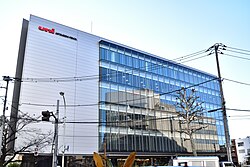 Mitsubishi Pencil
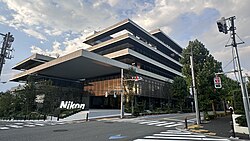 Nikon
Nikon
_8.jpg)


Former economic operations
editSony had its headquarters and related facilities in Kitashinagawa from 1947, the next year of its founding, until 2007.[3] They were relocated to Minato, Tokyo, and the site was redeveloped into an upscale residential area and office buildings.[4]
Nikon developed and manufactured products at factories in Nishiōi, Shinagawa from 1918 to 2016.[5][6] In 2024, the company built its headquarters building on the site of those former factories.[5]
 Former Sony headquarters in 2005
 Site of Sony headquarters in 2013
 Former factory of Nikon in 2016


Politics and government
editThe mayor of Shinagawa Ward is Kyoko Morisawa, elected on December 4, 2022. She is an independent politician born in 1978.
The Shinagawa Ward Assembly, consisting of 40 seats, held its last election on April 23, 2023.
Places
edit

- Museums
- ARCHI-DEPOT Museum[7]
- Kume Museum of Art
- The Museum of Package Culture[8]
- Nikon Museum
- O Art Museum
- Shinagawa Historical Museum,[9] a public local museum of Shinagawa
- Sugino Costume Museum
- SHINAGAWA AQUARIUM[10]
- The Galaxy Theatre
- Ohi Racecourse
- Togoshi Ginza Shopping District[11]
- Musashi Koyama Shopping District "PALM"[12]
- Historic sites
- Ōmori Shell Mounds[13]
- Former Tōkaidō Road
- Former Shinagawa-juku Station
- Site of Suzugamori Execution Grounds
- The Bridge of Tears[14]
- Former Shinagawa Port
- Site of Hamakawa Gun Battery[15]
- Parks
- Rinshi-no-mori Park[16]
- Shinagawa Kumin Park[17]
- Ikedayama Park,[18] site of a daimyō's villa
- Togoshi Park,[19] site of a daimyō's villa
- Ebara Shichi-Fuku-Jin (Seven Lucky Gods in Ebara area)
- Buddhist temples
- Shintō shrines
- Churches
- Meguro Catholic Church (St. Anselm's Church)[20]
- St. Stephen's Church,[21] Tokyo St. Mary's Church[22] – Anglican churches
- Christ Shinagawa Church[23] – a Presbyterian church
- Shinagawa Baptist Church,[24] Oi Baptist Church[25]
- Kreuzkirche Tokyo - a German-speaking Protestant Church[26]
Education
editHigher education
edit
Primary and secondary education
edit
Public elementary and junior high schools are operated by the Shinagawa Ward Board of Education. Public high schools are operated by the Tokyo Metropolitan Government Board of Education.
- Metropolitan high schools
- Private high schools
- The Junior High and Senior High School affiliated to the Bunkyo University
- Hoyu-Gakuin High School
- Kogyokusha Junior High and Senior High School
- Shinagawa Gakugei High School
- St. Hilda's School (Kōran Jogakkō Junior High and Senior High School)
- Shinagawa Etoile Girls' High School
- Shinagawa Joshi Gakuin Junior High and Senior High School
- Shinagawa Shouei Junior High School & Senior High School
- Seiryo Junior High and Senior High School
- International schools
- Special education schools
- Tokyo Metropolitan Shinagawa Special Needs Education School[29] – public school for intellectually disabled children
- Meisei Gakuen – private deaf school
Municipal combined elementary and junior high schools:[30]
Municipal junior high schools:[30]
- Ebara No. 1 Junior High School (荏原第一中学校)
- Ebara No. 5 Junior High School (荏原第五中学校)
- Ebara No. 6 Junior High School (荏原第六中学校)
- Fujimidai Junior High School (冨士見台中学校)
- Hamakawa Junior High School (浜川中学校)
- Osaki Junior High School (大崎中学校)
- Suzugamori Junior High School (鈴ヶ森中学校)
- Togoshidai Junior High School (戸越台中学校)
- Tokai Junior High School (東海中学校)
Municipal elementary schools:[30]
- No. 2 Enzan Elementary School (第二延山小学校)
- No. 1 Hino Elementary School (第一日野小学校)
- No. 3 Hino Elementary School (第三日野小学校)
- No. 4 Hino Elementary School (第四日野小学校)
- Asamadai Elementary School (浅間台小学校)
- Daiba Elementary School (台場小学校)
- Enzan Elementary School (延山小学校)
- Genjimae Elementary School (源氏前小学校)
- Gotenyama Elementary School (御殿山小学校)
- Hamakawa Elementary School (浜川小学校)
- Hatanodai Elementary School (旗台小学校)
- Hosui Elementary School (芳水小学校)
- Ito Elementary School (伊藤小学校)
- Jonan Elementary School (城南小学校)
- Jonan No. 2 Elementary School (城南第二小学校)
- Kamishinmei Elementary School (上神明小学校)
- Keiyo Elementary School (京陽小学校)
- Koyama Elementary School (小山小学校)
- Koyamadai Elementary School (小山台小学校)
- Mitsugi Elementary School (三木小学校)
- Miyamae Elementary School (宮前小学校)
- Nakanobu Elementary School (中延小学校)
- Ōhara Elementary School (大原小学校)
- Ōi No. 1 Elementary School (大井第一小学校)
- Samehama Elementary School (鮫浜小学校)
- Shimizudai Elementary School (清水台小学校)
- Suzugamori Elementary School (鈴ヶ森小学校)
- Tachiai Elementary School (立会小学校)
- Togoshi Elementary School (戸越小学校)
- Ushiroji Elementary School (後地小学校)
- Yamanaka Elementary School (山中小学校)
Transport
editImportant railway stations
edit

Shinagawa Station is in fact located in neighboring Minato but also serves the northern part of Shinagawa, and is a stop on the high-speed Tōkaidō Shinkansen line.
Rail
edit- East Japan Railway Company (JR East)
- Yamanote Line: Ōsaki, Gotanda and Meguro Stations
- Keihin-Tōhoku Line: Ōimachi Station
- Saikyō Line: Ōsaki Station
- Tōkaidō Main Line: does not stop at the stations in Shinagawa
- Yokosuka Line: Nishi-Ōi Station
- Shōnan-Shinjuku Line: Ōsaki and Nishi-Ōi Stations
- Tokyu Corporation (Tōkyū)
- Tōkyū Meguro Line: Meguro, Fudō-mae, Musashi-Koyama and Nishi-Koyama Stations
- Tōkyū Ōimachi Line: Shimo-Shinmei and Togoshi-kōen, Nakanobu, Ebaramachi and Hatanodai Stations
- Tōkyū Ikegami Line: Gotanda, Ōsaki-Hirokōji, Togoshi-Ginza, Ebara-Nakanobu and Hatanodai Stations
- Tokyo Waterfront Area Rapid Transit (Rinkai Line): Tennōzu Isle, Shinagawa Seaside, Ōimachi and Ōsaki Stations
- Tokyo Monorail: Tennōzu Isle and Ōi Keibajō Mae Stations
- Keikyu Corporation (Keikyū)
- Tokyo Metro
- Namboku Line: Meguro Station
- Tokyo Metropolitan Bureau of Transportation (Toei)
- Mita Line: Meguro Station
- Asakusa Line: Gotanda, Togoshi and Nakanobu Stations
Road
edit- Shuto Expressway (Shutokō)
- National highways
Shinagawa is also home to the main motor vehicle registration facility for central Tokyo (located east of Samezu Station). As a result, many license plates in Tokyo are labeled with the name "Shinagawa."
Major incidents / accidents
editInternational relations
edit


In popular culture
editNotable people from Shinagawa
edit- Tadasuke Akiyama, photographer
- Shizuka Arakawa, figure skater
- Nobutoshi Canna (Real Name: Nobutoshi Hayashi, Nihongo: 林 延年, Hayashi Nobutoshi), actor, voice actor, singer and narrator
- Char (Real Name: Hisato Takenaka, Nihongo: 竹中 尚人, Takenaka Hisato), musician, singer-songwriter and record producer
- Osamu Dezaki, anime director and screenwriter
- Renji Ishibashi (Real Name: Renji Ishida, Nihongo: 石田 蓮司, Ishida Renji), actor
- Kenji Kawai, composer and arranger
- Momoko Kikuchi, Japanese actress, entertainer, idol, and scholar
- Yun Kōga (Real Name: Risa Kimura, Nihongo: 木村 理沙, Kimura Risa), manga artist
- Akira Kurosawa, film director, screenwriter, and producer
- Taiki Matsuno (Real Name: Tatsuya Matsuno, Nihongo: 松野 達也, Matsuno Tatsuya), actor and voice actor
- Takeshi Mori, December 2, 1959, in Shinagawa, Tokyo, Japan), television announcer and tarento
- Keiji Nishikawa, professional shogi player ranked 8-dan
- Riho (Real Name Unknown), female professional wrestler and idol
- Yuki Sato, actor
- Chiyoko Shimakura, enka singer
- Tetsuo Suda, TV presenter and news anchor
- Issei Tamura, martial artist
- Taeko Watanabe, manga artist
- Miki Yamada, politician, member of the House of Representatives and member of the Liberal Democratic Party
- Masamoto Yashiro, businessman
- Masayoshi Takanaka (高中 正義, Takanaka Masayoshi), guitarist, composer, and producer.
Gallery
edit Main entrance of Togoshi Park
![Cherry blossoms at Goten-yama Hill [ja] in Kita-Shinagawa](http://wiki.nitrosworld.org/proxy-img/http%3A%2F%2Fupload.wikimedia.org%2Fwikipedia%2Fcommons%2Fthumb%2F2%2F25%2FGoten-yama_Hill%252C_Kita_Shinagawa_5Chome.jpg%2F250px-Goten-yama_Hill%252C_Kita_Shinagawa_5Chome.jpg) Cherry blossoms at Goten-yama Hill in Kita-Shinagawa
Cherry blossoms at Goten-yama Hill in Kita-Shinagawa Cherry blossoms at Goten-yama Hill by Hokusai
 Former Shinagawa Port
 Shinagawa Port by Hiroshige
 Night view of Higashi-Shinagawa

![Cherry blossoms at Goten-yama Hill [ja] in Kita-Shinagawa](http://wiki.nitrosworld.org/wiki/File:Goten-yama_Hill,_Kita_Shinagawa_5Chome.jpg)


References
edit- ↑ "Population by District". Tokyo Statistical Yearbook. Retrieved July 15, 2022.
- ↑ "Statistics of Shinagawa City". Shinagawa City Government. Retrieved April 14, 2016.
- ↑ "タイムカプセル Vol.8: さらば! 御殿山本社". Sony (in Japanese). Retrieved February 7, 2026.
- ↑ "【プロジェクト】ソニーのビル跡地2万5100m2に事務所や住宅を建設、積水ハウス". 日経不動産マーケット情報 (in Japanese). January 9, 2008. Retrieved February 7, 2026.
- 1 2 "History". Nikon. Retrieved February 26, 2026.
- ↑ 鈴木誠 (March 18, 2016). "ニコン大井製作所「101号館」の見納めに行ってきた". Impress Watch (in Japanese). Retrieved February 26, 2026.
- ↑ "ARCHI-DEPOT". ARCHI-DEPOT Museum. Retrieved August 2, 2018.
- ↑ "Exhibit Informatio". The Museum of Package Culture. Retrieved February 3, 2026.
- ↑ "Shinagawa Historical Museum". Shinagawa Historical Museum. Retrieved July 4, 2016.
- ↑ "There's plenty to see and do in the waters of Shinagawa!". SHINAGAWA AQUARIUM. Retrieved July 4, 2016.
- ↑ "Togoshi Ginza Shopping District". Tokyo Convention & Visitors Bureau. Retrieved July 4, 2016.
- ↑ "PALM GUIDE". Musashikoyama Shotengai Promotion Association. Retrieved July 4, 2016.
- ↑ "Shell-mound of Ohmori". Shinagawa Historical Museum. Retrieved July 3, 2016.
- ↑ Greg Lane. "The Bridge of Tears". Tokyo Cheapo. Retrieved March 7, 2026.
- ↑ Sleiman Azizi (April 4, 2021). "Shinagawa City Ward - Landmarks & History". Japan Travel. Retrieved March 7, 2026.
- ↑ "RINSHI-NO-MORI PARK". Shinagawa Tourism Association. Retrieved July 5, 2016.
- ↑ "Shinagawa Kumin Park". Tokyo Convention & Visitors Bureau. Retrieved July 4, 2016.
- ↑ "IKEDAYAMA PARK". Shinagawa Tourism Association. Retrieved July 5, 2016.
- ↑ "TOGOSHI PARK". Shinagawa Tourism Association. Retrieved July 5, 2016.
- ↑ "ご案内." カトリック目黒教会. February 8, 2016. Retrieved on April 8, 2016.
- ↑ "三光教会 St.Stephen's Church". Nippon Sei Ko Kai. Retrieved July 3, 2016.
- ↑ "東京聖マリア教会". Nippon Sei Ko Kai. Retrieved July 3, 2016.
- ↑ "品川教会の信仰." キリスト品川教会. 2014. Retrieved on April 8, 2016.
- ↑ "教会の案内." 品川バプテスト教会. Retrieved on April 8, 2016.
- ↑ "TOP." 大井バプテスト教会. 2016. Retrieved on April 8, 2016.
- ↑ "Information in English". Kreuzkirche Tokyo. Retrieved March 7, 2026.
- ↑ "Tokyo Metropolitan College of Industrial Technology". Tokyo Metropolitan College of Industrial Technology. Retrieved July 14, 2016.
- ↑ "Access." Canadian International School in Tokyo. Retrieved on October 29, 2014. "〒141–0001 5-8-20, Kitashinagawa, Shinagawa-ku, Tokyo"
- ↑ 東京都立品川特別支援学校. Tokyo Metropolitan Shinagawa Special Needs Education School. Retrieved July 16, 2016.
- 1 2 3 "小学校・中学校・義務教育学校ホームページ". Shinagawa. Retrieved November 7, 2022.
- 1 2 3 "姉妹都市・友好都市". Shinagawa City Government (in Japanese). March 28, 2025. Retrieved February 23, 2026.
- 1 2 3 "駐日外国公館リスト ヨーロッパ". Ministry of Foreign Affairs of Japan (in Japanese). February 6, 2026. Retrieved February 23, 2026.
- 1 2 3 4 "駐日外国公館リスト アジア". Ministry of Foreign Affairs of Japan (in Japanese). February 13, 2026. Retrieved February 23, 2026.
- 1 2 3 4 "駐日外国公館リスト ラテンアメリカ". Ministry of Foreign Affairs of Japan (in Japanese). January 9, 2026. Retrieved February 23, 2026.
- 1 2 3 "駐日外国公館リスト アフリカ". Ministry of Foreign Affairs of Japan (in Japanese). January 21, 2026. Retrieved February 23, 2026.
External links
edit


- Shinagawa City Official Website (in Japanese)