
The Sheats–Goldstein Residence is a house designed by American architect John Lautner, in the Beverly Crest neighborhood of Los Angeles, California. Designed and built between 1961 and 1963, Lautner used the sandstone ledge upon which the house was built as design inspiration for a cave-like dwelling, and used the hillside site to take advantage of the dramatic views of Benedict Canyon and Beverly Hills.[1] The house exemplifies the tenets of both Mid-Century Modern design and the American Organic Architecture ethos, deriving its form as an extension of its environment and of the individuals for whom it was built. The design of the house and the completed structure—like all of Lautner's work—have been commended as being strongly influenced and defined by addressing the challenges and constraints of the site.
| Sheats–Goldstein Residence | |
|---|---|
 | |
 Interactive map of the Sheats–Goldstein Residence area | |
General information | |
| Type | House |
Architectural style | Organic architecture |
| Location | Angelo View Drive, Los Angeles, California |
| Coordinates | 34°05′37″N 118°26′06″W / 34.0936°N 118.435°W |
Construction started | 1963 |
| Technical details | |
| Structural system | Poured-in-place concrete |
| Floor area | 4,500 sq ft (420 m2) |
| Design and construction | |
| Architect | John Lautner |
This article needs additional citations for verification. (January 2020) |
History
editThe house was originally built as a private residence for Helen Carolyn (née Johnson) Taylor Sheats (1910-1999),[2][3] and Paul Henry Sheats (1907-1984) and their three children. Helen, an architectural designer and Neo-Fauvist painter,[4][5][6] and Paul, Dean of University Extension and Professor in the UCLA Graduate School of Education,[7][8][9] had previously commissioned Lautner for their 1948–1949 Sheats Apartments project located in Westwood, a neighborhood adjacent to the University of California, Los Angeles.
The Sheats–Goldstein Residence is one of John Lautner's most well-known and completely unspoiled works. In addition to the house, Lautner designed the interiors, windows, lighting, rugs, furniture, and operable features as components of the home. Lautner’s comprehensive design of both the house and the forms within resulted in a cohesive and symbiotic design relationship: the materials and aesthetics of the forms enhance, complement, and tie the rooms together as individual but related design elements of the house as a whole. The extensive range of Lautner's design work is visible throughout the project.
Originally constructed with wood, steel, and poured-in-place concrete, the house has five bedrooms, four bathrooms, and one half-bathroom (sink and toilet). Lautner designed the living room completely open to the terrace, and protected by a forced-air curtain. Lautner's unique design took advantage of Southern California's temperate Mediterranean climate and the Santa Monica Mountains' warm canyon winds to create a natural, zesty environment with a seamless transition between the home's interior and exterior.
One of the home's most distinct features is the living room's coffered ceiling, the surface of which has over 750 cast drinking glass skylights. The home is cooled with cross-ventilation, while the floors and pool are warmed with copper-pipe radiant heating. Exterior pathways lead to guest bedrooms and the primary bedroom, and exterior features include a tennis court and nightclub. The primary bedroom and the studio have windows looking into the pool, designed so Helen Sheats could watch her children as she worked in her art studio.[citation needed]
In 1972, businessman James Goldstein purchased the residence from its third owners, and began a partnership with Lautner to renovate, upgrade, and improve the house.[10] For the following two decades, Goldstein and Lautner worked together "perfecting" the house until Lautner's death in 1994.[11] One of Goldstein's additions to the home is Above Horizon, an art installation designed by light artist James Turrell.
Located on a steep slope below the residence, Above Horizon was built with the same construction materials as the home. James Goldstein originally envisioned the installation as a collaboration between John Lautner and James Turrell, but Lautner died before being able to work extensively on the project. Completed in 2004, the room features two folding carbon-fiber portals and a built-in concrete lounge for viewing thousands of hidden LEDs lighting the room every evening.[12]
In 2016, James Goldstein entrusted the home and estate to the Los Angeles County Museum of Art (LACMA) as a promised gift to the institution. The endowment includes Goldstein's extensive art collection, Lautner's architectural models, and a 1961 Rolls-Royce Silver Cloud parked on the property. The collection is the first of its kind for LACMA and the endowment preserves the home's legacy, Lautner's work as an urban achievement, and its significance in Los Angeles architectural history.[13]
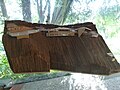 Scale site model
 Tennis court
 Concrete roof with cast-drinking glass skylights, exterior view
 Kitchen bar
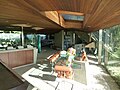 Dining area
 View from living room to terrace, pool
 Bedroom
 Club James


In popular culture
editThe house has been used in several movies, television shows, commercials, music videos, and adult films.[14]
Movies and Television
editSource:[15]
- Star Time (1992)
- The Big Lebowski (1998), as the house of porn magnate Jackie Treehorn[16]
- Bandits (2001)
- Charlie's Angels: Full Throttle (2003)
- Southland (2009–2013)
- Snowfall[17] (2017–2023)
- Selling Sunset (Season 7, Episodes 1, 2 (2023)
Music Videos
editSource:[15]
- Grapevyne[18] by Brownstone. (1995)
- It's All About You (Not About Me)[19] by Tracie Spencer. (1999) [20]
- Forgive[21] by Rebecca Lynn Howard. (2002)
- Let's Get Blown[22] by Snoop Dogg and Pharrell. (2005)
- The Fix by Nelly. (2015)[23][24]
- Say So[25] by Doja Cat. (2020)
Adult Films
editArt and Photography
edit- Actor Carel Struycken photographed the home's living room for his collection of spherical panoramas.[27]
Citations
edit- ↑ "The top houses from the movies". Daily Telegraph.
- ↑ Pimsleur, J.L. (May 22, 1999). "Helen Sheats". SFGATE. Retrieved 26 March 2025.
- ↑ "ARTIST HELEN TAYLOR SHEATS, 89". Chicago Tribune. 8 May 1999. Retrieved 26 March 2025.
- ↑ "Helen Carolyn (Johnson) Taylor Sheats - Biography". www.askart.com. Retrieved 26 March 2025.
- ↑ "Biography". Helen Art .com. Retrieved 26 March 2025.
- ↑ "Helen Taylor Sheats". Lost Art Salon. Retrieved 26 March 2025.
- ↑ "Paul H. Sheats, 1908-1984". University of California: In Memoriam, 1988. California Digital Library. Retrieved 26 March 2025.
- ↑ "Paul Henry Sheats Papers An inventory of his papers". Syracuse University. Retrieved 26 March 2025.
- ↑ "Paul Henry Sheats - 1907-12-05...1984-08-12". adulteducationcontributors.pbworks.com. Retrieved 26 March 2025.
- ↑ "This House Is a Work of Art, So the Owner Is Donating It to a Museum". NPR. Retrieved 2016-08-10.
- ↑ Hawthorne, Christopher (2016-02-17). "LACMA gets gravity-defying John Lautner-designed home featured in 'The Big Lebowski'". Los Angeles Times. Retrieved 2019-09-14.
- ↑ "The Light House". Robb Report. May 2004.
- ↑ "LACMA Announces Landmark Promised Gift of the James Goldstein House". Los Angeles County Museum of Art (LACMA). Retrieved 17 February 2016.
- 1 2 3 4
- Fleming, Steven (2009). "Archi-Porn - Eroticism in Architectural Theory as it Relates to the Adult Film Genre". NOVA open access repository. University of Newcastle (Australia). hdl:1959.13/919452. Retrieved 26 March 2025.
Fifth Global Conference on The Erotic: Exploring Critical Issues. Inter-Disciplinary (Salzburg, Austria 6-8 November, 2009)
- "5th Global Conference: The Erotic - Exploring Critical Issues (November 2009: Salzburg, Austria)". call-for-papers. University of Pennsylvania. Retrieved 26 March 2025.
- "A Global Network for Dynamic Research and Publishing". Inter-Disciplinary.Net. Archived from the original on 1 October 2016. Retrieved 26 March 2025.
- "Inter-Disciplinary Press". Inter/Connexions. 16 February 2022. Archived from the original on March 19, 2025. Retrieved 26 March 2025.
- "Publications and Talks". Dr. Steven Fleming. Retrieved 26 March 2025.
- Fleming, Steven. "Cycle Space". Cycle Space. Archived from the original on 6 October 2022. Retrieved 26 March 2025.
- Fleming, Steven (2009). "Archi-Porn - Eroticism in Architectural Theory as it Relates to the Adult Film Genre". NOVA open access repository. University of Newcastle (Australia). hdl:1959.13/919452. Retrieved 26 March 2025.
- 1 2 "Movies featuring Lautner buildings". The John Lautner Foundation. April 12, 2008. Retrieved May 15, 2026.
- ↑ Hawthorne, Christopher (February 17, 2026). "LACMA gets gravity-defying John Lautner-designed home featured in The Big Lebowski". Los Angeles Times. Retrieved May 15, 2026.
- ↑ "Snowfall – Season 1 (2017– ) FX Series Filming Locations". On Set Hollywood. Archived from the original on 15 March 2018. Retrieved 29 March 2020.
- ↑ "Brownstone - Grapevyne (Official Audio)". October 25, 2009 – via YouTube.
- ↑ "Tracie Spencer - It's All About You (Not About Me)". September 4, 2007 – via YouTube.
- ↑ "MAK Center's tennis tournament to serve up artful sport". Chicago Tribune. Retrieved 30 October 2021.
- ↑ "Rebecca Lynn Howard - Forgive". October 7, 2009 – via YouTube.
- ↑ "Snoop Dogg, Pharrell Williams - Let's Get Blown". December 24, 2009 – via YouTube.
- ↑ "Doja Cat: Say So (2020 Video) Filming & Production". IMDB.
- ↑ "Must see architecture in Los Angeles". Common. Retrieved 30 October 2021.
- ↑ "Doja Cat - Say So (Official Video)". February 27, 2020 – via YouTube.
- ↑
- Studio A. "Possessions". adult film database .com. Retrieved 26 March 2025.
- Blake, Andrew. "Possessions (2006) - Cast and Crew". AllMovie. Retrieved 26 March 2025.
- ↑ "Sheats/Goldstein residence livingroom". www.sphericalpanoramas.com. Retrieved 2022-11-29.
General sources
edit- Hess, Alan (2003). The Architecture of John Lautner. New York: Rizzoli.
- Lautner, John (1987). John Lautner, Architect. London Zurich Munich: Artemis.
External links
edit Media related to Sheats Goldstein Residence at Wikimedia Commons
- Official John Lautner website
- Architect Duncan Nicholson's web site
- James Goldstein's web site
- "Lautner, Schindler, Wright, and I" by Katya Tylevich; MARK No. 22