
The blue riverdamsel, Pseudagrion microcephalum[1] is a common species of damselfly in the family Coenagrionidae.[3] It is also known as the blue sprite[4] and blue grass dart.[5]
| Blue riverdamsel | |
|---|---|
| Male | |
 | |
| Female | |
Scientific classification  | |
| Kingdom: | Animalia |
| Phylum: | Arthropoda |
| Clade: | Pancrustacea |
| Class: | Insecta |
| Order: | Odonata |
| Suborder: | Zygoptera |
| Family: | Coenagrionidae |
| Genus: | Pseudagrion |
| Species: | P. microcephalum |
| Binomial name | |
| Pseudagrion microcephalum | |
| Synonyms[3] | |
| |
_male_Ben_Tre.jpg)

Taxonomic history
editFor many years, Pseudagrion microcephalum was considered to be a widespread species occurring across southern and eastern Asia, Australasia and the Pacific.[6]
In 2026, Malte Seehausen and Milen Marinov reviewed the Pseudagrion microcephalum species complex and restricted Pseudagrion microcephalum to populations from the Indian subcontinent and Sri Lanka.[6]
As part of this revision, Australian, Papuan and Pacific populations previously identified as Pseudagrion microcephalum were reassigned to several distinct species, including Pseudagrion crenatum in Australia and New Guinea. Other populations from Southeast Asia and the western Pacific were also reassigned to newly recognised regional species.[6]
Distribution
editDescription
editIt is a medium-sized damselfly with pale blue eyes, dark on top. They grow to 38mm in length. Its thorax is azure blue with black, broad dorsal stripes and narrow humeral stripes. Abdominal segments 1 and 2 are blue with black marks on the dorsum. Mark on segment 2 looks like a chalice or thistle-head. Segments 3 to 7 are black on dorsum and blue on the sides. Segments 8 and 9 are blue; 8 with a thick and 9 with a thin black apical annules. Segment 10 is black on dorsum and blue on the sides. Superior anal appendages are of the same length of segment 10; black and divided at the apices.[8]
Eyes and thorax of the female is bluish green, suffused with orange, marked as in the male; but black is replaced by orange. Color of the abdomen is similar to the male; but paler. Segments 8 and 9 are also black with fine apical blue rings. Segment 10 is pale blue.[8]
 Male
Male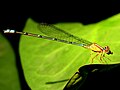 Young male
 Female
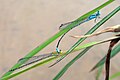 Tandem pair
 Mating pair
_male.,_നാട്ടുപ്പൂത്താലി._(26148144539).jpg)

_female.,_നാട്ടുപ്പൂത്താലി._(25267244818).jpg)
_Mating_(19652922464).jpg)
._(25346618558).jpg)
Habitat
editThis species can easily be found near running water or still water. They usually rest on the plants either in the middle of ponds or at the water edges. It breeds in ponds, lakes and streams. It is entirely a species of the plains, being replaced by Pseudagrion malabaricum in the neighboring hills of Western Ghats of India and Sri Lanka, and by Pseudagrion australasiae to the north-east of India and Burma.[8][9][10]
Etymology
editThe genus name Pseudagrion is derived from the Greek ψευδής (pseudēs, "false" or "not true"), combined with Agrion, a genus name derived from the Greek ἄγριος (agrios, "wild"). Agrion was the name given in 1775 by Johan Christian Fabricius for all damselflies.[11]
The species name microcephalum is derived from the Greek μικρός (mikros, "small") and κεφαλή (kephalē, "head"), referring to its relatively small head compared with other species.[2][11]
See also
editReferences
edit- 1 2 Dow, R.A.; Wilson, K.D.P. (2017). "Pseudagrion microcephalum". IUCN Red List of Threatened Species. 2017 e.T167199A83376119. doi:10.2305/IUCN.UK.2017-1.RLTS.T167199A83376119.en. Retrieved 20 November 2021.
- 1 2 Rambur, Jules (1842). Histoire naturelle des insectes. Névroptères (in French). Paris: Librairie Encyclopédique de Roret. pp. 534 [259] – via Gallica.
- 1 2 Paulson, D.; Schorr, M.; Abbott, J.; Bota-Sierra, C.; Deliry, C.; Dijkstra, K.-D.; Lozano, F. "World Odonata List". OdonataCentral. University of Alabama. Retrieved 3 April 2026.
- ↑ "Pseudagrion microcephalum Rambur, 1842". India Biodiversity Portal. Retrieved 2017-03-07.
- ↑ "Pseudagrion microcephalum Rambur, 1842 - Blue Sprite". Odonata of India. Retrieved 2026-04-03.
- 1 2 3 4 Seehausen, M.; Marinov, M. (2026). "Pseudagrion microcephalum (Rambur, 1842)—sifting through a putative familiar species, with erection of two new species (Odonata: Coenagrionidae)". Zootaxa. 5810 (1): 1–48. doi:10.11646/zootaxa.5810.1.1.
- ↑ K.A., Subramanian; K.G., Emiliyamma; R., Babu; C., Radhakrishnan; S.S., Talmale (2018). Atlas of Odonata (Insecta) of the Western Ghats, India. Zoological Survey of India. pp. 177–178. ISBN 978-81-8171-495-4.
- 1 2 3 C FC Lt. Fraser (1933). The Fauna of British India, including Ceylon and Burma, Odonata Vol. I. Red Lion Court, Fleet Street, London: Taylor and Francis. pp. 278–290.
- ↑ Fraser, F.C. (1924). "A Survey of the Odonate (Dragonfly) Fauna of Western India with Special Remarks on the Genera Macromia and Idionyx and Descriptions of Thirty New Species". Records of the Zoological Survey of India. 26 (5). doi:10.26515/rzsi/v26/i5/1924/162660.
- ↑ Subramanian, K. A. (2005). Dragonflies and Damselflies of Peninsular India - A Field Guide.
- 1 2 Endersby, Ian; Fliedner, Heinrich (2015). The Naming of Australia's Dragonflies. Eltham, Victoria, Australia: Busybird Publishing. ISBN 9781925260625.

