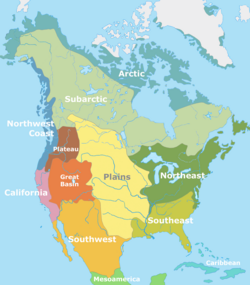
The Indigenous peoples of the Americas PortalThe Indigenous peoples of the Americas are the peoples who are native to the Americas or the Western Hemisphere. Their ancestors are among the pre-Columbian population of South or North America, including Central America and the Caribbean. Indigenous peoples live throughout the Americas. While often minorities in their countries, Indigenous peoples are the majority in Greenland and close to a majority in Bolivia and Guatemala. There are at least 1,000 different Indigenous languages of the Americas still in use in the 21st century. Some languages, including Quechua, Arawak, Aymara, Guaraní, Nahuatl, and some Mayan languages, have millions of speakers and are recognized as official by governments in Bolivia, Peru, Paraguay, and Greenland. (Full article...) Selected article Chaco Culture National Historical Park is a United States National Historical Park hosting the densest and most exceptional concentration of pueblos in the American Southwest.The park is located in northwestern New Mexico, between Albuquerque and Farmington, in a remote canyon cut by the Chaco Wash. Containing the most sweeping collection of ancient ruins north of Mexico, the park preserves one of the most important pre-Columbian cultural and historical areas in the United States. Between AD 900 and 1150, Chaco Canyon was a major center of culture for the Ancient Pueblo Peoples.Chacoans quarried sandstone blocks and hauled timber from great distances, assembling fifteen major complexes that remained the largest buildings in North America until the 19th century.Evidence of archaeoastronomy at Chaco has been proposed, with the "Sun Dagger" petroglyph at Fajada Butte a popular example. Many Chacoan buildings may have been aligned to capture the solar and lunar cycles,requiring generations of astronomical observations and centuries of skillfully coordinated construction Climate change is thought to have led to the emigration of Chacoans and the eventual abandonment of the canyon, beginning with a fifty-year drought commencing in 1130. Comprising a UNESCO World Heritage Site located in the arid and sparsely populated Four Corners region, the Chacoan cultural sites are fragile – concerns of erosion caused by tourists have led to the closure of Fajada Butte to the public. The sites are considered sacred ancestral homelands by the Hopi and Pueblo people, who maintain oral accounts of their historical migration from Chaco and their spiritual relationship to the land. Though park preservation efforts can conflict with native religious beliefs, tribal representatives work closely with the National Park Service to share their knowledge and respect the heritage of the Chacoan culture. The park is on the Trails of the Ancients Byway, one of the designated New Mexico Scenic Byways. Selected imageGeneral imagesThe following are images from various Indigenous peoples of the Americas-related articles on Wikipedia.
Selected biography Juan Evo Morales Ayma, (born October 26, 1959), popularly known as Evo (Spanish pronunciation: [ˈeβo]), is a Bolivian politician, cocalero activist, and footballer, who has served as President of Bolivia since 2006. Widely regarded as the country's first democratically-elected president to come from the indigenous population, his administration has focused on the implementation of leftist policies, poverty reduction, and combating the influence of the United States and transnational corporations in Bolivia. A democratic socialist, he is the head of the Movement for Socialism (MAS) political party. Born to an Aymara family of subsistence farmers in Isallawi, Orinoca Canton, Morales undertook a basic education before mandatory military service, in 1978 moving to Chapare Province. Growing coca and becoming a trade unionist, he rose to prominence in the campesino (rural laborers) union, campaigning against U.S. and Bolivian attempts to eradicate coca as a part of the War on Drugs, which he denounced as an imperialist violation of indigenous Andean culture. He repeatedly engaged in anti-government direct action protests, resuting in multiple arrests. Entering electoral politics in 1995, he became the leader of the MAS and was elected to Congress. His campaign focused on issues affecting indigenous and poor communities, advocating land reform and the redistribution of gas wealth. Gaining increasing visibility through the Cochabamba protests and gas conflict, in 2002 he was expelled from Congress, though came second in that year's presidential election. Did you know…
Subcategories Select [►] to view subcategories
Related portalsThings you can do
Topics
Recognized content
Featured articlesFormer featured articlesFeatured listsGood articles
Former good articlesDid you know? articles
In the News articles
Associated WikimediaThe following Wikimedia Foundation sister projects provide more on this subject:
American indigenous language WikipediasAvañe'ẽ (Warani) · Aymar aru (Aymara) · ᏣᎳᎩ (Cherokee) · Chahta (Choctaw) · ᐃᔨᔫ (Cree) · ᐃᓄᒃ (Inuktitut) · Iñupiak · Kalaallisut (Greenlandic Inuit) · Mvskoke (Muscogee) · Nahuatlahtolli · Diné bizaad (Navajo) · Qhichwa Simi · Tsêhesenêstsestôtse (Cheyenne) Indigenous languages in Wikimedia Incubators: Alabama · Blackfoot · Chinook Jargon · Choctaw · Creek · Lakota · Micmac · Mohawk · Nheengatu · Northwestern Ojibwa · O'odham · Shoshoni · Unami-Lenape · Wüne pakina (Mapudungun) · Yucatec Maya · Central Alaskan Yup'ik · Zuni | |||||||||||||||||||||||||||||||||||||


.jpg)


_-_49503469491.jpg)


.jpg)


_(cropped).jpg)


.jpg)


_2007.jpg)


.jpg)


.svg)
.svg)


.svg)