
A parochet (Hebrew: פרוכת, romanized: parôkheth; Yiddish: פרוכת, romanized: paroykhes), meaning "curtain" or "screen",[1] is the curtain that covers the Torah ark (Aron Kodesh) containing the Torah scrolls in a synagogue. File:Dutch-Portuguese Sephardic Torah Ark Curtain (Parochet), c. 1760–1770 – Silk velvet and metallic embroidery – Beatriz de Luna Art Collection.jpg|Dutch-Portuguese Sephardic parochet (Torah Ark Curtain), silk velvet and metallic embroidery, c. 1760–1770. The parochet symbolizes the curtain that covered the Ark of the Covenant, based on Exodus 40:21: "Then he put up the curtain for screening, and screened off the Ark of the Pact—just as יהוה had commanded Moses."[2]
.jpg)
In most synagogues, the parochet which is used all year round is replaced during the High Holy Days with a white one.
The term parochet is used in the Hebrew Bible to describe the curtain that separated the Holy of Holies from the main hall (Hebrew: היכל, romanized: hekhal)[3] of the Temple in Jerusalem. Its use in synagogues is a reference to the centrality of the Temple to Jewish worship.
The Umberto Nahon Museum of Italian Jewish Art in Jerusalem houses the oldest surviving parochet, dating to 1572.[4]
Gallery
edit Parochet of the Synagoge in Mühlhausen
 Original parochet from Great Lublin Maharshal's Synagogue from 1926, today in Bielsko-Biała synagogue, Poland
 Early-17th-century parochet from Cairo, Egypt
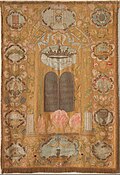 1698 linen and silk parochet from Venice, Italy
 Parochet in the Hurva Synagogue in Jerusalem
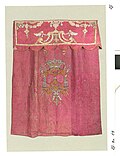 Parochet from 1797, Jewish Museum of Switzerland.
 Parochet in the Synagogue at 770 Eastern Parkway


_with_Hebrew_inscription_from_Psalms_CXVIII-20,_Egypt,_Cairo,_Ottoman_Empire,_early_1600s,_wool_-_Textile_Museum,_George_Washington_University_-_DSC09735.JPG)


See also
edit- Holy of Holies, inner sanctuary of the Temple in Jerusalem, separated from the Holy by a curtain (parochet)
- Crucifixion of Jesus - at the death of Jesus the curtain of the Temple (Gr. katapetasma; the parochet) is torn in two
References
edit- ↑ Sonne Isaiah (1962) 'Synagogue' in The Interpreter's dictionary of the Bible vol 4, New York: Abingdon Press pp 476-491
- ↑ "Exodus 40:21". www.sefaria.org.
- ↑ Stinespring W. F. (1962) 'Temple, Jerusalem' in 'The interpreters Dictionary of the Bible' vol 4 p 536
- ↑ Jewish Italian Heritage Lives On in Jerusalem