
A papadam, also known as a poppadom, papadom or papadum among other transliterations, is a snack that originated in the Indian subcontinent. Dough of black gram bean flour is either deep-fried or cooked with dry heat (flipped over an open flame) until crunchy. Other flours made from lentils, chickpeas, rice, tapioca, millet or potato are also used. Papadam is typically served as an accompaniment to a meal in India, Pakistan, Bangladesh, Nepal, Sri Lanka and the Caribbean or as an appetizer, often with dips such as chutneys, or toppings like chopped onions and chili peppers.
 Fire-roasted papadam | |
| Alternative names |
|
|---|---|
| Course | Appetizer or side dish |
| Main ingredients | |
| Variations |
|


Etymology
editRegional variations
edit

Papad recipes vary from region to region and from household to household. They are typically made from a flour or paste made from lentils, chickpeas, black gram, rice, or potatoes.[5]
Salt and peanut oil are added to make a dough, which can be flavored with seasonings such as chili, cumin, garlic, or black pepper. Sometimes, baking soda or slaked lime are also added. The dough is shaped into thin, round flatbreads, dried (traditionally in the sun[6]), and can be cooked by deep frying, roasting over an open flame, toasting, or microwaving, depending on the desired texture.
In most Indian restaurants around the world, they are served as an appetizer with dips, which often include mango chutney, lime pickle, onion chutney, and raita. Masala papad with sev, onion, tomato and coriander leaves is one of India's most popular appetizers.
Kappa pappadam
editKappa pappadam is a variety from the South Indian state of Kerala. It derives its name from its main ingredient of tapioca, which is known as "kappa" in Malayalam.[7] It is also known as Maracheni, Cheeni pappadam/Appalam, and Cassava Papad.
The key ingredient, tapioca, is spiced with red chili, peppers, salt, cumin and asafoetida. The red chili is responsible for the characteristic brownish-orange color of kappa pappadam. Some variants appear white in color owing to the replacement of red chili with green chili.
The tapioca is diced and ground with chili, pepper, cumin and water to form a fine paste. This paste is further boiled with salt, asafoetida, coconut oil and more water till it thickens.[8]
It is then spread out in circles on a cheesecloth or plastic sheet and is allowed to dry in the sun. Traditionally, a straw mat was used to dry the pappadams. After a few hours the pappadams are peeled and the sides reversed. After 2–3 days of good sunlight, the pappadams become crisp, indicating that they are ready to be fried.
The dried pappadams are then deep fried in oil and served. For those who wish to refrain from deep fried dishes, the pappadams can be coated with minimal oil and microwaved for one minute.
A 2017 film starring Fahadh Fazil is titled Kappa Pappadam, a reference to the snack and its culture.[9][10]
Ingredients and preparation
editPapadam can be prepared from different ingredients and methods. One popular recipe uses flour ground from hulled split black gram[11] mixed with black pepper, salt, a small amount of vegetable oil and a food-grade alkali, and the mixture is kneaded. A well-kneaded dough is then flattened into very thin rounds and then dried and stored for later preparation and consumption. It may also contain rice, jackfruit, sago, etc., as main ingredients.
Cracked black pepper, red chili powder, asafoetida, cumin or sesame seeds are often used as flavoring agents. Papadam is also made from rice flakes, ragi or horsegram.[12]
Gallery
edit Pappadam
 Rice papadam
 Uradal papadam
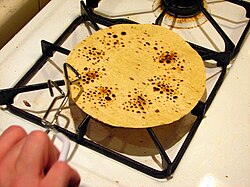 Fire-toasting papadam
 A Nepali thali with papad
 Raw jackfruit papad in coastal Karnataka
 Papadam with chutney served as an appetizer at a South Asian style restaurant in Finland
 Microwaved papad texture


See also
edit
- Indian bread – Various flatbreads and crêpes in Indian cuisine
- Sandige – Fried snack, originating from the Indian subcontinent
References
edit- ↑ "poppadom, n." OED Online. December 2006. Oxford University Press.<http://www.oed.com/view/Entry/147794?redirectedFrom=poppadum#>.
- ↑ "Digital Dictionaries of South Asia". University of Chicago. 1962.
- ↑ "Poppadom - Definition and synonyms of poppadom in the English dictionary". educalingo.com. Retrieved 22 September 2021.
- ↑ "Lip-Smacking Ways to Use Papad: From Masala Papad to Rolls and Chaats". NDTV Food. Retrieved 12 September 2022.
According to food historian and author KT Achaya, "The parpata (papad) is first mentioned in about 500BC in Buddhist-Jain canonical literature, and the medical authorities note that they are made from pulses like urad, masoor, chana and the like."
- ↑ Aoyagi, William Shurtleff; Akiko (17 February 2019). History of Soy Flour, Flakes and Grits (510 CE to 2019): Extensively Annotated Bibliography and Sourcebook. Soyinfo Center. p. 814. ISBN 978-1-948436-06-9.
{{cite book}}: CS1 maint: multiple names: authors list (link) - ↑ B.Gangwar (21 January 2013). Solving The Pulses Crisis. New India Publishing Agency. p. 197. ISBN 978-93-81450-48-2.
- ↑ Crispy Kappa Pappadam, Manorama Online, 3 June 2020, retrieved 8 April 2024
- ↑ "Kappa Pappadam Recipe, How to make Kappa Pappadam or Tapioca Papad - Cook with Whiskaffair". Cook with Whiskaffair. 12 July 2016. Archived from the original on 17 July 2016. Retrieved 8 October 2016.
- ↑ "IndiaGlitz - Fahad in Kappa Pappadam - Malayalam Movie News". Archived from the original on 18 October 2021. Retrieved 8 October 2016.
- ↑ Kappa Pappadam, FilmiBeat, 1 November 2021, retrieved 8 April 2024
- ↑ J. Smartt; Emmanuel Nwokolo (6 December 2012). Food and Feed from Legumes and Oilseeds. Springer Science & Business Media. p. 28. ISBN 978-1-4613-0433-3.
- ↑ "Poha papad, Rice flakes Papad, Summer Recipe". Udupi-Recipes. 11 March 2018. Retrieved 9 January 2020.
External links
edit Media related to Papadams at Wikimedia Commons