
Palace of the Inquisition (Cartagena, Colombia)
The Palace of the Inquisition, also known as the Inquisition Palace, (Spanish: Palacio de la Inquisición, Spanish pronunciation: [paˈlasjo ðe lajŋkisiˈsjon]) is an eighteenth-century the seat of the Holy Office of the Inquisition in Cartagena, now in modern Colombia. Completed in 1770,[1] The building now houses the Museo Histórico de Cartagena, which presents exhibits on the city’s colonial and republican past and on the operation of the Holy Office in Cartagena.[2] Alongside information on trials, imprisonment and autos-da-fé, the museum shows alleged Inquisition torture devices; however, many of these items appear to be modern replicas or generic “medieval” reconstructions, and there is little evidence that they were actually used by the tribunal in Cartagena.[3]
| Palace of the Inquisition | |
|---|---|
Palacio de la Inquisición | |
 Palace of the Inquisition | |
 Interactive map of the Palace of the Inquisition area | |
Alternative names | Inquisition Palace |
General information | |
Architectural style | Spanish Colonial, Baroque |
| Location | Cartagena, Colombia, Cartagena, Colombia |
| Coordinates | 10°25′22.47″N 75°33′4.88″W / 10.4229083°N 75.5513556°W |
Construction started | 1610 |
| Completed | 1770 |
| Owner | Colombian government |
| Technical details | |
| Floor count | 2 |
Some of the devices commonly associated with the Inquisition, such as the so‑called "iron maiden", are now considered nineteenth‑century inventions created for sensational exhibitions, rather than genuine instruments used by early modern tribunals.[4] When similar objects appear in "Inquisition museums", they are generally regarded by historians as later fabrications rather than authentic Spanish Inquisition equipment.[5]
History
editThe establishment of the Palace was decreed by Philip III of Spain.[6] Since Cartagena was a center of commerce, a transit point between the Caribbean and Spanish settlements in western South America, the city became the third in the Spanish empire to have a tribunal of the Holy Office of the Inquisition. Some merchants were Portuguese and suspected of being crypto-Jews (Jews passing as Christian). During the period 1580–1640, the crown of Portugal and that of Spain were ruled by the same monarch, and the period saw many Portuguese merchants active in Spain's overseas colonies. Established in 1610,[7] the current building was completed much later.[a] The tribunal operated for over two centuries until 1821, processing approximately 800 cases with only 3 to 5 executed.[10] [11]Despite its notorious reputation, only between 3 and 5 people were executed during this entire period, with most convicted individuals receiving sentences of flogging. The relatively low number of executions has led some historians to characterize the Cartagena tribunal as one of the more lenient inquisitorial courts of its era.
Architecture
edit

The Palace is built in Spanish Colonial style,[8] with elements from the Baroque era.[7] A crucifix occupies one of the walls facing a torture equipment.[12] The white brick structure[13] has gateways made of stone.[7] The rooms of the Palace are mostly made up of masonry.[14] The framework of the Palace is built out of wood;[15] double-storey[9] limestones were also used in the making of the Palace.[16] The museum displays coins, maps, weapons, furniture, church bells, and depictions of notable generals, in addition to the torture equipment used previously.[17] The Palace was partially restored to preserve Colombia's cultural heritage.[15]
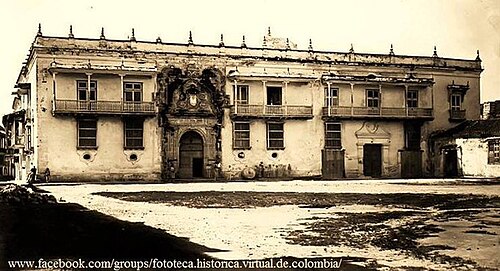 Palace of the Inquisition in 1875 (cleaned photo).
 Palace of the Inquisition in 1893. Yale University Library.[18]
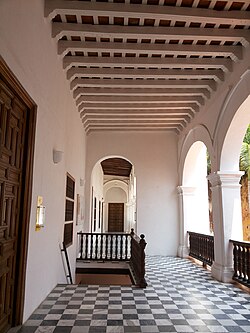 Colonial corridor
 Anonymous Complaint Window
.jpg)


See also
editNotes
editReferences
edit- ↑ Moreno-Goldschmidt, Aliza (2018). Conversos de origen judío en la Cartagena colonial: Vida social, cultural y económica en el siglo XVII. Pontifical Xavierian University Publisher. ISBN 978-9587812046.
- ↑ Álvarez, Moisés (8 September 2015). "Retiran instrumentos de tortura del Palacio de la Inquisición en Cartagena". RCN Radio (in Spanish). Retrieved 27 April 2026.
- ↑ "Historia y terror - Opiniones sobre Museo Histórico de Cartagena de Indias". Tripadvisor (in Spanish). 2013. Retrieved 27 April 2026.
- ↑ "La «Doncella de hierro», la máquina de tortura que se creó a raíz de una historia falsa". El Debate (in Spanish). 4 January 2025. Retrieved 27 April 2026.
- ↑ "Darío Madrid: «Los instrumentos que exponen en los llamados museos de la Inquisición son falsos»". España al Día (in Spanish). 3 January 2024. Retrieved 27 April 2026.
- ↑ Kelemen, Kal (1967). Baroque and Rococo in Latin America. Vol. 1 (2 ed.). Dover Publications.
- 1 2 3 Kohn, Michael (2006). Colombia. Ediz. Inglese (4 ed.). Lonely Planet. p. 129. ISBN 9781741042849.
- 1 2 Cruise Travel. Vol. 9. Lakeside. July 1987. p. 25.
- 1 2 Melton, J. Gordon (2010). Religions of the World, Second Edition: A Comprehensive Encyclopedia of Beliefs and Practices (2 ed.). ABC-CLIO. p. 746. ISBN 9781598842043.
- ↑ Parker, Geoffrey (October 1989). "Reviews : Gustav Henningsen and John Tedeschi, in association with Charles Amiel, eds, The Inquisition in Early Modern Europe; Studies on Sources and Methods, Dekalb, Northern Illinois University Press, 1986; xiv + 241 pp.; £31.80". European History Quarterly. 19 (4): 538–539. doi:10.1177/026569148901900407. ISSN 0265-6914.
- ↑ "La Inquisición: historia del Tribunal del Santo Oficio de Cartagena". www.radionacional.co. Retrieved 2026-04-26.
- ↑ Arbell, Mordehay (2002). The Jewish Nation of the Caribbean: The Spanish-Portuguese Jewish Settlements in the Caribbean and the Guianas. Gefen. p. 309. ISBN 9789652292797.
- ↑ Ebony. Johnson Publishing Company. April 1968. p. 131.
- ↑ Coghlan, Nicholas (2004). Saddest Country: On Assignment in Colombia. McGill-Queen's Press. p. 41. ISBN 9780773527874.
- 1 2 "Museo Histórico de Cartagena de Indias - Palacio de la Inquisición" (in Spanish). Cartagena de Indias. Archived from the original on January 5, 2012. Retrieved May 12, 2013.
- ↑ "Historia" (in Spanish). Musueo Historico de Cartagena. Retrieved May 12, 2013.
{{cite web}}: CS1 maint: deprecated archival service (link) - ↑ The Rotarian. Vol. 128. March 1976. p. 31.
- ↑ "Colombia, 1893 by Clímaco Calderón, Consul-General of Colombia, N.Y." Yale University Library Digital Collections.