
Owain ap Gruffudd Fychan or Owain Glyndŵr[a] ('Owain of Glyndyfrdwy', Welsh pronunciation: [ˈoʊain ˈɡlɨ̞nduːr], c. 1359 – c. 1416) was a Welsh nobleman and military commander in the late Middle Ages who led a sixteen-year-long Welsh revolt establishing an independent Wales free from English rule. Owain was acclaimed Prince of Wales by his supporters on 16 September 1400 because of his descent from the rulers of pre-Conquest Wales. Following initial successes, the rebellion was able to take control of the entirety of the country between 1404 and 1405. However, an increase of English military pressure and the lack of foreign aid resulted in the loss of all rebel territory by 1409, after which Owain continued sporadic resistance until his disappearance from the historical record in 1412.
| Owain Glyndŵr | |
|---|---|
 A nineteenth-century illustration of Owain Glyndŵr based on the design of his great seal | |
| Prince of Wales | |
| Pretence | 16 September 1400 – c. 1416 |
| Predecessor | Owain Lawgoch |
| Successor | No further Welsh claimants |
| Born | c. 1359 or earlier |
| Died | c. 1416 (aged 56–57) |
| Burial | Herefordshire (at first?) Cwmhir Abbey (reburial?) |
| Spouse | |
| Issue among others | |
| Dynasty | Lleision |
| Father | Gruffudd Fychan |
| Mother | Elen ferch Tomas ap Llywelyn |
| Military career | |
| Allegiance | England (1385 – 1400) Wales (1400 – c. 1416) |
Conflicts Battles | 1385 invasion of Scotland Hundred Years' War Glyndŵr rebellion See list
|
| Signature |  |
During the year 1400, Owain, a Welsh soldier and Lord of Glyndyfrdwy, had a dispute with a his English neighbour Reginald de Grey, a symptom of larger animosity between the Welsh and English in Wales which ultimately led to a national revolt that pitted common Welsh countrymen and nobles against the English military. In response to the rebellion, discriminatory penal laws were implemented against the Welsh people; this deepened civil unrest and significantly increased support for Owain across Wales. Then, in 1404, after a series of successful castle sieges and several battlefield victories for the Welsh, Owain gained control of most of Wales and held a parliament in Machynlleth in the presence of envoys from France, Scotland, the Spanish kingdoms of Castille and Leon, and representatives from every region of Wales. Military aid was given to the rebellion from France, Brittany, and Scotland. Owain wrote in the Pennal Letter of 1406 that he had plans to build two universities, one in North Wales and one in South Wales, and reinstate the traditional Welsh laws of Hywel Dda, and to expand Wales' borders into England, which would have affected the structure of the Church.
The war continued, and over the next several years, the English gradually gained control of large parts of Wales. By 1409 the rebellion’s last remaining castles of Harlech and Aberystwyth had been captured by English forces. Owain refused two royal pardons and retreated to the Welsh hills and mountains with his remaining forces, where he continued to resist English rule by using guerrilla warfare tactics, until his disappearance from the historical record in 1412.
Owain was never captured or killed, and the circumstances surrounding his death are unknown. In Welsh culture he acquired a mythical status alongside Cadwaladr, Cynon ap Clydno and King Arthur as a folk hero, and was seen as the 'Son of Destiny', just as was Owain Lawgoch a few decades earlier. He also appears in William Shakespeare's play Henry IV, Part 1 he appears as the character Owen Glendower.
Background, early life and career
Background
Owain Glyndŵr was the son of Gruffudd Fychan and Elen ferch Tomas ap Llywelyn.[1] Little is known of his father, though he held the important post of steward in the earl of Arundel's lordship of Oswestry from 1346 to 1348 and was lord of Glyndyfrdwy and Cynllaith, two non-contiguous lordships at opposite ends of the Berwyn range.[2][3] Through his father, Owain could boast senior, if remote, ancestry from Madog ap Maredudd, the last ruler of a united Powys.[4] However, his mother's lineage granted him descent not only from her own Dynasty of Deheubarth but also from the Second Dynasty of Gwynedd in three discrete instances and even from King John through John's daughter Joan.[5][6][b] This direct descent from the three major dynasties of pre-Conquest Wales made Owain a unique figure in his time.[13][14][15] This peculiar attribute was commented upon by the poet Iolo Goch, who sang a poem to Owain before his rebellion celebrating his ancestry from these dynasties and encouraging him to demand his legal rights under English rule to Powys as the senior representative of its old dynasty.[16][17] However, the only reference Owain himself would make towards his ancestry during his rebellion was to his supposed descent from Cadwaladr ap Cadwallon, a seventh-century king of Gwynedd who was seen as a legendary deliverer of the Welsh people and was recorded as the last King of the Britons in Geoffrey of Monmouth's immensely popular pseudo-history entitled De gestis Britonum.[18][19][20][21]

Early life
Owain was born in or before 1359.[22][c] A typical man of his era, Glyndŵr was trained as a soldier engaging in war in the 1380s for the English Kingdom, and becoming an esquire for Richard Fitzalan, 4th Earl of Arundel, dated 13 March 1387 and enrolling to overseas service in May 1388.[23] Yet not much is known of him before 1395, other than Sycharth and Glyndyfrdwy were his lands where he called home, and that Glyndŵr had an accomplished military career for the Kingdom of England.[24] Owain's father Gruffudd Fychan was descended from a younger brother of Llywelyn Fychan ap Gruffudd, the last lord of Northern Powys who was killed in the Edwardian conquest of Wales alongside Llywelyn ap Gruffudd.[25][26] Gruffudd Fychan was baron of Glyndyfrdwy (or Glyndŵr) and Cynllaith in his own right. Owain's father was dead by 1370, which left his mother Elen ferch Tomas a widow whilst he was still a boy.[27][28] Owain's mother was from Iscoed, Ceredigion, and was a descendant of Gruffudd, eldest son of the Lord Rhys, Prince of Deheubarth.[29][30] After Glyndwr's father died when he was young he was likely fostered in the home of David Hanmer, who shared responsibilities of raising him with his mother as well as the Arundell family, specifically the FitzAlans, who were expected to offer support and patronage to encourage his military career.[31]
Early career
The young Owain ap Gruffudd Fychan under the teutalage of David Hanmer became a rising lawyer shortly to be a justice of the King's Bench, or at the home of Richard Fitzalan, Earl of Arundel. Owain is then thought to have been sent to London to study law at the Inns of Court, as a student in Westminster, London,[32][33] for over a period of seven years. He was possibly in London during the Peasants' Revolt of 1381.[34] By 1384, he was living in Wales and married to David's daughter, Margaret Hanmer;[35] their marriage took place, perhaps in 1383, in St Chad's Church, Hanmer in north-east Wales.[36] Although other sources state that they were married in the 1370s.[37] They started a large family and Owain established himself as the squire of his ancestral lands at Sycharth and Glyndyfrdwy.[38]
Owain joined the king's military service in 1384 when he undertook garrison duty under the Welshman Sir Gregory Sais on the English–Scottish border at Berwick-upon-Tweed. His surname Sais, meaning 'Englishman' in Welsh, refers to his ability to speak English, not common in Wales at the time.[23][39] In August 1385, he served King Richard II under the command of John of Gaunt, again in Scotland.[22][40][41] At the age of twenty-seven, Owain was called to give evidence at the High Court of Chivalry, in the Scrope v Grosvenor trial on 3 September 1386 at Chester.[42] In March 1387, Owain fought as a squire to Richard Fitzalan, 4th Earl of Arundel,[22] where he saw action in the English Channel at the defeat of a Franco-Spanish-Flemish fleet off the coast of Kent during the Battle of Margate. Upon the death in late 1387 of his father-in-law, Sir David Hanmer, knighted earlier that same year by the then King of England, Richard II, Owain returned to Wales as executor of his estate.[43] Owain next served as a squire to Henry Bolingbroke (later King Henry IV),[22] son of John of Gaunt, at the short Battle of Radcot Bridge in December 1387.[33] From 1384 until 1388 he had been active in military service and had gained three full years of military experience in different theatres, and had witnessed some key events and noteworthy people at first hand.[44]
King Richard was distracted by a growing conflict with the Lords Appellant from this time on. Owain's opportunities were further limited by the death of Sir Gregory Sais in 1390 and the sidelining of FitzAlan, and he probably returned to his stable Welsh estates,[citation needed] living there quietly for ten years during his forties. The bard Iolo Goch, himself a Welsh Lord, visited Owain in Sycharth in the 1390s and wrote a number of odes to Owain, praising his host's liberality and writing of Sycharth, "Very rarely was a bolt or lock to be seen there."[45][46]
Prelude to rebellion
In the late 1390s, a series of events occurred which cornered Owain, and forced his ambitions towards a rebellion. The events would later be called the "Welsh Revolt", "the Glyndŵr Rising" (within Wales), or the "Last War of Independence". His neighbour, Baron Grey of Ruthin, had seized control of some land, for which Owain appealed to the English Parliament; however, Owain's petition for redress was ignored. Later, in 1400, Lord Grey did not inform Owain in time about a royal command to levy feudal troops for Scottish border service, thus enabling him to call Owain a traitor in London court circles.[47] Lord Grey had stature in the royal court of Henry IV. The law courts refused to hear the case, or it was delayed because Lord Grey prevented Owain's letter from reaching the King, which would have repercussions.[48] Sources state that Owain was under threat because he had written an angry letter to Lord Grey, boasting that lands had come into his possession, and he had stolen some of Lord Grey's horses; and believing Lord Grey had threatened to "burn and slay" within his lands, he threatened retaliation in the same manner. Lord Grey then denied making the initial threat to burn and slay, and replied that he would take the incriminating letter to Henry IV's council and that Owain would hang for the admission of theft and treason contained within the letter.[49] The deposed king, Richard II, had support in Wales, and in January 1400 serious civil disorder broke out in the English border city of Chester after the public execution of an officer of Richard II.[50][51]
Early rebellion, 1400-1404
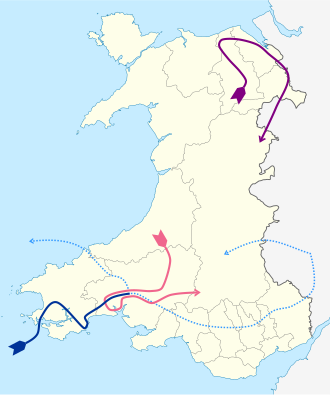


 Wales during the Glyndŵr rebellion (1400–1409). Click on the icons for details.
 - Important battle
Castle garrisoned by English forces
Castle unsuccessfully besieged by Welsh forces
Castle possibly sacked by Welsh forces
Castle sacked or occupied by Welsh forces (dates held)
 Welsh campaign of 1400
 Welsh campaign of 1403
 Franco-Welsh campaign of 1405
 Possible route of 1405 campaign
At Sycharth on 16 September 1400, in front of his immediate family, his in-laws, Welsh people from Berwyn, friends from North-East Wales, the Dean of St Asaph totalling 300 men, Owain Glyndŵr prophecised that he was the person to save his people from the English invasions, and proclaimed himself the Prince of Wales. The following day, he instigated a 15-year rebellion against the rule of Henry IV. Then came a number of initial confrontations between Henry IV and Owain's followers in September and October 1400, as the revolt began to spread around North Wales.[52] Owain was immediately proclaimed Prince of Wales by his followers and subsequently launched an assault on Lord Grey's territories, burning Ruthin. They continued to Denbigh, Rhuddlan, Flint, Holt, Oswestry and Welshpool, all of which were seen as English towns in Wales.[53] The initial revolt got the attention of the King of England after letters were sent asking for military assistance to combat the Welsh rebels.[54] Much of northern and central Wales went over to Owain, and from then on, he would only make an appearance to attack his enemy, his army using effective guerrilla warfare tactics against the English occupying territories.[33][55]
On Good Friday (1 April) 1401, 40 of Glyndwr's men who were led by his cousins, Rhys ap Tudur and Gwilym ap Tudur, took Conwy Castle in North Wales. In response, King Henry IV appointed Henry Percy (Hotspur) to bring the country to order. A month later, the King and the English parliament issued an amnesty which applied to all rebels with the exception of Owain and his cousins, the Tudurs; however, both the Tudurs were eventually pardoned after they gave up Conwy Castle on 28 May that same year. Hotspur won a battle at Cadair Idris two days later, but that was to be his final service for the King of England, as he retired his command as leader of the English troops after dealing with Owain.[22][56] During that time in the spring of 1401, Owain appears in South Wales.[22]
In June, Owain scored his first major victory in the field at Mynydd Hyddgen on Pumlumon; however, retaliation by Henry IV on Strata Florida Abbey was to follow in October that same year.[22][57] The rebel uprising had occupied all of North Wales; labourers seized whatever weapons they could, and farmers sold their cattle to buy arms. Secret meetings were held everywhere, and bards "wandered about as messengers of sedition." Henry IV heard of a Welsh uprising at Leicester; Henry's army wandered North Wales to Anglesey and drove out Franciscan friars who favoured Richard II. All the while Owain, who was in hiding, had his estate at Sycharth forfeited by the King to John Beaufort, 1st Earl of Somerset on 9 November 1400.[22] By autumn, Gwynedd and Ceredigion (which temporarily submitted to England for a pardon) and Powys adhered to the rising against the English rule by supporting the rebellion.[22] Owain's attempts at stoking rebellion with help from the Scottish and Irish were quashed, with the English showing no mercy and hanging some messengers.[citation needed]
As a response to the situation of warfare in Wales, the English Parliament between 1401 and 1402 enacted penal laws against the Welsh, designed to coerce submission in Wales, but the result was to create resentment that pushed many Welshmen into the rebellion.[58] In the same year, Owain captured his archenemy Baron Grey de Ruthyn. He held him for almost a year until he received a substantial ransom from Henry. In June 1402, Owain defeated an English force led by Sir Edmund Mortimer near Pilleth (the Battle of Bryn Glas), where Mortimer was captured. Owain offered to release Mortimer for a large ransom but, in sharp contrast to his attitude to de Grey, Henry IV refused to pay. Mortimer's nephew could be said to have had a greater claim to the English throne than Henry himself, so his speedy release was not an option. In response, Mortimer negotiated an alliance with Owain and married one of Owain's daughters.[33][22][59] It is also in 1402 that mention of the French and the people of Flanders helping Owain's daughter Janet, who was negotiating on the continent for her father for two years until 1404.[60]
News of the rebellion's success spread across Europe, and Owain began to receive naval support from Scotland and Brittany. He also received the support of King Charles VI of France, who agreed to send French troops and supplies to aid the rebellion.[61] In 1403 Glyndwr had amassed an army of 4,000 in his first division, and 12,000 soldiers in total. A Welsh army including a French contingent assimilated into forces mainly from Glamorgan and the Rhondda Valleys region commanded by Owain Glyndŵr, his senior general Rhys Gethin and Cadwgan, Lord of Glyn Rhondda, defeated a large English invasion force reputedly led by King Henry IV himself at the Battle of Stalling Down in Glamorgan.[62][63]

Owain, facing years on the run, finally lost his estate in the spring of 1403, when Prince Henry as usual marched into Wales unopposed and burnt down Owain's houses at Sycharth and Glyndyfrdwy, as well as the commote of Edeirnion and parts of Powys. Owain continued to besiege towns and burn down castles; for 10 days in July that year, he toured the south and southwest of Wales until all of the south joined arms in rebelling against English rule. These actions induced an internal rebellion against the King of England, with the Percys joining the rising.[22][64] It is around this stage of Owain's life that Hywel Sele, a cousin of the Welsh prince, attempted to assassinate Glyndŵr at the Nannau estate.[22][65]

In 1403, the revolt became truly national in Wales. Royal officials reported that Welsh students at Oxford and Cambridge Universities were leaving their studies to join Owain,[22][58] and also that Welsh laborers and craftsmen were abandoning their employers in England and returning to Wales. Owain could also draw on Welsh troops seasoned by the English campaigns in France and Scotland. Hundreds of Welsh archers and experienced men-at-arms left the English service to join the rebellion.[66][22]
In 1404, Owain's forces took Aberystwyth Castle and Harlech Castle,[33] then continued to ravage the south by burning Cardiff Castle. Then, a court was held at Harlech and Gruffydd Young was appointed as the Welsh Chancellor. There had been communication to Louis I, Duke of Orléans in Paris to try (unsuccessfully) to open the Welsh ports to French trade.[22]
De facto rule of Wales, 1404-1405
Parliament
By 1404, no less than four royal military expeditions into Wales had been repelled, and Owain had solidified his control of the nation. By this point, Owain and the rebellion had assumed de facto rule of Wales, and Owain was able to project himself to his French allies as a legitimate Prince of Wales. In 1404, he and his supporters held parliaments at Machynlleth and Harlech.[67][68] He also planned to build two national universities (one in the south and one in the north), to re-introduce the traditional Welsh laws of Hywel Dda, and to establish an independent Welsh church. There were envoys from other countries including France, Scotland, and the Kingdom of León (in Spain). In the summer of 1405, four representatives from every commote in Wales were sent to Harlech.[69]


Tripartite indenture
In February 1405, Owain negotiated the Tripartite Indenture with Edmund Mortimer and Henry Percy, Earl of Northumberland. The Indenture agreed to divide England and Wales among the three of them.[33] Wales would extend as far as the rivers Severn and Mersey, including most of Cheshire, Shropshire and Herefordshire. The Mortimer Lords of March would take all of southern and western England and the Percys would take the north of England.[70][71][e] Although negotiations with the lords of Ireland were unsuccessful, Owain had reason to hope that the French and Bretons might be more welcoming. He dispatched Gruffudd Yonge and his brother-in-law John Hanmer (Margaret's brother) to negotiate with the French. The result was a formal treaty that promised French aid to Owain and the Welsh. The immediate effect seems to have been that joint Welsh and Franco-Breton forces attacked and laid siege to Kidwelly Castle. The Welsh could also count on semi-official fraternal aid from the Duchy of Brittany and from Scotland.[72] Scots and French privateers were operating around Wales throughout Owain's war. Scottish ships had raided English settlements on the Llŷn Peninsula in 1400 and 1401. In 1403, a Breton squadron defeated the English in the Channel and devastated Jersey, Guernsey and Plymouth, while the French made a landing on the Isle of Wight. By 1404, they were raiding the coast of England, with Welsh troops on board, setting fire to Dartmouth and devastating the coast of Devon.[citation needed]
1405 was the "Year of the French" in Wales. A formal treaty between Wales and France was negotiated. On the continent, the French pressed the English as the French army invaded the English Plantagenet Aquitaine.[73] Simultaneously, the French landed in force at Milford Haven in west Wales, burned Haverfordwest, and attempted to capture Pembroke Castle before they were bought off.[22] The combined forces of French and Welsh took Carmarthen, which Owain had captured in 1403 but lost again. The occupants were given safe passage out, and they burned the town walls. Enguerrand de Monstrelet, a later chronicler gives an uncorroborated account of a march through Herefordshire and on into Worcestershire to Woodbury Hill, ten miles from Worcester. They met the English army and took positions from which they daily and viewed each other from a mile without any major action for eight days. Then, both sides seeming to find engagement too risky, departed.[74]
Letter to Charles VI of France

.jpg)
.jpg)
.jpg)
By 1405, most French forces had withdrawn after politics in Paris shifted towards peace, with the Hundred Years' War continuing between England and France.[76] On 31 March 1406, in St Peter ad Vincula church at Pennal, Owain wrote a letter to be sent to Charles VI of France. Owain's letter requested to maintain military support from the French to fend off the English in Wales. Owain suggested that in return, he would recognise Benedict XIII of Avignon as the Pope. The letter sets out the ambitions of Owain for an independent Wales with its own parliament, led by himself as Prince of Wales. These ambitions also included the return of the traditional law of Hywel Dda, rather than the enforced English law, establishment of an independent Welsh church by expanding the Bishoporic of St. David's into England, well as two universities, one in south Wales, and one in north Wales.[77] Following this letter, senior churchmen and important members of society flocked to Owain's banner and English resistance was reduced to a few isolated castles, walled towns, and fortified manor houses.[69]
Owain's Great Seal and a letter handwritten by him to the French in 1406 are in the Bibliothèque nationale de France in Paris. This letter is currently held in the Archives Nationales in Paris. Facsimile copies involving specialist ageing techniques and moulds of Owain's seal were created by the National Library of Wales and presented by the heritage minister Alun Ffred Jones to six Welsh institutions in 2009.[78] The royal great seal from 1404 was given to Charles IV of France and contains images and Owain's title –[79]
Latin: Owynus Dei Gratia Princeps Walliae –
"Owain, by the grace of God, Prince of Wales".
Glyndwr referred to himself as the "Prince of Wales" and claimed his "right of inheritance" in these letters[80]
The faltering rebellion, 1405–1412
_(cropped).jpeg)
In early 1405, the Welsh forces, who had until then won several easy victories, suffered a series of defeats. Owain's brother, Lord Tudur ap Gruffudd, a commander during the war, died at the Battle of Pwll Melyn in May 1405. English forces landed in Anglesey from Ireland and would over time push the Welsh back until the resistance in Anglesey formally ended toward the end of 1406.[40]
Following the intervention of French forces, battling continued for years. In 1406 Prince Henry restored fines and redemption for Welsh soldiers so they could choose their own fate. Prisoners were taken after the battle and castles were restored to their original owners. In the same year a son of Owain died in battle. By 1408 Owain had taken refuge in the North of Wales, having lost his ally from Northumberland.[22]
Despite the initial success of the revolution, in 1407 the superior numbers, resources, and wealth that England had at its disposal began to turn the tide of the war, and the much larger and better-equipped English forces gradually began to overwhelm the Welsh. In times of war, the English changed their strategy.[citation needed] Rather than focusing on punitive expeditions as favoured by his father, the young Prince Henry adopted a strategy of economic blockade. Using the castles that remained in English control, he gradually began to retake Wales while cutting off trade and the supply of weapons. By 1407, this strategy was beginning to bear fruit, and by 1408, the English regained Aberystwyth and then marched north Harlech Castle, which also surrendered during the cold winter into 1409. Edmund Mortimer died during the siege, and Owain's wife Margaret along with two of his daughters (including Catrin) and three of Mortimer's granddaughters were captured on the fall of the castle and imprisoned in the Tower of London. They were all to die in the Tower in 1413 and were buried at St Swithin, London Stone.[81] Before his downfall, Owain was considered the wealthiest of all Welshmen.[82]
Owain managed to escape capture by disguising himself as an elderly man, sneaking out of the castle and slipping past the English military blockade in the darkness of the night.[citation needed] Owain retreated to the Welsh wilderness with a band of loyal supporters; he refused to surrender and continued the war with guerrilla tactics such as launching sporadic raids and ambushes throughout Wales and the English borderlands.[83]

Owain remained free, but he had lost his ancestral home and was a hunted prince. He continued the rebellion, particularly wanting to avenge his wife. In 1410, Owain led a raid into rebel-controlled Shropshire,[33] and in 1412, he carried out one of the final successful raids. With his most faithful soldiers, he cut through the King's men in an ambush in Brecon, where he captured, and later ransomed, a leading Welsh supporter of King Henry, Dafydd Gam ('Crooked David').[84] This was the last time that Owain was seen alive by his enemies, although it was claimed he took refuge with the Scudamore family.[85] In the autumn, Owain's Aberystwyth Castle surrendered, while he was away fighting,[86] but by then things were changing. Henry IV died in 1413, and his son Henry V began to adopt a more conciliatory attitude towards the Welsh. Royal pardons were offered to the major leaders of the revolt and other opponents of his father's regime.[87][page needed] As late as 1414, there were rumours that the Herefordshire-based Lollard leader Sir John Oldcastle was communicating with Owain, and reinforcements were sent to the major castles in the north and south.[citation needed]
On 21 December 1411, the King of England issued pardons to all Welsh except their leader and Thomas of Trumpington (until 9 April 1413, from which Owain was no longer excepted).[22] Owain ignored offers of a pardon on many different occasions, his followers continued to be punished for crimes of war until the 1410s.[88] The poet Lewys Glyn Cothi wrote an elegy for Gwenllian, an illegitimate daughter of Owain, where it was mentioned that at the time of the Welsh War of independence, the whole of Wales was under Owain's command, with forty dukes as the prince's allies, and that later in life he supported 62 female pensioners.[89]
Disappearance and death
Owain was never captured and appears to have spent the last years of his life in hiding. In the sixteenth-century antiquarian Gruffudd Hiraethog's Annals of Owain Glyn Dŵr, it is recounted that in 1415 Owain "went into hiding on St Matthew's Day in Harvest [September 21]", but this date is discounted by J. E. Lloyd as a mere repetition of his first absconding to the woods after the beginning of his revolt, which occurred on the same day in 1400.[90] In 1415 and 1416, Owain's old enemy Henry V attempted to entreat Owain and the few remaining rebels to surrender and be pardoned, to which Owain never responded; Owain is presumed to have died around this time.[91]
Accounts from Herefordshire


The uncertain circumstances surrounding Owain's final days gave rise to many legends surrounding his death. According to J. E. Lloyd and Gruffydd Aled Williams, the most credible sources associate Owain's death and burial with Herefordshire.[92][93] The seventeenth-century History of Owen Glendower written by the antiquarians Robert Vaughan and Thomas Ellis notes that by their time "some say he dyed at his daughter Scudamores, others, at his daughter Monington's house".[94] An early sixteenth-century translation of Tito Livio Frulovisi's Life of Henry the Fifth inserts into the text an assertion that Owain died "vppon the topp of Lawton's hope Hill in Herefordshire".[95] Lawton's Hope farm near Canon Pyon was inherited by the Monnington family around the turn of the fourteenth century, and its owner around the time of Owain's death would have been Sir Richard Monnington, husband of Owain's daughter Sioned.[96]
Other traditions associate the site of Owain's death with Kentchurch Court, owned by another one of Owain's sons-in-law, John Skydmore, though the better-attested hall of the family at this time was Bodenham at La Verne.[97] In the early fifteenth century, the area around Kentchurch would have been majority Welsh-speaking, and Skydmore was the employed by the state as the Welsh interpreter for Gwidigada and Elfed in Carmarthenshire from the years 1411-1431.[98] Another hall associated with this family is Monnington Straddle, which possessed a medieval chapel and was endorsed as Owain's place of rest by J. E. Lloyd.[99][100] The final likely possibility for Owain's burial ground is at St James the Great, Kimbolton, which was formerly the chapelry of Leominster Priory and also owned by the Skydmores; this tradition is attributed to is attributed to the sixteenth-century scholar Edmund Prys, a Welshman who was vicar of nearby Ludlow from 1576 to 1579.[101]
A second burial?
Owain may nave been buried a second time, as according to Adam Usk, "After four years in hiding from the king and kingdom, Owen Glendower died, and was buried by his followers in the darkness of night. His grave was discovered by his enemies, however, so he had to be re-buried, though it is impossible to discover where he was laid."[102] While Owain may have been reburied at some other location in Herefordshire, another possibility is outside of the county, even in Wales.[103] The fifteenth-century poet Robin Ddu of Anglesey, writing in the tumultuous reign of Richard III, prophesied that "There is an old man in Maelienydd / whose hair is like blossom on trees... I have heard, captivating muse, / much poetry about an old white-haired man, / and if this one who will claim his right / is the prophesied white-haired one, / battle-axe and sword without delay / will extend the boundary of our land..." and in one line names this man as "Owain".[104][105] In the fifteenth century, Lewys Glyn Cothi called the husband of Owain's daughter Gwenllïan who lived in the parish of St Harmon on the border between Gwrtheyrnion and Maelienydd "son-in-law to the Old White-haired One"; Lewys Glyn Cothi also associates Owain with Maelienydd in another poem.[106][107][108] Thus, Gruffydd Aled Williams suggested the final resting place of Owain Glyndŵr may have been Cwmhir Abbey, which was located in Maelienydd and was also the final resting place of Llywelyn ap Gruffudd, the native Prince of Wales killed by the forces of Edward I of England in 1282.[109]
Issue and descendants

Owain married Margaret Hanmer, also known by her Welsh name Marred ferch Dafydd, and together they had five or six sons and four or five daughters. Also, Owain had some illegitimate children out of wedlock.[33][22][111][112]
Sons
All of Owain and Margaret's sons from their marriage were either taken prisoner and died in confinement, or died in battle and had no issue. Gruffudd was captured in Gwent by Prince Henry, imprisoned in Nottingham Castle, and later taken to the Tower of London in 1410. Maredudd was recorded as communicating with John Talbot and the English Crown on 24 February 1416, and receiving a royal pardon in 1421, but dying a few years later.[22][112]
Daughters
- Alice (Alys), m. John Scudamore of Ewyas.
- Jane.
- Janet, m. Sir John De Croft.
- Margaret, m. Sir Richard Monnington.
- Catherine (Catrin) (d. 1413), m. (1) Edmund Mortimer (d. 1409), (2) Roger Mortimer.
Upon Owain's disappearance and death, his eldest (oldest child with descendants) daughter Alice came to be known as the Lady of Glyndyfrdwy and Cynllaith, and heiress de jure of the Principalities of Powys, South Wales and Gwynedd. During 1431, she successfully went to court in Meirionydd to regain her inheritance as the heiress of Sycharth in Glyndyfrdwy against John, Earl of Somerset, who had been granted Owain's forfeited lands by the King of England in 1400. Alice's descendants married into the Scudamore family and her direct descendant John Lucy Scudamore married the daughter of Harford Jones-Brydges in the early 19th century, and whose daughter in 1852 married the son of Edward Lucas from the Castleshane estate in Ireland. Another daughter, Jane, married Henry, Lord Grey de Ruthin without issue. Then, Janet married into the noble family of Croft Castle in Herefordshire, whose descendants today are titled the Croft Baronets. Whilst Margaret married a knight from Monnington, also in Herefordshire.[22][113]
Illegitimate
Owain's illegitimate children with other women included Ieuan, Myfanwy and Gwenllian, whilst it is debated whether his son David was born out of wedlock. Ieuan became Owain's only male descendant to have children. Like his other illegitimate kin, they remained in Wales and married locally into Welsh families. Gwenllian became the wife of Philip ab Rhys ab Cenarth, and died near St Harmon in Powys (Radnorshire).[114]
Family poem
Iolo Goch wrote of Owain's wife, Margaret:[115]
The best of wives.
Eminent woman of a knightly family, Her children come in pairs,
A beautiful nest of chieftains.
Legacy
In Welsh culture Owain acquired a mythical status alongside other medieval kings such as Cadwaladr, Cynon ap Clydno and King Arthur. He was perceived as a folk hero awaiting a call to return and liberate his people in the classic Welsh mythical role – Y Mab Darogan ('the foretold son'). The myth was that one day after a thousand years of servitude under English rule, a 'Son of Prophecy' would return the Welsh people as rulers of the island of Great Britain.[116][117] Also, in Welsh folklore, the name Owain has been connected to a legend of the 'son of destiny'. His claim as the Prince of Wales was similar to that of another distant relative from the Gwynedd dynasty. It was another Owain, Lawgoch (Owain ap Thomas ap Rhodri) who proclaimed his patrimony a few decades earlier, when he attempted to regain his family stature with aid from the King of France in a Franco-Welsh alliance from the late 1360s, until his assassination in 1378.[118]
Modern legacy


.jpg)
- Owain was described by Fidel Castro as the first effective guerrilla leader. It has been suggested that Castro, who may have kept books about the Welshman, and Che Guevara copied some of Owain's methods in the Cuban Revolution.[120][page needed][121]
- During the First World War, the prime minister David Lloyd George unveiled a statue to Owain in Cardiff City Hall.[122] A statue of Owain by the sculptor Simon van de Put was installed in The Square in Corwen in 1995, and in 2007 it was replaced with a larger equestrian statue by Colin Spofforth.[123]
- Owain came second to Aneurin Bevan in the 100 Welsh Heroes poll of 2003/2004.[124] Stamps were issued with his likeness in 1974 and 2008,[125] and streets, parks, and public squares were named after him throughout Wales. There is a campaign to make 16 September (Owain Glyndŵr Day), the date Owain raised his standard, a public holiday in Wales, including by Dafydd Wigley in 2021.[126]
- RGC 1404 (Rygbi Gogledd Cymru, 'north Wales rugby') rugby union team is named in honour of "the year Owain Glyndŵr became Prince of Wales".[127]
- To celebrate the 600th anniversary of Owain's life, a monument was erected in Machynlleth in the grounds of Plas Machynlleth.[119]
Meibion Glyndŵr
Owain is now remembered as a national hero and numerous small groups have adopted his symbolism to advocate independence for Wales or Welsh nationalism. For example, during the 1980s, a group calling itself Meibion Glyndŵr ("the Sons of Glyndŵr") claimed responsibility for the burning of English holiday homes in Wales.[128]
Literature
- After Owain's death, there was little resistance to English rule. The Tudor dynasty saw Welshmen become more prominent in English society. In Henry IV, Part 1, Shakespeare portrays him as Owen Glendower (the name has since been adopted as the anglicised version of Owain Glyndŵr),[129] wild and exotic; a man who claims to be able to "call spirits from the vasty deep", ruled by magic and tradition in sharp contrast to the more logical but highly emotional Hotspur.[130] Glendower is further noted as being "not in the roll of common men" and "a worthy gentleman,/Exceedingly well read, and profited/ In strange concealments, valiant as a lion/And as wondrous affable and as bountiful/As mines of India."[131] His enemies describe him "that damn'd magician", which was in reference to having the weather on his side in battle.[132]
- It was not until the late 19th century that Owain's reputation was revived, when the Cymru Fydd ('young Wales') movement recreated Owain as the father of Welsh nationalism.[133]
- Owain later acquired mythical status as the hero awaiting a call to return and liberate his people.[117][134] Thomas Pennant, in his Tours in Wales (1778, 1781 and 1783), searched out and published many of the legends and places associated with the memory of Owain.[135]
- Owain has been featured in a number of works of modern fiction, including most notably John Cowper Powys's novel Owen Glendower (1941),[136] and Edith Pargeter's 1972 publication A Bloody Field by Shrewsbury.[137]
- A highly fictionalised Owain is featured in the popular YA book series The Raven Cycle by Maggie Stiefvater as Owen Glendower. In the series, which takes place in the Shenandoah Valley, characters believe that Owain's body was brought from Wales to Virginia after his death, and that whoever can "wake" him will be granted a favour.[138]
- In 2026, a new play by Gary Owen called Owain & Henry, about Owain's rebellion against the rule of Henry IV of England in the 15th century, will be performed at the Welsh National Theatre with Michael Sheen playing Owain.[139]
Namesakes


- The Owain Glyndwr Hotel in Corwen is a historic 18th century coaching inn.[140]
- The Owain Glyndŵr pub in Cardiff, briefly named Owen Glendower was named in his honour.[119]
- The waymarked, 132-mile long-distance footpath Glyndŵr's Way runs through Mid Wales near to his homelands.[141]
- At least two ships and two locomotives have been named after Owain:
- In 1808, the Royal Navy launched a 36-gun fifth-rate frigate,HMS Owen Glendower. She served in the Baltic Sea during the Gunboat War where she participated in the seizure of Anholt Island, and then in the Channel. Between 1822 and 1824, she served in the West Africa Squadron (or "Preventative Squadron") chasing down slave ships, capturing at least two;[142]
- Owen Glendower, an East Indiaman, a Blackwall frigate built in 1839;[143]
- In 1923, a 2-6-2T Vale of Rheidol locomotive was named after Owain. The locomotive is still operational and was one of a few used by British Rail until it was privatised;[144][145]
- 70010 Owen Glendower, renamed Owain Glyndŵr, built in 1951 at the Crewe Works, it was withdrawn in June 1965. It was a British Railways Standard Class 7 mixed-traffic steam locomotive.[146]
- In 2002, a plaque was unveiled near the Tower of London to commemorate Glyndwr's daughter Catrin who died there with her children.[119]
- From 2008 to 2023, Wrexham University was known as (Wrexham) Glyndŵr University in his honour. Despite dropping the name in 2023, the university maintains links with the Owain Glyndŵr Society for one of its annual graduate awards.[147]
Arms
 |
|

Ancestry
| Ancestors of Owain Glyndŵr[154] | ||||||||||||||||||||||||||||||||||||||||||||||||||||||||||||||||||||||||||||||||||||||||||||||||||||||||||||||||||||||||||||||||||||||||||||||||||||||||||||||||||||||||||||||||||||||||||||||||||||||||||||||||||||||||||||||||||||||||||||||||||||||||||||||||||||||||||||||||||||||||||||||||||||||||||||||||||||||||||||||||||||||||||||||||||||||||||||||||||||||||||||||||||||||||||||||||||||||||||||||||||||||||||||||||||||||||||||||||||||||||||||||||||||||||||||||||||||||||||||||||||||||||||||||||||||||||||||||||||||||||||||||||||||||||||||||||||||||||||||||||||||||||||||||||
|---|---|---|---|---|---|---|---|---|---|---|---|---|---|---|---|---|---|---|---|---|---|---|---|---|---|---|---|---|---|---|---|---|---|---|---|---|---|---|---|---|---|---|---|---|---|---|---|---|---|---|---|---|---|---|---|---|---|---|---|---|---|---|---|---|---|---|---|---|---|---|---|---|---|---|---|---|---|---|---|---|---|---|---|---|---|---|---|---|---|---|---|---|---|---|---|---|---|---|---|---|---|---|---|---|---|---|---|---|---|---|---|---|---|---|---|---|---|---|---|---|---|---|---|---|---|---|---|---|---|---|---|---|---|---|---|---|---|---|---|---|---|---|---|---|---|---|---|---|---|---|---|---|---|---|---|---|---|---|---|---|---|---|---|---|---|---|---|---|---|---|---|---|---|---|---|---|---|---|---|---|---|---|---|---|---|---|---|---|---|---|---|---|---|---|---|---|---|---|---|---|---|---|---|---|---|---|---|---|---|---|---|---|---|---|---|---|---|---|---|---|---|---|---|---|---|---|---|---|---|---|---|---|---|---|---|---|---|---|---|---|---|---|---|---|---|---|---|---|---|---|---|---|---|---|---|---|---|---|---|---|---|---|---|---|---|---|---|---|---|---|---|---|---|---|---|---|---|---|---|---|---|---|---|---|---|---|---|---|---|---|---|---|---|---|---|---|---|---|---|---|---|---|---|---|---|---|---|---|---|---|---|---|---|---|---|---|---|---|---|---|---|---|---|---|---|---|---|---|---|---|---|---|---|---|---|---|---|---|---|---|---|---|---|---|---|---|---|---|---|---|---|---|---|---|---|---|---|---|---|---|---|---|---|---|---|---|---|---|---|---|---|---|---|---|---|---|---|---|---|---|---|---|---|---|---|---|---|---|---|---|---|---|---|---|---|---|---|---|---|---|---|---|---|---|---|---|---|---|---|---|---|---|---|---|---|---|---|---|---|---|---|---|---|---|---|---|---|---|---|---|---|---|---|---|---|---|---|---|---|---|---|---|---|---|---|---|---|---|---|---|---|---|---|---|---|---|---|---|---|---|---|---|---|---|---|---|---|---|---|---|---|---|---|---|---|---|---|---|---|---|---|---|---|---|---|---|---|---|---|---|---|---|---|---|---|---|---|---|---|---|---|---|---|---|---|---|---|---|---|---|---|---|---|---|---|---|---|---|---|---|---|---|---|---|---|---|---|---|---|---|---|---|---|---|---|---|---|---|---|---|---|---|---|---|---|---|---|---|---|---|---|---|---|---|---|---|---|---|---|---|---|---|---|---|---|---|---|---|---|---|---|---|---|---|---|---|
| ||||||||||||||||||||||||||||||||||||||||||||||||||||||||||||||||||||||||||||||||||||||||||||||||||||||||||||||||||||||||||||||||||||||||||||||||||||||||||||||||||||||||||||||||||||||||||||||||||||||||||||||||||||||||||||||||||||||||||||||||||||||||||||||||||||||||||||||||||||||||||||||||||||||||||||||||||||||||||||||||||||||||||||||||||||||||||||||||||||||||||||||||||||||||||||||||||||||||||||||||||||||||||||||||||||||||||||||||||||||||||||||||||||||||||||||||||||||||||||||||||||||||||||||||||||||||||||||||||||||||||||||||||||||||||||||||||||||||||||||||||||||||||||||||
See also
References
- ↑ Bartrum 1974, 'Bleddyn ap Cynfyn' 3
- ↑ Lloyd 1931, p. 14
- ↑ Davies 1995, p. 136
- ↑ Bartrum 1974, 'Bleddyn ap Cynfyn' 3, 4, 5
- ↑ Bartrum 1974, 'Rhys ap Tewdwr' 4, 6, 7, 'Gruffudd ap Cynan' 4, 12
- 1 2 Panton 2011, p. 173
- ↑ Messer 2017.
- ↑ Lloyd 1919, p. 128.
- ↑ Davies 1994, p. 154.
- ↑ Davies & Morgan 2009, p. 12-13.
- ↑ Burke 1876, pp. 7, 43, 51, 97
- ↑ Connolly 2021, p. 205.
- ↑ Davies 1995, p. 130-131
- ↑ Lloyd 1881, pp. 194, 197, 212
- ↑ Davies & Morgan 2009, pp. 11, 13
- ↑ Johnston 1993, p. 30-35, 163
- ↑ Guy 2020, p. 45, n. 239
- ↑ Given-Wilson 1997, pp. 148–149
- ↑ Lloyd 1931, pp. 46–47
- ↑ Davies 1995, p. 158
- ↑ Lewis 2023, p. 173
- 1 2 3 4 5 6 7 8 9 10 11 12 13 14 15 16 17 18 19 20 21 Smith 2004
- 1 2 Turvey 2010, p. 117
- ↑ Davies & Morgan 2009, pp. 9, 22–23.
- ↑ Bartrum 1974, 'Bleddyn ap Cynfyn' 4, 5
- ↑ Stephenson 2016, pp. 164–165
- ↑ Gower 2012, p. 134.
- ↑ Davies & Morgan 2009, p. 14.
- ↑ Bartrum 1974, 'Rhys ap Tewdwr' 6, 7
- ↑ Davies & Morgan 2009, pp. 11–13.
- ↑ Davies & Morgan 2009, p. 14-15.
- ↑ Davies & Morgan 2009, p. 15-16.
- 1 2 3 4 5 6 7 8 Pierce 1959
- ↑ Evans 2016, p. 15.
- ↑ Henken 1996, p. 4.
- ↑ Penberthy 2010, p. 33.
- ↑ Davies & Morgan 2009, p. 16.
- ↑ Davies 1995, p. 6,22,113.
- ↑ Carr 1977.
- 1 2 Davies 1995
- ↑ Davies & Morgan 2009, p. 18.
- ↑ Nicolas 1832, pp. 244–245
- ↑ Davies & Morgan 2009, p. 20.
- ↑ Davies & Morgan 2009, pp. 18–20, 23.
- ↑ Johnston 1993, p. 42.
- ↑ Williams 2011, pp. 20–22.
- ↑ Allday 1981, p. 51.
- ↑ Davies & Morgan 2009, p. 32.
- ↑ Mortimer 2013, pp. 226-.
- ↑ Davies & Morgan 2009, p. 34.
- ↑ Skidmore 1978, p. 24.
- ↑ Davies & Morgan 2009, pp. 29–32, 35.
- ↑ Davies 1995, pp. 1, 59, 102.
- ↑ Davies & Morgan 2009, pp. 32–33.
- ↑ Davies & Morgan 2009, p. 43.
- ↑ Davies & Morgan 2009, pp. 41–42.
- ↑ Davies & Morgan 2009, pp. 43–44.
- 1 2 Davies & Morgan 2009, p. 37.
- ↑ Davies & Morgan 2009, pp. 47–51.
- ↑ Lloyd 1881, p. 215.
- ↑ Davies & Morgan 2009, pp. 32, 91.
- ↑ Lloyd 1881, p. 250.
- ↑ Morgan 1911, pp. 418–425.
- ↑ Davies & Morgan 2009, p. 82.
- ↑ Davies & Morgan 2009, pp. 62, 130, 142.
- ↑ Davies & Morgan 2009, p. 84.
- ↑ Davies 1995, pp. 163–164.
- ↑ Brough 2017, p. 7.
- 1 2 Davies & Morgan 2009, p. 104.
- ↑ Davies 1994, p. 195.
- ↑ Davies & Morgan 2009, pp. 107–111.
- ↑ Davies & Morgan 2009, pp. 75–77.
- ↑ Davies & Morgan 2009, pp. 91–95.
- ↑ Davies 1995, p. 194.
- ↑ museum 1992.
- ↑ Davies & Morgan 2009, p. 95.
- ↑ Davies & Morgan 2009, pp. 102–104, 112.
- ↑ National Library of Wales n.d.
- ↑ Davies & Morgan 2009, p. 101.
- ↑ Siddons 1991, p. 287.
- ↑ Davies & Morgan 2009, pp. 123–124, 127, 133–134.
- ↑ Carr 1995, pp. 108–132.
- ↑ Davies & Morgan 2009, pp. 127–129.
- ↑ Davies & Morgan 2009, pp. 129–132.
- ↑ Davies & Morgan 2009, p. 135.
- ↑ Davies & Morgan 2009, pp. 127–128.
- ↑ Chapman 2015.
- ↑ Turvey 2010, pp. 122/3
- ↑ Lloyd 1881, p. 257.
- ↑ Lloyd 1931, pp. 143, 150, 154
- ↑ Lloyd 1931, pp. 143–144
- ↑ Lloyd 1931, p. 144
- ↑ Williams 2017, p. 168
- ↑ Williams 2017, p. 49
- ↑ Kingsford 1911, p. 191
- ↑ Williams 2017, pp. 75–76, 132–133
- ↑ Williams 2017, p. 133, 115-120
- ↑ Williams 2017, pp. 80–82
- ↑ Lloyd 1931, pp. 144–145
- ↑ Williams 2017, pp. 103–109, 133–134
- ↑ Williams 2017, pp. 121–130, 134
- ↑ Given-Wilson 1997, p. 263
- ↑ Williams 2017, pp. 134–135
- ↑ Williams 2013, pp. 84–86
- ↑ Williams 2017, pp. 161–162
- ↑ Johnston 1995, p. 410
- ↑ Johnston 1995, p. 397
- ↑ Williams 2017, pp. 163–164
- ↑ Williams 2017, p. 167
- ↑ Bentley 2002.
- ↑ Davies & Morgan 2009, p. 13.
- 1 2 Lloyd 1881, p. 252
- ↑ Lloyd 1881, pp. 252–257.
- ↑ Lloyd 1881, pp. 252, 257–258.
- ↑ Davies & Morgan 2009, p. 133.
- ↑ Davies & Morgan 2009, pp. 144/5.
- 1 2 Davies, Jenkins & Baines 2008, p. 635.
- ↑ Turvey 2010, pp. 115–116.
- 1 2 3 4 Davies & Morgan 2009, p. 152
- ↑ Roberts 2017.
- ↑ Williams 2003, p. 18.
- ↑ Davies 1995, p. v.
- ↑ Van Tilburg 2021.
- ↑ 100 Welsh Heroes 2004.
- ↑ BBC 2008.
- ↑ Wigley 2021.
- ↑ BBC 2010.
- ↑ Brooke 2018, p. 60.
- ↑ Shakespeare 1998, p. 288.
- ↑ Davies & Morgan 2009, p. 146.
- ↑ Shakespeare 1998, 3.1.
- ↑ Davies & Morgan 2009, p. 142.
- ↑ Arron 2013.
- ↑ Davies & Morgan 2009, p. 137.
- ↑ Pennant 1784, p. 393
- ↑ Powys 1941, p. 1.
- ↑ Parteger 1989, p. 1.
- ↑ Stiefvater 2015.
- ↑ Prichard 2025.
- ↑ Cadw n.d.
- ↑ Davies & Morgan 2009, p. 153.
- ↑ Burke 2011.
- ↑ Royal Museums Greenwich n.d.
- ↑ Johnson 2020.
- ↑ Reading & Reading 2023.
- ↑ Langston 2012, p. 45.
- ↑ Wrexham University 2023.
- ↑ Holyoake 1976, p. 21
- ↑ Siddons 1991, p. 287
- ↑ Siddons 1993, pp. 580–1
- 1 2 3 4 Siddons 1993, p. 419
- ↑ Siddons 1993, p. 420
- ↑ Bartrum 1974, pp. 445, 'Bleddyn ap Cynfyn' 5, ff.
Notes
- ↑ also Glyn Dŵr; anglicised as Owen Glendower
- ↑ There is also a discredited assertion that Owain was descended from Llywelyn ap Gruffudd's fictitious daughter Catherine. However, Llywelyn ap Gruffudd's only historical daughter, Gwenllian, died unmarried in a nunnery in 1337.[7][8][9] Owain's claim to Gwynedd through female lines was unusual though necessary, as Owain Lawgoch, the last male-line descendant of Llywelyn ab Iorwerth, was killed in 1378.[10] A similarly discredited assertion in The Armorial Register is that he was descended from King Edward I through his fictitious granddaughter Eleanor.[11][6][12]
- ↑ Owain's birth-year may be inferred from a contemporary record of the 1386 Scrope trial discussed below, which gives his age as "twenty-seven years and more". See Nicolas 1832, pp. 244–245. Two other dates are printed in Thomas Pennant's Tour in Wales, namely 28 May 1354 or 1349, the year the Black Death arrived in Wales. See Pennant 1784, p. 326. However, these are dubious and derived from the much later eighteenth-century NLW MS 2021B and seventeenth-century NLW MS 3039B, respectively. See Lloyd 1931, p. 18.
- ↑ (Illustration from Hutchinson's History of the Nations, 1915)
- ↑ R. R. Davies noted that certain internal features underscore the roots of Owain's political philosophy in Welsh mythology: in it, the three men invoke prophecy, and the boundaries of Wales are defined according to Merlinic literature.
- ↑ Owain's personal coats of arms before his rebellion are unknown. A late sixteenth-century armorial ascribes to Owain a garbled version of coat of the arms attributed to the founder of their line, Gruffudd Maelor, namely [Paly] Argent and Gules, a lion rampant Sable, armed Gules. However, the fifteenth-century scholar Gutun Owain asserts that Owain's brother Tudur bore the arms ascribed to Gruffudd Maelor's father, the king of Powys Madog ap Maredudd, namely Per pale Argent and Gules, a lion rampant Sable, armed Gules.[152]
- ↑ uixillum suum album cum dracone aureo ibidem displicuit "[Owain] raised his standard, a golden dragon on a white field".[153]
Bibliography
- Arron, Jane (5 June 2013). "'A Nation Once Again': Owain Glyndŵr and the 'Cymraec Dream' of Anglophone Welsh Victorian Poets". walesartreview.org.
- Allday, D. Helen (1981). Insurrection in Wales: the rebellion of the Welsh led by Owen Glyn Dwr (Glendower) against the English Crown in 1400. Lavenham: Terence Dalton. p. 51. ISBN 0-86138-001-0.
- Bartrum, P. C., ed. (1974). Welsh Genealogies: AD 300-1400. Cardiff: University of Wales Press. doi:10.20391/40837b6f-1887-4afd-9c6e-9b7e3a122693. ISBN 070830561X. Archived from the original on 6 June 2023.
- "Glyndŵr's burial mystery 'solved'". news.bbc.co.uk. 6 November 2004.
- "New Owain Glyndwr stamp unveiled". BBC News. 29 February 2008.
- "North Wales summon Owain Glyndwr's spirit in revamp". bbc.co.uk. 6 January 2010.
- Bentley, G. E. (27 February 2002). "Blake's Visionary Heads: Lost Drawings and a Lost Book". In Fulford, T. (ed.). Romanticism and Millenarianism. Palgrave Macmillan US. pp. 183–205. ISBN 978-0-312-24011-0.
- Bradley, A.G. (1901). Owen Glyndwr and the Last Struggle for Welsh Independence. G. P. Putnam's Sons.
- Brooke, Nick (17 April 2018). Terrorism and Nationalism in the United Kingdom: The Absence of Noise. Springer. ISBN 978-3-319-76541-9.
- Brough, Gideon (2017). The Rise and Fall of Owain Glyn Dwr: England, France and the Welsh Rebellion in the Late Middle Ages. I. B. Tauris. ISBN 978-1784535933.
- Burke, Bernard (1876). The Royal Families of England, Scotland (PDF). Pall Mall, London: Harrison.
- Burke, Steven (April 2011). Humphreys, Cathy (ed.). "The Reality of Travelling the African Coast: Midshipman Binstead on chasing". New Histories. 2 (6). Retrieved 6 November 2024.
- "Full Report for Listed Buildings". cadwpublic-api.azurewebsites.net. Cadw, Welsh Government. Retrieved 5 November 2024.
- Carr, A.D. (1995). "Rebellion and Revenge". Medieval Wales, British History in Perspective, Chapter 46: Rebellion and Revenge. Palgrave, London. pp. 108–132. doi:10.1007/978-1-349-23973-3_6. ISBN 9781349239733.
- Chapman, Adam (2015). Welsh soldiers in the Later Middle Ages. Woodbridge: The Boydell Press. ISBN 978-1783270316.
- Carr, A.D. (1977). "A Welsh Knight in the Hundred Years War: Sir Gregory Sais". Transactions of the Honourable Society of Cymmrodorion, 1977: 40–53. Retrieved 6 November 2024.
- Connolly, Sharron Bennett (2021). Defenders of the Norman Crown : Rise and Fall of the Warenne Earls of Surrey. Pen & Sword History. ISBN 9781526745323.
- Davies, John; Jenkins, Nigel; Baines, Menna, eds. (2008). The Welsh Academy Encyclopaedia of Wales. Cardiff: University of Wales Press. ISBN 978-0708319536.
- Davies, John (1994). A History of Wales. London: Penguin Books. p. 195. ISBN 0-14-014581-8.
- Davies, R. R. (1995). The Revolt of Owain Glyn Dŵr. Oxford: Oxford University Press. doi:10.1093/acprof:oso/9780198205081.001.0001. ISBN 978-0198205081. IA revoltofowaingly0000davi_j0a7.
- Davies, R. R.; Morgan, Gerald (2009). Owain Glyn Dŵr: Prince of Wales. Ceredigion: Y Lolfa. ISBN 978-1-84771-127-4.
- Evans, David (2016). "Owain Glyndŵr". Owain Glyndŵr.
- Given-Wilson, Chris, ed. (1997). The chronicle of Adam Usk, 1377-1421. Oxford: Clarendon Press. IA chronicleofadamu0000adam.
- Gower, Jon (9 February 2012). The Story of Wales. Random House. ISBN 978-1-4464-1710-2.
- Guy, Ben, ed. (2020). Medieval Welsh Genealogy: an Introduction and Textual Study. Woodbridge: Boydell Press. ISBN 9781783275137.
- Henken, Elissa R. (1996). National Redeemer: Owain Glyndŵr in Welsh Tradition. Cornell University Press. ISBN 978-0-8014-8349-3.
- Holyoake, C. J. (1976). "Heraldic Notes on the issue of Postage Stamps". Family History: 15–43.
- Johnson, Peter (30 April 2020). The Vale of Rheidol Railway: The Story of a Narrow Gauge Survivor. Pen and Sword Transport. ISBN 978-1-5267-1808-2.
- Johnston, Dafydd, ed. (1993). Iolo Goch: Poems. Llandysul: Gomer Press. ISBN 978-0-86383-707-4. IA iologochpoems0000iolo.
- Johnston, Dafydd, ed. (1995). Gwaith Lewys Glyn Cothi (in Welsh). Cardiff: University of Wales Press.
- Kingsford, Charles Lethbridge, ed. (1911). The first English life of King Henry the Fifth, written in 1513 by an anonymous author commonly known as The Translator of Livius. Oxford: Clarendon Press. IA cu31924027928047.
- Langston, Keith (1 January 2012). British Steam BR Standard Locomotives. Casemate Publishers. ISBN 978-1-84563-146-8.
- Lewis, Henry (1959). "Sion Cent (1367? - 1430?), poet". Dictionary of Welsh Biography. National Library of Wales.
- Lewis, Barry, ed. (2023). Bonedd y Saint: An edition and study of the genealogies of the Welsh saints. Dublin: Dublin Institute of Advanced Studies. ISBN 9781855002517.
- Lloyd, Jacob Youde W. (1881). "6". The History of the Princes. Vol. 1. Great Queen Street, London: T. Richards Printer.
- Lloyd, J.E. (1919). "Owain Glyn Dŵr : His Family and Early History". Transactions of the Honourable Society of Cymmrodorion, 1918–1919: 128–145. Retrieved 5 November 2024.
- —— (1931). Owen Glendower: Owen Glyn Dŵr. Oxford: Clarendon Press.
- Messer, Danna R (2017). "Eleanor de Montfort (c. 1258–1282), princess and diplomat". Dictionary of Welsh Biography. National Library of Wales.
- Morgan, Owen (1911). A history of Wales from the Earliest Period: Including Hitherto Unrecorded Antiquarian Lore. – A History of Wales at Google Books
- Mortimer, Ian (2013). The Fears of Henry IV: The Life of England's Self-Made King. Random House. pp. 226–. ISBN 978-1-4070-6633-2.
- "Seal impression: Owain Glyn Dwr Privy seal". museum.wales. 1992. Retrieved 12 April 2026.
- Nicolas, Nicholas Harris, ed. (1832). De controversia in curia militari inter Ricardum Le Scrope et Robertum Grosvenor milites: rege Ricardo Secundo, MCCCLXXXV-MCCCXC e recordis in turre Londinensi asservatis (in Latin). Vol. 1. London: Samuel Bentley.
- "Pennal letter". library.wales.
- Panton, Kenneth (2011). Historical Dictionary of the British Monarchy. Scarecrow Press.
- Parteger, Edith (1989) [1972]. A Blood Field by Shrewsbury. Headline Book Publishing. ISBN 0747233667.
- Penberthy, David (June 2010). "Owain Glyndwr and his uprising – Interpretation Plan" (PDF). Cadw – Welsh Government. Cymdeithion Siân Shakespear Associates. Retrieved 5 November 2024.
- Pennant, Thomas (1784). A tour in Wales. Vol. 2. Retrieved 13 May 2026.
- Pierce, Thomas Jones (1959). "Owain Glyndwr (c. 1354–1416), 'Prince of Wales'". Dictionary of Welsh Biography. National Library of Wales.
- Pierce, Thomas Jones (1959). "LLYWELYN ap GRUFFYDD ('Llywelyn the Last,' or Llywelyn II), Prince of Wales (died 1282)". Dictionary of Welsh Biography. National Library of Wales.
- Powys, John Cowper (1941). Owen Glendower. Simon & Schuster.
- Prichard, Lorna (2 April 2025). "Michael Sheen to portray 'iconic' Welsh prince Owain Glyndwr". www.bbc.com. Retrieved 11 September 2025.
- Reading, Brian; Reading, Ian (15 February 2023). Narrow Gauge and Industrial Railways: The Late 1940s to Late 1960s. Amberley Publishing Limited. ISBN 978-1-3981-0013-8.
- Roberts, Emrys (2017). Highlights From Welsh History. Y Lolfa. ISBN 978-1-78461-482-9.
- "The "Owen Glendower", East Indiaman, 1000 Tons. (Entering Bombay Harbour)". The Collections. Royal Museums Greenwich. Retrieved 14 January 2020.
- Shakespeare, William (1998). Bevington, David (ed.). Henry IV, Part 1. Oxford University Press. ISBN 978-0-19-283421-8.
- Siddons, Michael Powell (1991). The Development of Welsh Heraldry. Vol. 1. Aberystwyth: National Library of Wales. ISBN 090715851X.
- —— (1993). The Development of Welsh Heraldry. Vol. 2. Aberystwyth: National Library of Wales. ISBN 090715851X.
- Skidmore, Ian (1978). Owain Glyndŵr: Prince of Wales. Swansea: Christopher Davies. p. 24. ISBN 0715404725.
- Smith, Llinos (2004). "Glyn Dŵr [Glyndŵr], Owain [Owain ap Gruffudd Fychan, Owen Glendower]". Oxford Dictionary of National Biography (online ed.). Oxford: Oxford University Press. doi:10.1093/ref:odnb/10816. (Subscription, Wikipedia Library access or UK public library membership required.)
- Stephenson, David (2016). Medieval Powys: Kingdom, Principality and Lordships, 1132-1293. Studies in Celtic History. Woodbridge: Boydell Press. ISBN 9781783271405.
- Stiefvater, Maggie (2015). The Raven King (The Raven Cycle, Book 4). Scholastic Press. p. 480. ISBN 978-0545424981.
- Turvey, Roger (2010). Twenty-One Welsh Princes. Conwy: Gwasg Carreg Gwalch. ISBN 9781845272692.
- Van Tilburg, Kees (2021). "Equestrian statue of Owain Glyndwr in Corwen UK".
- Wigley, Dafydd (16 September 2021). "Glyndŵr Day is worthy of a new national holiday". The National. Archived from the original on 2 December 2022. Retrieved 29 January 2022.
- Williams, Phil (2003). The Psychology of Distance: Wales: One Nation. Institute of Welsh Affairs. p. 18. ISBN 978-1-86057-066-7.
- Williams, Gruffydd Aled (2011). "More than 'skimble-skamble stuff': the Medieval Welsh Poetry Associated with Owain Glyndŵr: 2010 Sir John Rhŷs Memorial Lecture" (PDF). Proceedings of the British Academy. 181. Archived from the original (PDF) on 26 July 2020.
- —— (2013). "Cywydd brud gan Robin Ddu a'i berthnasedd posibl i hanes Owain Glyndŵr". Dwned (in Welsh). 19: 96–102.
- —— (2017). The Last Days of Owain Glyndŵr. Talybont: Y Lolfa. ISBN 9781784614638.
- "Prifysgol Wrecsam/Wrexham University unveils rebrand and new name". Wrexham University. 25 September 2023. Retrieved 20 October 2023.
- "100 Welsh Heroes". 100welshheroes. 2004. Archived from the original on 13 April 2014.
Further reading
- "Owain Glyndwr". bbc.co.uk. Retrieved 29 May 2025.
- Burton, Robert (1730). The history of the principality of Wales. : In three parts. Paternoster Row, London. – A history of the Principality of Wales at Google Books
- Dillon, Paddy (7 May 2024). Walking Glyndwr's Way: A National Trail through mid-Wales. Cicerone Press Limited. ISBN 978-1-78765-068-8.
- Latimer, Jon; Murray, John (2001). Deception in War. pp. 12–13.
- Lowe, Walter Bezant (1912). The Heart of Northern Wales. Vol. 1. pp. 205–207. – The Heart of Northern Wales, p. 205, at Google Books
- Moseley, Charles (1 August 1999). Burke's Peerage & Baronetage (106 ed.). pp. 714, 1295. ISSN 0950-4125.
- Ramsay, James H. (1892). The scholar's history of England . London: H. Milford. Retrieved 17 March 2023.
- Scott-Giles, Charles Wilfrid (1967) [1929]. The Romance of Heraldry (Revised ed.). J.M. Dent & Sons. p. 74. ISBN 0900455284.
External links
- "Canolfan & Senedd-Dŷ Owain Glyndŵr (Owain Glyndŵr's Parliament & Centre)". canolfanowainglyndwr.org.
- "The Owain Glyndŵr Society". owain-glyndwr.wales.


.svg)

