
The Novohrad-Nógrád UNESCO Global Geopark is a UNESCO geopark that extends over the territory of 28 municipalities in Slovakia (southern parts of the districts of Rimavská Sobota and Lučenec) and 64 municipalities in Hungary (northern part of Nógrád).[1]
| Novohrad-Nógrád Geopark | |
|---|---|
 Fiľakovo castle, a part of the protected area | |
 Interactive map of Novohrad-Nógrád Geopark | |
| Location | Banská Bystrica Region, Slovakia |
History
editThe project was started in 2003 as a conceptual idea, which was developed between 2006 and 2007 into a detailed spatial and developmental study focused on the development of a geopark between the two countries.[1][2] In 2008, organizations were established in both countries, which signed a Memorandum of Cooperation and began building a joint management system for the geopark. They prepared to join the European and Global Geopark Networks, which they successfully achieved in 2010, when they became the 37th member of the European Geopark Network and the 66th member of the Global Geopark Network. In 2014, 2018, and 2022, they successfully defended their membership in these networks.[1]
Location
editThe Geopark in Slovakia covers the territory of the districts of Lučenec (including the town of Fiľakovo[3] and the villages of Belina, Biskupice, Čakanovce, Čamovce, Fiľakovské Kováče, Lipovany, Kalonda, Mučín, Pleš, Prša, Radzovce, Rapovce, Ratka, Šiatorská Bukovinka, Šurice, Šíd, Trebeľovce) and Rimavská Sobota (villages Blhovce, Dubno, Gemerský Jablonec, Hajnáčka, Nová Bašta, Petrovce, Stará Bašta, Studená, Tajchy, Večelkov).[1][4] On the Hungarian side, it includes the Novohrad-Nógrád UNESCO Global Geopark with 64 villages totaling 167 sites.[5]
Within the geopark are the Cerová Vrchovina Protected Landscape Area and the Protected Area of TK Karancs Medves. Cerová Vrchovina is a unique geological area where brown coal was mined in the past until 1948. This area lies in the south of central Slovakia in the districts of Rimavská Sobota and Lučenec, with the southern border being the state boundary with Hungary, and to the north the Rimavská Basin and Lučenec Basin. According to orographic classification, it belongs to the Matransko-Slanskej region.[6]
Geology of the Geopark
edit| Area of the geopark | total 1,578 km², of which Slovakia 336 km², Hungary 1,251 km²[7] |
| Geopark protection | CHKO Cerová vrchovina (Slovakia), NP Bükk (Hungary) |
| Number of geotopes | total 76, with 32 in Slovakia and 44 in Hungary |
| Presented themes | geology, nature conservation, history, folk culture |
| Geological characteristics | neovolcanites |
During excursions in the geopark, it is considered that geological processes shaped the area over a period of 200 million years. From rock fragments from the Triassic period to fossilized sediments of a shallow sea, 24 million years old, we gradually discover natural formations and traces of ancient volcanic activity. This area is known for its extinct and dormant volcanoes, which have become a characteristic feature of this territory at an international level. A variety of volcanic forms are preserved on a relatively small area, in different rock types.[8]
Evidence of the flow of destructive rhyolitic-pumice tuffs, layers of andesitic volcanic rocks, formed both underwater and on land, as well as an extensive network of vein deposits stretching over several kilometers has been found in the geopark. A unique feature of the area is the largest continuous basalt plateau in Europe, along with a bundle of regularly arranged, bent columns formed from rocks created by the cooling of basaltic and andesitic lava. These geological formations, which originated about 20 million years ago, testify to the formation of the entire Pannonian region and demonstrate the volcanic processes that shaped the territory.[8][9][7]
 Basalt from the Cerová Vrchovina area
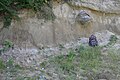 Lipovianske Sandstones


Geopark Localities
editAmong the most significant Slovak sites within the geopark are Fiľakovo Castle, Šomoška National Nature Reserve with the Šomoška Castle and the Šomoška stone waterfall. The Pohanský Hrad National Nature Reserve, Ragáč National Nature Reserve, Hajnáčsky Castle Hill Nature Reserve, Steblová Rock Nature Reserve, Soví Hrad Nature Monument, Ebeczkého Cave, and other sites contain lava flow remnants, craters, and other geological, natural, and cultural-historical monuments.[5] On the Hungarian side, there is the significant locality of Ipolytarnóc, known as one of the richest Miocene Fossil sites in the world.[5]

 Soví Castle
 Hajnáčsky Castle Hill
 Fossils from the Ipolytarnóc area


Management and Cooperation of the Geopark
editThe protection of nature conservation and the landscape within the geopark is primarily ensured through the Cerová Vrchovina Protected Landscape Area, the Protected Landscape Area of Karancs–Medves (Karancs–Medves Tájvédelmi Körzet), as well as other protected areas, such as the Kelet-Cserhát, Mátra, Hollókő, and Naturpark Cserhát.[3] Some natural reserves in the territory are among the oldest in Slovakia.
Cooperation with schools involves organizing various events, competitions, exhibitions, accompanying tours, and expert lectures. Basic schools are provided with a methodological manual on the fundamentals of teaching about living and non-living nature within GNN, which is also used by participants of the week-long Summer Youth Camp in Fiľakovo.[10]
References
edit- 1 2 3 4 "Novohrad-Nógrád UNESCO globálny geopark – Geoparky na Slovensku" (in Slovak). Retrieved 2026-04-06.
- ↑ "Novohrad-Nógrád Geopark". Bükki Nemzeti Park Igazgatóság (in Slovak). Retrieved 2026-04-06.
- 1 2 "Geopark Nógrad – Novohrad". Región NOVOHRAD (in Slovak). Retrieved 2026-04-06.
- ↑ geopark.sk https://www.geopark.sk/wp-content/uploads/2018/12/NNG_SK.pdf. Retrieved 6 April 2026.
{{cite web}}: Missing or empty|title=(help) - 1 2 3 "unesco | Globálna sieť Geoparkov: navštívte slovenský geopark Novohrad-Nógrád". www.unesco.sk. Retrieved 2026-04-06.
- ↑ "Novohradský geopark". Slovakia.travel. Retrieved 6 April 2026.
- 1 2 "Novohrad-Nógrád UNESCO Globálny Geopark". i-dest.com. Retrieved 6 April 2026.
- 1 2 "Novohrad-Nógrád UNESCO Global Geopark". unesco.org. Retrieved 6 April 2026.
- ↑ "Ipolytarnóci Ősmaradványok". Bükki Nemzeti Park Igazgatóság (in Slovak). Retrieved 2026-04-06.
- ↑ "Novohrad-Nógrád Geopark - Úvod". www.nn-geopark.com. Retrieved 2026-04-06.