
The orange threadtail[1] or ochre threadtail (Nososticta solida) is an Australian damselfly in the family Platycnemididae.[3] They are medium-sized with a length of around 35mm. Orange threadtails can be found near semi-shaded running water, and usually rest on plants at the water's edge. Orange threadtails may be seen all year round. In Victoria they occur at lower altitudes during summer, though further north they can be seen in spring and autumn. When at rest, Nososticta damselflies hold their wings closely folded up vertically over their thorax. The male threadtails have an orange-yellow thorax with black patterns. Their abdomen is narrow, black in colour with yellow strips. There is a brown yellow colour at the base of their wings. Females are the same size as the males. They are pale brown in colour and have the same black patterns as the males.
| Orange threadtail | |
|---|---|
 | |
| Male | |
.jpg) | |
| Female | |
Scientific classification  | |
| Kingdom: | Animalia |
| Phylum: | Arthropoda |
| Clade: | Pancrustacea |
| Class: | Insecta |
| Order: | Odonata |
| Suborder: | Zygoptera |
| Family: | Platycnemididae |
| Genus: | Nososticta |
| Species: | N. solida |
| Binomial name | |
| Nososticta solida | |
 | |
| Synonyms[3] | |
| |

Distribution
editOrange threadtails are found in eastern Australian States: Queensland, New South Wales, Australian Capital Territory and Victoria.[4]
Etymology
editThe genus name Nososticta combines the Greek νόσος (nosos, "disease") with στικτός (stiktos, "spotted" or "marked"). The suffix -sticta is commonly used in names of taxa related to Protoneura and the subfamily Isostictinae.[5]
The species name solida is derived from the Latin solidus ("dense", "solid" or "firm"), likely referring to its robust thorax.[2][5]
Gallery
edit Male
Male Male
Male Mating pair. Male holds the female while she oviposits.
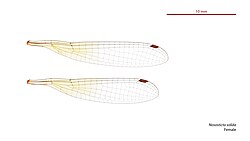 Female wings
 Male wings
.jpg)


.jpg)
.jpg)
See also
editReferences
edit- 1 2 Dow, R.A. (2017). "Nososticta solida". IUCN Red List of Threatened Species. 2017 e.T87536431A87540104. doi:10.2305/IUCN.UK.2017-1.RLTS.T87536431A87540104.en. Retrieved 20 November 2021.
- 1 2 Selys-Longchamps, E. (1860). "Nososticta, Hagen in: Synopsis des Agrionines, dernière légion: Protonevra". Bulletin de la Classe des Science, Académie Royale de Belgique. 2 (in French). 10: 431–462 [457] – via Biodiversity Heritage Library.
- 1 2 "Species Nososticta solida (Hagen, 1860)". Australian Faunal Directory. Australian Biological Resources Study. 2012. Retrieved 14 April 2017.
- ↑ Theischinger, Gunther; Endersby, Ian (2009). Identification Guide to the Australian Odonata (PDF). Department of Environment, Climate Change and Water NSW. p. 229. ISBN 978-1-74232-475-3.
- 1 2 Endersby, Ian; Fliedner, Heinrich (2015). The Naming of Australia's Dragonflies. Eltham, Victoria, Australia: Busybird Publishing. ISBN 9781925260625.

