"My Old Man's a Dustman" is a song first recorded by the British skiffle singer Lonnie Donegan. It reached number one in the British, Irish, Australian, Canadian, and New Zealand singles charts in 1960.
| "My Old Man's a Dustman" | ||||
|---|---|---|---|---|
 Sleeve for the Scandinavian pressing on Metronome Records | ||||
| Single by Lonnie Donegan | ||||
| B-side | "The Golden Vanity" | |||
| Released | 16 March 1960 | |||
| Recorded | 20 February 1960, Gaumont Cinema, Doncaster | |||
| Genre | Folk, music hall, pop | |||
| Length | 3:21 | |||
| Label | Pye Records | |||
| Songwriters | Lonnie Donegan, Peter Buchanan, Beverly Thorn | |||
| Producers | Alan A. Freeman, Michael Barclay | |||
| Lonnie Donegan singles chronology | ||||
| ||||
The chorus of the song is:[1]
Oh, my old man's a dustman
He wears a dustman's hat
He wears cor blimey trousers
And he lives in a council flat
Composition
editThe song was written by Lonnie Donegan, Peter Buchanan (Donegan's manager between 1956 and 1962),[2] and Beverly Thorn; Thorn was not credited on the original release. According to his autobiography, Beverley Thorn was a pseudonym of the songwriter Leslie Bricusse.[3]
It probably has its origins in "My Father Was a Fireman", a song sung by British World War I troops. The two songs share a lyrical similarity in their reference to "cor blimey trousers".[4] A song beginning with the line "My old man's a dustman", but otherwise sharing no lyrics with Donegan's, is recorded as a playground song in the 1956 novel My Old Man's a Dustman by Wolf Mankowitz. This song tells of the exploits of the protagonist at the Battle of Mons.[5] A version concerning a football game and beginning "My old man's a scaffie [dustman or street-sweeper, from scavenger][6]/He wears a scaffie's hat" (echoing the first two lines of Donegan's song) is recorded as a Scottish playground song during the 1950s.[7] A very similar song, beginning "My old man's a baker", is recorded in Chester-le-Street in 1967.[8] All of these songs share the same metric structure.
The melody is borrowed from the theme starting at around 2 minutes and 20 seconds into the music for the ballet Petrushka, composed by Igor Stravinsky.[citation needed]
The song represented a change in style for Donegan, away from American folk and towards British music hall.[9]
Single release
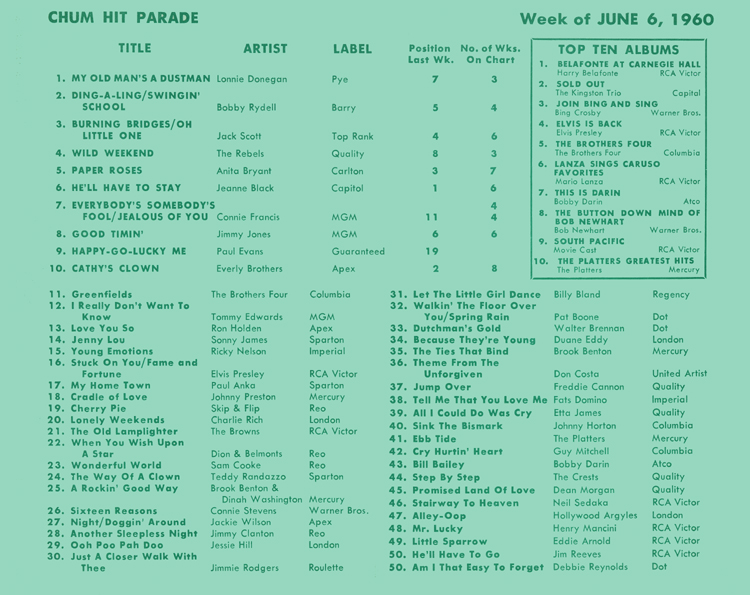
editOn 16 March 1960, through Pye Records in the UK, Donegan released a version of the song recorded live at the Gaumont cinema in Doncaster just a few weeks earlier, on 20 February.[10] The B-side was a version of the English folk song "The Golden Vanity". The single reached number one in the UK Singles Chart on 31 March and maintained that position for four weeks.[11] It also reached number one in Ireland, Australia, New Zealand, and on the Canadian CHUM Chart for 2 weeks, selling over a million copies in total.[12][13]
Cover versions
editThis section needs additional citations for verification. (June 2019) |
In 1960, a Dutch version was released by Toby Rix. Also in 1960, a parody version, "My Old Man's An All-Black", was released in New Zealand by the Howard Morrison Quartet in reaction to the New Zealand rugby tour of Apartheid-era South Africa.[14][15] The song was performed by the Bee Gees on the Australian TV show Bandstand in 1963, and, in the US, the Smothers Brothers included a parody based on the song on their LP Think Ethnic. In 1966, The Irish Rovers included a version of the song on their LP The First of the Irish Rovers.
A parody version titled ‘My Old Man’s a Provo’, by Gerry O’Glacain of the Irish Brigade, became one of the most popular Irish republican rebel folk songs in the latter part of the twentieth century.[16]
The tune to the chorus has become a popular football chant in recent years. For example, Arsenal supporters sang "Arsène Wenger's magic, he wears a magic hat, and when he saw the double, he said 'I'm having that!'" at the end of their double winning season in 2002; Chelsea fans later adopted it after ex-Arsenal player Cesc Fabregas assisted the Blues in securing a double of their own in 2015.[17]
References
edit- ↑ "My Old Man's a Dustman". Lyrics.com. Retrieved 25 June 2018.
- ↑ Hill, Chris (25 August 2010). "Death of Norfolk man who penned My Old Man's A Dustman". Dereham Times. Retrieved 22 June 2019.
- ↑ "The Roar of the Greasepaint – Interview With Leslie Bricusse – Part Two". Musical Theatre Review. 6 October 2015. Retrieved 22 June 2019.
- ↑ Howse, Christopher (9 August 2009). "He wears a gorblimey hat". The Daily Telegraph. Archived from the original on 12 August 2009. Retrieved 20 June 2017 – via Wayback Machine.
- ↑ Mankowitz, Wolf (1956). My Old Man's a Dustman. London: André Deutsch. p. 49. ISBN 978-1135834326.
{{cite book}}: ISBN / Date incompatibility (help) - ↑ Robinson, Mairi, ed. (1 March 1987). The Concise Scots Dictionary. Aberdeen University Press. p. 583. ISBN 978-0080284927.
- ↑ Ritchie, James T. R. (1 January 1964). The Singing Street. Edinburgh: Oliver and Boyd. p. 127. ISBN 978-0050011508.
{{cite book}}: ISBN / Date incompatibility (help) - ↑ Rutherford, Frank, ed. (December 1971). All the Way to Pennywell: Children's Rhymes of the North-east. University of Durham Institute of Education. p. 96. ISBN 978-0903380003.
- ↑ "Lonnie Donegan obituary". The Daily Telegraph. 5 November 2002.
- ↑ Rice, Jonathan; Rice, Tim; Gambaccini, Paul; Read, Mike, eds. (1 September 1982). The Guinness Book of 500 Number One Hits (1st ed.). London: Guinness Superlatives. pp. 49–50. ISBN 978-0851122502.
- ↑ "MY OLD MAN'S A DUSTMAN - LONNIE DONEGAN". Official Charts Company. Retrieved 22 June 2019.
- ↑ "BRITISH Newsnotes". Billboard. 5 September 1960. p. 6.
- ↑ "CHUM Hit Parade - June 6, 1960".
- ↑ Gebbie, Fred (5 October 1963). "Controversial Is Hit Route". Billboard. p. 24.
- ↑ "My old man's an All Black". New Zealand History. Retrieved 30 October 2023.
- ↑ Boyle, Mark (28 August 2011). Metropolitan Anxieties: On the Meaning of the Irish Catholic Adventure in Scotland. Routledge. p. 163. ISBN 978-0754633792.
- ↑ "'Fabregas Is Magic' - Chelsea FanChants". FanChants.com. Retrieved 17 May 2022.