
The Sultan Mosque is a historic mosque located within the Kampong Glam locality of Rochor, Singapore. Built in 1826 and later rebuilt into its present form in 1932, it is the most well-known mosque in the country and has been gazetted as a national monument. The mosque was named after Sultan Hussein Shah of Johor, who was a major figure in the founding of Singapore.[1]
| Sultan Mosque Masjid Sultan | |
|---|---|
مسجد سلطان | |
.jpg) The main facade of the Sultan Mosque that faces Bussorah Street. | |
| Religion | |
| Affiliation | Islam |
| Branch/tradition | Sunni Islam |
| Location | |
| Location | 3 Muscat Street, Singapore 198833 |
| Country | Singapore |
.svg)  Location in Singapore | |
 Interactive map of Sultan Mosque Masjid Sultan | |
| Coordinates | 1°18′08″N 103°51′32″E / 1.3022°N 103.8590°E |
| Architecture | |
| Architect | Denis Santry of Swan & Maclaren |
| Type | Mosque |
| Style | Indo–Saracenic |
| Founder | Hussein Shah of Johor |
| Funded by | Sir Stamford Raffles (original structure, 1820s) |
| Swan & Maclaren | |
| Established | 1824 (original) 1929 (current) |
| Groundbreaking | 1824 (original) 1924 (current) |
| Completed | 1826 (original) 1932 (current) |
Construction cost | 3,000 spanish dollars (original) S$200,000 (current)[a] |
| Capacity | 5,000 |
Designated as NHL | |
| Designated | 8 March 1975 |
| Reference no. | 14 |
| Website | |
| sultanmosque | |
History
editThe original mosque was a single-story wooden building with a double tiered roof, built in the 1826 at the behest of Sultan Hussain Shah of Johor.[2][3] After handing Singapore over to the British, he requested that a mosque for the Muslim community be built adjacent to his istana ("palace") that was located in the same place. Sir Stamford Raffles agreed to his request and contributed $3,000 to the funds for the mosque.[2][3] The land of the mosque was expanded in 1875 by Tunku Alam, a grandson of Sultan Hussein, who bought parts of land surrounding the mosque and donated them to be used within the mosque's awqaf endowment. Aside from the expansion of land, Tunku Alam also appointed a committee to manage the mosque with permission from the relevant colonial authorities.[4] A domed mausoleum, reserved for the relatives of Sultan Hussein, was also established behind the mosque in the 1920s.[5]
The building began to gradually dilapidate over the years, which prompted the committee of the Sultan Mosque to propose a complete reconstruction that was estimated to cost at least $200,000.[5][6][7] The mosque was rebuilt in phases, partly due to a lack of funds and also to prevent disrupting the daily prayers, which were continued to be held in the mosque.[7] Deemed usable for the general public, the mosque, which was still unfinished, was officially reopened in December of 1929.[4] Construction would only be completed by 1932, while the minarets were slightly renovated in 1936 to accommodate the installation of loudspeakers for the adhan.[8]
During World War II, the mosque was damaged by air raids conducted by the Japanese aerial forces.[9] After the war, the mosque became the centre of the Maria Hertogh Riots in 1950 when the rioters hid inside the mosque from colonial police. With approval from a qāḍī, Muslim officers were able to enter the mosque and disperse the rioters.[10][11] Ownership and management of the mosque was transferred to the Majlis Ugama Islam Singapura (MUIS) after the independence of Singapore. In 1968, King Faisal of Saudi Arabia donated $37,000 to assist in funding major restoration works on the mosque.[12]
The Sultan Mosque was officially gazetted as a national monument of Singapore on 8 March 1975, due to its historical significance of being one of the earliest mosques to be built in Singapore, second only to Masjid Omar Kampong Melaka.[2][3] In 1987, an annexe building was constructed next to the mosque within the same compound. This new annexe was officially opened on 8 July 1993 by the then Prime Minister, Goh Chok Tong.[13]
The mosque underwent an extensive renovation starting in 2014 which was sponsored by the MUIS.[14] Restoration works were conducted, which included replacing broken and unusable doors and windows with new, identical ones as well as re-tiling of several parts of the mosque, while the electronics and lighting of the mosque were inspected.[14] The renovation took two years and was completed by early 2016.[15]
Architecture
editDesigned by Denis Santry from the architectural firm Swan & MacLaren, the present-day Sultan Mosque is a highlight of Indo-Saracenic architecture in the country.[16][17] The mosque and its ancillary building skewer off the street grid to face the direction of Mecca. A boundary wall, support railings and different entry gates surround the compound of the mosque.[2][3][18]

The most notable features of the mosque are the two identical onion domes on each end of the mosque, both of which are golden in colour.[2][3] The base of each dome is adorned with bottle caps collected from the poor, which was a decision made by Sultan Hussein Shah who requested that everyone from the community contribute to the mosque regardless of wealth or background.[7][19] The first dome tops the entrance to the main prayer hall, while the second dome tops a private mausoleum belonging to Tunku Alam and other close relatives of Sultan Hussein Shah.[2][17] A careful choice has been made to separate the burial ground entirely from the main mosque via the qibla wall, as the matter of having a gave within a mosque is of disputed controversy within the Islamic world.[17]

At each corner of the mosque are minarets which are accessible from the rooftop balcony. Each minaret is eight stories high and topped by a small golden dome.[2][3] Within the tops of the minarets are loudspeakers for the adhan to be recited aloud.[20]
The mosque was formerly green and white in colour.[18]
Gallery
editExterior of the mosque
edit An aerial view of the Sultan Mosque.
 An aerial view of North Bridge Road with the mosque in the foreground.
 Gate to the mosque from Muscat Street.
 The annex building, with the mosque visible in the background behind it.
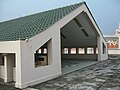 Rooftop pavilion on the annex building.
 Pinnacles along the balcony of the annex building.
 The minaret of the mosque at night, lit up with a light display.
 A festive light show at the mosque during the Islamic month of Ramadan in 2022.


.jpg)
.jpg)


Interior of the mosque
edit The main prayer hall of the mosque.
 The minbar of the mosque, used mainly during the Friday prayer.
 One of the few ablution areas located within the mosque boundaries.
.jpg)


Historic photographs of the mosque
edit The mosque in 1971. The dome has not yet been painted in gold at the time.
.jpg)
Transportation
editThe nearest form of transport to the Sultan Mosque is the Bugis MRT Station on both the Downtown Line and the East–West Line.[21]
See also
editFootnotes
edit- ↑ Estimated, the common currency used in Singapore at the time was the Straits dollar.
References
edit- ↑ Devi, Uma (2002). Singapore's 100 Historic Places. Singapore: National Heritage Board. ISBN 9789814068239.
- 1 2 3 4 5 6 7 Lee, Geok Boi (2002). The Religious Monuments of Singapore: Faiths of Our Forefathers (1st ed.). Singapore: Landmark Books. pp. 94–96. ISBN 9789813065628.
- 1 2 3 4 5 6 Liu, Gretchen (1996). In Granite and Chunam: The National Monuments of Singapore (1st ed.). Singapore: Landmark Books. pp. 103–108. ISBN 9789813065031.
- 1 2 Puzi, Mohammed (2025). The Grand Mosque of Singapore (1st ed.). Singapore: Majlis Ugama Islam Singapura. pp. 69–154. ISBN 9789819418374.
- 1 2 Dunearn, Adelfi (25 September 1925). "The Sultan Mosque". The Straits Budget. p. 17.
- ↑ "Matters Muslim Column". The Singapore Free Press and Mercantile Advertiser. 4 November 1926. pp. 11–12.
- 1 2 3 Choo, Elizabeth (18 September 1971). "The Sultan Mosque, an imposing structure in green and white". New Nation. p. 7.
- ↑ "Completion of a new Singapore Mosque". The Straits Times. 5 April 1932. p. 7.
- ↑ "The Sultan Mosque at North Bridge Road suffered damage during a Japanese bombing attack of Singapore". National Archives of Singapore. 23 January 1942. Retrieved 3 April 2026.
- ↑ "Five dead, a hundred hurt in the riots". The Straits Times. 12 December 1950. p. 1.
- ↑ "Only Muslim police went into mosque". The Straits Times. 17 December 1950. p. 1.
- ↑ "King Faisal's Gift to Mosque". The Straits Times. 11 April 1968. p. 4.
- ↑ "$4.2m annexe for Sultan Mosque". The Straits Times. 8 July 1993. p. 22.
- 1 2 Zaccheus, Melody (9 February 2014). "Sultan Mosque to get $4 million facelift". The Straits Times. p. 14.
- ↑ Lee, Pearl (16 January 2016). "Restoration of Sultan Mosque complete". The Straits Times. ISSN 0585-3923. Retrieved 3 April 2026.
- ↑ "History of the Sultan Mosque". The Straits Times. 8 July 1993. p. 22.
- 1 2 3 Leu-Jiun, Ten (1 April 2013). "The Invention of a Tradition: Indo Saracenic Domes on Mosques in Singapore". National Library Board.
- 1 2 Choo, Elizabeth (18 September 1971). "The Sultan Mosque, an imposing structure in green and white". New Nation. p. 7.
- ↑ Teoh, Eliza (20 March 1997). "Let the poor contribute bottles". The Straits Times. p. 6.
- ↑ Pratama, Fikri Surya; Erasiah, Erasiah; Fitri, Anggi Meydel; Yelni, Aletri (11 December 2023). "A HISTORICAL AND POLITICAL REVIEW OF SINGAPORE'S POLICY TOWARDS THE MALAYS AND THE MUSLIMS: TINJAUAN HISTORIS-POLITIK ATAS KEBIJAKAN POLITIK SINGAPURA TERHADAP ORANG MELAYU DAN MUSLIM". Journal of Religious Policy. 2 (2): 269–294. doi:10.31330/repo.v2i2.36. ISSN 2987-5749.
- ↑ "Sultan (Mosque) - 3 Muscat Street (S)198833". www.streetdirectory.com. Retrieved 3 April 2026.
External links
edit