
This article has multiple issues. Please help improve it or discuss these issues on the talk page. (Learn how and when to remove these messages)
|
This is a list of current and former female monarchs regardless of title, including queens regnant, empresses regnant, pharaohs and monarchs by other titles (grand duchess, princess, etc.). Consorts, such queens consort (i.e. spouses of male monarchs) are not included, see list of current consorts of sovereigns. Female regents are not included; see list of regents.
.jpg)


- Top left: Elizabeth II was the longest-reigning female monarch, reigning as Queen of the United Kingdom for 70 years, from 1952 to 2022.
- Top right: Victoria reigned as Queen of the United Kingdom for 63 years, from 1837 to 1901; the longest at the time.
- Bottom left: Wilhelmina, Queen of the Netherlands for 58 years from 1890 to 1948, is the longest-reigning female monarch outside the United Kingdom.
- Bottom right: Margrethe II was Queen of Denmark for 52 years, from 1972 until her abdication in 2024; she is the most recent sole female monarch of a sovereign state.
The following is an incomplete list of women monarchs who are well known from popular writings, although many ancient and poorly documented ruling monarchs (such as those from Africa and Oceania) are omitted. Section 1 lists monarchs who ruled in their own right, such as queens regnant. Section 2 lists legendary monarchs. Section 3 lists monarchs who ruled in their own right, but had no official legal recognition while in power. Section 4 lists various female rulers who were referred to with the title "Chieftainess". Regents, such as queens regent, are not monarchs and are not included here. The lists do include claimants and anti-rulers whose recognition among their subjects and legitimacy as monarchs are disputed.
Independent or autonomous monarchs
editAfrica
editNorth Africa
editAlgeria
edit| Monarch | Portrait | Office | State | Reign dates | Length | Ref. |
|---|---|---|---|---|---|---|
| Cleopatra Selene II |  |
Queen | Mauretania | 25–5 BC | 20 years | |
| Tin Hinan |  |
Queen | Hoggar | 4th century AD | Unknown | |
| Dihya | .jpg) |
Queen | Kingdom of the Aurès | c. 668–703 AD | c. 35 years |
Canary Islands
editThe Canary Islands are a Spanish territory in North Africa.
| Monarch | Portrait | Office | State | Start of reign | End of reign | Length | Ref. |
|---|---|---|---|---|---|---|---|
| Inés Peraza[a] | – | Queen | Lordship of the Canary Islands | 1452 | 1477 | 25 years | [1] |
| Isabella I of Castile[b] |  |
Queen | Kingdom of the Canary Islands | 4 September 1479 | 26 November 1504 | 25 years, 83 days | |
| Joanna of Castile[b] |  |
Queen | 26 November 1504 | 12 April 1555 | 50 years, 137 days | ||
| Isabella II of Spain[b] |  |
Queen | 29 September 1833 | 30 November 1833 | 62 days |
Egypt
editThe first verified female monarch of Egypt is Sobekneferu of the Twelfth dynasty. However, queens from earlier periods such as Neithhotep, Merneith and Khentkaus I held powerful positions and may have ruled Egypt in their own right, but the archaeological evidence is ambiguous.[2]
| Monarch | Portrait | Office | State | Start of reign | End of reign | Length | Ref. |
|---|---|---|---|---|---|---|---|
| Sobekneferu | .jpg) |
Pharaoh | Middle Kingdom of Egypt | c. 1777 BC | c. 1773 BC | 3 years, 10 months and 24 days | [3] |
| Hatshepsut |  |
Pharaoh | New Kingdom of Egypt | c. 1479 BC[c] | c. 1458 BC |
|
|
| Neferneferuaten |  |
Pharaoh | New Kingdom of Egypt | c. 1334 BC | c. 1332 BC | c. 2 years | |
| Twosret |  |
Pharaoh | New Kingdom of Egypt | c. 1191 BC | c. 1188 BC | 3 years | |
| Arsinoe II[d] |  |
Pharaoh (disputed) |
Ptolemaic Kingdom | 273 or 272 BC | 270 or 268 BC | 2–5 years | [7] |
| Berenice II[d] |  |
Pharaoh (disputed) |
Ptolemaic Kingdom | 246 BC | 221 BC | 25 years | [8] |
| Arsinoe III[d] |  |
Pharaoh (disputed) |
Ptolemaic Kingdom | 220 BC | 204 BC | 16 years | [9] |
| Cleopatra I[d] |  |
Pharaoh (disputed) |
Ptolemaic Kingdom | 193 BC | 176 BC | 17 years | [10] |
| Cleopatra II |  |
Pharaoh | Ptolemaic Kingdom | 170 BC | 164 BC | 51 years (Total) | [11] |
| 163 BC | 127 BC | ||||||
| 124 BC | 115 BC | ||||||
| Cleopatra III | .jpg) |
Pharaoh | Ptolemaic Kingdom | c. 139 BC | 130 BC | c. 35 years (Total) | [12] |
| 127 BC | 101 BC | ||||||
| Berenice III |  |
Pharaoh | Ptolemaic Kingdom | 101 BC | 88 BC | 14 years (Total) | [13] |
| 81 BC | 80 BC | ||||||
| Cleopatra V[e] |  |
Pharaoh | Ptolemaic Kingdom | 79 BC | 69 BC | 10 years | [14] |
| Cleopatra VI[e] | – | Pharaoh | Ptolemaic Kingdom | 58 BC | 57 BC | 1 year | [15] |
| Berenice IV | – | Pharaoh | Ptolemaic Kingdom | 58 BC | 55 BC | 3 years | [16] |
| Cleopatra VII |  |
Pharaoh | Ptolemaic Kingdom | 51 BC | 12 August 30 BC | 21 years | [17] |
| Arsinoe IV |  |
Pharaoh (disputed) |
Ptolemaic Kingdom | December 48 BC | January 47 BC | 1 or 2 months | [18] |
| Zenobia |  |
Queen (disputed) |
Aegyptus | October 270 | June 272 | 1 year and 9 months | [19] |
| Shajar al-Durr |  |
Sultan | Mamluk Sultanate | 2 May 1250 | 30 July 1250 | 3 months |
Libya
edit| Monarch | Portrait | State | Reign dates | Length | Ref. |
|---|---|---|---|---|---|
| Berenice II | |
Cyrenaica | 258–246 BC | 12 years | |
| Cleopatra Selene II | |
Cyrenaica | 34–30 BC | 4 years |
Sudan
edit| Monarch | Portrait | Office | State | Reign dates | Length | Ref. |
|---|---|---|---|---|---|---|
| Nahirqo |  |
Kandake | Kingdom of Kush | Mid-2nd century BC | – | [20] |
| Unknown Queen[f] | – | Kandake | Kingdom of Kush | End of 2nd–first half of 1st century BC | – | [21] |
| Amanirenas | .jpg) |
Kandake | Kingdom of Kush | End of 1st century BC–Beginning of 1st century AD | – | |
| Amanishakheto |  |
Kandake | Kingdom of Kush | Early 1st century AD | – | |
| Shanakdakhete | – | Kandake | Kingdom of Kush | First half of the 1st century AD | – | |
| Nawidemak | .jpg) |
Kandake | Kingdom of Kush | – | ||
| Amanitore |  |
Kandake | Kingdom of Kush | Mid-1st century AD | – | |
| Amanikhatashan |  |
Kandake | Kingdom of Kush | Mid-2nd century AD | – | [22] |
| Amanikhalika | .jpg) |
Kandake | Kingdom of Kush | Second half of the 2nd century AD | – | [23] |
| Patrapeamani | .png) |
Kandake | Kingdom of Kush | First half of the 4th century AD | – | [22] |
| Amanipilade | .png) |
Kandake | Kingdom of Kush | Mid-4th century AD | – | |
| Gaua | – | Queen | Dotawo | c. 1520–1526 | c. 6 years | [24] |
West Africa
editBenin
edit| Monarch | Office | State | Reign dates | Length | Ref. |
|---|---|---|---|---|---|
| Hangbe | Queen (disputed) |
Kingdom of Dahomey | 1716–1718 | 2 years | |
| Hude | Queen | Hogbonu | 1746–1752 | 6 years | [25] |
The Gambia
edit| Monarch | Portrait | Office | State | Reign dates | Length | Ref. |
|---|---|---|---|---|---|---|
| Elizabeth II | .jpg) |
Queen | The Gambia | 1965–1970 | 5 years |
Ghana
edit| Monarch | Portrait | Office | State | Start of reign | End of reign | Length | Ref. |
|---|---|---|---|---|---|---|---|
| Dode Akaabi | – | Gã Mantse | Gã | 1610 | 1635 | 25 years | [26] |
| Afrakoma | – | Ohemmaa | Akwamu | 1625 | 1640 | 15 years | |
| Amoako Atta Yiadom | – | Denkyirahene | Denkyira | 1770 | 1793 | 23 years | |
| Nana Afia Dokuaa | – | Okyenhene | Akyem Abuakwa | 1817 | 1835 | 18 years | [27] |
| Ama Sewa | – | Dwabenhene | Dwaben | c. 1841 | c. 1845 | c. 4 years | [28] |
| Nana Juaben Serwaa II | – | Dwabenhene | Dwaben | 1959 | 1963 | 4 years | [29] |
| Elizabeth II |  |
Queen | Dominion of Ghana | 6 March 1957 | 1 July 1960 | 3 years, 117 days |
Guinea-Bissau
editOrango
edit- Okinka Pampa (reigned 1910–1930)
Canhabaque
edit- Idiana Ibop, also known as Juliana (reigned ?–1925)[30][31]
Côte d'Ivoire
editLiberia
edit- Famata Bendu Sandemani, queen of the Vai people (reigned ?–1892)[33]
Mali
editMali Empire
edit- Kassi (reigned ?–1352/1353), co-ruler with Mansa Sulayman
Nigeria
editAkure Kingdom
edit- Èyé Àró (reigned 1393–1419)
- Èyémọ̀ị́n (reigned 1705–1735)
- Amọ́robíòjò (reigned 1850–1851)
Arnado Debbo
editArnado Debbo has been ruled by women for about two and a half centuries (since 1770).[34]
- Nyagangwu Sukbarub[34]
- Nyagangwu Seuduu[34]
- Nyagangwu Jubkuna[34]
- Nyagangwu Shukji[34]
- Nyagangwu Kuhube[34]
- Nyagangwu Nyagyeb[34]
- Nygangwu Nyabuu[34]
- Nyagangwu Saante[34]
- Nyagangwu Gan Ya Khantso[34]
- Nyagangwu Nyasir[34]
- Nyagangwu Wekangshi[34]
- Nyagangwu Umma Toro[34]
- Nyaganwu Astadukko Buba[34]
- Nyagangwu Bintu Namda[34]
Daura
editThe title "Kabara" was used by female monarchs who ruled over the Hausa people in the Middle Ages. A line of matriarchal monarchs is recorded in the Kano Chronicle that ends with the reign of Daurama in the 9th century.[35] These queens reigned from c. 700 to c. 1000.[36]
- Kufuru
- Ginu
- Yakumo
- Yakunya
- Wanzamu
- Yanbamu
- Gizir-gizir
- Inna-Gari
- Daurama
- Ga-Wata
- Shata
- Fatatuma
- Sai-Da-Mata
- Ja-Mata
- Ha-Mata
- Zama
- Sha-Wata
- Daurama II
Federation of Nigeria
edit- Elizabeth II, Queen of Nigeria (reigned 1960–1963)
Ifẹ
edit- Ooni Luwoo (reigned in the 10th century)
Igala Kingdom
editIgodomigodo
editKumbwada
editKumbwada has been ruled by women for at least six successive generations.[38]
- Magajiya Maimuna[38]
- Hajiya Maimuna (reigned ?–1998) – grandmother of Hajiya Haidzatu Ahmed
- Hajiya Haidzatu Ahmed (reigned 1998–2021)
- Idris (reigned 2021–present) – daughter of Hajiya Haidzatu Ahmed
Ondo Kingdom
edit- Pupupu, founder and ruler of the Ondo Kingdom c. 1510.
Oyo Empire
editZazzau
edit- Bakwa Turunku (reigned 1536–1539/1566)
- Amina (reigned 1576–1610)
- Zaria (reigned 1610–?) – she succeeded her sister Amina[39]
Senegal
edit| Monarch | Portrait | Office | State | Start of reign | End of reign | Length | Ref. |
|---|---|---|---|---|---|---|---|
| Fatim Yamar[g] | Lingeer | Waalo | Unknown | 1820 | — | ||
| Njembot Mbodj[g] | Lingeer | Waalo | 1820 | 1846 | 26 years | ||
| Ndaté Yalla Mbodj[g] |  |
Lingeer | Waalo | 1846 | 1855 | 9 years | |
| Ayimpène | Queen | Floup people | c. 1907 | c. 1931 | c. 24 years | [41][42] | |
| Sibeth (Sibet) | Queen | Floup people | Late 1930s | 1976 | c. 37–39 years | [41][42] |
Sierra Leone
edit| Monarch | Portrait | Office | State | Start of reign | End of reign | Length | Ref. |
|---|---|---|---|---|---|---|---|
| Fatima | Queen | Koya Temne | 1826 | 1840 | 14 years | [43] | |
| Madam Yoko | Queen | Kpa Mende | 1878 | 1906 | 28 years | ||
| Elizabeth II | 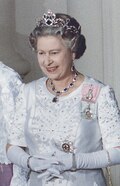 |
Queen | Dominion of Sierra Leone | 1961 | 1971 | 10 years |
Central Africa
editAngola
edit| Monarch | Portrait | Office | State | Start of reign | End of reign | Length |
|---|---|---|---|---|---|---|
| Mussasa | – | Queen | Imbangala | 17th century | Unknown | – |
| Tembandumba | .jpg) |
Queen | Imbangala | 17th century | Unknown | – |
| Mwongo Matamba | – | Queen | Matamba | Unknown | 1631 | – |
| Nzinga (Ana I) |  |
Ngola | Ndongo | 1624 | 1626 | 2 years |
| 1657 | 1663 | 6 years | ||||
| Queen | Matamba | 1631 | 1663 | 32 years | ||
| Barbara | – | Ngola | Ndongo | 1663 | 1666 | 3 years |
| Queen | Matamba | |||||
| Verónica I[h] | – | Queen | Matamba | 1681 | 1721 | 40 years |
| Ana II[h] | – | Queen | Matamba | 1742 | 1756 | 14 years |
| Verónica II[h] | – | Queen | Matamba | 1756 | 1758 | 2 years |
| Ana III[h] | – | Queen | Matamba | 1758 | 1767 | 9 years |
| Kamana | – | Queen | Jinga | 1767 | 1810 | 43 years |
Mbunda Kingdom
edit- Vamwene Naama
- Vamwene Yamvu
- Vamwene Mbaao ya Chinguli (reigned in the 1500s–early 1600s)
- Vamwene Kaamba ka Mbaao
- Vamwene Mukenge wa Lweembe, Livindamo
Kingdom of Kongo
editThere were two female monarchs during Kongo Civil War.
- Ana Afonso de Leão, queen of Nkondo and matriarch of Kinlaza[44]
- Suzana de Nóbrega, queen of Luvota and matriarch of Kimpanzu[44]
Luvale
editCameroon
edit- Wou-Ten, founder of the Tikar dynasty (reigned c. 1299–?)[47]
- Ngon-Nso, founder of the Nso dynasty (reigned late 14th century–c. 1421)[47]
- Soukda, founder of the Mandara Kingdom (reigned c. 1500)
- Ngoungoure, queen of Bamum (reigned 1865) – her reign lasted 30 minutes[48]
Chad
edit| Monarch | Portrait | Office | State | Start of reign | End of reign | Length | Ref. |
|---|---|---|---|---|---|---|---|
| Aissa Koli | – | Magira | Kanem–Bornu Empire | 1563 | 1570 | 7 years | [49] |
Congo-Kinshasa
edit| Monarch | Portrait | Office | State | Start of reign | End of reign | Length |
|---|---|---|---|---|---|---|
| Lueji A'Nkonde | – | Queen | Lunda Kingdom | c. 1650 | c. 1670 | c. 20 years |
| Diambi Kabatusuila |  |
Queen | Bakwa Luntu | 15 July 2017 | Incumbent |
East Africa
editComoros
edit| Monarch | Portrait | Office | State | Start of reign | End of reign | Length | Ref. |
|---|---|---|---|---|---|---|---|
| Alimah I | – | Sultan | Ndzuwani | Unknown | c. 1590 | – | [50] |
| Alimah II | – | Sultan | Ndzuwani | c. 1632 | c. 1676 | 44 years | [50] |
| Alimah III | – | Sultan | Ndzuwani | c. 1676 | c. 1711 | 35 years | [50] |
| Wabedja | – | Sultan | Itsandra | Unknown | 1743 | c. 50 years | [51] |
| Alimah IV | – | Sultan | Ndzuwani | 1788 | 1792 | 4 years | [50] |
| Djoumbé Fatima |  |
Sultan | Mwali | 1842 | September 1865 | 23 years | |
| 1874 | 1878 | 4 years | [52] | ||||
| Salima Machamba |  |
Sultan | Mwali | 1888 | 1909 | 21 years | [52] |
Other female sultans also ruled on the Comoros, but their reign dates are unknown:
| Monarch | Office | State | Reign dates | Ref. |
|---|---|---|---|---|
| Nyau wa Faume | Sultan | Bambao | Unknown | [52] |
| Ja Mhaba | Sultan | Bajini | c. 1880s | [52] |
| Hadija bint Ahmed | Sultan | Bajini | c. 1880s | [52] |
Ethiopia
edit| Monarch | Portrait | Office | State | Start of reign | End of reign | Length |
|---|---|---|---|---|---|---|
| Zewditu |  |
Empress | Ethiopian Empire | 27 September 1916 | 2 April 1930 | 13 years, 187 days |
Kenya
edit- Elizabeth II, Queen of Kenya (reigned 1963–1964)
- Mwana Mkisi, founder of Mombasa, founded in c. 900 AD
- Mwana Inali, ruler of Kitao on Manda Island – she was the ruler of Kitao when the Pate Sultan Omar (d. 1392/3) conquered Kitao, according to the Pate Chronicle[53]
- Mwana Mimi, ruler of the Pate Sultanate (reigned 1763–1773)[54]
Madagascar
edit| Monarch | Portrait | Office | State | Start of reign | End of reign | Length | Ref. |
|---|---|---|---|---|---|---|---|
| Rangita | – | Queen | Vazimba | 1520 | 1530 | 10 years | |
| Rafohy | – | Queen | Vazimba | 1530 | 1540 | 10 years | |
| Bety | – | Queen | Betsimisaraka | 1750 | 1762 | 12 years | |
| Andrianaginarivo | – | Queen | Boina Kingdom | 1777 | 1778 | 1 year | [55] |
| Tombola | – | Queen | Boina Kingdom | 1778 | 1778 | Less than 1 year | [55] |
| Ravahiny | – | Queen | Boina Kingdom | 1778 | 1808 | 30 years | [55] |
| Ranavalona I |  |
Queen | Merina Kingdom | 11 August 1828 | 16 August 1861 | 33 years, 5 days | |
| Oantitsy | – | Queen | Boina Kingdom | 1832 | 1836 | 4 years | [55] |
| Tsiomeko | – | Queen | Boina Kingdom | 1836 | 1840 | 4 years | [55] |
| Rasoherina | .jpg) |
Queen | Merina Kingdom | 12 May 1863 | 1 April 1868 | 4 years, 325 days | |
| Ranavalona II |  |
Queen | Merina Kingdom | 2 April 1868 | 13 July 1883 | 15 years, 102 days | |
| Ranavalona III |  |
Queen | Merina Kingdom | 30 July 1883 | 28 February 1897 | 13 years, 213 days |
Ambohidratrimo
edit- Ravorombato[56]
Menabe
editBemihisatra
edit- Safy Mozongo – Mother of Binao
- Binao – Daughter of Safy Mozongo
Bemazava
editAntankarana
editMauritius
edit| Monarch | Portrait | Office | State | Start of reign | End of reign | Length |
|---|---|---|---|---|---|---|
| Elizabeth II | |
Queen | Mauritius | 1968 | 1992 | 24 years |
Mozambique
editSomalia
edit- Asha Ngumi, ruler of Ngumi Island in the Bajuni Islands[61]
Somaliland
editSultanate of Ifat
edit- Māti Layla Abūd (c. 1344–1352)[62]
South Sudan
editTanzania
editTanganyika
edit- Elizabeth II, Queen of Tanganyika (reigned 1961–1962)
Unguja
edit- Mwana Mwema, queen of Unguja[64] (reigned ?–1653)[65]
- Fatuma binti Yusuf al-Alawi, queen of Unguja (reigned ?–1698 and 1709–1715)
Pemba Island
edit- Mwana Mize binti Muaba (reigned in the 17th century)[66]
- Mwana Fatuma binti Dathash (reigned in the 17th century)[66]
- Mwana Hadiya (reigned in the 17th century)[66]
- Mwana Aisha (reigned in the 17th century)[66]
Tumbatu Island
editKua
editMikindani
edit- Sabani binti Ngumi – she was succeeded by her daughter[68]
- Daughter of Sabani binti Ngumi[68]
Unyanyembe
edit- Mugalula (reigned 1893)[69]
Uganda
edit| Monarch | Portrait | Office | State | Start of reign | End of reign | Length | Ref. |
|---|---|---|---|---|---|---|---|
| Nyakahuma | – | Queen | Busongora Kingdom | c. 1330 | c. 1375 | c. 45 years | [70] |
| Kitami kya Nyawera | – | Queen | Busongora Kingdom | c. 1685 | c. 1725 | c. 40 years | [70] |
| Kantunguru | – | Queen | Busongora Kingdom | c. 1740 | c. 1750 | c. 10 years | [70] |
| Akech | – | Queen | Paroketu | 1760 | 1787 | 27 years | [71] |
| Kogyere III Ikamiro | – | Queen | Busongora Kingdom | 1886 | 1889 | 3 years | [70] |
| Elizabeth II |  |
Queen | Dominion of Uganda | 9 October 1962 | 9 October 1963 | 1 year, 0 days |
Southern Africa
editEswatini
editThe Ndlovukati serves as a joint head of state, ruling alongside the Ngwenyama.
Malawi
edit| Monarch | Portrait | Office | State | Start of reign | End of reign | Length |
|---|---|---|---|---|---|---|
| Elizabeth II |  |
Queen | Malawi | 1964 | 1966 | 2 years |
Namibia
edit| Monarch | Office | State | Start of reign | End of reign | Length | Ref. |
|---|---|---|---|---|---|---|
| Kapango | Queen | Mbunza | c. 1750 | – | – | [72] |
| Mate I | Hompa | Uukwangali | c. 1750 | – | – | [73] |
| Nankali | Hompa | Uukwangali | c. 1770 | – | – | [73] |
| Simbara | Hompa | Uukwangali | 1785 | 1800 | 15 years | [73] |
| Mate II | Hompa | Uukwangali | 1800 | 1818 | 18 years | [73] |
| Nakashwa | Queen | Ongandjera | 1862 | – | – | [73] |
| Mpande | Hompa | Uukwangali | 1880 | 1886 | 6 years | [73] |
| Kanuni | Hompa | Uukwangali | 1926 | 1941 | 28 years (Total) | [73] |
| 1958 | 1971 | |||||
| Maria Mwengere | Queen | Shambyu | 1947 | 1987 | 40 years | [73] |
| Anna Katrina Christiaan | Kaptein | Bondelswarts | 1977 | 2011 | 34 years | [74] |
| Angelina Matumbo Ribebe | Queen | Shambyu | 1989 | 2015 | 26 years | [75] |
| Martha Nelumbu | Ohmaba | Oukwanyama | November 2005 | Incumbent | 20 years to date | |
| Sofia Mundjembwe Kanyetu | Queen | Shambyu | 2023 | Incumbent | 2 years to date | [76] |
South Africa
edit| Monarch | Portrait | Office | State | Start of reign | End of reign | Length |
|---|---|---|---|---|---|---|
| Mamani kaPhahlo | Queen | AmaMpondomise | 1732 | 1758 | 26 years | |
| Elizabeth II | .JPG) |
Queen | Union of South Africa | 1952 | 1961 | 9 years |
Lobedu people
editThe Modjadji or Rain Queen is the hereditary queen of Lobedu, the people of the Limpopo Province of South Africa. The succession to the position of Rain Queen is matrilineal, meaning that the Queen's eldest daughter is the heir, and that males are not entitled to inherit the throne at all. The Rain Queen is believed to have special powers, including the ability to control the clouds and rainfall.
- Maselekwane Modjadji (reigned 1800–1854)
- Masalanabo I Modjadji (reigned 1854–1894)
- Khetoane Modjadji (reigned 1895–1959)
- Makoma Modjadji (reigned 1959–1980)
- Mokope Modjadji (reigned 1981–2001)
- Makobo Modjadji (reigned 2003–2005)
- Masalanabo II Modjadji (reigned 2023–present)
Zambia
editMakololo
edit- Mamochisane (reigned 1851)
Lozi kingdom
editThe Lozi kingdom is divided into north and south. The north (called Namuso) is ruled by a man, the Litunga or "King", while the south (called Lwambi) is ruled by a woman, the Litunga la Mboela or "Queen of the south", and is subordinate to the north.[77]
- Notulu
- Kandundu
- Kaiko
- Mwangala
- Matauka
- Maibiba
- Atangambuyu
- Mulima
- Makwibi (reigned 1959–2011)
- Mbuyu (reigned 2011–present)
Zimbabwe
edit| Monarch | Portrait | Office | State | Start of reign | End of reign | Length |
|---|---|---|---|---|---|---|
| Elizabeth II | |
Queen | Rhodesia | 1965 | 1970 | 5 years |
Americas
editNorth America
editCanada
edit| Monarch | Portrait | Office | State | Start of reign | End of reign | Length | Ref. |
|---|---|---|---|---|---|---|---|
| Victoria[i] | .jpg) |
Queen | Canada | 1867 | 1901 | 34 years | |
| Elizabeth II |  |
1952 | 2022 | 70 years |
Mexico
editCoba
edit- Ix Ch'ak Ch'een (reigned c. 569 – c. 573)[78]
- Lady Yopaat (reigned c. 600 – c. 640)[79]
- Lady Kʼawiil Ajaw (reigned 640–682)
Ecatepec
edit- Tlapalizquixochtzin (reigned in the late 15th–early 16th century)
Palenque
edit
- Ix Yohl Ikʼnal (reigned 583–604)
- Sak Kʼukʼ, also known as Muwaan Mat (reigned 612–615)
Tepetlaoztoc
editToltec Empire
edit- Xiuhtlaltzin (reigned 979–983)
Toniná
edit- Lady K'awiil Yopaat (reigned 762–774)
Tzacoalco
edit- Malinxalchitl (reigned ?–1524)
Mixtec
edit- Lady 9 Wind Stone Quexquemitl
- Lady 6 Monkey War Quexquemitl
- Lady 1 Death
- Lady 13 Flower Precious Bird
- Lady 2 Flower Rising Jewel
- Lady 11 Monkey Jade Spiderweb
- Lady 11 Alligator Quetzal Jewel
- Lady 2 Jaguar Jade Spiderweb
- Lady 5 Rabbit Jewel
- Lady 3 Jaguar Precious Butterfly Sun
- Lady 6 Water Quetzal Jewel of Flower War
- Lady 3 Rabbit Divine Flame
- Lady 12 Flower Broken Mountain Butterfly
- Lady 11 Rabbit Jewel of the Rising Sun
- Lady 8 Deer Quetzal Spiderweb
- Lady 1 Flower Jaguar Quexquemitl
Central America
editBelize
edit| Monarch | Portrait | Office | State | Start of reign | End of reign | Length | Ref. |
|---|---|---|---|---|---|---|---|
| Elizabeth II | .jpg) |
Queen | Belize | 21 September 1981 | 8 September 2022 | 40 years, 352 days |
Pusilha
edit- Lady Ich’aak K’inich[81] (reigned c.710–731)
Guatemala
editEl Perú
edit- Lady K'abel (reigned 672–692)
La Florida
edit- Lady Chaak (reigned c. 731)[82]
Naranjo
edit- Wac Chanil Ahau, also known as Lady Six Sky
Tikal
edit- Unen Bahlam (reigned c. 317)
- Lady of Tikal (reigned 511–527?)
Caribbean
editWest Indies
edit| Monarch | Portrait | Office | State | Start of reign | End of reign | Length | Ref. |
|---|---|---|---|---|---|---|---|
| Elizabeth II | .jpg) |
Queen | Antigua and Barbuda | 1 November 1981 | 8 September 2022 | 40 years, 311 days | |
| Queen | Bahamas | 10 July 1973 | 8 September 2022 | 49 years, 60 days | |||
| Queen | Barbados | 30 November 1966 | 30 November 2021 | 55 years, 0 days | |||
| Queen | Grenada | 7 February 1974 | 8 September 2022 | 48 years, 213 days | |||
| Queen | Jamaica | 6 August 1962 | 8 September 2022 | 60 years, 33 days | |||
| Queen | Saint Kitts and Nevis | 19 September 1983 | 8 September 2022 | 38 years, 354 days | |||
| Queen | Saint Lucia | 22 February 1979 | 8 September 2022 | 43 years, 198 days | |||
| Queen | Saint Vincent and the Grenadines | 27 October 1979 | 8 September 2022 | 42 years, 316 days | |||
| Queen | Trinidad and Tobago | 31 August 1962 | 1 August 1976 | 13 years, 130 days | |||
South America
editBrazil
edit| Monarch | Portrait | Office | State | Start of reign | End of reign | Length |
|---|---|---|---|---|---|---|
| Maria I | _in_an_18th_century_painting.jpg) |
Queen | Kingdom of Brazil | 16 December 1815 | 20 March 1816 | 95 days |
Ecuador
editGuyana
edit| Monarch | Portrait | Office | State | Start of reign | End of reign | Length |
|---|---|---|---|---|---|---|
| Elizabeth II |  |
Queen | Guyana | 1966 | 1970 | 4 years |
Peru
edit- Lady of Cao, Moche ruler[83]
Asia
editEast Asia
editChina
edit| Monarch | Portrait | Office | State | Start of reign | End of reign | Length |
|---|---|---|---|---|---|---|
| Daughter of Xiaoming | – | Empress (disputed) |
Northern Wei | 1 April 528 | 1 April 528 | Less than 1 day |
| Wu Zetian |  |
Empress | Wu Zhou | 16 October 690 | 21 February 705 | 14 years, 128 days |
Eastern Queendom
editWuman
edit- Acha (Cuanman) (Chinese: 阿姹) – her son Cuan Shouyu submitted to Geluofeng of Nanzhao, and instead she declared herself "Wáng of the Wuman tribe (烏蠻部落王)"[88]
Kingdom of Derge
editWithin the Derge royal lineage of Dharma Kings (法王), there were two female "Dharma Kings".[89]
- Yangchen Drolma (reigned 1774–1786)[90]
- Tsewang Lhamo (reigned 1790–1806/08, disputed)
Japan
edit| Monarch | Portrait | Office | State | Start of reign | End of reign | Length | Ref. |
|---|---|---|---|---|---|---|---|
| Himiko | – | Queen | Yamatai | c. 180 | c. 247 or 248 | 67 or 68 years | [91] |
| Toyo | – | Queen | Yamatai | c. 248 | Unknown | – | [92] |
| Suiko |  |
Empress | Yamato | 15 January 593 | 15 April 628 | 35 years, 91 days | [93] |
| Kōgyoku |  |
Empress | Yamato | 19 February 642 | 12 July 645 | 3 years, 143 days | [94] |
| Saimei | 14 February 655 | 24 August 661 | 6 years, 191 days | ||||
| Jitō |  |
Empress | Japan | 686 | 697 | 11 years | [95] |
| Genmei |  |
Empress | Japan | 17 August 707 | 3 October 715 | 8 years, 47 days | [96] |
| Genshō |  |
Empress | Japan | 3 October 715 | 3 March 724 | 8 years, 152 days | [97] |
| Kōken |  |
Empress | Japan | 19 August 749 | 7 September 758 | 8 years, 324 days | |
| Shōtoku | 6 November 764 | 28 August 770 | 5 years, 295 days | ||||
| Saionji Neishi[j] | – | Chiten no Kimi | Northern Court | 1352 | 1353 | 1 year | |
| Meishō |  |
Empress | Japan | 22 December 1629 | 14 November 1643 | 13 years, 327 days | [98] |
| Go-Sakuramachi |  |
Empress | Japan | 15 September 1762 | 9 January 1771 | 8 years, 116 days | [99] |
Korea
edit
South Asia
editBangladesh
edit| Monarch | Portrait | Office | State | Start of reign | End of reign | Length |
|---|---|---|---|---|---|---|
| Kalindi | – | Rani | Chakma Circle | 1832 | 1873 | 41 years |
North India
edit| Monarch | Portrait | Office | State | Start of reign | End of reign | Length | Ref. |
|---|---|---|---|---|---|---|---|
| Kumaradevi |  |
Empress | Gupta Empire | Early 4th century | Early 4th century | – | |
| Sugandha | – | Queen | Utpala dynasty | 904 | 906 | 2 years | |
| Didda | – | Queen | Utpala dynasty | 980 | 1003 | 23 years | |
| Somalladevi[k] | – | Queen | Chahamanas of Shakambhari | c. 1110 | c. 1135 | c. 25 years | [100] |
| Razia Sultana |  |
Sultana | Delhi Sultanate | 19 November 1236 | 20 April 1240 | 3 years, 153 days | |
| Kota Rani | – | Maharani | Lohara dynasty | 1338 | 1339 | 1 year | |
| Daya Kaur | – | Rani | Nishanwalia Misl | 1786 | 1808 | 22 years | [101] |
| 1809 | 1823 | 14 years | |||||
| Victoria | .jpg) |
Empress | British Raj | 1 May 1876 | 22 January 1901 | 24 years, 266 days |
East India
edit| Monarch | Portrait | Office | State | Start of reign | End of reign | Length | Ref. |
|---|---|---|---|---|---|---|---|
| Tribhuvana Mahadevi I | – | Maharajadhiraja | Bhauma-Kara dynasty | 845 | 850 | 5 years | |
| Tribhuvana Mahadevi II | – | Maharajadhiraja | Bhauma-Kara dynasty | 890 | 896 | 6 years | [102] |
| Tribhuvana Mahadevi III | – | Maharajadhiraja | Bhauma-Kara dynasty | 896 | 905 | 9 years | [102] |
| Gauri Mahadevi | – | Maharajadhiraja | Bhauma-Kara dynasty | c. 910 | c. 916 | c. 6 years | |
| Dandi Mahadevi | – | Maharajadhiraja | Bhauma-Kara dynasty | c. 916 | c. 936 | c. 20 years | |
| Vakula Mahadevi | – | Maharajadhiraja | Bhauma-Kara dynasty | c. 936 | c. 940 | c. 4 years | |
| Dharma Mahadevi | – | Maharajadhiraja | Bhauma-Kara dynasty | c. 940 | c. 950 | c. 10 years | |
| Lakhima Devi | – | Maharani | Oiniwar dynasty | 1416 | 1428 | 12 years | [103] |
| Visvasa Devi | – | Maharani | Oiniwar dynasty | 1431 | 1443 | 12 years | [104] |
| Mohan Kumari | – | Rani | Sambalpur State | 1827 | 1833 | 6 years | [105] |
| Mukhyapan Devi | – | Rani | Sambalpur State | 1849 | 1849 | Less than 1 year | [105] |
South India
edit| Monarch | Portrait | Office | State | Start of reign | End of reign | Length | Ref. |
|---|---|---|---|---|---|---|---|
| Pandambika | – | Queen | Kotas of Tadikonda | c. 1117 | – | – | [106] |
| Ganapamadevi | – | Queen | Kotas of Yenamadala | 1251 | 1264 | 13 years | [106] |
| Vennaladevi | – | Queen | Kotas of Tadikonda | c. 1261 | – | – | [106] |
| Rudrama Devi |  |
Maharaja | Kakatiya dynasty | 1262 | November 1289 | 27 years | |
| Ballamahadevi | – | Chakravarti | Alupa dynasty | 1275 | 1292 | 17 years | |
| Chikkayi-Tayi | – | Chakravarti | Alupa dynasty | 1333 | 1348 | 15 years | [107] |
| Abbakka Chowta |  |
Rani | Ullal | 1525 | 1570 | 45 years | |
| Chennabhairadevi | – | Rani | Gerusoppa | 1552 | 1606 | 54 years | [108] |
| Keladi Chennamma | – | Rani | Keladi Nayaka Kingdom | 1672 | 1697 | 25 years | |
| Ali Raja Bibi Harrabichi Kadavube | – | Arakkal Beevi | Arakkal kingdom | 1728 | 1732 | 4 years | |
| Ali Raja Bibi Junumabe I | – | Arakkal Beevi | Arakkal kingdom | 1732 | 1745 | 13 years | |
| Sujana Bai |  |
Rani | Thanjavur Maratha kingdom | 1737 | 1738 | 1 year | |
| Virammaji | – | Rani | Keladi Nayaka Kingdom | 1757 | 1763 | 6 years | |
| Ali Raja Bibi Junumabe II | – | Arakkal Beevi | Arakkal kingdom | 1777 | 1819 | 42 years | |
| Velu Nachiyar |  |
Rani | Sivaganga estate | c. 1780 | c. 1790 | c. 10 years | |
| Vellacci | – | Rani | Sivaganga estate | c. 1790 | c. 1793 | c. 3 years | |
| Devammaji | – | Rani | Kingdom of Coorg | 1809 | 1811 | 2 years | [109] |
| Gowri Lakshmi Bayi |  |
Maharani | Travancore kingdom | 7 November 1810 | 1813 | 3 years |
Quilon
editAttingal
editAttingal was an independent principality until 1729 when Marthanda Varma ascended the throne and incorporated his mother's Attingal in Travancore.[110]
- Makayiram Thirunal (reigned as junior queen ?–? and as senior queen ?–1678)[112]
- Umayamma Rani (reigned as junior queen ?–1678 and as senior queen 1678–1698)
- Queen of Attingal, name unknown (reigned as junior queen ?–1698 and as senior queen 1698–1729)[110] – she was one of the two princesses from Kolathunad adopted by Umayamma Rani in 1688; she concluded an agreement with Britain following the Attingal Outbreak of 1721; she was the mother of Marthanda Varma
- Queen of Attingal, name unknown (reigned as junior queen 1698–?)[110] – she was the other of the two princesses from Kolathunad adopted by Umayamma Rani in 1688
Maruthurkulangara
edit- Queen of Maruthurkulangara, name unknown (reigned 1733–?)[113] – she was installed on the throne by Marthanda Varma of Travancore in 1733
Kottarakkara
edit- Queen of Elayadathu Swarupam, name unknown (reigned 1739–1742)[114] – she was installed on the throne by the Dutch during the Travancore–Dutch War
Western India
edit| Monarch | Portrait | Office | State | Start of reign | End of reign | Length | Ref. |
|---|---|---|---|---|---|---|---|
| Bai Saheb Daphle | – | Rani | Daphlapur State | 16 December 1885 | 13 January 1917 | 31 years, 28 days |
Central India
edit| Monarch | Portrait | Office | State | Start of reign | End of reign | Length | Ref. |
|---|---|---|---|---|---|---|---|
| Ahilyabai Holkar |  |
Maharani | Indore State | 1 December 1767 | 13 August 1795 | 27 years, 255 days | |
| Qudsia Begum |  |
Nawab Begum | Bhopal State | 14 November 1819 | 29 November 1837 | 18 years | [115] |
| Shah Jahan Begum | .jpg) |
Nawab Begum | Bhopal State | 1844 | 30 September 1860 | 14 years | |
| 30 October 1868 | 16 June 1901 | 32 years, 229 days | |||||
| Sikandar Begum |  |
Nawab Begum | Bhopal State | 30 September 1860 | 30 October 1868 | 8 years, 30 days | |
| Sultan Jahan |  |
Nawab Begum | Bhopal State | 16 June 1901 | 20 April 1926 | 24 years, 308 days | |
| Prafulla Kumari Devi | – | Rani | Bastar State | 23 November 1922 | 28 February 1936 | 13 years, 97 days |
Maldives
edit| Monarch | Office | State | Start of reign | End of reign | Length |
|---|---|---|---|---|---|
| Srimati Damahara | Queen | Kingdom of Dheeva Maari | 10th century | 10th century | – |
| Khadijah | Sultana | Sultanate of Maldives | 1347 | 1362 | 28 years (Total) |
| 1363 | 1373 | ||||
| 1376 | 1379 | ||||
| Raadhafathi | Sultana | 1379 | 1380 | 1 year | |
| Dhaain | Sultana | 1384 | 1388 | 4 years | |
| Kuda Kala Kamanafaanu | Sultana | 1609 | 1613 | 4 years | |
| Amina Kabafaanu | Sultana | 1753 | 1754 | 1 year | |
| Amina Rani Kilegefaanu | Sultana | 1757 | 1759 | 2 years |
Nepal
edit| Monarch | Office | State | Start of reign | End of reign | Length |
|---|---|---|---|---|---|
| Ganga Rani | Rani | Kingdom of Bhaktapur | 1560 | Unknown | – |
Pakistan
edit| Monarch | Portrait | Office | State | Start of reign | End of reign | Length |
|---|---|---|---|---|---|---|
| Elizabeth II | _(page_1_crop).jpg) |
Queen | Dominion of Pakistan | 1952 | 1956 | 4 years |
Assacani
edit- Cleophis (reigned 326 BC–?)
Gilgit
edit- Dadi Jawari (reigned 1642—1667 and 1689—1705) – also known as Malika Jawahir Khatun
- Malika Sahibnuma, also spelled as Sahebnuma[116] (reigned 1825–1828)[117]
Kanhaiya Misl
edit- Sada Kaur (reigned 1789–1821)
Soomra dynasty
editSri Lanka
edit| Monarch | Picture | Office | State | Start of reign | End of reign | Length |
|---|---|---|---|---|---|---|
| Anula | – | Queen | Anuradhapura Kingdom | 47 BCE | 42 BCE | 5 years |
| Sivali | – | Queen | Anuradhapura Kingdom | 35 CE | 35 CE | 4 months |
| Sugala Devi | – | Queen | Principality of Ruhuna | Unknown | 1158 | – |
| Lilavati | – | Queen | Kingdom of Polonnaruwa | 1197 | 1200 | 5 years (Total) |
| 1209 | 1210 | |||||
| 1211 | 1212 | |||||
| Kalyanavati | – | Queen | Kingdom of Polonnaruwa | 1202 | 1208 | 6 years |
| Kusumasana Devi |  |
Queen | Kingdom of Kandy | 1581 | 1581 | Less than 1 year |
| Elizabeth II |  |
Queen | Dominion of Ceylon | 6 February 1952 | 22 May 1972 | 20 years, 106 days |
Southeast Asia
editCambodia
edit| Monarch | Picture | Office | State | Start of reign | End of reign | Length |
|---|---|---|---|---|---|---|
| Soma | – | Queen | Funan | 68 CE | Unknown | – |
| Kulaprabhavati | – | Queen | Funan | 514 | 517 | 3 years |
| Kambuja-raja-lakshmi | – | Queen | Chenla | 575 | 580 | 5 years |
| Jayadevi | – | Queen | Chenla | c. 681 | c. 713 | 32 years |
| Indrani | – | Queen | Sambhupura | 8th century | – | – |
| Nṛpatendradevī | – | Queen | Sambhupura | 8th century | – | – |
| Jayendrabhā | – | Queen | Sambhupura | 8th century | – | – |
| Jyeṣṭhāryā | – | Queen | Sambhupura | c. 803 | Unknown | – |
| Tey | – | Queen | Kingdom of Cambodia | 1687 | 1687 | Few months |
| Ang Mey |  |
Queen | Kingdom of Cambodia | May 1835 | 1840 | 5 years |
| March 1844 | October 1846 | 2 years, 7 months | ||||
| Sisowath Kossamak | _(crop_2x3).jpg) |
Queen | Kingdom of Cambodia | 20 June 1960 | 9 October 1970 | 10 years, 111 days |
Sumatra
edit| Monarch | Portrait | Office | State | Start of reign | End of reign | Length | Ref. |
|---|---|---|---|---|---|---|---|
| Permaisuri Iskandar Syah[l] | – | Queen | Kingdom of Bentan | c. 1290 | Unknown | – | [119] |
| Nur Ilah | – | Sultana | Samudera Pasai Sultanate | 1360/69 | 1380/89 | 20 years | |
| Nahrasiyah | .jpg) |
Sultana | Samudera Pasai Sultanate | 1406 | 1428 | 22 years | |
| Taj ul-Alam Safiatuddin Syah |  |
Sultana | Aceh Sultanate | 18 February 1641 | 23 October 1675 | 34 years, 247 days | |
| Nurul Alam Naqiatuddin Syah | – | Sultana | Aceh Sultanate | 23 October 1675 | 23 January 1678 | 2 years, 92 days | |
| Inayat Zakiatuddin Syah | – | Sultana | Aceh Sultanate | 23 January 1678 | 3 February 1688 | 10 years, 11 days | |
| Zainatuddin Kamalat Syah | – | Sultana | Aceh Sultanate | 3 October 1688 | October 1699 | 11 years |
Jambi Sultanate
edit- Putri Selaras Pinang Masak (reigned 1460–1480)[120] – she co-ruled with her husband Datuk Puduko Berhalo
Old Port Pacification Superintendency
edit- Shi Er-jie (Chinese: 施二姐), also romanized as Shih Er-chieh (reigned c. 1431)[121] – she succeeded her father Shi Jinqing (施進卿) but contested with her brother Shi Jisun (施濟孫)
Pagaruyung Kingdom
editBundo Kanduang is the title for a female leader in Minangkabau.
- Puti Reno Silinduang Bulan (reigned 1457–1460)[122]
- Puti Panjang Rambut II (reigned 1460–1480)[122] – she is the queen who appears in the Cindua Mato epic
Java
edit| Monarch | Portrait | Office | State | Start of reign | End of reign | Length | Ref. |
|---|---|---|---|---|---|---|---|
| Shima | – | Queen | Kalingga Kingdom | c. 674 | c. 695 | 21 years | |
| Sri Isyana Tunggawijaya | – | Maharani | Mataram kingdom | 947 | c. 958 | 11 years | |
| Tribhuwana Wijayatunggadewi |  |
Maharani | Majapahit Empire | 1328 | 1350 | 22 years | |
| Suhita | .jpg) |
Maharani | Majapahit Empire | 1429 | 1447 | 18 years | |
| Ratu Kalinyamat |  |
Sultana | Kalinyamat Sultanate | c. 1549 | c. 1579 | 30 years | |
| Raden Ayu Rasmana Tirtanegara[m] | – | Adipati | Duchy of Sumenep | 1750 | 1762 | 12 years | [123] |
Lodoyong Kingdom
edit- Dyah Tulodong (reigned ?–1032) – she was a queen of Lodoyong, now Tulungagung; she defeated Airlangga in 1031, but was ultimately defeated by Airlangga in 1032[124]
Sindangkasih Kingdom
editFemale rulers of Sindangkasih Kingdom:
- Nyai Ambetkasih, also known as Nyi Rambut Kasih (reigned in the 15th century)[125]
Nusa Tenggara
edit| Monarch | Portrait | Office | State | Start of reign | End of reign | Length | Ref. |
|---|---|---|---|---|---|---|---|
| Śri Wijaya Mahadewi | – | Queen | Bali Kingdom | 983 | 989 | 6 years | |
| Mahendradatta | – | Queen | Bali Kingdom | 989 | 1007 | 17 years | |
| Śri Ajñadewi | – | Queen | Bali Kingdom | c. 1016 | Unknown | – | |
| Śri Maharaja Sakalendukirana Laksmidhara Wijayottunggadewi | – | Queen | Bali Kingdom | 1088 | 1101 | 13 years | |
| Arjayadengjayaketana | – | Queen | Bali Kingdom | 1181 | 1200 | 19 years | |
| Unknown queen[n] | – | Queen | Bali Kingdom | Unknown | 1284 | – | [126] |
| Nyai Cili | – | Queen | Solor | 1646 | 1664 | 18 years | [127] |
| Nyai Cili Muda | – | Queen | Solor | 1664 | 1686 | 22 years | [127] |
| Bi Sonbai | – | Keizerin | Sonbai Kecil | 1672 | 1717 | 45 years | [128] |
| Unknown Queen | – | Liurai | Wehali | c. 1732 | Unknown | – | [129] |
| Daeng Sado | – | Queen | Pekat Kingdom | 1739 | Unknown | – | [130] |
| Kamalat Syah | – | Sultana | Bima Sultanate | 1748 | 1751 | 3 years | |
| Siti Aisyah | – | Sultana | Sumbawa Sultanate | 1759 | 1761 | 2 years | [131] |
| Shafiyatuddin | – | Sultana | Sumbawa Sultanate | 1791 | 1795 | 4 years | [131] |
| Istri Kanya | – | Dewa Agung | Kingdom of Klungkung | 1814 | 1850 | 36 years | |
| Unknown Queen | – | Liurai | Wehali | c. 1814 | Unknown | – | [129] |
Kalimantan
edit| Monarch | Portrait | Office | State | Start of reign | End of reign | Length | Ref. |
|---|---|---|---|---|---|---|---|
| Ratu Sukadana | – | Queen | Kingdom of Matan | 1608 | 1622 | 14 years | |
| Aji Ragi | – | Queen | Kutai Kartanegara Sultanate | 1686 | 1700 | 14 years | [132] |
Mempawah Kingdom
edit- Gusti Intan, also known as Ratu Permaisuri (reigned 1892–1902)[133]
Paser Sultanate
editFemale rulers of the Paser Sultanate:
- Putri Di Dalam Petung (reigned 1516–?)[134]
Tanah Bumbu Kingdom
editFemale rulers of the Tanah Bumbu Kingdom:
- Ratu Mas (reigned in the mid-18th century)[135] – after her death, the kingdom was divided into several petty states, each with its own ruler
- Ratu Intan I (reigned in the late 18th century) – ruler of Cantung and Batulicin[135]
- Gusti Besar (reigned in the early 19th century) – ruler of Bangkalaan, Sampanahan, Menungul, Cengal, Cantung, and Batulicin[135]
- Aji Tukul, also known as Ratu Intan II (reigned in the mid-19th century) – ruler of Bangkalaan, Menungul, and Cengal[135]
Tanjung Pematang Sawang Kingdom
editFemale rulers of the Tanjung Pematang Sawang Kingdom:
- Nyai Undang (reigned in the 14th century)[136]
Tidung Kingdom
editFemale rulers of the Tidung Kingdom:
- Ikenawai (reigned 1542–1557)[137]
Sulawesi
edit| Monarch | Portrait | Office | State | Start of reign | End of reign | Length | Ref. |
|---|---|---|---|---|---|---|---|
| Wa Kaa Kaa | – | Queen | Buton | 1332 | Unknown | – | [138] |
| Bulawambona | – | Queen | Buton | 14th century | 14th century | – | [138] |
| Tumanurung Baine | – | Queen | Gowa | c. 14th century | c. 14th century | – | |
| Tekkawanua | – | Datu | Kingdom of Soppeng | 1408 | 1438 | 30 years | [139] |
| Benrigau' | – | Arumpone | Bone State | 1470 | 1490 | 20 years | [140] |
| Tenri-Rawe | – | Datu | Kingdom of Luwu | 1571 | 1587 | 16 years | [141] |
| Sambo | – | Queen | Kingdom of Tallo | 1576 | 1590 | 14 years | |
| Tenri-Tuppu | – | Arumpone | Bone State | 1602 | 1611 | 9 years | [140] |
| Adang | – | Datu | Kingdom of Soppeng | 1654 | 1666 | 12 years | [142] |
| Pattekke-Tana I | – | Datu | Tanette | 1690 | 1733 | 43 years | [143] |
| Batari Tungke | – | Datu | Kingdom of Luwu | 1706 | 1715 | 9 years | [141] |
| Batari Toja | – | Sultana | Bone State | 1714 | 1715 | 1 year | [140] |
| 1724 | 1738 | 14 years | |||||
| 1741 | 1749 | 8 years | |||||
| Datu | Kingdom of Luwu | 1715 | 1748 | 33 years | [141] | ||
| Datu | Kingdom of Soppeng | 1727 | 1737 | 10 years | [144] | ||
| 1742 | 1744 | 2 years | |||||
| Tenri-Leleang | – | Datu | Tanette | 1744 | 1750 | 6 years | [143] |
| Datu | Kingdom of Luwu | 1748 | 1760 | 12 years | [141] | ||
| 1765 | 1778 | 13 years | |||||
| Sitti Saleh I | – | Sultana | Kingdom of Tallo | 1767 | 1777 | 10 years | |
| Tenri-Awaru I | – | Datu | Kingdom of Luwu | 1810 | 1825 | 15 years | [141] |
| Datu | Kingdom of Soppeng | 1820 | 1840 | 20 years | [145] | ||
| Sitti Saleh II | – | Sultana | Kingdom of Tallo | 1814 | 1824 | 10 years | |
| Maniratu | – | Sultana | Bone State | 1823 | 1835 | 12 years | [140] |
| Tanisanga | – | Datu | Tanette | 1824 | 1829 | 5 years | [143] |
| Aisyah | – | Sultana | Kingdom of Tallo | 1845 | 1850 | 5 years | |
| Tenri-Olle |  |
Datu | Tanette | 1855 | 1910 | 55 years | [143] |
| Tenri-Awaru II | – | Sultana | Bone State | 1857 | 1860 | 3 years | [140] |
| Banrigau' | – | Sultana | Bone State | 1871 | 1895 | 24 years | [140] |
| Sitti Zaenab | – | Datu | Kingdom of Soppeng | 1895 | 1940 | 45 years | [139] |
| Kambo |  |
Datu | Kingdom of Luwu | 1901 | 1935 | 34 years | [141] |
| Pancaitana | – | Datu | Tanette | 1910 | 1926 | 16 years | [143] |
| Pattekke-Tana II | – | Datu | Tanette | 1926 | 1927 | 1 year | [143] |
Bungku Kingdom
edit- Boki Panesi (reigned 1825–?)[146]
Konawe Kingdom
editFemale rulers of the Konawe Kingdom:
- Wekoila (reigned c. 1150)[147]
Lipukasi
editTagulandang Kingdom
editFemale rulers of the Tagulandang Kingdom:
- Ratu Leheraung (reigned 1570–1609)[149]
Laos
edit| Monarch | Office | State | Start of reign | End of reign | Length |
|---|---|---|---|---|---|
| Nang Keo Phimpha | Queen | Lan Xang | 1438 | 1438 | Few months |
Myanmar
edit| Monarch | Picture | Office | State | Start of reign | End of reign | Length | Ref. |
|---|---|---|---|---|---|---|---|
| Kuverami | – | Queen | Waithali | 334 | 341 | 7 years | [150] |
| Saw Yin Mi | – | Queen | Sandoway | 1420s | 1437 | ||
| Shin Sawbu |  |
Queen | Hanthawaddy | 1454 | 1471 | 17 years | |
| Wife of Sao Ne Ya | – | Saopha | Laihka State | 1680 | 1683 | 3 years | [151] |
| Youngest Sister of Hkun Hkawt | – | Saopha | 1866 | 1868 | 2 years | [152] |
Möng Mao
edit- Nang Ye Hkam Leng (Chinese: 南玉罕良), ruler of Möng Mao (reigned 1293–1310 or 1127–1152)[153] – according to some sources, she succeeded her father Hkun Hpang Hkam (Chinese: 混芳罕)
Möng Sit
editPangtara
editPhilippines
editPasig
edit- Dayang Kalangitan (reigned c. 1450–c. 1500)
Kingdom of Maynila
editSultanate of Sulu
edit- Nur ul-Azam (reigned c. 1685)[156]
Thailand
edit| Monarch | Portrait | Office | State | Start of reign | End of reign | Length of reign | Ref. |
|---|---|---|---|---|---|---|---|
| Jamadevi | .jpg) |
Queen | Hariphunchai | 662 or 659 | 669 or 679 or 688 | 7 or 17 or 29 years | |
| Chiraprapha |  |
Queen | Lanna | 1545 | 1546 | 1 year | |
| Wisutthi Thewi[o] | — | Queen | Lanna | 1564 | 1578 | 14 years | |
| Ratu Hijau |  |
Queen | Patani | 1584 | 1616 | 32 years | |
| Ratu Biru | — | Queen | Patani | 1616 | 1624 | 8 years | |
| Ratu Ungu | — | Queen | Patani | 1624 | 1635 | 11 years | |
| Ratu Kuning | — | Queen | Patani | 1635 | 1651 | 16 years | [157] |
| Raja Mas Kelantan | — | Raja | Patani | 1670 | 1698 | 28 years | [157] |
| Raja Mas Chayam | — | Raja | Patani | 1698 | 1702 | 6 years (Total) | [157] |
| 1716 | 1718 | ||||||
| Raja Dewi | — | Raja | Patani | 1702 | 1711 | 9 years | [157] |
Timor-Leste
editThere were many chiefdoms on Timor, but according to the hierarchy among the Timorese domains, the ruler of Sonbai of West Timor, the ruler of Wehali of Central Timor, and the ruler of Likusaen (today: Liquiçá) of East Timor were three paramount rulers of Timor.[158]
Liquiçá
edit- Ursula da Costa (reigned c. 1818)[159]
- Dona Gracia da Costa Rodrigues Pereira (reigned c. 1881 – c. 1883)[159]
- Dona Engracia da Costa Delgado (reigned c. 1890 – c. 1892)[159]
Vietnam
edit| Monarch | Portrait | Office | State | Start of reign | End of reign | Length |
|---|---|---|---|---|---|---|
| Trưng Trắc |  |
Queen | Jiaozhi | 40 | 43 | 3 years |
| Trưng Nhị | ||||||
| Triệu Ẩu |  |
Lady | Jiaozhou | 248 | 248 | Less than 1 year |
| Daughter of Kandarpadharma | – | Queen | Champa | Unknown | 653 | – |
| Lý Chiêu Hoàng | – | Empress | Đại Việt | 1224 | 1225 | 1 year |
West Asia
editIran
edit| Monarch | Portrait | Office | State | Start of reign | End of reign | Length | Ref. |
|---|---|---|---|---|---|---|---|
| Anzaze |  |
Basilissa | Elymais | c. 82 or 81 BCE | c. 75 BCE | c. 6 or 7 years | |
| Musa |  |
Basilissa | Parthian Empire | 2 BCE | 4 CE | 6 years | |
| Ulfan | – | Basilissa | Elymais | 2nd century CE | 2nd century CE | – | |
| Boran |  |
Banbishn | Sasanian Empire | 630 | 630 | Less than 1 year | |
| June 631 | June 632 | 1 year | |||||
| Azarmidokht | – | Banbishn | Sasanian Empire | 630 | 631 | 1 year | |
| Sulafa Khatun | – | Atabeg | Ahmadilis | 1209 | 1225 | 16 years | |
| Kutlugh Turkan | – | Khatun | Qutlugh-Khanids | 1257 | 1282 | 25 years | |
| Abish Khatun | – | Atabeg | Salghurids | 1264 | 1284 | 20 years | |
| Padishah Khatun |  |
Khatun | Qutlugh-Khanids | 1292 | 1295 | 3 years | |
| Kurdujin Khatun | – | Khatun | Qutlugh-Khanids | June or July 1295 | November 1295 | 4 or 5 months | |
| Atabeg (disputed) |
Salghurids | 1319 | 1338 | 19 years | |||
| Dawlat Khatun | – | Atabeg | Khorshidi dynasty | 1316 | 1316 | – | |
| Sati Beg | – | Il khan | Ilkhanate | July or August 1338 | May 1339 | 9 or 10 months |
Iraq
edit| Monarch | Portrait | Office | State | Start of reign | End of reign | Length |
|---|---|---|---|---|---|---|
| Puabi |  |
Nin | First Dynasty of Ur | c. 2600 BC | – | – |
| Tandu Khatun | – | Sultan | Jalayirid Sultanate | 1411 | 1419 | 8 years |
| Mir Xanzad | – | Mir | Soran Emirate | c. 1590 or c. 1620 | – | 7 years |
Israel and Palestine
edit| Monarch | Portrait | Office | State | Start of reign | End of reign | Length | Ref. |
|---|---|---|---|---|---|---|---|
| Lady of the Lions | – | Nin | Beit Shemesh | c. 1350 BC | – | – | [160] |
| Athaliah |  |
Queen | Kingdom of Judah | c. 841 BC | c. 835 BC | 6 years | |
| Salome Alexandra |  |
Queen | Hasmonean dynasty | c. 76 BC | c. 67 BC | 9 years | |
| Salome I | – | Toparch | Herodian dynasty | 4 BC | 10 AD | 14 years | |
| Berenice |  |
Queen | Herodian dynasty | 48 | – | – | |
| Melisende |  |
Queen | Kingdom of Jerusalem | 1131 | 1153 | 22 years | |
| Sibylla |  |
Queen | Kingdom of Jerusalem | 1186 | 1190 | 4 years | |
| Isabella I | .jpg) |
Queen | Kingdom of Jerusalem | 1190 | 1205 | 15 years | |
| Maria |  |
Queen | Kingdom of Jerusalem | 1205 | 1212 | 7 years | |
| Isabella II |  |
Queen | Kingdom of Jerusalem | 1212 | 1228 | 16 years |
Jordan
editGileadite
edit- Laodice of the Sameans (reigned c. 92 BC) – in the Codex Leidensis, the people of Laodice is Gileadites.
Nabataean Kingdom
editThe queens of the later Nabataean Kingdom appear alongside their husbands as co-rulers on their coinage.[161]
- Chuldu (reigned 9 BC – 16 AD) – she ruled with her husband Aretas IV Philopatris
- Shaqilath (reigned 16–40 AD) – she ruled with her husband Aretas IV Philopatris
- Shaqilath II – she ruled with her husband Malichus II; after his death she was regent for her son Rabbel II Soter
- Gāmilat – she ruled with Rabbel II Soter
- Hagaru – she ruled with Rabbel II Soter
Lebanon
editTripoli
editThe County of Tripoli was an autonomous state.[162]
- Lucia of Tripoli (reigned 1287–1289)
Saudi Arabia
editBāzu
edit- Iapa, queen of the city Dihrani – Esarhaddon conquered eight kings and queens of the land Bāzu[163]
- Baslu, queen of the city Ihilum – Esarhaddon conquered eight kings and queens of the land Bāzu[163]
Qedarite
edit- Zabibe (reigned c. 750–735 BC)
- Samsi (reigned c. 735–710 BC)
- Yatie (reigned c. 710–695 BC)
- Te'el-hunu (reigned c. 695–690 BC)
- Tabua (reigned c. 678–675 BC)
Syria
edit| Monarch | Portrait | Title | State | Start of reign | End of reign | Length | Ref. |
|---|---|---|---|---|---|---|---|
| Cleopatra Thea |  |
Queen | Seleucid Empire | 126 BC | 121 BC | 5 years | |
| Cleopatra Selene I |  |
Queen | Seleucid Empire | 82 BC | 69 BC | 13 years | |
| Zenobia |  |
Empress | Palmyrene Empire | 272 | 272 | Less than 1 year | |
| Mavia | Queen | Tanukhids | 375 | 425 | 50 years |
Turkey
edit| Monarch | Portrait | Office | State | Start of reign | End of reign | Length | Ref. |
|---|---|---|---|---|---|---|---|
| Artemisia I[p] |  |
Queen | Caria | c. 480 BC | – | – | |
| Mania[q] | Tyrant | Dardanus | – | c. 399 BC | – | ||
| Artemisia II[p] | Queen | Caria | 353 BC | 351 BC | 2 years | ||
| Ada[p] |  |
Queen | Caria | 344 BC | 340 BC | 4 years | |
| 334 BC | 326 BC | 8 years | |||||
| Amastris |  |
Basilissa | Heraclea | c. 300 BC | c. 284 BC | c. 16 years | |
| Laodice | Queen | Kingdom of Pontus | c. 162 BC | c. 150 BC | c. 12 years | ||
| Orsabaris | Queen | Prusias | c. 47 BC | c. 37 BC | c. 10 years | ||
| Orodaltis | Queen | Prusias | c. 37 BC | c. 31 BC | c. 6 years | ||
| Aba |  |
Tyrant | Olba | c. Late 30s BC | – | – | |
| Pythodorida | Queen | Kingdom of Pontus | 8 BC | 38 AD | 46 years | ||
| Constance[r] | Princess | Principality of Antioch | 1130 | 1163 | 33 years | ||
| Mama Hatun | Melike | Saltukid dynasty | 1191 | 1200 | 9 years | ||
| Isabella |  |
Queen | Armenian Kingdom of Cilicia | 1219 | 1252 | 33 years | |
| Theodora |  |
Empress | Empire of Trebizond | 1284 | 1285 | 1 year | |
| Hudavend Hatun[s] | Queen | Tokat | 1292 | 1332 | 40 years | [164] | |
| Niğde | |||||||
| Irene Palaiologina | Empress | Empire of Trebizond | 1340 | 1341 | 1 year | ||
| Anna | Empress | Empire of Trebizond | 1341 | 1342 | 1 year |
Yemen
edit| Monarch | Office | State | Start of reign | End of reign | Length | Ref. |
|---|---|---|---|---|---|---|
| Asma bint Shihab | Queen | Sulayhid dynasty | 1047 | 1087 | 40 years | |
| Arwa al-Sulayhi | Queen | 1067 | 1138 | 71 years |
Central Asia
editAfghanistan
edit- Queen of Greater Yuezhi, name unknown (reigned in the 2nd century BC) – after the king of the Greater Yuezhi was killed by the Xiongnu, his wife became the new monarch of Greater Yuezhi[165][166]
Uzbekistan and Kazakhstan
edit- Tomyris (reigned c. 570–520 BC) – queen of Massagetae
North Asia
editSiberia
edit- Botohui-Tarhun (reigned in the 13th century) – queen of Khori-Tumed
Europe
editCentral Europe
editAustria, Hungary, Croatia, and Czechia
edit| Monarch | Portrait | Office | State | Start of reign | End of reign | Length | Ref. |
|---|---|---|---|---|---|---|---|
| Fritigil | .jpg) |
Queen | Marcomanni | Late 4th century | – | – | |
| Mary[t] | .jpg) |
Queen | Hungary | 10 September 1382 | December 1385 | 3 years and 4 months | |
| Croatia | |||||||
| Hungary | 24 February 1386 | 17 May 1395 | 9 years, 82 days | ||||
| Croatia | |||||||
| Maria Theresa[u] | .jpg) |
Archduchess | Austria | 20 October 1740 | 29 November 1780 | 40 years, 40 days | |
| Queen | Hungary | ||||||
| Croatia | |||||||
| Slavonia | |||||||
| Bohemia | 19 December 1741 | 1 year, 60 days | |||||
| 12 May 1743 | 29 November 1780 | 37 years, 201 days |
Poland
edit.jpg)
Eastern Europe
editGeorgia, Armenia, and Azerbaijan
edit| Monarch | Portrait | Office | State | Start of reign | End of reign | Length | Ref. |
|---|---|---|---|---|---|---|---|
| Erato |  |
Queen | Kingdom of Armenia | 8 BC | 5 BC | 3 years | |
| 2 BC | 2 AD | 4 years | |||||
| 6 AD | 12 AD | 6 years | |||||
| Shahandukht II[v] | — | Queen | Kingdom of Syunik | 1072 | 1094 or 1096 | 22 or 24 years | [167] |
| Dinar |  |
Queen | Kingdom of Hereti | — | c. 1010s | — | |
| Tamar I[w] |  |
Mepe | Kingdom of Georgia | 27 March 1184 | 18 January 1213 | 28 years, 297 days | |
| Dop[x] | — | Princess | Principality of Khachen | c. early 13th-century | — | — | [168] |
| Rusudan | .jpg) |
Mepe | Kingdom of Georgia | 18 January 1223 | 1245 | 22 years | |
| Tamar II | – | Queen | Kingdom of Kartli | 1744 | 12 April 1746 | 2 years |
Russia
edit| Monarch | Portrait | Office | State | Start of reign | End of reign | Length | Ref. |
|---|---|---|---|---|---|---|---|
| Camasarye Philotecnus | – | Queen | Bosporan Kingdom | c. 180 BC | c. 150 BC | c. 30 years | |
| Dynamis |  |
Queen | Bosporan Kingdom | 47 BC | 47 BC | Less than 1 year | |
| 44 BC | 13 BC | 31 years | |||||
| 8 BC | 8 AD | 16 years | |||||
| Gepaepyris | – | Queen | Bosporan Kingdom | 37 or 38 | 39 | 1 or 2 years | |
| Boa | – | Queen | Sabir people | 520s | – | – | [169] |
| Tulun Beg | – | Khanum | Blue Horde | 1370 | 1371 | 1 year | |
| Bikhakhanim | – | Princess | Hytuk | c. 1419 | – | – | [170] |
| Fatima Soltan | – | Khanbika | Qasim Khanate | 1679 | 1681 | 2 years | |
| Irina Godunova |  |
Tsaritsa (disputed) |
Tsardom of Russia | 26 January 1598 | 3 March 1598 | 36 days | |
| Catherine I |  |
Empress | Russian Empire | 8 February 1725 | 17 May 1727 | 2 years, 98 days | |
| Anna | .jpg) |
Empress | Russian Empire | 26 February 1730 | 28 October 1740 | 10 years, 245 days | |
| Elizabeth | .jpg) |
Empress | Russian Empire | 6 December 1741 | 5 January 1762 | 20 years, 30 days | |
| Catherine II |  |
Empress | Russian Empire | 9 July 1762 | 17 November 1796 | 34 years, 131 days |
Ukraine
edit| Monarch | Portrait | Office | State | Start of reign | End of reign | Length | Ref. |
|---|---|---|---|---|---|---|---|
| Maria Theresa | |
Queen | Kingdom of Galicia and Lodomeria | 1772 | 1780 | 8 years |
Northern Europe
editDenmark, Norway and Sweden
edit| Monarch | Portrait | Office | State | Start of reign | End of reign | Length of reign | Ref. |
|---|---|---|---|---|---|---|---|
| Åsa | – | Queen | Agder | c. 814 | c. 834 | 20 years | |
| Margaret I | _effigy_2010_(2).jpg) |
Queen | Denmark | 10 August 1387 | 28 October 1412 | 25 years, 79 days | |
| Norway | 2 February 1388 | 24 years, 269 days | |||||
| Sweden | 24 February 1389 | 23 years, 247 days | |||||
| Christina |  |
Queen | Sweden | 16 November 1632 | 16 June 1654 | 21 years, 212 days | |
| Ulrika Eleonora |  |
Queen | Sweden | 5 December 1718 | 29 February 1720 | 1 year, 86 days | |
| Margrethe II |  |
Queen | Denmark | 14 January 1972 | 14 January 2024 | 52 years, 0 days |
Lithuania
edit| Monarch | Portrait | Office | State | Start of reign | End of reign | Length | Ref. |
|---|---|---|---|---|---|---|---|
| Anna |  |
Grand Duchess | Lithuania | 15 December 1575 | 19 August 1587 | 11 years, 247 days |
Western Europe
editLuxembourg and Belgium
editBurgundian Netherlands
edit- Mary of Burgundy (reigned 1477–1482) – according to E. William Monter's book, Mary of Burgundy and Isabella Clara Eugenia are included in the list of thirty women sovereigns over European states between 1300 and 1800[171]
Spanish Netherlands
edit- Isabella Clara Eugenia (reigned as independent sovereign 1598–1621) – during her and Albert's co-reign period, the Spanish Netherlands temporarily had formal independence from Spain
Austrian Netherlands
edit- Maria Theresa (reigned 1740–1780) – she was also the sovereign of many other states as ruler of the Habsburg monarchy
Grand Duchy of Luxembourg
edit- Marie-Adélaïde (reigned 1912–1919)
- Charlotte (reigned 1919–1964)
Netherlands
edit| Monarch | Portrait | Office | State | Start of reign | End of reign | Length of reign | Ref. |
|---|---|---|---|---|---|---|---|
| Wilhelmina |  |
Queen | Netherlands | 23 November 1890 | 4 September 1948 | 57 years, 286 days | |
| Juliana | _–_Nationaal_Archief.jpg) |
Queen | Netherlands | 4 September 1948 | 30 April 1980 | 31 years, 239 days | |
| Beatrix |  |
Queen | Netherlands | 30 April 1980 | 30 April 2013 | 33 years, 0 days |
Monaco
edit| Monarch | Portrait | Office | State | Start of reign | End of reign | Length of reign | Ref. |
|---|---|---|---|---|---|---|---|
| Claudine |  |
Lady | Monaco | July 1457 | 16 March 1458 | c. 8 months | |
| Louise Hippolyte | .jpg) |
Princess | Monaco | 20 February 1731 | 29 December 1731 | 312 days |
United Kingdom and Ireland
editIncluding England and Scotland before the union of 1707. Wales as an independent state never had a female monarch.
| Monarch | Portrait | Office | State | Start of reign | End of reign | Length | Ref. |
|---|---|---|---|---|---|---|---|
| Cartimandua |  |
Queen | Brigantes | c. 43 | c. 69 | c. 25 years | |
| Boudica |  |
Queen | Iceni | c. 60 | c. 61 | c. 1 year | |
| Seaxburh | – | Queen | Wessex | c. 672 | c. 674 | c. 2 years | |
| Æthelflæd |  |
Lady | Mercia | 911 | 918 | c. 7 years | |
| Ælfwynn | – | Lady | Mercia | 12 June 918 | 4 December 918 | 175 days | |
| Matilda |  |
Lady (disputed) | England | 8 April 1141 | 1148 | c. 7 years | [172] |
| Margaret |  |
Queen (disputed) | Scotland | 19 March 1286 | September 1290 | 4 years, 6 months | |
| Mary | _-_Google_Art_Project.jpg) |
Queen | Scotland | 14 December 1542 | 24 July 1567 | 24 years, 222 days | |
| Jane |  |
Queen (disputed) | England | 10 July 1553 | 19 July 1553 | 9 days | [173] |
| Ireland | |||||||
| Mary I |  |
Queen | England | 24 July 1553 | 17 November 1558 | 5 years, 116 days | |
| Ireland | |||||||
| Elizabeth I |  |
Queen | England | 17 November 1558 | 24 March 1603 | 44 years, 127 days | |
| Ireland | |||||||
| Mary II |  |
Queen | England | 13 February 1689 | 28 December 1694 | 5 years, 318 days | |
| Ireland | |||||||
| Scotland | 11 April 1689 | 5 years, 261 days | |||||
| Anne |  |
Queen | England | 8 March 1702 | 1 May 1707 | 5 years, 54 days | |
| Scotland | |||||||
| Ireland | 1 August 1714 | 12 years, 146 days | |||||
| Great Britain | 1 May 1707 | 7 years, 92 days | |||||
| Victoria |  |
Queen | United Kingdom | 20 June 1837 | 22 January 1901 | 63 years, 216 days | |
| Elizabeth II | .jpg) |
Queen | United Kingdom | 6 February 1952 | 8 September 2022 | 70 years, 214 days |
Picts
edit- Pictish Queen, name unknown (reigned c. 617) – in 617, she summoned pirates to massacre Donnán and his companions on the island of Eigg; she is the only woman ruler mentioned in early Scottish history[174]
Southern Europe
editAlbania
edit| Monarch | Title | State | Start of reign | End of reign | Length |
|---|---|---|---|---|---|
| Caeria | Queen | Illyrians | Unknown | 344 or 343 BC | – |
| Joanna | Duchess | Duchy of Durrës | 1348 | 1368 | 20 years |
| 1376 | 1383 | 7 years | |||
| Helena Thopia[y] | Lady | Principality of Albania | 1388 | 1392 | 4 years |
| 1394 | 1403 | 9 years | |||
| Comita Muzaka[y] | Lady | Principality of Vlorë | 1385 | 1396 | 11 years |
| Rugjina Balsha[y] | Lady | Principality of Vlorë | 1414 | 1417 | 3 years |
Bosnia
edit| Monarch | Title | State | Start of reign | End of reign | Length |
|---|---|---|---|---|---|
| Jelena Gruba | Queen | Kingdom of Bosnia | 1395 | 1398 | 3 years |
Bulgaria
editOdrysian kingdom
edit- Antonia Tryphaena (reigned 18–38) – she ruled with her son Rhoemetalces II
- Pythodoris II (reigned 38–46) – she ruled with Rhoemetalces III
Cyprus
edit| Monarch | Portrait | Office | State | Start of reign | End of reign | Length |
|---|---|---|---|---|---|---|
| Charlotte |  |
Queen | Kingdom of Cyprus | 28 July 1458 | 1464 | 6 years |
| Catherine Cornaro |  |
Queen | Kingdom of Cyprus | 26 August 1474 | 26 February 1489 | 14 years, 184 days |
Greece
edit| Monarch | Portrait | Office | State | Start of reign | End of reign | Length | Ref. |
|---|---|---|---|---|---|---|---|
| Cratesipolis | Tyrant | Sicyon | 314 BC | 308 BC | 6 years | ||
| Corinth | |||||||
| Nicaea | Tyrant | Corinth | 247 BC | 245 or 244 BC | 2 or 3 years | ||
| Deidamia II | Queen | Kingdom of Epirus | 234 BC | 233 BC | 1 year | ||
| Irene of Athens | .jpg) |
Empress | Byzantine Empire | 15 January 792 | 31 October 802 | 10 years, 289 days | |
| Thekla | .jpg) |
Empress | Byzantine Empire | 842 | 856 | 14 years | |
| Zoe Porphyrogenita |  |
Empress | Byzantine Empire | 21 April 1042 | 11 June 1042 | 51 days | |
| Theodora Porphyrogenita |  |
Empress | Byzantine Empire | 21 April 1042 | 31 August 1056 | 14 years, 132 days | |
| Eudokia Makrembolitissa |  |
Empress (disputed) |
Byzantine Empire | 22/23 May 1067 | 31 December 1067 | 223 days | |
| Yolanda | Empress (disputed) |
Latin Empire | 1217 | September 1219 | 2 years | ||
| Catherine I[z] |  |
Empress | Latin states in Greece | 15 December 1283 | 11 October 1307 | 23 years, 300 days | |
| Irene of Montferrat[aa] |  |
Empress | Thessalonica | 1303 | 1317 | 14 years | |
| Catherine II[z] |  |
Empress | Latin states in Greece | 11 October 1307 | October 1346 | c. 39 years | |
| Anna of Savoy[aa] |  |
Empress | Thessalonica | 1351 | 1365 | 14 years | |
| Helena of Bulgaria[ab] | .jpg) |
Tsaritsa | Principality of Serres | 1355 | 1365 | 10 years | |
| Maria Angelina |  |
Basilissa | Despotate of Epirus | 23 December 1384 | February 1385 | 2 months |
Italy
edit| Monarch | Portrait | Office | State | Start of reign | End of reign | Length of reign | Ref. |
|---|---|---|---|---|---|---|---|
| Amalasuintha |  |
Queen | Ostrogothic Kingdom | 2 October 534 | 30 April 535 | 210 days | |
| Elena of Gallura |  |
Judge | Judicate of Gallura | 1203 | 1218 | approx. 15 years | |
| Benedetta of Cagliari | Judge | Judicate of Cagliari | 1214 | 1233 | approx. 9 years | ||
| Adelasia of Torres | Judge | Judicate of Logudoro | 1236 | 1259 | approx. 23 years | ||
| Joanna of Gallura[ac] | Judge | Judicate of Gallura | 1296 | 1308 | approx. 12 years | ||
| Eleanor of Arborea | Judge | Judicate of Arborea | 1383 | June 1404 | approx. 21 years | ||
| Constance I of Sicily |  |
Queen | Kingdom of Sicily | 25 December 1194 | 27 November 1198 | 3 years, 337 days | |
| Constance II of Sicily | .png) |
Queen | Kingdom of Sicily | 1282 | 1285 | approx. 3 years | [177] |
| Joanna I of Naples | .jpg) |
Queen | Kingdom of Naples | 20 January 1343 | 25 August 1381 | 38 years, 217 days | |
| Maria of Sicily |  |
Queen | Kingdom of Sicily | 27 July 1377 | 25 May 1401 | 23 years, 302 days | |
| Joanna II of Naples |  |
Queen | Kingdom of Naples | 6 August 1414 | 2 February 1435 | 20 years, 180 days | |
| Joanna of Castile |  |
Queen | Kingdom of Sicily | 23 January 1516 | 12 April 1555 | 39 years, 79 days | |
| Kingdom of Naples | |||||||
| Kingdom of Sardinia | |||||||
| Maria Teresa Cybo-Malaspina[ad] |  |
Duchess | Duchy of Massa | 18 August 1731 | 29 December 1790 | 59 years, 133 days | |
| Princess | Principality of Carrara | ||||||
| Maria Theresa[ad] | |
Duchess | Duchy of Parma and Piacenza | 20 October 1740 | 18 October 1748 | 7 years, 364 days | |
| Duchess | Duchy of Milan | 29 November 1780 | 40 years, 40 days | ||||
| Elisa Bonaparte[ae] |  |
Princess | Principality of Lucca and Piombino | 19 March 1805 | 18 March 1814 | 8 years, 364 days | |
| Grand Duchess | Grand Duchy of Tuscany | 3 March 1809 | 1 February 1814 | 4 years, 335 days | |||
| Pauline Bonaparte[ae] |  |
Duchess | Duchy of Guastalla | 30 March 1806 | 14 August 1806 | 137 days | |
| Marie Louise[af] |  |
Duchess | Duchy of Parma and Piacenza | 11 April 1814 | 17 December 1847 | 33 years, 250 days | |
| Duchy of Guastalla | |||||||
| Maria Luisa of Spain[af] |  |
Duchess | Duchy of Lucca | 9 June 1815 | 13 March 1824 | 8 years, 278 days | |
| Maria Beatrice d'Este[ag] |  |
Duchess | Duchy of Massa | 29 December 1790 | 30 June 1796 | 5 years, 184 days | |
| Princess | Principality of Carrara | ||||||
| Duchess | Duchy of Massa | 9 June 1815 | 14 November 1829 | 14 years, 158 days | |||
| Princess | Principality of Carrara |
Portugal
edit| Monarch | Portrait | Office | State | Start of reign | End of reign | Length | Ref. |
|---|---|---|---|---|---|---|---|
| Theresa | _mini.jpg) |
Queen (disputed) |
Portugal | 1116 | 24 June 1128 | approx. 12 years | |
| Beatrice |  |
Queen (disputed) |
Portugal | 1383 | 1385 | approx. 2 years | |
| Maria I | _-_Google_Cultural_Institute.jpg) |
Queen | Portugal | 24 February 1777 | 20 March 1816 | 39 years, 25 days | |
| Maria II |  |
Queen | Portugal | 2 May 1826 | 23 June 1828 | 2 years, 52 days | |
| 26 May 1834 | 15 November 1853 | 19 years, 173 days | |||||
Romania
edit| Monarch | Portrait | Office | State | Start of reign | End of reign | Length | Ref. |
|---|---|---|---|---|---|---|---|
| Catherine[ah] |  |
Princess | Transylvania | 15 November 1629 | 21 September 1630 | 310 days | |
| Maria Theresa[ai] | |
Princess | Transylvania | 1740 | 1765 | 25 years | |
| Grand Princess | 1765 | 1780 | 15 years |
Spain and Andorra
edit- Toda of Pamplona (reigned c. 958) – queen of Deio and Lizarrara[179]
- Andregoto Galíndez (reigned c. 971) – queen of Lumbier
- Tota of Ribagorza (reigned 1003–1010) – independent countess of Ribagorza
- Mayor García of Castile (reigned 1010–1025) – independent countess of Ribagorza
| Monarch | Portrait | Office | State | Start of reign | End of reign | Length | Ref. |
|---|---|---|---|---|---|---|---|
| Jimena Díaz | Princess | Principality of Valencia | 1099 | 1102 | |||
| Urraca |  |
Empress | Hispania | 30 June 1109 | 8 March 1126 | 16 years, 251 days | |
| Queen | León | ||||||
| Queen | Castile | ||||||
| Queen | Galicia | 1111 | |||||
| Petronilla |  |
Queen | Aragon | 13 November 1137 | 18 July 1164 | 26 years, 248 days | |
| Urraca the Asturian | Queen | Kingdom of Artajona | 1144 | 1153 | |||
| Berengaria |  |
Queen | Castile | 6 June 1217 | 31 August 1217 | 86 days | |
| Queen | Toledo | ||||||
| Sancha | Queen | León | 24 September 1230 | 11 December 1230 | 78 days | ||
| Queen | Galicia | ||||||
| Dulce | Queen | León | 24 September 1230 | 11 December 1230 | 78 days | ||
| Queen | Galicia | ||||||
| Joan I |  |
Queen | Navarre | 22 July 1284 | 2 April 1305 | 20 years, 254 days | |
| Joan II |  |
Queen | Navarre | 1 April 1328 | 6 October 1349 | 21 years, 188 days | |
| Isabella of Foix-Castelbon | Co-Princess | Andorra | 1398 | 1412 | |||
| Blanche I | .jpg) |
Queen | Navarre | 8 September 1425 | 1 April 1441 | 15 years, 205 days | |
| Blanche II | .jpg) |
Queen | Navarre | 23 September 1461 | 2 December 1464 | 3 years, 70 days | |
| Isabella I | |
Queen | Castile | 11 December 1474 | 26 November 1504 | 29 years, 351 days | |
| Queen | León | ||||||
| Eleanor | Queen | Navarre | 28 January 1479 | 12 February 1479 | 15 days | ||
| Catherine |  |
Queen | Navarre | 7 January 1483 | 12 February 1517 | 34 years, 36 days | |
| Co-Princess | Andorra | ||||||
| Joanna the Mad | |
Queen | Castile | 26 November 1504 | 12 April 1555 | 50 years, 137 days | |
| Queen | Aragon | 23 January 1516 | 39 years, 79 days | ||||
| Queen | Upper Navarre | ||||||
| Jeanne d'Albret |  |
Queen | Lower Navarre | 25 May 1555 | 9 June 1572 | 17 years, 15 days | |
| Co-Princess | Andorra | ||||||
| Isabella II | .jpg) |
Queen | Spain | 29 September 1833 | 30 September 1868 | 35 years, 1 day | |
| Queen | Upper Navarre | 30 November 1833 | 62 days | ||||
Malta
edit| Monarch | Portrait | Office | State | Start of reign | End of reign | Length | Ref. |
|---|---|---|---|---|---|---|---|
| Elizabeth II | _(cropped)_(3-to-4_aspect_ratio).jpg) |
Queen | Malta | 21 September 1964 | 13 December 1974 | 10 years, 83 days |
Montenegro
editOceania
editAustralasia
editAustralia
edit

New Zealand
edit| Monarch | Portrait | Office | State | Start of reign | End of reign | Length |
|---|---|---|---|---|---|---|
| Makea Takau Ariki[ak] |  |
Queen | Kingdom of Rarotonga | 1871 | 1911 | 40 years |
| Elizabeth II |  |
Queen | New Zealand | 1952 | 2022 | 70 years |
Melanesia
editFiji, Papua New Guinea and Solomon Islands
edit| Monarch | Portrait | Office | State | Start of reign | End of reign | Length | Ref. |
|---|---|---|---|---|---|---|---|
| Elizabeth II | .jpg) |
Tui Viti | Fiji | 1970 | 1987 | 17 years | |
| Queen | Papua New Guinea | 1975 | 2022 | 47 years | |||
| Queen | Solomon Islands | 1978 | 2022 | 44 years | |||
Polynesia
editAmerican Samoa
edit
- Tuimanufili (reigned as 20th Tui Manu'a)
- Siliave (reigned as 23rd Tui Manu'a)
- Seuea (reigned as 27th Tui Manu'a)
- Matelita (reigned 1891–1895, as 39th Tui Manu'a)
French Polynesia
editBora Bora
edit- Teriimaevarua II (reigned 1860–1873)
- Teriimaevarua III (reigned 1873–1895)
Huahine
edit
- Teha'apapa I (reigned 1760–1790)
- Teri'itaria II (reigned 1815–1852)
- Teha'apapa II (reigned 1868–1893)
- Teuhe (reigned 1888–1890) – she reigned under a rebellion government against her mother Queen Tehaapapa II
- Teha'apapa III (reigned 1893–1895)
Raiatea
edit- Tehauroarii (reigned 1881–1884)
- Tuarii (reigned till 1897) – she reigned under a rebellion government against the French with the support of Teraupo'o after Tamatoa VI abdicated.
Rapa Iti
edit- Daughter of Parima (reigned ?–1887)[180]
Rimatara
edit- Tamaeva IV (reigned 1876–1892)
- Tamaeva V (reigned 1892–1901)
Tahiti
editNuku Hiva
edit- Vaekehu – her husband died in 1863, but Vaekehu continued to reign on her own as Queen
Hawaii
editHilo
edit- Ululani, 7th Chiefess of Hilo
Ko'olau
edit- Hinakaimauli'awa, 2nd Chiefess of Ko'olau
- Mualani, 3rd Chiefess of Ko'olau
- Kaimihauoku, 7th Chiefess of Ko'olau
- Holaulani (Kauaohalaulani), 16th Chiefess of Ko'olau
- Ipuwai-o-Hoalani, 19th Chiefess of Ko'olau
Molokai
edit- Kapau-a-Nuʻakea, 3rd Chiefess of Molokai
- Kamauliwahine, 4th Chiefess of Molokai
- Hualani, 5th Chiefess of Molokai
- Kanealai, Chiefess of Molokai (reigned during the 18th century)
Oʻahu
edit- Kūkaniloko, 11th Moʻi of Oʻahu
- Kalaimanuia, 12th Moʻi of Oʻahu (reigned 1600–1665)
Hawaiʻi Island
edit- Kaikilani, 17th Moʻi of Hawaiʻi Island (reigned 1575–1605)
- Keakamahana, 19th Moʻi of Hawaiʻi Island (reigned 1635–1665)
- Keakealaniwahine, 20th Moʻi of Hawaiʻi Island (reigned 1665–1695)
- Kalanikauleleiaiwi, 21st Moʻi of Hawaiʻi Island (reigned 1695–1725) – co-ruler with her brother Keaweʻīkekahialiʻiokamoku
Kauaʻi
edit- Kamakahelei, 22nd Moʻi of Kauaʻi (reigned 1770–1794)
Kingdom of Hawaii
edit
- Liliʻuokalani (reigned 1891–1893 and claimed status as queen until her death in 1917) – the only queen regnant of the Kingdom of Hawaii established by Kamehameha I
Tonga
edit- Tupoumahe'ofo (reigned 1777–1781, as Tu'i Kanokupolu)
- Salote Tupou III (reigned 1918–1965)
Tuvalu
edit| Monarch | Portrait | Office | State | Start of reign | End of reign | Length |
|---|---|---|---|---|---|---|
| Elizabeth II | _(1).jpg) |
Queen | Tuvalu | 1978 | 2022 | 44 years |
Wallis and Futuna
editUvea
edit- Toifale (reigned 1825–1829)
- Falakika Seilala (reigned 1858–1869)
- Amelia Tokagahahau Aliki (reigned 1869–1895)
- Aloisia Brial (reigned 1953–1958)
Legendary and mythological monarchs
editChad
editChile
editChina
edit- Nüwa, the only female among Three Sovereigns and Five Emperors
- Queen Mother of the West
- Queen of the Aini people (爱尼人), a branch of the Hani people[181]
Congo-Kinshasa
editKuba Kingdom
editWomen written in italics in the list of Kuba Kingdom rulers:[182]
- Lobamba
- Gokare
- Sanga Motunu
- Pelama Pena
- Boeke
- Sanga Lenga
- Bosh Akama
- Kele Kama
- Bolueme
Czechia
editDenmark
edit- Asa – she was described in Chronicon Lethrense
- Hethae – she was described in Chronicon Lethrense
Easter Island
edit- Vakai, queen of Kingdom of Rapa Nui
Ecuador
edit- Paccha Duchicela, queen of the Kingdom of Quito
Egypt
edit- Nitocris of the Sixth Dynasty – Nitocris is mentioned within Herodotus' book Histories as being the last Pharaoh of the Sixth Dynasty of Egypt.
- Charoba – A queen mentioned in a history of Egypt written by 12th-century Arab writer Murtada ibn al-'Afif.[183]
- Daluka of the Soleyman Dynasty – An Antediluvian monarch from medieval Coptic and Arabic texts who supposedly built a wall around Egypt to protect the country from invasion and also was said to have built a pyramid and a nilometer at Memphis. Sometimes claimed to be a cousin of Charoba and her immediate successor.[183]
- Borsa of the Soleyman Dynasty – Mentioned in medieval Coptic and Arabic texts as a ruler of Egypt in the Antediluvian era.[184] Sometimes described as a "priestess".[183]
Ethiopia
editThe following names all come from a regnal list written in 1922, which is partially based on native traditions and older regnal lists, but also contains additional names of Coptic and Nubian origin, the latter due to its association with the word "Aethiopia" in ancient and Biblical texts. Claimed dates follow the Ethiopian calendar.[185]
- Borsa (reigned 4321–4254 BC) – Originated from Coptic tradition.[184]
- Eylouka (reigned 3776–3731 BC) – Originated from Coptic tradition.[184]
- Nehasset Nais (reigned 2434–2404 BC)
- Kasiyope (reigned 1890–1871 BC) – Originated from Greek mythology.
- Mumazes (reigned 1675–1671 BC) – Daughter of king Bonu I.[186]
- Aruas (reigned 1671 BC) – Daughter of Mumazes.[185]
- Helena (reigned 1358–1347 BC)
- Makeda (reigned 1013–982 BC) – The Biblical queen of Sheba in Ethiopian tradition and mother of Menelik I. She succeeded to the throne after the death of her father king Kawnasya.[187]
- Nicauta Kandake I (reigned 740–730 BC)
- Hadina (reigned 372–362 BC) – Most regnal lists of Ethiopia claim this monarch reigned for 9 years.[188]
- Nikawla Kandake II (reigned 342–332 BC) – An alternate name for the Queen of Sheba[189]
- Akawsis Kandake III (reigned 325–315 BC)
- Nikosis Kandake IV (reigned 242–232 BC)
- Awsena (reigned 99–88 BC) – Most regnal lists of Ethiopia claim this monarch reigned for 1 year.[188]
- Nicotnis Kandake V (reigned 35–25 BC)
- Garsemot Kandake VI (reigned 40–50 AD) – Supposedly the Kandake from the Biblical story of the Ethiopian Eunuch.[185]
- Wakana (reigned 230 AD) – Reigned for 2 days.[185]
- Ahywa Sofya (reigned 299–332 AD) – Likely based on Sofya of Axum, mother of Ezana.
- Adhana I (reigned 369–374 AD) – Some regnal lists of Ethiopia claim this monarch reigned for 14 years.[190]
- Adhana II (reigned 412–418 AD) – Some regnal lists claim this monarch co-ruled with king Abreha III.[190]
Kingdom of Simien
edit- Gudit (reigned c. 960 – c. 1000)
Sidama people
editFrench Polynesia
editGreece
edit- Omphale of Lydia, wife of Heracles
- Gerana, queen of Pygmy
- Callidice of Thesprotia
Amazons
edit- Otrera, the daughter of Eurus (the east wind)
- Hippolyta, the Amazonian queen who possessed a magical girdle
- Penthesilea, the daughter of Ares and Otrera and the sister of Hippolyta, Antiope and Melanippe
- Antianara, the daughter of Ares and Otrera and the sister of Hippolyta, Antiope and Melanippe
- Eurypyle
- Lampedo
- Marpesia
- Aegea
- Myrina
- Orithyia
- Antiope
- Thalestris
Iceland
edit- Brunhild – in the Nibelungenlied, she is first presented as the ruling queen of Iceland
India
edit- Yashovati, ruler of Kashmir – she was described in Rajatarangini
- Pandaie
Indonesia
edit- Mahisa Suramardini Warmandewi, queen of Salakanagara (reigned 276–289 AD)[191]
- Sphatikarnawa Warmandewi, queen of Salakanagara (reigned 340–348 AD)[191]
- Dona Maria of the Kingdom of Sikka[192]
- Dona Ines da Silva of the Kingdom of Sikka[192]
Iran
editIraq
edit- Kubaba of Kish, the only queen on the Sumerian King List (reigned in the 25th century BC)
- Semiramis of Assyria, claimed to be Shammuramat
- Nitocris of Babylon, the ruling queen of Babylon described by Herodotus in his Histories
- Queen Zidam – according to the legend of Bayajidda, she conquered Baghdad[193]
Ireland
editJapan
edit- Empress Jingū (reigned 201–269)
- Princess Iitoyo (reigned 484; disputed)
- Kamu-nashi-hime (神夏磯媛), female Tsuchigumo of Hōfu-shi (防府市)[194]
- Hayatsuhime (速津媛), female Tsuchigumo of Hayami-gun (速見郡)[194]
- Taburatsuhime (田油津媛), female Tsuchigumo of Yamato-gun (山門郡)
- Sanai Isoba, ruler of Yonaguni
Korea
edit- Lady Saso, honorary queen regnant of Silla
- Queen of Jeoknyeo-guk – Talhae's mother was the princess of Jeoknyeo-guk (Korean: 적녀국; Hanja: 積女國), an island country where only women lived[195]
- Queen of Tamna – she is mentioned in the legend of Mountain Shrine and Lady Shring in the Bongnae Mountain (봉래산 산제당과 아씨당)[196]
- Hongranyeo (Korean: 홍라녀; Hanja: 紅羅女) – according to the legend of Yeowangjwagangsanhyeong (Korean: 여왕좌강산형; Hanja: 女王坐江山型), she became the monarch of Balhae[197]
Libya
editMalaysia
edit| Monarch | Portrait | Office | State | Start of reign | End of reign | Length |
|---|---|---|---|---|---|---|
| Siti Wan Kembang | Queen | Kelantan | 1610 | 1667 | 57 years | |
| Puteri Saadong | Queen | Kelantan | 1667 | 1671 | 4 years |
Mexico
editTenochtitlan
edit- Ilancueitl (disputed)
- Atotoztli II (reigned 1466–1472, disputed)
Myanmar
editNorway
editPakistan
editPeru
edit- Mama Waqu Quya, mother and predecessor of Manco Cápac as ruler of Inca people according to Felipe Guaman Poma de Ayala[198][199]
- Catalina Huanca
Poland
editRussia
editSomaliland
editSouth Africa
edit- Majaji (reigned c. 350 AD)
Spain
editSri Lanka
edit- Kuveni, queen of Yakkha people of Sri Lanka before the founding of Kingdom of Tambapanni
- Alli Raani
Sudan
edit- Pelekh Candace of Meroë (reigned c. 345 – c. 332 BC)
Syria
editTunisia
editTurkey
editTurkmenistan
editUganda
edit| Monarch | Portrait | Office | State | Start of reign | End of reign | Length | Ref. |
|---|---|---|---|---|---|---|---|
| Kudidi[al] | – | Empress | Chwezi Empire | 950 | 990 | 40 years | [70] |
| Nyakahongerwa | – | Empress | 1000 | 1025 | 25 years | ||
| Kogyere I Rusija-Miryango | – | Empress | 1075 | 1085 | 40 years | ||
| 1090 | 1120 | ||||||
| Kogyere II | – | Empress | 1120 | 1130 | 10 years | ||
| Njunaki Kamaranga | – | Empress | 1250 | 1280 | 30 years |
United Kingdom
edit- Queen Gwendolen (reigned in the 11th century BC)
- Queen Cordelia (reigned in the 8th century BC)
- Queen Marcia (reigned in the 4th century BC)
- Hermuthruda
Vatican City
edit- Pope Joan, legendary monarch of the Papal States
Vietnam
edit- Lady Po Nagar of Champa, According to Cham legend, was the founder of the Cham nation
Yemen
edit- Bilkis in Yemen, claimed to be Queen of Sheba
Zambia
edit- Mwambwa – she is mentioned in the Lozi mythology
- Mbuyu – she is mentioned in the Lozi mythology
Self-proclaimed monarchs
editChina
editEaster Island
edit- Koreto, reigning queen of Easter Island (reigned ?–1876)[206] – Dutrou-Bornier married Koreto and appointed her as Queen
- Caroline, reigning queen of Easter Island (reigned 1877)[206] – after the death of Dutrou-Bornier, his widow Koreto briefly installed their daughter Caroline as Queen
Guinea
editGuinea-Bissau
editHaiti
edit- Ti Memenne of La Gonâve (reigned c. 1920s) – she was the tribal ruler of La Gonâve
India
edit- Rani Gaidinliu, leader of the Naga people
Italy
editJamaica
edit- Queen Nanny, leader of the Jamaican Maroons
Korea
edit- Yi Hae-won, titular empress regnant of Korean Empire
Myanmar
edit- Olive Yang of Kokang
New Zealand
edit- Te Atairangikaahu, Māori queen (reigned 1966–2006)
- Nga wai hono i te po, Māori queen (reigned 2024–present)
Panama
edit- Rufina Santana, queen of Naso people (reigned 1982–1988)
Senegal
edit- Aline Sitoe Diatta, Queen of Kabrousse
Trinidad and Tobago
editThe list of Carib Queens were:
- Delores MacDavid
- Maria Fuentes Werges Ojea
- Edith Martinez
- Justa Werges
- Valentina Medina
- Jennifer Cassar
- Nona Aquan
United States of America
edit- Verdiacee Goston, empress of the Washitaw Nation
Chieftainesses
editArgentina
edit- Juana Koslay (princess)
- Isabel Pallamay, Cacica of the Quilme people (reigned 1708–1718)[207]
Australia
edit- Cora Gooseberry (reigned 1830–1852)
Botswana
edit- Kgosi Basadi Seipone III
- Kgosi Rebecca Banika
- Mosadi Muriel Seboko (reigned 2002–present), the kgosikgolo of the Balete people
Brazil
edit- Juma Xipaia of the Xipaya people[208] (reigned 2015–present)
- Mandei Juma of the Juma people[209]
- Borea Juma of the Juma people[209]
- Ajareaty Waiapi of Waiapi[210]
Burundi
editCameroon
edit- Nkunkuma Marie-Louise Zoa of Okoa[211]
- Marie-Thérèse Assiga Ahanda
- Michèle Gaëlle Mahouve[212]
Canada
editChile
editChina
edit- Bǐtóngqián (Chinese: 比铜钳), female chieftain of the Shāohé (燒何) tribe of the Ancient Qiang (reigned c. 57)
- Lady Xian,[214][215] female chieftain of the Lǐ people (俚人), an ancestral group associated with the later Lí people (黎族)
- Huang Shi (Chinese: 黃氏), female chieftain of the Lí people (黎族) (reigned ?–1181)[216] – mother of Wang Erniang
- Wang Erniang (Chinese: 王二娘), female chieftain of the Lí people (黎族) (reigned 1181–1216)[216]
- Wu Shi (Chinese: 吳氏), female chieftain of the Lí people (黎族) (reigned 1216–?)[216] – daughter of Wang Erniang
- Chogi (Korean: 초기; Hanja: 椒箕), female chieftain of the Mancha (만차; 蔓遮) tribe of the Jianzhou Jurchens (reigned c. 1596)[217][218]
- Ziji Drolma (Tibetan: གཟི་བརྗིད་སྒྲོལ་མ།, Wylie: Gzi brjid sgrol ma; Chinese: 斯吉卓玛), Golok Queen of the Hongmaocang (红毛仓) tribe of the Golok people (reigned c. 1893 – c. 1917)[219][220]
- Lude (Tibetan: ཀླུ་སྡེས།, Wylie: Klu sdes; Chinese: 鲁德), Golok Queen of the Hongmaocang (红毛仓) tribe of the Golok people (reigned c. 1917–1933/35)[219][220]
- Maliya Suo, the last female chieftain of the Aoluguya tribe of the Evenki people (reigned ?–2022)
Colombia
editCongo-Brazzaville
edit- Ngalifourou, Chef de canton of the Tio Kingdom (reigned 1918–1956)
Dominican Republic
edit- Higuanamá, also spelled Hiquanama, Cacica of Higüey, one of the Chiefdoms of Hispaniola (reigned ?–1502) – she was described by Las Casas in his A Short Account of the Destruction of the Indies;[221] Juan de Esquivel hanged Higuanamá in 1502[222]
- doña María de Higüey, Cacica of Higüey (reigned c. 1514)[223]
- Isabel de Iguanama, Cacica of Higüey (reigned c. 1514)[223]
Ecuador
editEthiopia
edit- Diso Obo Warqe, ruler of the Nonno Jebat[224]
Fiji
edit- Lala Mara, the Roko Tui Dreketi of Rewa (reigned 1957–2004)
- Teimumu Kepa, the Roko Tui Dreketi of Rewa (reigned 2004–present)
Ghana
editHaiti
edit- Anacaona, Cacica of Jaragua, one of the Chiefdoms of Hispaniola
Iceland
edit- Aud the Deep-Minded, Ringkvinna who settled in Dalasýsla
India
edit- Banaitangi, ruler of the western Lushai Sailo family[225]
- Ropuiliani, ruler of the southern Lushai Hills[225]
- Gauri of the Kolar chiefship[226]
Ireland
edit- Grace O'Malley, also known as "the Pirate Queen", chieftainess of the Ó Máille clan in Umaill
Israel
edit- Deborah, the only female judge of Israelite tribes in Biblical judges
Kenya
editKorea
edit- Chieftainess buried in Jeongchon Tomb (정촌고분)[227]
Kyrgyzstan
edit- Kurmanjan Datka, tribal leader of the Alay Kyrgyz (reigned 1862–1895)
Liberia
editMalawi
editMalaysia
edit- Tok Temong, female chief of Temong in Hulu Perak (reigned c. 1528)[228]
- Datuk Puteri Siti Awan I, female Undang of Johol (reigned 1723–1747)[229]
- Datuk Rambut Panjang, female Undang of Johol (reigned 1747–1760)[229]
- Datuk Puteri Siti Awan II, female Undang of Johol (reigned 1760–1790)[229]
Marshall Islands
edit- Dorothy Tarjikit Laelan Kabua, paramount chief of Majuro (reigned c. 1953–c. 1954)[230]
- Atama Zedkaia, paramount chief (Leroijlaplap) of Majuro (reigned c. 2001–2010)[231][232]
- Libinnirok, Leroijlaplap of Mejit (reigned c. 1900s)[231]
Mongolia
edit- Great Beyiji (Chinese: 大嬖只) (reigned c. 1580s)[233] – a Mongol female chieftain who resided outside the Great Wall at Gubeikou (古北口)
- Monkejin (Chinese: 猛可真) (reigned c. 1580s)[233] – a Mongol female chieftain who resided outside the Great Wall at Malanyu (馬蘭峪)
Morocco
editNew Zealand
editMāori people
editRarotonga
edit- Makea Te Vaerua Ariki, High Chiefess of Te Au O Tonga (reigned 1845–1857)
- Pa Upoko Takau Ariki, High Chiefess of Takitumu (reigned 1855–1890)
- Tinomana Mereana Ariki, High Chiefess of Puaikura (reigned 1881–1908)
Niger
editNigeria
edit- Abibatu Mogaji, Ìyál'ọ́jà of Lagos
- Abiola Dosunmu, Erelu Kuti of Lagos
- Agbani Darego, Oloye of Lagos
- Ahebi Ugbabe, Eze of Enugu-Ezike
- Alaba Lawson, Iyalode of Yorubaland
- Aminatu Abiodun, Iyalode of Ibadan
- Efunroye Tinubu, Iyalode of Egbaland
- Efunsetan Aniwura, Iyalode of Ibadan
- Funmilayo Ransome-Kuti, Oloye of Yorubaland
- Laduntan Oyekanmi, Iyalode of Ibadan
- Wuraola Esan, Iyalode of Ibadan
Palau
editPanama
editPapua New Guinea
editPeru
edit- Capillana, Capullana of a northern part of Peru
- Tomasa Tito Condemayta
Puerto Rico
editSierra Leone
edit- Nyarroh of the Barri Chiefdom
- Daughter of Nyarroh of the Barri Chiefdom[241]
- Madam Nenge of the Baoma Chiefdom[242]
- Madam Matolo of the Nongowa Chiefdom[243]
- Humonya of the Nongowa Chiefdom[243]
- Ella Koblo Gulama of the Kaiyamba Chiefdom
- Madam Mamawa Benya of the Small Bo Chiefdom[244]
- Madam Theresa Vibbie of Kandu Leppiam Chiefdom[245]
South Africa
edit- Phylia Nwamitwa II
- Queen Hoho of Khoekhoe[246] (reigned c. 1750)[247]
South Sudan
editSuriname
editSweden
editTaiwan
edit- Lian-lei (Chinese: 蘭雷), female chieftain of the Xīnwǔlǐ (心武里) tribe of the Paiwan people (reigned ?–1723)[248][249]
- Older Sister of Láolǐruǎn (勞里阮), name unknown, female chieftain of the Máoxìxì (毛系系) tribe of the Paiwan people (reigned c. 1723–c. 1735)[248][249]
- Wife of Jiǔliú (久留), name unknown, female chieftain of the Jiābèng (加泵) tribe of the Paiwan people (reigned c. 1727)[248][249]
- Leng-leng (Chinese: 冷冷), female chieftain of the Jiābèng (加泵) tribe of the Paiwan people (reigned c. 1768)[248][249]
- Bao-zhu (Chinese: 寶珠), female chieftain of the Puyuma people (reigned c. 1796–c. 1820)[248][249]
Tanzania
edit- Therese Ntare VI of Heru[250]
Uganda
editThe female chiefs, Murogo and her female descendants, worked for the Ankole kings for several generation in the Ibanda area.[251]
- Murogo of Ibanda (reigned in the early 19th century)[252]
- Nyabuzana of Ibanda (reigned in the mid-19th century)[252]
- Kishokye of Ibanda (reigned ?–1903)[252]
- Julia Kibubura of Ibanda (reigned 1903–1926)[252]
United States of America
edit- Askamaboo
- Oholasc
- Quaiapen, also known as Old Queen
- Squaw Sachem of Mistick, also known as Massachusetts Queene
- Edith Turner
- Phyliss J. Anderson
- Zara Cisco Brough
- Sharon Bryant
- Alice Brown Davis
- Joyce Dugan
- Lucy Tayiah Eads
- Eagle Woman
- Robbie Hedges
- Cheryll Toney Holley
- Viola Jimulla
- Wilma Mankiller
- G. Anne Richardson
- Wah-Pah-Ho-Ko
- Glenna Wallace
- Opossunoquonuske, also known as Queen of Appamatuck
- The Lady of Cofitachequi
- Pine Leaf
- Glory of the Morning
- Cockacoeske of Pamunkey
- Queen Betty of Pamunkey
- Queen Ann of Pamunkey
- Weetamoo
- Awashonks
- Queen Alliquippa
- Queen of Wayonaoake, name unknown (reigned c. 1677) – she was one of the Native American leaders who signed the Treaty of 1677
- Tabbity Abby of Accomac
- Mary of Accomac
- Queen of Pungoteague, name unknown (reigned c. 1705) – she was mentioned by Robert Beverley in 1705[253]
- Weunquesh of Narragansett – she succeeded her father Ninigret
- Queen Esther of Narragansett[254]
Vanuatu
editVenezuela
editYemen
editZamindars
editBangladesh
editIndia
edit- Rani Bhawani, zamindar of Midnapore Raj
- Rani Shiromani, zamindar of Midnapore Raj
- Rani Rashmoni, zamindar of Janbazar
- Mangaleswari Nachiyar, zamindar of Ramnad estate
- Rani Muthu Virai Nachiyar, zamindar of Ramnad estate
- Parvatha Vardhani Ammal Nachchiyar, zamindar of Ramnad estate
- Kathama Nachiar, zamindar of Sivaganga estate
- Anna Purna, zamindar of Pal Lahara State[255]
- Chellamma, zamindar of Avuku[256]
- Rani Dhwaja Moni Devi, zamindar of Bishnupur (reigned 1885–1889)[257]
Notes
edit- ↑ She reigned until 1502, but titled herself queen only until 1477.
- 1 2 3 The title of "King/Queen of the Canary Islands" was included in the list of titles and honours of the Spanish Crown.
- ↑ As regent; declared Pharaoh between Year 2 and 7 of her regency.[4]
- 1 2 3 4 Many of the Ptolemaic kings co-ruled with their queens. However, Arsinoe II, Berenice II, Arsinoe III and Cleopatra I are considered monarchs by Sally-Ann Ashton, but not by Tara Sewell-Lasater.[5][6]
- 1 2 Cleopatra V and Cleopatra VI are most likely the same person.
- ↑ She is the queen buried in Bar. 8. Her name is unknown.
- 1 2 3 These Queens of Waalo, as legitimate heiresses to the crown, selected the King (Brak) to share the crown with the Queen (Lingeer).[40]
- 1 2 3 4 She also had the title of Queen of Ndongo, but in title only, as the Kingdom of Ndongo was destroyed in the Battle of Pungo Andongo in 1671.
- ↑ Canada became a dominion by the Canadian Confederation in 1867.
- ↑ She was the only female to hold the position of Chiten no Kimi (治天の君, 'lord who governs all under heaven'), exercising cloistered rule while reigning alongside the Emperor.
- ↑ She was the wife and co-ruler of Ajayaraja II.
- ↑ It is not her name, but it means "Queen of Iskandar Syah". Her name is unknown.
- ↑ She was an autonomous ruler. The Duchy of Sumenep, which was originally under the Mataram Sultanate, fell into the hands of the Dutch East India Company in 1705 and became an autonomous state.
- ↑ In 1284, Kertanegara attacked Bali and captured the queen of Bali. Her name is unknown.
- ↑ She ruled as a vassal queen under Burmese rule.
- 1 2 3 She ruled as a satrap under Persia, but was also an autonomous queen.
- ↑ She ruled as a sub-satrap under Persia, but was also an autonomous tyrant.
- ↑ The Principality of Antioch was an autonomous state.[162]
- ↑ Hudavend Hatun, daughter of Kilij Arslan IV and widow of Arghun, was granted governance over Tokat and Niğde by the Ilkhanate, ruling as queen from 1292 until her death in 1332, and was buried in the Hudavend Hatun Turbe.[164]
- 1 2 She was crowned with the title of rex ("king").
- ↑ She was also the titular Queen of Dalmatia, but at the time, it was actually under Venetian rule.
- ↑ She was the sister and co-ruler of Senekerim.
- ↑ She was also the suzerain of Zakarid Armenia, an Armenian state, and the Kingdom of Shirvan, a Persian state in modern Azerbaijan.
- ↑ Following the death of her husband Prince Hasan I Dopian, Princess Dop became the ruler, leading her descendants to adopt her name and style themselves as Dopians.
- 1 2 3 With the fall of the Serbian Empire after 1355, for a period Albania were ruled by local chieftains. In the 14th and 15th centuries Ottoman Empire conquered the sovereign Albanian principalities.[175]
- 1 2 The Latin Empire was disestablished in 1261, but Latin states in Greece, also known as Frankokratia, continued to recognize Latin emperors in exile as their overlords until 1383.
- 1 2 She was an autonomous ruler. Two Byzantine empresses reigned with autonomy in Thessalonica.
- ↑ She built up her own autonomous principality.[176]
- ↑ She was also a titular Judge of Gallura in 1308–1339. The Republic of Pisa's possession of the Judicate of Gallura became definitive in 1308.
- 1 2 The Italian states within the Holy Roman Empire's Kingdom of Italy were de jure granted a degree of sovereignty by the Peace of Westphalia of 1648.
- 1 2 She was de facto her brother Napoleon's puppet ruler, but de jure a sovereign.
- 1 2 She reigned as an independent duchess. The Italian duchies, restored by the Congress of Vienna, became fully sovereign, because the Holy Roman Empire's Kingdom of Italy was not restored.
- ↑ She was fully sovereign only during her second reign, because the Holy Roman Empire's Kingdom of Italy still existed during her first reign.
- ↑ Transylvania, as an Ottoman tributary state, enjoyed autonomy.[178]
- ↑ Habsburg-ruled Transylvania, according to the Diploma Leopoldinum, was a separate state from the Kingdom of Hungary.
- ↑ Australia became a dominion by the Federation of Australia in 1901.
- ↑ After 1888, when the Kingdom of Rarotonga became a British protectorate, she reigned as a non-sovereign monarch.
- ↑ She is known to Ethiopians as Gudit.[203]
References
edit- ↑ "El linaje español más antiguo en Canarias :: Revista de historia". mdc.ulpgc.es. Archived from the original on 2022-09-27.
- ↑ Tyldesley, Joyce. Chronicle of the Queens of Egypt. pp. 26–29, 33–34, 52–53.
- ↑ Shaw, Ian, ed. (2003). The Oxford History of Ancient Egypt. Oxford: Oxford University Press. p. 483. ISBN 978-0-19-815034-3.
- ↑ Cooney, Kara (2018). When Women Ruled the World: Six Queensof Egypt. National Geographic. p. 131. ISBN 978-1-4262-1977-1.
- ↑ Ashton, Sally-Ann (2014-09-19). The Last Queens of Egypt: Cleopatra's Royal House. Routledge. pp. 112–113. ISBN 978-1-317-86873-6.
- ↑ Sewell-Lasater, Tara (2020). "Becoming Kleopatra: Ptolemaic Royal Marriage, Incest, and the Path to Female Rule". University of Houston: 16.
- ↑ Bennett, Chris. "Arsinoe II". Egyptian Royal Genealogy.
- ↑ Stanwick, Paul Edmund (22 July 2010). Portraits of the Ptolemies: Greek Kings as Egyptian Pharaohs. University of Texas Press. ISBN 9780292787476.
- ↑ Chrystal, Paul (2017-02-28). Women at War in the Classical World. Grub Street Publishers. ISBN 978-1-4738-5661-5.
Arsinoe III was Queen of Egypt from 220–204 BCE,
- ↑ Chris Bennett. "Cleopatra I". Tyndale House. Retrieved December 21, 2023.
- ↑ Cleopatra II Archived 23 May 2011 at the Wayback Machine by Chris Bennett
- ↑ Cleopatra III Archived 5 October 2011 at the Wayback Machine by Chris Bennett
- ↑ Berenice III Archived 5 October 2011 at the Wayback Machine by Chris Bennett
- ↑ Cleopatra V Archived 26 November 2011 at the Wayback Machine by Chris Bennett
- ↑ Tyldesley, Joyce (2006), Chronicle of the Queens of Egypt, WW Norton, p. 200, ISBN 0-500-05145-3.
- ↑ Tyldesley, Joyce (2019). The Pharaohs. London: Quercus. p. 209. ISBN 978-1-78747-900-5.
- ↑ Tyldesley, Joyce (2009). Cleopatra: Last Queen of Egypt. Profile Books. pp. 61–62, 252 (e-book ed.). ISBN 978-1861979018.
- ↑ Arsinoe IV Archived 26 November 2011 at the Wayback Machine by Chris Bennett
- ↑ Bryce, Trevor (2014). Ancient Syria: A Three Thousand Year History. Oxford University Press. p. 304. ISBN 978-0-19-100292-2.
- ↑ Droa-Krupe, Kerstin; Fink, Sebastian (2021). Powerful Women in the Ancient World: Perception and (Self)Presentation. ISD LLC. pp. 308–316. ISBN 978-3-96327-139-7.
- ↑ Kuckertz, Josefine (2021). "Meroe and Egypt". UCLA Encyclopedia of Egyptology: 5.
- 1 2 Török, László (2015). The Kingdom of Kush: Handbook of the Napatan-Meroitic Civilization. BRILL. p. 206. ISBN 978-90-04-29401-1.
- ↑ Kuckertz, Josefine (2021). "Meroe and Egypt". UCLA Encyclopedia of Egyptology: 6.
- ↑ Adam Simmons, 'A Short Note on Queen Gaua: A New Last Known Ruler of Dotawo (r. around 1520–6)?', Dotawo: A Journal of Nubian Studies (2023), doi:10.5070/D60060625.
- ↑ Stewart, John (2024-10-18). African States and Rulers (3 ed.). McFarland. p. 183. ISBN 978-1-4766-1707-7.
- ↑ "Kings of the Ga state". GaDangme Heritage & Cultural Foundation. Retrieved 2024-11-26.
- ↑ Stewart, John (1989). African States and Rulers. London: McFarland. p. 8. ISBN 0-89950-390-X.
- ↑ A. A. Boahen. "ASAFO, AGYEI". Encyclopaedia Africana. Retrieved 2026-07-06.
- ↑ Kwabena Boateng; Stephen Afranie; Solomon Kofi Amoah (2016-01-01). "Social Mobilisation in the Midst of Social Change: The Case of Traditional Authorities in Ghana". Journal of Educational and Social Research: 108. doi:10.5901/JESR.2016.V6N2P103.
- ↑ Havik, Philip J. (2004). Silences and Soundbites: The Gendered Dynamics of Trade and Brokerage in the Pre-colonial Guinea Bissau Region. LIT Verlag Münster. p. 268. ISBN 978-3-8258-7709-5.
- ↑ Henry, Christine (1994). Les îles où dansent les enfants défunts. Âge, sexe et pouvoir chez les Bijogo de Guinée-Bissau (in French). Les Editions de la MSH. p. 66. ISBN 978-2-7351-1682-9.
- 1 2 Basil Davidson (2014). West Africa Before the Colonial Era: A History to 1850. Routledge. p. 229. ISBN 978-1-317-88265-7.
- ↑ Dunn, Elwood D.; Beyan, Amos J.; Burrowes, Carl Patrick (2000-12-20). Historical Dictionary of Liberia. Scarecrow Press. p. 288. ISBN 978-1-4616-5931-0.
- 1 2 3 4 5 6 7 8 9 10 11 12 13 14 15 "Arnado Debbo: Adamawa Community Where Only Women Can Rule". Daily Trust. 2016-05-01. Retrieved 2026-02-23.
- ↑ Palmer, H. R (1908). Journal of the Royal Anthropological Institute of Great Britain and Ireland. Vol. 1908.
- ↑ Stewart, John (2006). African States and Rulers (3rd ed.). London: McFarland & Co. p. 71. ISBN 9780786425624.
- ↑ Achebe, Nwando; Robertson, Claire, eds. (2019-04-16). Holding the World Together: African Women in Changing Perspective. University of Wisconsin Pres. p. 64. ISBN 978-0-299-32110-9.
- 1 2 Emmanuel, Olu (2021-09-17). "The kingdom in Northern Nigeria that can only be ruled by a woman". National Daily. Lagos, Nigeria. Retrieved 2024-12-16.
- ↑ Abubakr, Sa'ad (1992). "Queen Amina of Zaria". In Awe, Bolanle (ed.). Nigerian Women in Historical Perspective. Sankore Publishers; Bookcraft. p. 14.
It has even been suggested in one account that Amina was also succeeded by her sister, Zaria.
- ↑ Imke Weichert (2013-07-02). "Les souveraines dans les systèmes politiques duaux en Afrique : l'exemple de la lingeer au Sénégal". In François-Xavier Fauvelle-Aymar; Bertrand Hirsch (eds.). Les ruses de l'historien. Essais d'Afrique et d'ailleurs en hommage à Jean Boulègue (in French). KARTHALA Editions. pp. 233–252. ISBN 978-2-8111-0940-0.
- 1 2 Diedhiou, Samuel (5 September 2011). "Sibet Diedhiou, reine des Floup". au-senegal.com (in French). Retrieved 2025-06-11.
- 1 2 Baum, Robert M. (2015-11-09). West Africa's Women of God: Alinesitoué and the Diola Prophetic Tradition. Indiana University Press. pp. 84–85, 114–116. ISBN 978-0-253-01791-8.
- ↑ Stewart, John (2006). African States and Rulers (3 ed.). McFarland & Company. p. 136. ISBN 978-0-7864-2562-4.
- 1 2 Shillington, Kevin, ed. (2005). Encyclopedia of African History 3-Volume Set. Routledge. p. 776. ISBN 978-1-135-45670-2.
- 1 2 3 4 "Origem do título Nyakatolo segundo Francisco Chiwende". TV Zimbo. 2023-08-10. Retrieved 2024-12-16.
- ↑ "Entronização da Rainha "Nhakatolo" marca 10.º Festival Internacional do Povo Luvale". 4 de fevereiro (in Portuguese). 2024-09-10. Retrieved 2026-03-07.
- 1 2 "Bui History". Bui Family Union - USA. Retrieved 2025-12-28.
- ↑ "Qui était Ngoungoure, la princesse qui régna pendant 30 min à la tête de la dynastie Bamoun?". Le bled parle (in French). 2021-10-10. Retrieved 2025-02-28.
- ↑ Sheldon, Kathleen (2016). Historical Dictionary of Women in Sub-Saharan Africa. Rowman & Littlefield. pp. 26, 168. ISBN 978-1-4422-6293-5.
- 1 2 3 4 Stewart, John (2006). African States and Rulers (third ed.). London: McFarland. pp. 19–20. ISBN 0-7864-2562-8.
- ↑ Walker, Iain Bruce (2019). Islands in a Cosmopolitan Sea: A History of the Comoros. Oxford University Press. pp. 71–72. ISBN 978-0-19-007130-1.
- 1 2 3 4 5 "Njazidja (Grande Comore), French Comoros, Comoro Islands (Comoros) Coins and Rulers". www.chiefacoins.com. Retrieved 2025-05-17.
- ↑ Tolmacheva, Marina, ed. (2012-01-01). The Pate Chronicle. MSU Press. pp. 53–57. ISBN 978-1-60917-302-9.
- ↑ Tolmacheva, Marina, ed. (2012-01-01). The Pate Chronicle. MSU Press. p. 263. ISBN 978-1-60917-302-9.
- 1 2 3 4 5 Truhart, Peter [in German] (2017-10-23). Regents of Nations / Regenten der Nationen, Part 2, Asia, Australia-Oceania / Asien, Australien-Ozeanien (in German). Walter de Gruyter GmbH & Co KG. pp. 1627–1628. ISBN 978-3-11-161625-4.
- ↑ Chapus, Georges-Sully; Dandouau, André (1952-01-01). Histoire des populations de Madagascar (in French). FeniXX. p. 133. ISBN 978-2-402-66293-2.
{{cite book}}: ISBN / Date incompatibility (help) - ↑ Campbell, Gwyn (2005-03-14). An Economic History of Imperial Madagascar, 1750–1895: The Rise and Fall of an Island Empire. Cambridge University Press. p. 230. ISBN 978-0-521-83935-8.
- 1 2 3 Sharp, Lesley A. (2002-09-03). The Sacrificed Generation: Youth, History, and the Colonized Mind in Madagascar. University of California Press. p. 166. ISBN 978-0-520-22951-8.
- 1 2 KARIMBHAY, Tamim (2010-10-08). Nosy-Bé : Âme malgache, Coeur français (in French). TheBookEdition. pp. 88–89. ISBN 978-2-9533865-4-7.
- ↑ Newitt, Malyn (1972). "The Early History of the Sultanate of Angoche". The Journal of African History. 13 (3): 403. doi:10.1017/S0021853700011713. JSTOR 180586.
- ↑ African Society (1926). Journal of the African Society. Vol. 25. MacMillan. p. 254.
- ↑ Stewart, John (2006). African States and Rulers. London: McFarland. p. 123. ISBN 0-7864-2562-8.
- ↑ Evans-Pritchard, E. E. (2011). "The divine kingship of the Shilluk of the Nilotic Sudan". HAU: Journal of Ethnographic Theory. 1: 407–422. doi:10.14318/hau1.1.016. S2CID 162247139.
- ↑ McIntyre, Chris; McIntyre, Susan (2009). Zanzibar. Bradt Travel Guides. p. 8. ISBN 978-1-84162-254-5.
- ↑ Ingrams, W. H. (2020-10-28). Zanzibar: The Island Metropolis of Eastern Africa. Routledge. p. 148. ISBN 978-1-000-10174-4.
- 1 2 3 4 Acquaviva, Graziella (2019). "More than just warriors: Mythical and archetypal images of the hero in Swahili literature". Kervan. International Journal of Afro-Asiatic Studies: 17.
- 1 2 3 Ingrams, W. H. (2020-10-28). Zanzibar: The Island Metropolis of Eastern Africa. Routledge. p. 160. ISBN 978-1-000-10174-4.
- 1 2 3 4 Yahya-Othman, Saïda (2010). Des femmes écrivent l'Afrique: L'Afrique de l'Est (in French). KARTHALA Editions. p. 123. ISBN 978-2-8111-0410-8.
- ↑ Stewart, John (2024-10-18). African States and Rulers (3 ed.). McFarland. p. 160. ISBN 978-1-4766-1707-7.
- 1 2 3 4 5 "Busongora Kinglist". Busongora-Chwezi Kingdom. Retrieved 2024-01-14.
- ↑ Sheldon, Kathleen (2017-04-24). African Women: Early History to the 21st Century. Indiana University Press. pp. 56–57. ISBN 978-0-253-02731-3.
- ↑ Dierks, Klaus. "THE PERIOD OF THE EXPLORERS, HUNTERS AND TRADERS". klausdierks.com.
- 1 2 3 4 5 6 7 8 Dierks, Klaus. "Traditional Leaders in the History of Namibia". klausdierks.com.
- ↑ Cloete, Luqman (2011-09-26). "Late Bondelswart chief buried". The Namibian. Retrieved 2025-01-04.
- ↑ "Shambyu leader Queen Ribebe has died". The Namibian. 2015-06-15. Retrieved 2023-12-22.
- ↑ "Hompa Sofia Mundjembwe Kanyetu Coronated". nbc. Retrieved 2023-12-22.
- ↑ "Litunga(s) la Mboela - Litunga(s) of the south - (also referred to as Malena a Nalolo)". www.barotseland.net. Retrieved 2026-01-04.
- ↑ Thorsberg, Christian (29 October 2025). "Archaeologists Decipher Crumbling Hieroglyphs to Reveal the Name of a Forgotten Maya Queen Who Ruled 1,400 Years Ago". Smithsonian Magazine. Retrieved 6 November 2025.
- ↑ Shaw, Garry (2020-07-23). "Decoded Maya hieroglyphs reveal the name of powerful woman ruler: 'Lady Yopaat'". The Art Newspaper. Retrieved 2026-02-21.
- ↑ Nelson, Sarah Milledge, ed. (2003-06-05). Ancient Queens: Archaeological Explorations. Bloomsbury Publishing PLC. pp. 143–146. ISBN 978-0-7591-1617-7.
- ↑ "The life, death, and afterlife of an ancient Maya king: A study of Pusilha Ruler G". Contributions in New World Archaeology: 269. 2016.
- ↑ Baron, Joanne (2017). "The Mystery Queen of La Florida-Namaan". Expedition Magazine. Vol. 59, no. 2.
- ↑ 권, 혜진 (2017-07-05). "계란형 얼굴에 구릿빛 피부…1천700년 전 페루 여왕 얼굴 복원". 연합뉴스 (in Korean). Retrieved 2024-01-13.
- ↑ Jay, Jennifer W. (1996). "Imagining Matriarchy: "Kingdoms of Women" in Tang China". Journal of the American Oriental Society. 116 (2): 220–229. doi:10.2307/605697. ISSN 0003-0279. JSTOR 605697.
- ↑ Book of Sui, vol. 83
- 1 2 Fan, Wenlan (1994). Zhongguo tong shi. Vol. 4. 人民出版社. ISBN 978-7-01-002029-7.
- 1 2 3 4 Old Book of Tang, vol. 197
- ↑ Fan Chuo, Manshu, vol. 4; "阿姹自為烏蠻部落王,從京師朝參,大蒙恩賞。"
- ↑ 張昆晟博士演講「天德格.地德格:地方視野下的藏族宗派發展與政治」紀要. 中央研究院明清研究推動委員會. Retrieved 2026-01-04.
- ↑ Dorje, Sonam (March 2016). "Derge Queen Yangchen Drolma". The Treasury of Lives: Biographies of Himalayan Religious Masters. Retrieved 2026-01-04.
- ↑ Association of the Buddha Jayanti (1959). Japan and Buddhism. Tokyo News Service. p. 23.
- ↑ Yoshie, Akiko; Tonomura, Hitomi; Takata, Azumi Ann (2013). 'Gendered Interpretations of Female Rule: The Case of Himiko, Ruler of Yamatai". US-Japan Women's Journal, 44(1), p. 13. doi:10.1353/jwj.2013.0009
- ↑ Brown, Delmer et al. (1979). Gukanshō, pp. 263–264; Varley, H. Paul. (1980). Jinnō Shōtōki, pp. 126–129; Titsingh, Isaac. (1834). Annales des empereurs du Japon, pp. 39–42., p. 39, at Google Books
- ↑ Brown, Delmer et al. (1979). Gokanshō, p. 265–267; Varley, H. Paul. (1980). Jinnō Shōtōki. p. 130–134; Titsingh, Isaac. (1834). Annales des empereurs du Japon, pp. 43–54., p. 43, at Google Books
- ↑ Titsingh, Isaac. (1834). Annales des empereurs du Japon, p. 59., p. 59, at Google Books
- ↑ Titsingh, Isaac. (1834). Annales des empereurs du Japon, pp. 63–65, p. 63, at Google Books; Brown, Delmer M. (1979). Gukanshō, p. 271; Varley, H. Paul. (1980). Jinnō Shōtōki. p. 140.
- ↑ Brown, Delmer et al. (1979). Gukanshō, pp. 271–272; Varley, H. Paul. (1980). Jinnō Shōtōki. pp. 140–141; Titsingh, Isaac. (1834). Annales des empereurs du Japon, pp. 65–67., p. 65, at Google Books
- ↑ Titsingh, Isaac. (1834). Annales des empereurs du Japon, pp. 411–412.
- ↑ Titsingh, Isaac. (1834). Annales des empereurs du Japon, pp. 419–420.
- ↑ Altekar, A. S. (2025-10-27) [2008]. "Coinage of North India". In Sharma, R. S.; Shrimali, K. M. (eds.). A Comprehensive History of India, Vol. IV, Part 2. BRILL. p. 702. ISBN 978-90-04-75304-4.
Ajayadeva's queen Somalladevi was one of the few Indian queens who issued her own coinage. According to the Pṛithvīrājavijaya, like her husband, she issued coins everyday. This indicates that she issued her coins not as a dowager queen or regent but as a regnant queen, her husband having permitted her to do so in his own lifetime.
- ↑ Singh, Harbans (ed.). The Encyclopaedia of Sikhism: A-D. Vol. 1. Punjabi University. p. 538.
- 1 2 Arihant Experts (4 June 2019). Know Your State Odisha. Arihant Publications India limited. p. 16. ISBN 978-9313193272.
Next female rulers were Tribhuvana Mahadevi II (890-896AD) and Tribhuvana Mahadevi III (896-905AD).
- ↑ Upendra Thakur (1956). History of Mithila. Mithila Institute. pp. 320–322.
- ↑ Jha, Makhan (1997). Anthropology of Ancient Hindu Kingdoms: A Study in Civilizational Perspective. M.D. Publications Pvt. Ltd. p. 57. ISBN 978-81-7533-034-4.
- 1 2 O'malley, L. S. S. (2007) [1909]. Bengal District Gazetteer : Sambalpur. Concept Publishing Company. pp. 26–28. ISBN 978-81-7268-139-5.
- 1 2 3 Devi, Yashoda (1993). "The Kotas (A.D. 1100-1270)". The History of Andhra Country, 1000 A.D.-1500 A.D. Gyan Publishing House. pp. 170–172. ISBN 978-81-212-0438-5.
- ↑ A History of South Kanara. p. 309.
- ↑ Jyotsna Kamat (2010-05-07). "Queen of Gersoppa: Chennabhairadevi, Brave Ruler of Gersoppa (1552–1606 C.E)". Kamatpotporri. Retrieved 2010-05-25.
- ↑ The Imperial Gazetteer of India. Vol. 11 (New ed.). Oxford: Clarendon Press. 1908. p. 15.
- 1 2 3 4 Raghunandan, Lakshmi (1995). "Historical position of the Senior Rani of Travancore as Rani of Attingal". At the Turn of the Tide: The Life and Times of Maharani Setu Lakshmi Bayi, the Last Queen of Travancore. Maharani Setu Lakshmi Bayi Memorial Charitable Trust. pp. 449–459.
- ↑ M. O. Koshy (1989). The Dutch Power in Kerala, 1729–1758. Mittal Publications. p. 15. ISBN 978-81-7099-136-6.
- ↑ Menon, A. Sreedhara, ed. (1962). Kerala District Gazetteers: Trivandrum. Trivandrum: Superintendent of Government Press. p. 174.
- ↑ M. O. Koshy (1989). The Dutch Power in Kerala, 1729–1758. Mittal Publications. pp. 53, 59. ISBN 978-81-7099-136-6.
- ↑ M. O. Koshy (1989). The Dutch Power in Kerala, 1729–1758. Mittal Publications. pp. 64, 74. ISBN 978-81-7099-136-6.
- ↑ The Begums of Bhopal: A Dynasty of Women Rulers in Raj India, by Shahraryar M. Khan. Published by I. B.Tauris, 2000. ISBN 1-86064-528-3
- ↑ UNESCO (2003). Adle, Chahryar; Habib, Irfan; Baipakov, Karl M. (eds.). History of civilizations of Central Asia. Vol. 5. UNESCO Publishing. p. 241. ISBN 92-3-103876-1.
- ↑ Khan, Shah Rais (1987). Dani, Ahmad Hasan (ed.). Shah Rais Khan's History of Gilgit (PDF). Quaid-i-Azam University. p. 33. ISBN 978-9937871914.
- ↑ Siddiqui, Dr. Habibullah. "The Soomras of Sindh: their origin, main characteristics and rule" (PDF). Literary Conference on Soomra Period in Sindh.
- ↑ "Bentan, Negeri Para Laksamana". jantungmelayu.co (in Indonesian). 2020-07-19. Retrieved 2024-12-09.
- ↑ Nuraida Fitri Habi. Hukum waris dan keadilan gender dalam Seloko adat Jambi pada hukum pucuk induk undang nan limo (in Indonesian). Publica Indonesia Utama. p. 91. ISBN 978-623-5257-54-9.
- ↑ Tan Yeok Seong (2005). "Chinese Element in the Islamization of Southeast Asia: A Study of the Story of Njai Gede Pinatih, the Great Lady of Gresik". In Leo Suryadinata (ed.). Admiral Zheng He and Southeast Asia. Institute of Southeast Asian Studies. pp. 58–71. ISBN 978-981-230-329-5.
- 1 2 Kurnia, S.; Permana, Z.; Soares, G. V.; Nasri, D. (July 2025). "Reinterpretasi Kaba Cindua Mato dalam Perspektif Kitab Salasilah Raja-raja di Minangkabau". Tambo: Journal of Manuscript and Oral Tradition. 3 (1): 29–48. doi:10.55981/tambo.2025.10346.
- ↑ Redaksi Mamira (2021-06-25). "Asmara Berujung Prahara: Kisah Cinta Patih kepada Ratu Tirtanegara". MAMIRA.ID (in Indonesian). Retrieved 2025-07-21.
- ↑ Anang Basso (2021-01-09). Heryanto (ed.). "Mencari Jejak Dyah Tulodong: Ratu Sakti Asal Tulungagung yang Kalahkan Raja Erlangga". Malang Times (in Indonesian). Retrieved 2026-01-29.
- ↑ Erick Disy Darmawan (2025-02-04). "Legenda Nyi Rambut Kasih hingga Terbentuknya Kabupaten Majalengka". detikjabar (in Indonesian). Retrieved 2026-01-30.
- ↑ John Norman Miksic; Goh Geok Yian (2016-10-14). Ancient Southeast Asia. Taylor & Francis. p. 464. ISBN 978-1-317-27904-4.
- 1 2 Hägerdal, Hans (2012-01-01). Lords of the Land, Lords of the Sea: Conflict and Adaptation in Early Colonial Timor, 1600–1800. BRILL. pp. 234–236, 422. ISBN 978-90-04-25350-6.
- ↑ Hägerdal, Hans (2012-01-01). Lords of the Land, Lords of the Sea: Conflict and Adaptation in Early Colonial Timor, 1600–1800. BRILL. pp. 205–206. ISBN 978-90-04-25350-6.
- 1 2 Niner, Sara, ed. (2016-08-05). Women and the Politics of Gender in Post-Conflict Timor-Leste: Between Heaven and Earth. Routledge. pp. 24–25, 27–28, 41. ISBN 978-1-317-32789-9.
- ↑ Hägerdal, Hans (2017). Held's History of Sumbawa: An Annotated Translation. Amsterdam University Press. pp. 139, 196.
- 1 2 "Sultan-Sultan Sumbawa". Ensiklopedia Sumbawa. Archived from the original on 2019-05-18. Retrieved 2024-06-14.
- ↑ H. M. Tahir. Ida Suryani Wijaya (ed.). Sejarah Dakwah Islam di Kalimantan (Studi Pendekatan dan Jaringan) (in Indonesian). Bening Media Publishing. p. 119. ISBN 978-623-8006-41-0.
- ↑ Saefullah, Asep (2012). "Inskripsi pada Kompleks Makam Raja-raja Mempawah, Kalimantan Barat". SUHUF. 5 (1): 78–79. doi:10.22548/shf.v5i1.51. ISSN 2548-6942.
- ↑ "Sejarah". Humas Kabupaten Paser (in Indonesian). Retrieved 2026-01-29.
- 1 2 3 4 Hägerdal, Hans (2023-02-01), "Tanah Bumbu", Kerajaan2 Indonesia, retrieved 2026-02-07
- ↑ Herry Porda Nugroho Putro; M. Zaenal Arifin Anis; Mansyur (2017). The lost city: menelusuri jejak Nyai Undang dari Kuta Bataguh dalam memori suku Dayak Ngaju (in Indonesian). Ombak. ISBN 978-602-258-436-0.
- ↑ Eva Apriani; Siti Sulistyani Pamuji (2024). Sastra Lisan Tidung: Menelusuri Sastra Lisan Tidung sebagai Pemertahanan Budaya (in Indonesian). Jejak Pustaka. p. 5. ISBN 978-623-183-813-1.
- 1 2 O'Connor, Sue; McWilliam, Andrew; Brockwell, Sally, eds. (2020-09-07). Forts and Fortification in Wallacea: Archaeological and Ethnohistoric Investigations. ANU Press. p. 191. ISBN 978-1-76046-389-2.
- 1 2 Mustamin, Fiam (2020-12-02). "Di manakah Perempuan Tanah Bugis yang Patriotik Pemberani dan Malebbi Itu". PINISI.co.id. Retrieved 2024-11-29.
- 1 2 3 4 5 6 Omar, Rahilah (2003-11-01). The history of Boné A.D. 1775–1795: the diary of Sultan Ahmad as-Salleh Syamsuddin (Thesis). p. 319.
- 1 2 3 4 5 6 "Inilah Sosok Perempuan yang Menjadi Datu di Kerajaan Luwu" (in Indonesian). INDEKS MEDIA. 2023-05-10. Retrieved 2024-11-05.
- ↑ Monumen Islam di Sulawesi Selatan (in Indonesian). Direktorat Jenderal Kebudayaan. p. 230.
- 1 2 3 4 5 6 Noor, Arba’iyah Mohd (2017-12-07). Sumbu Dunia Melayu: Hubungan Keserumpunan Malaysia-Indonesia (in Malay). The University of Malaya Press. p. 39. ISBN 978-983-100-971-0.
- ↑ Mattalatta, Andi (2003). Meniti siri dan harga diri: catatan dan kenangan (in Indonesian). Khasanah Manusia Nusantara. p. 14. ISBN 978-979-97305-0-3.
- ↑ Abd. Muttalib M. (1981). Taman purbakala Jera Lompoe (in Indonesian). Suaka Peninggalan Sejarah dan Purbakala Sulawesi Selatan. p. 19.
- ↑ Hägerdal, Hans (2023-02-01), "Bungku", Kerajaan2 Indonesia, retrieved 2026-02-07
- ↑ Sejarah Kebangkitan Nasional Daerah Sulawesi Tenggara (in Indonesian). Direktorat Jenderal Kebudayaan. pp. 4–5, 29.
- ↑ Crawfurd, John (1820). History of the Indian Archipelago. Vol. 1. pp. 74–75.
- ↑ Iverdixon Tinungki (2019-07-05). Ady Putong (ed.). "Daftar Raja-raja Kerajaan Tagulandang 1570–1942". Barta1.com (in Indonesian). Retrieved 2026-02-02.
- ↑ Singer, Noel F. (2008). Vaishali and the Indianization of Arakan. APH Publishing. pp. 49–50. ISBN 978-81-313-0405-1.
- ↑ James George Scott; John Percy Hardiman (1901). Gazetteer of Upper Burma and the Shan States, Part 2, Volume 2. p. 5.
He was succeeded in 1012 B.E. (1650) by his younger brother, Sao Ne Ya, who reigned for thirty years. He left no children and was succeeded by his wife, who held the State for three years and then died.
- ↑ James George Scott; John Percy Hardiman (1901). Gazetteer of Upper Burma and the Shan States, Part 2, Volume 2. p. 6.
Hkun Hkawt, a brother of Hkun Lek, was appointed Sawbwa, but died in four years. In 1228 B.E. (1866), therefore, his youngest sister, one of the Queens, was appointed to the charge of Lai Hka with the title of Myoza. She appointed myooks and myo-teins to govern the State for her. This continued for two years and then the former Sawbwa, Hkun Mawng, now become a youth, was appointed to the State.
- ↑ James George Scott (1967). "Hsenwi State Chronicle" (PDF). The Guardian.
- ↑ Memoranda On Native States In Indian, 1910. 1910. p. 316.
- 1 2 James George Scott; John Percy Hardiman (1901). Gazetteer of Upper Burma and the Shan States, Part 2, Volume 2. p. 747.
- ↑ Majul, Cesar Adib. "An Analysis of the "Genealogy of Sulu"". Asian Studies: Journal of Critical Perspectives: 15.
- 1 2 3 4 Amirell, Stefan (2011). "The Blessings and Perils of Female Rule: New Perspectives on the Reigning Queens of Patani, c. 1584–1718". Journal of Southeast Asian Studies. 42 (2): 303–323. doi:10.1017/S0022463411000063. S2CID 143695148.
- ↑ Hägerdal, Hans (2007). "Rebellions or factionalism? Timorese forms of resistance in an early colonial context, 1650–1769". Bijdragen tot de Taal-, Land- en Volkenkunde. 163 (1): 8. ISSN 0006-2294. JSTOR 27868341.
- 1 2 3 Niner, Sara, ed. (2016-08-05). Women and the Politics of Gender in Post-Conflict Timor-Leste: Between Heaven and Earth. Routledge. p. 39. ISBN 978-1-317-32789-9.
- ↑ Siegel-Itzkovic, Judy (2009-04-16). "Have archeologists found the only female ruler of ancient Canaan?". The Jerusalem Post. Retrieved 2023-06-04.
- ↑ Briffault, Robert (1927). The Mothers: A Study of the Origins of Sentiments and Institutions. Vol. 1. The Macmillan Company. p. 375.
- 1 2 Hamilton, Bernard (2005-07-07). The Leper King and His Heirs: Baldwin IV and the Crusader Kingdom of Jerusalem. Cambridge University Press. p. 44. ISBN 978-0-521-01747-3.
- 1 2 Leichty, Erle (2011-06-23). The Royal Inscriptions of Esarhaddon, King of Assyria (680–669 BC). Penn State Press. pp. 20–21. ISBN 978-1-57506-646-2.
- 1 2 Çelik, Cahit (2024). "Anadolu Selçuklu Devletinde Güçlü Bir Kadın: Hüdavend Hatun" (PDF). Türk İdare Dergisi (in Turkish): 69–95.
- ↑ Book of Han, vol. 61
- ↑ Mair, Victor H., ed. (1998). The Bronze Age and Early Iron Age Peoples of Eastern Central Asia. Vol. 2. The Institute for the Study of Man in collaboration with The University of Pennsylvania Museum Publications. p. 777. ISBN 978-0-941694-63-6.
Among the Greater Yuezhi it appears that a lady was appointed to be the ruling queen on at least one occasion. 'Zhang Qian zhuan' 張騫傳 (Biography of Zhang Qian) in the History of the Han records that after the king of the Greater Yuezhi was killed by the Xiongnu, his wife was appointed to be the queen.
- ↑ "Сенекерим". Soviet Historical Encyclopedia (in Russian).
- ↑ Chorbajian, Levon; Donabédian, Patrick; Mutafian, Claude (1994). The Caucasian Knot: The History & Geopolitics of Nagorno-Karabagh. Zed Books. p. 66. ISBN 978-1-85649-288-1.
- ↑ Nicholson, Oliver (19 April 2018). The Oxford Dictionary of Late Antiquity. Oxford University Press. p. 1316. ISBN 978-0-19-256246-3.
- ↑
 This article incorporates text from a publication now in the public domain: Rosenthal, Herman (1902). "Bikhakhanim". In Singer, Isidore; et al. (eds.). The Jewish Encyclopedia. Vol. 3. New York: Funk & Wagnalls. p. 210.
 - ↑ Monter, William (2012-01-24). The Rise of Female Kings in Europe, 1300–1800. Yale University Press. p. ix–xiii. ISBN 978-0-300-17327-7.
- ↑ David Williamson (1986). Debrett's kings and queens of Britain. Webb & Bower. p. 51. ISBN 9780863501012.
- ↑ Williamson, David (2010). Kings & Queens. National Portrait Gallery Publications. p. 95. ISBN 978-1-85514-432-3.
- ↑ Chadwick, Hector Munro (2013-03-28) [1949]. Early Scotland: The Picts, the Scots and the Welsh of Southern Scotland. Cambridge University Press. p. 92. ISBN 978-1-107-69391-3.
- ↑ Koço, Eno (2015-02-27). A Journey of the Vocal Iso(n). Cambridge Scholars. p. 8. ISBN 978-1-4438-7578-3.
- ↑ Nicol, Donald M. (1984). The Despotate of Epiros, 1267–1479: A Contribution to the History of Greece in the Middle Ages. Cambridge: Cambridge University Press. p. 134. ISBN 978-0-521-13089-9.
- ↑ Baker, Julian (2020-10-20). Coinage and Money in Medieval Greece 1200–1430. BRILL. p. 767. ISBN 978-90-04-43464-6.
- ↑ Kármán, Gábor, ed. (2020-08-10). Tributaries and Peripheries of the Ottoman Empire. BRILL. p. 134. ISBN 978-90-04-43060-0.
- ↑ Collins, Roger (30 April 2016). "Queens-Dowager and Queens-Regent in Tenth-Century León and Navarre". In Parsons, John Carmi (ed.). Medieval Queenship. Springer. p. 89. ISBN 978-1-137-08859-8.
- ↑ Hanson, F. Allan (1974). "Chapitre II. Rapa et l'Histoire". Rapa: Une île polynésienne hier et aujourd'hui. Publications de la SdO (in French). Société des Océanistes. pp. 13–32. ISBN 978-2-85430-103-8.
- ↑ 陈永邺; 洪宜婷 (2017-01-01). 法律起源与国家法的形成:以西南少数民族的神话等文本为例 (in Chinese). 社会科学文献出版社. p. 241. ISBN 978-7-5201-0691-7.
- ↑ Torday, Emil; Joyce, Thomas Athol (1910). Notes ethnographiques sur les peuples communément appelés Bakuba, ainsi que sur les peuplades apparentées. Les Bushongo (in French). pp. 17–19.
- 1 2 3 Colavito, Jason. "Murtada ibn al-'Afif". Jason Colavito.
- 1 2 3 Morié, Louis J. (1904). Histoire de L'Éthiopie (Nubie et Abyssinie): Tome Ier – La Nubie (in French). Paris. pp. 155–161.
{{cite book}}: CS1 maint: location missing publisher (link) - 1 2 3 4 Rey, C. F. (1927). In the Country of the Blue Nile. London: Camelot Press. pp. 263–270.
- ↑ Araia, Ghelawdewos (December 7, 2009). "Brief Chronology of Ethiopian History". Retrieved 4 September 2022.
- ↑ Budge, E. A. Wallis (1928). A History of Ethiopia: Nubia and Abyssinia. Vol. I. London: Methuen & Co. p. 193.
- 1 2 Budge, E. A. Wallis (1928). A History of Ethiopia: Nubia and Abyssinia. Vol. I. London: Methuen & Co. pp. 205–207.
- ↑ "Nicaula". Brooklyn Museum. Retrieved 13 November 2022.
- 1 2 Budge, E. A. Wallis (1928). A History of Ethiopia: Nubia and Abyssinia. Vol. I. London: Methuen & Co. pp. 259–261.
- 1 2 "Salakanagara, Kerajaan (Sunda) Tertua di Nusantara". Nusantara Institute (in Indonesian). 2019-03-28. Retrieved 2023-07-14.
- 1 2 Lewis, E. Douglas (2010). The Stranger-Kings of Sikka: With an Integrated Edition of Two Manuscripts on the Origin and History of the Rajadom of Sikka. BRILL. p. 101. ISBN 978-90-04-25377-3.
- ↑ Falola, Toyin; Oyeniyi, Bukola A. (2015-02-24). Nigeria. Bloomsbury Publishing USA. p. 34. ISBN 978-1-59884-969-1.
- 1 2 Nihon Shoki, vol. 7
- ↑ "적녀국(積女國)". Encyclopedia of Korean Culture (in Korean). Retrieved 2024-02-10.
- ↑ "「봉래산 산제당과 아씨당」". Encyclopedia of Korean Local Culture. Retrieved 2025-01-11.
- ↑ 韓國民俗學 (in Korean). Vol. 27. 韓國民俗學研究會. 1995. p. 240.
- ↑ Guaman Poma de Ayala, Felipe (1615?). Nueva Corónica y Buen: Codex péruvien ilustré. pp. 80-82
- ↑ Szemiński, Jan; Ziółkowski, Mariusz (2014). Mity, rytuały i polityka Inków (in Polish) (2nd ed.). PIW. pp. 159–160. ISBN 978-83-64822-01-8.
- ↑ Burton, Richard Francis (1856). First Footsteps in East Africa: Or, An Explanation of Harar. Longman, Brown, Green, and Longmans. pp. 209–210.
- ↑ Bryce, Trevor (2014-03-06). Ancient Syria: A Three Thousand Year History. OUP Oxford. pp. 295–296. ISBN 978-0-19-100292-2.
- ↑ Leick, Gwendolyn (1991). A Dictionary of Ancient Near Eastern Mythology. Psychology Press. p. 142. ISBN 978-0-415-00762-7.
- ↑ "Basongora & The Shenzi [Zenj] Empire". Busongora Kingdom. Retrieved 2026-06-23.
- ↑ 馮敏飛 (2016-01-01). 危世圖存 : 中國歷史上的15次中興 (in Chinese). 新華出版社. p. 355. ISBN 978-7-5166-2761-7.
- ↑ History of Ming, vol. 316
- 1 2 Fischer, Steven R. (2005). Island at the End of the World: The Turbulent History of Easter Island. Reaktion Books. pp. 119–121. ISBN 978-1-86189-245-4.
- ↑ "Isabel Pallamay". Mujeres Bonaerenses. Retrieved 2025-12-15.
- ↑ "Juma Xipaia". ThinkLandscape. Retrieved 2025-04-20.
- 1 2 "Indigenous women rescue Amazon tribe from extinction". Daily Sabah. 2023-12-04. Retrieved 2025-01-02.
- ↑ Tomassoni, Teresa (2019-08-25). "The Amazon's best hope? A female indigenous chief is on a mission to save Brazil's forests". NBC News. Retrieved 2025-01-02.
- ↑ "The Woman King and the Kingdom of Okoa". African Roots and Heritage Foundation. Retrieved 2026-02-23.
- ↑ "Région du Sud : Une femme accède pour la première fois, au trône du groupement Batanga Lohove". Le bled parle (in French). 2021-12-24. Retrieved 2026-03-07.
- ↑ Cybulski, Jerome S., ed. (2001). Perspectives on Northern Northwest Coast Prehistory. University of Ottawa Press. p. 231. ISBN 978-1-77282-154-3.
- ↑ Goodman, David, ed. (2002). China's Provinces in Reform: Class, Community and Political Culture. Routledge. p. 57. ISBN 978-1-134-71271-7.
- ↑ Witzel, Morgen (2019-12-06). A History of Leadership. Routledge. ISBN 978-1-351-66649-7.
Lady Xian, a hereditary chieftain of the Li people in southern China in the sixth century AD, was a powerful figure who suppressed banditry, abolished slavery and defeated an invasion, all in order to protect her people.
- 1 2 3 潘洪鋼 (2003-11-29). "傳統社會中南方少數民族婦女的社會角色——兼與漢族婦女比較" (PDF). Twenty-First Century (in Chinese) (20). Chinese University of Hong Kong.
- ↑ 王冬芳 (2013). 大清国的由来与去向.王冬芳文集 (in Chinese). 社会科学文献出版社. p. 268. ISBN 978-7-5097-5320-0.
- ↑ 박정민 (2018). "임진왜란기 조선과 건주여진의 교통로 복원 - 『건주기정도기』를 중심으로-". 사학연구 (in Korean) (129): 306–307.
- 1 2 Horlemann, Bianca (2007). "The Golok of Tibet through Western Eyes: Fascination and Horror". In Engelhardt, Isrun (ed.). Tibet in 1938–1939: Photographs from Ernst Schäfer's Expedition to Tibet. Serindia Publications. pp. 91–102.
- 1 2 Horlemann, Bianca (2012). "Tibetans and Muslims in Northwest China: Economic and Political Aspects of a Complex Historical Relationship". Asian Highlands Perspectives. 21: 159, 182–183.
- ↑ A Short Account of the Destruction of the Indies, Chapter III: Of the Kingdoms contained in Hispaniola
- ↑ "Cotubanamá". Diccionario biográfico español. Real Academia de la Historia. Retrieved 2024-04-26.
- 1 2 Ochoa, Margarita R.; Guengerich, Sara V., eds. (2021-03-11). Cacicas: The Indigenous Women Leaders of Spanish America, 1492–1825. University of Oklahoma Press. p. 4. ISBN 978-0-8061-6999-6.
- ↑ Huntingford, G. W. B. (2017-02-10). The Galla of Ethiopia; The Kingdoms of Kafa and Janjero: North Eastern Africa Part II. Taylor & Francis. p. 55. ISBN 978-1-315-30810-4.
- 1 2 Chatterjee, Suhas (1995). Mizo Chiefs and the Chiefdom. New Delhi: Mittal Publications. ISBN 81-85880-72-7.
- ↑ Gazetteer of the Bombay Presidency: Belgaum. Government Central Press. 1884. p. 604.
- ↑ 이, 기환 (2019-10-10). "파리 번데기와 묻힌 40대 여성…그녀는 1500년전 영산강 유역의 지도자였다". 경향신문 (in Korean). Retrieved 2024-12-19.
- ↑ "Tok Temong". Pejabat DYMM Sultan Perak. Retrieved 2026-02-09.
- 1 2 3 Buyong Adil (1981). "Sejarah Johol". Sejarah Negeri Sembilan (PDF) (in Malay). Kuala Lumpur: Dewan Bahasa dan Pustaka. pp. 34–36.
- ↑ Maclellan, Nic (2024-01-02). "MANUSCRIPT XLIII: Petition to the United Nations Trusteeship Council from the Marshallese People, 20 April 1954". The Journal of Pacific History. 59 (1): 106–112. doi:10.1080/00223344.2023.2285475. ISSN 0022-3344.
- 1 2 McDonagh, Eileen (2009-08-01). The Motherless State: Women's Political Leadership and American Democracy. University of Chicago Press. p. 245. ISBN 978-0-226-51456-7.
- ↑ Johnson, Giff (2010-11-25). "Huge funeral recognizes late Majuro chief". Marianas Variety News & Views. Archived from the original on 2011-07-14. Retrieved 2010-11-28.
- 1 2 Spindler, David (2009-11-01). "A Twice-Scorned Mongol Woman, the Raid of 1576, and the Building of the Brick Great Wall" (PDF). Ming Studies. 2009 (60): 66–94. doi:10.1179/175975909X12589849512419. ISSN 0147-037X.
- 1 2 Glacier, Osire (2012). "Power and the production of knowledge: the case of Moroccan feminism" (PDF). Journal of New Media Studies in MENA: 4.
- ↑ Maghribi, Brahim Al (2024-03-23). "CHAMSI AZ-ZIWAWIYYA". Maroc-Patriotique (in French). Retrieved 2026-03-27.
- ↑ Maghribi, Brahim Al (2024-03-23). "RQIA BENT HADIDOU". Maroc-Patriotique (in French). Retrieved 2026-03-27.
- ↑ "Resolution No. 16-21: Relative to Recognizing Bilung Gloria G. Salii as a Master of Micronesian Traditional Knowledge" (PDF). Board of Regents, University of Guam. 2016-04-21. Retrieved 2026-02-05.
- ↑ Arthur James Richens Trendell (1891). "The" Colonial Year Book for the Year 1891. Sampson, Low, Marston & Company. p. 102.
- ↑ Quanchi, Max, ed. (2009-03-26). Photographing Papua: Representation, Colonial Encounters and Imaging in the Public Domain. Cambridge Scholars Publishing. p. 136. ISBN 978-1-4438-0674-9.
- ↑ Méndez-Méndez, Serafín; Fernández, Ronald (2015-07-14). Puerto Rico Past and Present: An Encyclopedia (2 ed.). Bloomsbury Publishing USA. p. 380. ISBN 978-1-4408-2832-4.
- ↑ Day, L. (2012-01-02). Gender and Power in Sierra Leone: Women Chiefs of the Last Two Centuries. Springer. p. 82. ISBN 978-0-230-33792-3.
- ↑ Paxton, Pamela; Hughes, Melanie M. (2007-03-06). Women, Politics, and Power: A Global Perspective. Pine Forge Press. p. 241. ISBN 978-1-4129-2742-0.
- 1 2 Fyle, Magbaily C. (2006-03-27). Historical Dictionary of Sierra Leone. Scarecrow Press. p. 70. ISBN 978-0-8108-6504-4.
- ↑ Day, L. (2012-01-02). Gender and Power in Sierra Leone: Women Chiefs of the Last Two Centuries. Springer. p. 139. ISBN 978-0-230-33792-3.
- ↑ Ibrahim Alieu Kanu (2018-02-19). "PC, 4 Chiefs Declare For APC In Kenema". Cocorioko. Retrieved 2026-03-02.
- ↑ Saunders, Christopher; Limb, Peter (2020-12-15). Historical Dictionary of South Africa (3 ed.). Rowman & Littlefield. p. 315. ISBN 978-1-5381-3026-1.
- ↑ Peires, Jeffrey B. (1982). The House of Phalo: A History of the Xhosa People in the Days of Their Independence. University of California Press. p. 23. ISBN 978-0-520-04663-4.
- 1 2 3 4 5 杜, 曉梅. "女土官蘭雷、冷冷與寶珠──清代臺灣原住民女性人物的書寫與研究". 臺灣風物. 67 (3): 23–54.
- 1 2 3 4 5 杜, 曉梅 (August 2017). 清代臺灣原住民女性人物與形象研究 (PDF) (MA thesis) (in Chinese). 國立臺灣師範大學臺灣史研究所. p. 80.
- ↑ Mwakikagile, Godfrey (2020-03-20). Colonial Mentality and the Destiny of Africa. African Renaissance Press. p. 144.
- ↑ Tripp, Aili Mari (2000-05-05). Women and Politics in Uganda. Univ of Wisconsin Press. pp. 32–33. ISBN 978-0-299-16484-3.
- 1 2 3 4 John Milner Gray (1960). "A history of Ibanda, Saza of Mitoma, Ankole". The Uganda Journal. 24 (2): 166–182.
- ↑ Rountree, Helen C. (1990). Pocahontas's People: The Powhatan Indians of Virginia Through Four Centuries. University of Oklahoma Press. pp. 126–127. ISBN 978-0-8061-2849-8.
- ↑ Boissevain, Ethel (1959). "Narragansett Survival: A Study of Group Persistence through Adapted Traits". Ethnohistory. 6 (4): 350. doi:10.2307/480725. ISSN 0014-1801. JSTOR 480725.
- ↑ L. E. B. Cobden-Ramsay (2011). Feudatory States of Orissa: Bengal District Gazetteers. Concept Publishing Company. pp. 276–277. ISBN 978-81-7268-216-3.
- ↑ Sewell, Robert, ed. (1884). Lists of Inscriptions, and Sketch of the Dynasties of Southern India. p. 210.
- ↑ Ganguli, Samir (2025-02-19). Capitals Of Bengal Before Calcutta, Some Famous, Some Lost, Some Not Found. Blue Rose Publishers. p. 99.