
The Junkers Ju 88 was a German twin-engined multirole combat aircraft designed and manufactured by Junkers Flugzeug- und Motorenwerke before and during the Second World War. Initially conceived as a high-speed Schnellbomber, it was developed into a level and dive bomber, torpedo bomber, maritime-strike aircraft, reconnaissance aircraft, heavy fighter, night fighter and ground-attack aircraft. It was also used as the explosive lower component of several Mistel composite-aircraft combinations. The Ju 88 became one of the most important and versatile aircraft operated by the German Luftwaffe. The design originated in a Reich Air Ministry requirement for a fast medium bomber. Junkers chief designer Ernst Zindel directed the project, assisted by W. H. Evers and Alfred Gassner. The first prototype flew on 21 December 1936. The performance of the third prototype led to the abandonment of the competing Henschel Hs 127 and Messerschmitt Bf 162.[2] A subsequent requirement that the aircraft should also conduct steep dive-bombing attacks led to extensive structural and aerodynamic changes, delaying its entry into service and reducing the speed advantage of the original design.[3] The Ju 88 entered squadron service in September 1939. Twelve aircraft were attached to a bomber unit during the invasion of Poland, but their small number meant that they had little effect on the campaign.[4][5] On 26 September, aircraft of Erprobungskommando 88 conducted the unit's first recorded operation, attacking British warships in the Firth of Forth.[6] Ju 88 units subsequently operated over the North Sea and Atlantic, Norway, western Europe, the Mediterranean, North Africa, the Balkans and the Eastern Front. More than 15,000 Ju 88s were completed in numerous variants. Published totals differ according to whether prototypes, newly manufactured aircraft and later conversions are counted separately; Antony Kay gives 15,183 aircraft, while German production programmes document 14,882 newly built examples through 31 March 1945.[1] The basic airframe remained in production throughout the war and was progressively adapted as German operational requirements shifted from offensive bombing towards reconnaissance and night defence.[7]
| Ju 88 | |
|---|---|
.jpg) A Ju 88A over France in 1942 | |
| General information | |
| Type | |
| Manufacturer | Junkers Flugzeug- und Motorenwerke |
| Designer | Ernst Zindel, W. H. Evers and Alfred Gassner |
| Primary users | Luftwaffe |
| Number built | 15,183[1] |
| History | |
| Manufactured | 1939–1945 |
| Introduction date | September 1939 |
| First flight | 21 December 1936 |
| Retired | 1945 (Luftwaffe) 1951 (France) |
| Variants | |
Design and development
editBackground
editThe origins of the Ju 88 can be traced to a 1934 Reich Air Ministry requirement for a new multipurpose aircraft. In August 1935, the requirement was revised towards the concept of a Schnellbomber, a high-speed bomber without powered defensive turrets, carrying a crew of three and a bomb load of 800 to 1,000 kg (1,800 to 2,200 lb).[8] The requirement was issued to Focke-Wulf, Henschel, Junkers and Messerschmitt; all except Focke-Wulf produced proposals. Junkers began two parallel design studies on 15 January 1936. These became the twin-tail Ju 85 and the single-tail Ju 88.[9] The Reich Air Ministry selected the Ju 88, while the Ju 85 was not developed for service.[10] The detailed design work was directed by Junkers chief designer Ernst Zindel, assisted by Wilhelm Heinrich Evers and American engineer Alfred Gassner. Evers and Gassner had previously worked together at the Fokker Aircraft Corporation of America. Junkers presented the design in June 1936 and received authorisation to construct two prototypes, Werknummer 4941 and 4942. Three additional prototypes, Werknummer 4943 to 4945, were subsequently ordered. The first two were intended to use Daimler-Benz DB 600 engines, while the later aircraft used Junkers Jumo 211 engines.[11]
Into flight
editThe Ju 88 V1, civil registration D-AQEN, made its maiden flight on 21 December 1936.[12] It reached approximately 580 km/h (360 mph) during initial testing but was lost in an accident on 10 April 1937. The Jumo 211-powered V3 first flew on 13 September 1937 and underwent extensive evaluation at the Rechlin test centre. Its performance was sufficiently promising for further work on the Henschel Hs 127 and Messerschmitt Bf 162 to be abandoned.[13] The early prototypes reflected the Schnellbomber concept, with a streamlined fuselage, a three-man crew and limited defensive armament. In March 1939, the Ju 88 V5 set a 1,000 km (620 mi) closed-circuit record while carrying a 2,000 kg (4,400 lb) payload, averaging 517 km/h (321 mph).[14][15]
.jpg)
The first five prototypes had twin-strut main landing-gear legs that retracted rearwards. From the V6 onward, each single main leg rotated through 90 degrees during retraction, allowing the wheel to lie flat within the engine nacelle. Stacks of conical Belleville washers provided the main landing-gear suspension. The arrangement was retained, with limited modifications, on the later Ju 188 and Ju 388.[16] By 1938, the Ju 88 had undergone major changes to meet the requirement for a heavy dive bomber. The wings and fuselage were strengthened, dive brakes were installed, the crew was increased to four and the forward fuselage was redesigned as a compact glazed crew compartment. A pre-production batch of ten Ju 88 A-0 aircraft was completed in early 1939 for service trials.[17]

Production
editThe Ju 88 was manufactured through a widely distributed production system. Junkers carried out development and assembly at Dessau and Bernburg, while major components were produced at plants including Aschersleben, Halberstadt, Leopoldshall and Schönebeck. Licensed manufacture and assembly also involved Arado, Henschel, Dornier, Heinkel, Allgemeine Transportanlagen-Gesellschaft and Siebel. Breaking the fuselage and other assemblies into smaller production units facilitated manufacture of the aircraft's many specialised versions.[18] Production was initially slow because of continuing development and manufacturing problems. Approximately 100 aircraft were completed in 1939, followed by about 2,400 in 1940 and 2,780 in 1941. Production increasingly shifted towards heavy- and night-fighter versions as the Luftwaffe was forced onto the defensive. In January 1945, 188 Ju 88s were completed, almost all of them G-6 night fighters.[18] Published production totals are not directly comparable. Kay gives a total of 15,183 aircraft.[1] German production programmes held by the Bundesarchiv-Militärarchiv record 14,882 newly manufactured Ju 88s delivered through 31 March 1945. Eleven further night fighters were handed over between 1 and 11 April, although the records do not establish whether all were newly built aircraft.[19]
| Principal role | Aircraft |
|---|---|
| Bomber and attack variants | 9,344 |
| Reconnaissance variants | 1,866 |
| Heavy- and night-fighter variants | 3,672 |
| Total | 14,882 |
The same production records list at least 1,547 conversions of existing aircraft, including trainers, torpedo bombers, reconnaissance aircraft, heavy-gun attack versions and high-speed bombers.[19] These conversions should not be added to the new-build figure without adjustment, because most reused airframes already included in production totals. The frequently used figure of “about 15,000” is therefore a reasonable summary, but the exact total depends on the accounting method.
Dive bomber
edit
In October 1937, Ernst Udet ordered that the Ju 88 should be developed as a heavy dive bomber, influenced by the effectiveness of the Junkers Ju 87 in that role. Junkers gave priority to the study of dive brakes and automatic pull-out systems.[20] The V4 was the first prototype tested as a dive bomber, followed by the V5 and V6. The V5 flew on 13 April 1938 and the V6 on 28 June. Both had four-bladed propellers, an additional bomb bay and an automatic recovery system. Moving the dive lever deployed the dive brakes, adjusted propeller pitch and elevator trim, closed the radiator flaps, changed the supercharger setting and armed the recovery controls. Releasing the external bombs initiated the automatic pull-out. The system was intended to reduce pilot workload and recover the aircraft at approximately three times the force of gravity.[18] Although the Ju 88 could deliver heavy loads accurately, steep dive bombing imposed considerable stress on the airframe. In 1943, normal procedures were changed to use a shallower dive of about 45 degrees. Aircraft and bombsights were modified and the dive brakes were removed from many aircraft. The Stuvi dive bombsight retained good accuracy. The A-4 could carry up to 3,000 kg (6,600 lb), although a normal load was approximately 1,500 to 2,000 kg (3,300 to 4,400 lb).[21][22]
Airframe and systems
edit
The Ju 88 was an all-metal, stressed-skin monoplane with a mid-mounted wing and retractable conventional landing gear. The liquid-cooled Jumo 211 engines used annular radiators immediately behind the propellers. Their circular appearance sometimes caused the engines to be mistaken for radials. The short cooling lines reduced complexity, while separate intakes cooled the exhaust manifolds and supplied supercharger air. The four crew members of bomber versions were grouped in the forward Kampfkopf ("battle head"). The pilot sat on the left, with the observer and bombardier to the right and slightly behind. The radio operator faced aft, and the ventral gunner used the under-fuselage Bola gondola. Concentrating the crew improved communication and reduced fuselage drag but restricted defensive arcs; there was no tail-gun position, and an attacking fighter could often be engaged by only one flexible machine gun. Internal bomb bays were supplemented by racks beneath the inner wings. Large external loads substantially increased drag and take-off weight, and the heaviest loads could require rocket-assisted take-off.
Fighter-bomber
editThe Ju 88C series comprised heavy-fighter, fighter-bomber and night-fighter versions developed from the A-series bomber. The glazed bomber nose was replaced by a solid metal nose carrying fixed forward-firing weapons. The C-6 applied experience from the A-4 and used the same Jumo 211J engines.[23] The C-6 was initially used as a fighter-bomber and was therefore assigned to bomber units. From July 1942, C-6 aircraft based in France flew anti-shipping patrols and escort missions in response to attacks on German shipping and U-boats in the Bay of Biscay. V./Kampfgeschwader 40 was specifically formed for this role and became I./Zerstörergeschwader 1 in 1943. The unit escorted Focke-Wulf Fw 200 Condor maritime patrol aircraft and intercepted Allied anti-submarine aircraft. Between July 1942 and July 1944, Ju 88s of KG 40 and ZG 1 were credited with 109 confirmed aerial victories, while suffering 117 aircraft losses.[24] The units incurred heavy losses against the Allied invasion of Normandy and were disbanded in August 1944.[25] Some Ju 88s were also used as the lower component of Mistel composite aircraft. An explosive-filled, normally unmanned Ju 88 was attached beneath a piloted fighter, usually a Messerschmitt Bf 109 or Focke-Wulf Fw 190. The fighter pilot guided the combination towards the target, released the Ju 88 and returned independently.
Attack bomber
edit
The Ju 88P was developed from 1942 as a ground-attack aircraft and bomber destroyer carrying large-calibre cannon. The under-fuselage Bola gondola was removed to make space for a conformal gun pod. The prototype, based on the A-4, carried a 75 mm (3.0 in) weapon derived from the 7.5 cm Pak 40. The Ju 88 P-1 standardised the solid nose of the C-series and used the semiautomatic 75 mm (3.0 in) BK 7,5 cannon. Approximately 40 P-1s were completed, but the installation made the aircraft slow and vulnerable.[26] The P-2 carried two 37 mm (1.5 in) BK 37 cannon and was tested by Erprobungskommando 25. The P-3 retained the twin cannon and added crew armour. It was supplied in small numbers to night ground-attack units on the Eastern Front, in northern Norway and in Italy. The P-4 carried a single 50 mm (2.0 in) BK 5 cannon; 32 were built. A proposed P-5 with an 88 mm (3.5 in) cannon was not produced.
Heavy fighter and night fighter
editJu 88C
edit
The Ju 88 V19, Werknummer 0373, served as a test bed for the C-series.[27] The C-series had a solid nose normally containing one 20 mm (0.79 in) MG FF cannon and three 7.92 mm (0.312 in) MG 17 machine guns. The aircraft retained the ventral Bola, although some units removed it to reduce drag. The Ju 88C was increasingly used as a night fighter, which became its principal role.[28] Twenty C-1 aircraft were converted from A-1 airframes. Some served with the Zerstörerstaffel of KG 30, which became part of II./NJG 1 in July 1940. Twenty C-2s were converted from A-5 airframes. The C-4 was the first production version; 60 were newly built and 60 converted from A-5s. Approximately 900 C-6 aircraft were produced, based on the A-4 with more powerful engines and strengthened defensive armament.

The C-6 night fighter normally carried FuG 202 Lichtenstein BC airborne-interception radar with a 32-dipole Matratze aerial. Four radar-equipped C-6s were tested by Nachtjagdgeschwader 2 in early 1942. Later aircraft used FuG 212 Lichtenstein C-1 and then FuG 220 Lichtenstein SN-2 radar. The lower-frequency SN-2 required the larger eight-dipole Hirschgeweih aerial array.[29] Some C-6 night fighters received two upward-firing 20 mm (0.79 in) cannon in a Schräge Musik installation. A standard field-conversion kit became available during 1943.
Ju 88R
edit
The Ju 88R was a C-6 derivative powered by BMW 801 radial engines. The R-1 used 1,147 kW (1,539 hp) BMW 801L engines, while the R-2 used 1,250 kW (1,677 hp) BMW 801G-2 engines.[30] On 9 May 1943, Ju 88 R-1 Werknummer 360043, D5+EV of 10./Nachtjagdgeschwader 3, was flown from Denmark to RAF Dyce in Scotland. Two members of its crew had decided to defect and held the third at gunpoint. The aircraft was transferred to Farnborough, received the RAF serial PJ876 and was extensively evaluated. Its FuG 202 radar gave British intelligence valuable information about German night-fighter equipment.[31] The aircraft survives at the Royal Air Force Museum Midlands.
Ju 88G
edit.jpg)
The G-series was designed specifically as a night fighter. It omitted the A-series Bola gondola and used the enlarged vertical tail of the Junkers Ju 188. The G-1 was powered by two 1,250 kW (1,677 hp) BMW 801G-2 radial engines and normally carried four forward-firing 20 mm (0.79 in) MG 151/20 cannon in a streamlined ventral tray. The G-1 used FuG 220 Lichtenstein SN-2 radar and could also carry FuG 350 Naxos equipment for detecting Allied H2S radar or FuG 227 Flensburg receivers for homing on British Monica tail-warning radar. On 13 July 1944, a G-1 of 7./NJG 2 mistakenly landed at RAF Woodbridge, allowing the British to examine its SN-2 and Flensburg equipment.[32]

The G-6 used 1,287 kW (1,726 hp) Junkers Jumo 213A engines, enlarged fuel tanks and frequently two obliquely upward-firing MG 151/20 cannon. Some late aircraft carried FuG 218 Neptun radar, while a small number received the experimental centimetric FuG 240 Berlin radar with a dish aerial inside a smooth nose radome.[33] Approximately 15 Berlin sets were completed before the end of the war. Many German night-fighter aces flew Ju 88s, including Helmut Lent, Heinrich Prinz zu Sayn-Wittgenstein and Heinz Rökker.
Operational history
editInitial operations and the invasion of Poland
editThe first Ju 88s assigned to an operational unit went to Erprobungskommando 88, which tested the new bomber and developed tactics for its use. Twelve aircraft and their crews were attached to 1./Kampfgeschwader 25 during the invasion of Poland.[4][5] Their small number meant that the type had no significant influence on the campaign. On 26 September 1939, the unit conducted its first recorded operation when Ju 88s attacked British naval forces in the Firth of Forth.[6] Four Ju 88s participated together with nine Heinkel He 111s. A bomb struck the battlecruiser HMS Hood but failed to explode; the aircraft carrier HMS Ark Royal was not damaged, despite a German claim that it had been sunk.[34]
Norwegian campaign
editThe Luftwaffe committed II./Kampfgeschwader 30 to Operation Weserübung under X. Fliegerkorps.[35] Ju 88s were used principally against Allied shipping. On 9 April 1940, aircraft of KG 30 dive-bombed British naval forces in cooperation with Heinkel He 111s of KG 26, helping to damage the battleship HMS Rodney and sink the destroyer HMS Gurkha. Four Ju 88s were lost, the type's highest single combat loss during the campaign.[36] Ju 88s subsequently operated from Norwegian bases in maritime reconnaissance, bombing and anti-shipping missions over the North Sea, Arctic Ocean and approaches to the Soviet Union.
Battle of France
edit

Ju 88s served with most German air corps during the campaign in France. Mixed bomber units of Kampfgeschwader 51, under Luftflotte 3, helped claim between 233 and 248 Allied aircraft destroyed on the ground between 10 and 13 May 1940.[37] Between 13 and 24 May, I. and II./KG 54 flew 174 attacks against rail systems, disrupting French logistics and mobility.[38] On 17 June 1940, Ju 88s, principally from KG 30, sank the 16,243 GRT ocean liner RMS Lancastria off Saint-Nazaire, killing several thousand Allied personnel.[39] Approximately 133 Ju 88s were committed during the campaign. Combat losses and accidents revealed shortcomings in crew training and in the A-1's handling and performance. A longer-span wing with extended rounded tips was introduced on the A-5 and became standard on the A-4. Surviving A-1s were progressively brought to the improved standard.
Battle of Britain and later operations over Britain
edit
By August 1940, Ju 88 A-1s and A-5s were arriving in operational units as the Battle of Britain intensified. On 11 August, the type conducted a major attack on Weymouth and Portland Harbour. Later attacks were flown against Portsmouth, Farnborough, Driffield, Brize Norton and Middle Wallop. On 7 September, the German bombing offensive shifted towards London.[40] The Ju 88 was fast and manoeuvrable for a bomber and could absorb substantial damage, but its defensive armament was weak and poorly concentrated. Inexperience, accidents and austere operating conditions at French airfields added to combat losses. From October 1940, most bombing operations against Britain were flown at night.[41] Defensive improvements included additional cockpit armour and replacement of some single MG 15 guns with twin MG 81Z installations. On 27 September 1940, the crew of a Ju 88 A-1 fought British soldiers after making a forced landing during the Battle of Graveney Marsh. It was the last recorded ground engagement between British and foreign military forces on the British mainland.Green, Ron; Harrison, Mark (30 September 2009). "Forgotten frontline exhibition tells how Luftwaffe fought with soldiers on Kent marshes". Kent Online. Retrieved 11 July 2026. Between January 1943 and April 1944, Ju 88s participated in smaller retaliatory bombing campaigns against Britain.[42] In April 1944, attacks were redirected towards southern ports in an unsuccessful attempt to disrupt preparations for the Normandy landings. By August, the Ju 88 bomber force in western Europe had been heavily depleted.[43]
Balkans, Greece and Crete
editJu 88s served with VIII. Fliegerkorps during the German invasion of Yugoslavia and the German invasion of Greece in April 1941. They laid mines in the approaches to Piraeus and attacked shipping, contributing to the closure of the port for several weeks.[44] During the Battle of Crete in May 1941, Ju 88s and other German bombers attacked the Royal Navy's Mediterranean Fleet. On 22 May, German air attacks sank one cruiser and damaged two cruisers and a battleship.[45] Ju 88s were also used during the German campaign to capture the Italian-held Dodecanese islands in late 1943.
Eastern Front
editBefore Operation Barbarossa, Ju 86 and Ju 88 reconnaissance aircraft helped map the western Soviet Union. By the summer of 1941, many units previously operating the Dornier Do 17 had converted to the Ju 88. On 22 June 1941, Ju 88 units attacked Soviet airfields, transport links and troop concentrations. 3./Kampfgeschwader 3 attacked Pinsk airfield and claimed 60 Soviet bombers destroyed; the Soviet unit there lost 43 Tupolev SBs and five Petlyakov Pe-2s. KG 51 sent 80 Ju 88s against airfields and claimed more than 100 aircraft.[46] The type also suffered substantial losses. Six Ju 88s of III./KG 51 were shot down over Kurovitsa, and total Ju 88 losses on the first day of the campaign reached 23 aircraft.[47] On 23 June, KG 1, KG 76 and KG 77 reported 18 aircraft lost over enemy territory, followed by four additional losses.[48]

Ju 88s were sent against Moscow during the opening months of the campaign. More than 100 bombers were initially dispatched on some nights, but competing demands reduced the effort to as few as seven aircraft per night by December 1941.[49] Because insufficient Ju 87 dive bombers were available, Ju 88s were frequently used for direct ground support, exposing them to heavy anti-aircraft fire. They also conducted interdiction attacks against railways and roads. On 1 July, Ju 88s of KG 51 and KG 54, operating with He 111s of KG 55, were credited with destroying approximately 220 trucks and 40 tanks.[50] Ju 88 units operating over the Baltic attacked Soviet shipping during the campaign in Estonia. On 8 August 1941, KGr 806 sank the destroyer Karl Marx in Loksa Bay.[51] On 28 and 29 August, Ju 88s sank or damaged several transports during the Soviet evacuation of Tallinn. Many other vessels were lost in minefields after being forced to alter course.[52] Ju 88 bombers and torpedo aircraft later attacked the Arctic convoys supplying the Soviet Union. Convoy PQ 17 lost 23 of its 34 merchant ships to attacks by aircraft and submarines after being ordered to scatter.[53] Later convoys with heavier escorts, including escort carriers, were considerably more costly to attack.[54]
Mediterranean and North Africa
editJu 88s began arriving in Sicily during 1940, and additional units were transferred to the Mediterranean in 1941 and 1942.[55] During the Siege of Malta, they attacked airfields, harbour installations and Allied shipping. In May 1942, Ju 88 attacks destroyed several Spitfires on the ground. The bombers were often escorted by Bf 110 heavy fighters.[56] Ju 88s also supported Axis forces in North Africa, carrying out bombing, reconnaissance, maritime-strike and minelaying missions. By March 1943, operations in the Mediterranean were largely confined to night attacks. Following Allied attacks on Sardinian bases, German units withdrew to Sicily and mainland Italy. Only one Ju 88 unit remained in Sicily by the Allied invasion in July 1943.[57]
Italian campaign
editFive Ju 88 units were based in Italy before the Allied landings at Reggio Calabria and Salerno in September 1943. They attacked troops, shipping and port facilities. On 2 December 1943, 105 Ju 88 A-4s armed with bombs and motobomba circling torpedoes attacked the Allied port of Bari. The raid achieved surprise and sank more than 20 ships, including the American Liberty ship John Harvey, which was carrying mustard-gas bombs. Approximately 1,000 people were killed and another 1,000 injured, many through exposure to mustard gas. One attacking aircraft was lost. The port was closed for three weeks and did not regain full capacity until February 1944.[58] In December 1943, many of the remaining Ju 88 units in Italy were transferred to other fronts.
Finnish Air Force
edit
Finland purchased 24 Ju 88 A-4 bombers from Germany in early 1943 while fighting the Continuation War against the Soviet Union. One aircraft was destroyed during the delivery flight, and 23 reached Finland.[59][60] They received serials in the JK-251 to JK-274 range and equipped No. 44 Squadron at Onttola near Joensuu. The squadron's Bristol Blenheims were transferred to No. 42 Squadron. Because the Ju 88 was substantially more complex than the Blenheim, much of 1943 was devoted to conversion training. Early operations included an attack on the Lehto partisan village on 20 August and a raid on Lavansaari airfield on 18 September. Seven aircraft were damaged in forced landings after the latter mission encountered poor weather.[61] During the summer of 1943, Finnish crews detected deformation and fatigue associated with recovery from steep bombing dives. The dive brakes were removed and the normal attack profile was changed from dives of approximately 60–80 degrees to glide bombing at about 45 degrees. This reduced structural stress without a substantial loss of bombing accuracy.[60]

On 9 March 1944, Finnish bombers attacked Soviet Long Range Aviation bases near Leningrad. The Finnish formation followed Soviet bombers returning from a night raid on Tallinn, allowing it to approach the airfields without warning and attack aircraft and fuel stores. On 22 March, Ju 88s participated in a raid against an aerosledge base at Petsnajoki.[61] During the Soviet offensive that began in June 1944, No. 44 Squadron operated as part of Flying Regiment 4. Ju 88s flew repeated missions against Soviet forces around Kuuterselkä, Kivennapa, Viipuri Bay, Tali–Ihantala and Vuosalmi. Missions were flown several times per day when weather and serviceability permitted, and level bombing was used when conditions prevented glide-bombing attacks.[62][60] During the Lapland War, No. 44 Squadron was assigned to Lentoryhmä Sarko and operated against withdrawing German forces. Ju 88s were used for reconnaissance and bombing, principally against vehicle columns. Their range permitted reconnaissance flights to the coast of northern Norway. The final Finnish wartime Ju 88 mission was a reconnaissance flight by JK-268 on 4 April 1945.[63][64] After the war, the surviving aircraft were used for training at Kemi and Luonetjärvi. Finland was prohibited from operating bombers with internal bomb bays, and the Ju 88s were removed from the active inventory in 1948. The remaining aircraft were scrapped, the last during the early 1950s.[60] No complete Finnish Ju 88 survives. A Jumo 211 engine used in a Finnish aircraft is preserved by the Finnish Air Force Museum, while cockpit-glazing structure from a German Ju 88 is held by the Finnish Aviation Museum.
Other operators and post-war use
editRomania received bomber and reconnaissance variants and operated them on the Eastern Front. On 22 July 1943, a Romanian Ju 88 D-1 was flown to British-controlled Cyprus by a defecting pilot and was later transferred to the United States for evaluation. Italy, Hungary and Spain also operated the type. Spain acquired aircraft from Germany and placed several aircraft that had landed or been interned on Spanish territory into service. Britain operated captured Ju 88s for technical evaluation and enemy-aircraft familiarisation. The Soviet Union purchased three Ju 88 A-1 aircraft for evaluation in 1940 and later tested captured aircraft. France assembled, repaired and operated captured Ju 88 and Ju 188 aircraft after liberation, using them for trials, training and naval aviation. The final French aircraft were retired in 1951.
Variants
editThe Ju 88 designation covered a large number of production versions, conversions and experimental aircraft. Subvariants frequently differed in engines, armament, tropical equipment, reconnaissance installations or minor structural changes.
Ju 88A
editMain bomber family powered by Jumo 211 engines. ;Ju 88 A-0 :Pre-production service-test aircraft.
- Ju 88 A-1
- Initial production variant with 895 kW (1,200 hp) Jumo 211B-1 engines and the original short-span wing.
- Ju 88 A-2
- A-1 derivative with Jumo 211G-1 engines and provision for rocket-assisted take-off.
- Ju 88 A-3
- Dual-control trainer converted from the A-1.
- Ju 88 A-4
- Principal bomber version with the longer-span wing, reinforced landing gear, stronger defensive armament and Jumo 211J-1 or J-2 engines producing approximately 1,050 kW (1,410 hp).
- Ju 88 A-5
- Interim version introduced before the A-4, combining the earlier engines with the longer-span wing.
- Ju 88 A-6
- A-5 fitted with a balloon-cable fender and a rear-fuselage counterweight. Most were later returned to normal A-5 configuration. Surviving aircraft were also converted for maritime reconnaissance as the A-6/U.
- Ju 88 A-7
- Dual-control trainer based on the A-5.
- Ju 88 A-8
- Balloon-cable-cutting version with Jumo 211F-1 engines and a crew of three.
- Ju 88 A-9
- Tropicalised A-1.
- Ju 88 A-10
- Tropicalised A-5.
- Ju 88 A-11
- Tropicalised A-4.
- Ju 88 A-12
- Dual-control trainer with the ventral gondola, dive brakes and armament removed.
- Ju 88 A-13
- Low-level assault version with additional armour and provision for machine-gun pods and anti-personnel weapons.
- Ju 88 A-14
- A-4 derivative with additional crew armour and balloon-cable cutters.
- Ju 88 A-15
- A-4 derivative with an enlarged wooden bomb bay intended to carry up to 3,000 kg (6,600 lb) internally. The installation produced excessive drag.[65]
- Ju 88 A-16
- Dual-control trainer based on the A-14.
- Ju 88 A-17
- Dedicated torpedo bomber without the ventral gondola. A torpedo rack was fitted beneath each wing, and aiming equipment was installed on the starboard side of the nose.
Ju 88B
editPrototype family with a new fully glazed, stepless crew-compartment nose, developed into the Junkers Ju 188.
- Ju 88 B-0
- Ten pre-production aircraft, normally powered by BMW 801 radial engines.
Ju 88C
editHeavy-fighter, fighter-bomber and night-fighter family based on the A-series with a solid nose.
- Ju 88 C-1
- Heavy fighter; 20 converted from A-1 airframes.
- Ju 88 C-2
- Heavy fighter; 20 converted from A-5 airframes.
- Ju 88 C-3
- BMW 801-powered heavy-fighter prototype; one built.[66]
- Ju 88 C-4
- Heavy-fighter and reconnaissance version based on the A-5; 60 built and 60 converted.
- Ju 88 C-5
- BMW 801-powered C-4 derivative; up to four converted.
- Ju 88 C-6
- Principal Jumo 211J-powered heavy- and night-fighter version; approximately 900 built.
Ju 88D
editLong-range photographic-reconnaissance family based on the A-4 and A-5.
- Ju 88 D-1
- Long-range reconnaissance version based on the A-4.
- Ju 88 D-2
- Long-range reconnaissance version based on the A-5.
- Ju 88 D-3
- Tropicalised D-1.
- Ju 88 D-4
- Tropicalised D-2.
- Ju 88 D-5
- D-1 with metal VDM propellers.
Ju 88G
editPurpose-designed night-fighter family with the ventral gondola omitted, the Ju 188 tail and a streamlined ventral gun tray.
- Ju 88 G-1
- BMW 801G-2-powered version with FuG 220 Lichtenstein SN-2 radar.
- Ju 88 G-6
- Jumo 213A-powered version with FuG 220 Lichtenstein SN-2 or FuG 218 Neptun radar. Some aircraft carried FuG 240 Berlin radar and upward-firing 20 or 30 mm (0.79 or 1.18 in) cannon.
- Ju 88 G-7
- Planned high-altitude version with Jumo 213E engines and Ju 188 wings.[67]
- Ju 88 G-3, G-4 and G-8
- Proposed versions not placed in production.[68]
Ju 88H
editLong-range reconnaissance and fighter family using an extended fuselage.[69]
- Ju 88 H-1
- Long-range maritime-reconnaissance version with FuG 200 Hohentwiel radar and cameras in the aft fuselage.
- Ju 88 H-2
- Long-range fighter armed with six forward-firing MG 151/20 cannon.
- Ju 88 H-3
- Proposed ultra-long-range maritime-reconnaissance version.
- Ju 88 H-4
- Proposed long-range heavy fighter.
Ju 88P
editHeavy-gun ground-attack and bomber-destroyer family.
- Ju 88 P-1
- Single 75 mm (3.0 in) BK 7,5 cannon in a ventral pod; approximately 40 produced.
- Ju 88 P-2
- Twin 37 mm (1.5 in) BK 37 cannon.
- Ju 88 P-3
- P-2 with additional armour.
- Ju 88 P-4
- Single 50 mm (2.0 in) BK 5 cannon; 32 built.
- Ju 88 P-5
- Proposed version with an 88 mm (3.5 in) cannon; not built.
Ju 88R
editC-series night fighters powered by BMW 801 engines.
- Ju 88 R-1
- BMW 801L-powered version.
- Ju 88 R-2
- BMW 801G-2-powered version.
Ju 88S
editHigh-speed bomber family based on the A-4, with the ventral gondola removed, a cleaner nose, reduced defensive armament and, on some versions, GM-1 nitrous-oxide boost.[70]
- Ju 88 S-0
- BMW 801G-2-powered pre-production aircraft.
- Ju 88 S-1
- BMW 801G-2-powered production version with GM-1 boost.
- Ju 88 S-2
- BMW 801J-powered version with the wooden bomb-bay extension used on the A-15.
- Ju 88 S-3
- Jumo 213A-powered version with GM-1 boost.
Ju 88T
editThree-seat photographic-reconnaissance family derived from the S-series.[71]
- Ju 88 T-1
- Reconnaissance derivative of the S-1 with additional fuel or GM-1 tanks in the bomb bays.
- Ju 88 T-3
- Reconnaissance derivative of the S-3.
Mistel combinations
editJu 88 airframes were used in several Mistel composite-aircraft combinations. The crew compartment was replaced by a large shaped-charge warhead, and the unmanned Ju 88 was attached beneath a piloted Bf 109 or Fw 190. The principal combinations included Mistel 1, based on the Ju 88 A-4 and Bf 109F, and later Fw 190/Ju 88 combinations.
Operators
edit


- French Air Force – captured and post-war aircraft
- French Naval Aviation – post-war aircraft


- Soviet Air Forces – three aircraft purchased for evaluation in 1940 and additional captured aircraft

- Spanish Air Force – ten aircraft purchased and approximately 15 interned aircraft placed in service

- Royal Air Force – captured aircraft

- United States Army Air Forces – evaluation of captured aircraft
Surviving aircraft
editTwo substantially complete Ju 88s survive in museum collections. Several recovered aircraft are preserved or under long-term restoration.

- Ju 88 D-1/Trop, Werknummer 430650
- This long-range photographic-reconnaissance aircraft served with the Royal Romanian Air Force. On 22 July 1943, a Romanian pilot flew it from Mariupol to Cyprus intending to defect to the Allies. Strong winds carried it off the planned route to Syria, and four RAF Hurricanes escorted it to Limassol.
- The aircraft was given the name Baksheesh and the RAF serial HK959 and was test-flown in Egypt. It was then transferred to the United States Army Air Forces. Fitted with additional external fuel tanks, it was flown across Africa to Nigeria, via Ascension Island to Brazil, and then through the Caribbean to Florida.[72]
- In the United States it was registered as FE-1598 and tested at Wright Field during 1943 and 1944. It was stored at Davis–Monthan Air Force Base in 1946 and transferred to the Air Force Museum in January 1960. It is displayed in Romanian markings at the National Museum of the United States Air Force in Dayton, Ohio.[72]

Ju 88 R-1 Werknummer 360043 at the Royal Air Force Museum

- Ju 88 R-1, Werknummer 360043
- Built as an A-series bomber and converted to an R-1 night fighter, the aircraft was flown from Denmark to Scotland by its defecting crew on 9 May 1943. After refuelling at Kristiansand, two members of the crew diverted west while holding the third at gunpoint. Two Spitfires of No. 165 Squadron intercepted the Ju 88 and escorted it to RAF Dyce, where it was slightly damaged by anti-aircraft fire while landing.
- The aircraft carried FuG 202 Lichtenstein radar and was of considerable intelligence value. It received the RAF serial PJ876 and was evaluated by the Royal Aircraft Establishment, Fighter Interception Unit and No. 1426 (Enemy Aircraft) Flight. It was used for enemy-aircraft recognition training before the Normandy landings and last flew in May 1945.[73]
- The aircraft was restored in 1975 and fitted with a replica Matratze radar aerial. In August 1978, it was moved to the Royal Air Force Museum Midlands at Cosford, where it remains on display.[73]
Ju 88 A-1 Werknummer 0880119 under restoration at Gardermoen in 2013
.jpg)
- Ju 88 A-1, Werknummer 0880119, U4+TK
- This aircraft is under long-term restoration at the Norwegian Armed Forces Aircraft Collection at Gardermoen. It first flew in January 1940 and served with 2./KG 30 during the Norwegian campaign. In April 1940, it operated from the frozen surface of Jonsvatnet, which the Germans used as a temporary airfield. The aircraft sank when the ice melted and was recovered in 2003 with a Heinkel He 111 and the tail of another Ju 88.[74]
- Ju 88 A-4, Werknummer 0881478, 4D+AM
- Formerly of 4./KG 30, this aircraft is displayed at the Norwegian Aviation Museum in Bodø. On 13 April 1942, it ran out of fuel while returning from an attack on Soviet shipping. The crew abandoned the aircraft, which continued flying and made a comparatively intact crash landing at Garddevarre in Finnmark. It was recovered in 1988.[75]
- Ju 88 A-5, Werknummer 0886146, CV+VP
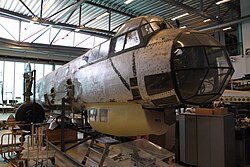
- This aircraft is held by the Deutsches Technikmuseum in Berlin. Delivered to the Luftwaffe in June 1940, it served with KG 54 during the Battle of Britain and invasion of the Soviet Union. In June 1942, while serving with Kampffliegerschule 3, it was stolen by two German personnel intending to defect to Britain. The aircraft crashed into Kilsfjord near Kragerø, Norway; one man drowned and the survivor was captured and later executed. The wreck was recovered in August 2000, restored in Norway from 2000 to 2004 and moved to Germany in 2006.[76]
Specifications (Ju 88 A-4)
edit
Data from [77]
General characteristics
- Crew: 4: pilot, observer/bombardier, radio operator/rear gunner and navigator/ventral gunner
- Length: 14.4 m (47 ft 3 in)
- Wingspan: 20 m (65 ft 7 in)
- Height: 4.8 m (15 ft 9 in)
- Wing area: 54.5 m2 (587 sq ft)
- Empty weight: 9,860 kg (21,738 lb)
- Gross weight: 12,105 kg (26,687 lb)
- Max takeoff weight: 14,000 kg (30,865 lb)
- Powerplant: 2 × Junkers Jumo 211J-1 or J-2 liquid-cooled inverted V-12 piston engine, 1,000 kW (1,300 hp) each for take-off
- Propellers: 3-bladed VDM variable-pitch propeller
Performance
- Maximum speed: 470 km/h (290 mph, 250 kn) at 5,300 m (17,400 ft)
- Cruise speed: 370 km/h (230 mph, 200 kn)
- Range: 1,790 km (1,110 mi, 970 nmi) with 2,896 L (637 imp gal; 765 US gal) of fuel
- Ferry range: 2,730 km (1,700 mi, 1,470 nmi) with 4,028 L (886 imp gal; 1,064 US gal) of fuel
- Service ceiling: 8,200 m (26,900 ft)
- Time to altitude: 5,400 m (17,700 ft) in 23 minutes
- Wing loading: 221 kg/m2 (45 lb/sq ft)
- Power/mass: 0.165 kW/kg
Armament
- Guns:
- 1 × 7.92 mm (0.312 in) MG 81J on a flexible mount in the forward windscreen
- 1 × 7.92 mm MG 81J in the lower nose glazing
- 2 × 7.92 mm MG 81J in the rear of the cockpit canopy
- 1 × 7.92 mm MG 81Z twin machine gun in the rear ventral Bola position
- Bombs:
- Up to 1,400 kg (3,100 lb) internally in two bomb bays
- Up to 3,000 kg (6,600 lb) total with external racks; external loads substantially reduced performance and the maximum load normally required rocket-assisted take-off
See also
editRelated development
Aircraft of comparable role, configuration, and era
Related lists
References
editNotes
editCitations
edit- 1 2 3 Kay 2004, p. 161.
- ↑ Smith & Kay 1972, pp. 394–396.
- ↑ Dressel & Griehl 1994, pp. 71–75.
- 1 2 Weal 2000, p. 8.
- 1 2 Smith & Kay 1972, pp. 399–400.
- 1 2 Smith & Kay 1972, p. 400.
- ↑ Angelucci & Matricardi 1978, pp. 118–119.
- ↑ Dressel & Griehl 1994, p. 71.
- ↑ Smith & Kay 1972, p. 394.
- ↑ Suchenwirth 1968, p. 156.
- ↑ Smith & Kay 1972, pp. 394–395.
- ↑ Smith & Kay 1972, p. 395.
- ↑ Smith & Kay 1972, pp. 395–396.
- ↑ Winchester 2004, p. 146.
- ↑ Smith & Kay 1972, p. 396.
- ↑ Smith & Kay 1972, pp. 396–397.
- ↑ Dressel & Griehl 1994, p. 75.
- 1 2 3 Ringlstetter, Herbert (2010). "Junkers Ju 88". Flugzeug Classic Special (in German) (5). Munich: GeraMond: 14–29. ISSN 1617-0725.
- 1 2 "Ju 88 production programmes". RL 3, Produktionsprogramme. Freiburg im Breisgau: Bundesarchiv-Militärarchiv.
- ↑ Dressel & Griehl 1994, p. 74.
- ↑ Winchester 2004, p. 147.
- ↑ Smith & Kay 1972, p. 399.
- ↑ Smith & Kay 1972, pp. 403–404.
- ↑ Goss 2001, pp. 222, 242.
- ↑ Goss 2001, p. 174.
- ↑ Smith & Kay 1972, pp. 409–410.
- ↑ Goss & Streetly 2023, p. 10.
- ↑ Smith & Kay 1972, pp. 402–403.
- ↑ Smith & Kay 1972, p. 401.
- ↑ Smith & Kay 1972, p. 404.
- ↑ Scutts 1998, p. 47.
- ↑ Smith & Kay 1972, pp. 410–411.
- ↑ Smith & Kay 1972, p. 411.
- ↑ Rohwer & Hümmelchen 2005, p. 7.
- ↑ Hooton 2007, p. 32.
- ↑ Hooton 2007, p. 34.
- ↑ Hooton 2007, p. 62.
- ↑ Hooton 2007, p. 66.
- ↑ Hooton 2007, p. 88.
- ↑ Smith & Kay 1972, pp. 400–401.
- ↑ Smith & Kay 1972, pp. 401–402.
- ↑ Smith & Kay 1972, pp. 415–416.
- ↑ Smith & Kay 1972, pp. 416–417.
- ↑ Smith & Kay 1972, p. 405.
- ↑ Smith & Kay 1972, pp. 405–406.
- ↑ Bergström 2007, p. 14.
- ↑ Bergström 2007, pp. 16, 20.
- ↑ Bergström 2007, p. 22.
- ↑ Smith & Kay 1972, p. 406.
- ↑ Bergström 2007, p. 39.
- ↑ Bergström 2007, p. 36.
- ↑ Bergström 2007, p. 60.
- ↑ Smith & Kay 1972, pp. 406–407.
- ↑ Smith & Kay 1972, pp. 407–408.
- ↑ Smith & Kay 1972, p. 408.
- ↑ Smith & Kay 1972, pp. 408–409.
- ↑ Smith & Kay 1972, p. 415.
- ↑ "Tucson Senior Helps Retired Doctor Receive Military Honor". Mohave Daily Miner. 20 May 1988. Retrieved 26 April 2015.
- ↑ Stenman 1995, p. 35.
- 1 2 3 4 Keskinen & Stenman 1999.
- 1 2 Stenman 1995, p. 37.
- ↑ Stenman 1995, pp. 37–38.
- ↑ Stenman 1995, p. 39.
- ↑ Smith & Kay 1972, p. 414.
- ↑ Dressel & Griehl 1994, p. 78.
- ↑ Goss & Streetly 2023, p. 13.
- ↑ MacKay 2001, p. 189.
- ↑ MacKay 2001, p. 188.
- ↑ Smith & Kay 1972, pp. 411–412.
- ↑ Smith & Kay 1972, pp. 412–413.
- ↑ Smith & Kay 1972, p. 413.
- 1 2 "Junkers Ju 88D-1/Trop". National Museum of the United States Air Force. Retrieved 11 July 2026.
- 1 2 "Junkers Ju 88 R-1". Royal Air Force Museum. Retrieved 11 July 2026.
- ↑ "The recovery of U4+TK". Ju88.net. Archived from the original on 5 October 2007. Retrieved 12 September 2012.
- ↑ Sørensen, Kjell. "Junkers Ju 88 A-4 Garddevarre Finnmark". World War II Aircraft Wreck Sites in Norway. Archived from the original on 1 September 2012. Retrieved 11 September 2012.
- ↑ Hinton, Douglas (March 2001). "Desperate Journey". Air & Space. Archived from the original on 3 July 2012. Retrieved 11 September 2012.
- ↑ Green 1972, pp. 448–482.
Bibliography
edit- Angelucci, Enzo; Matricardi, Paolo (1978). World Aircraft: World War II. Vol. 1. Maidenhead: Sampson Low. ISBN 978-0-528-88170-1.
- Bergström, Christer (2007). Barbarossa: The Air Battle, July–December 1941. London: Chevron/Ian Allan. ISBN 978-1-85780-270-2.
- Cooksley, Peter G. (1990). The Battle of Britain. London: Ian Allan. ISBN 978-0-7110-1878-5.
- de Zeng, H. L.; Stanket, D. G.; Creek, E. J. (2007). Bomber Units of the Luftwaffe 1933–1945. Vol. 1. London: Ian Allan. ISBN 978-1-85780-279-5.
- Dressel, Joachim; Griehl, Manfred (1994). Bombers of the Luftwaffe. London: Arms and Armour Press. ISBN 1-85409-140-9.
- Feist, Uwe (1974). Junkers Ju 88 in Action. Carrollton, Texas: Squadron/Signal Publications. ISBN 3-7909-0026-5.
- Goss, Chris (2001). Bloody Biscay. Manchester: Crécy Publishing. ISBN 0-947554-87-4.
- Goss, Chris; Streetly, Martin (2023). Junkers Ju 88 Day and Nightfighters: Development—Equipment—Operations 1940–1945. Crécy Publishing. ISBN 978-1-80035-289-6.
- Green, William (1972). The Warplanes of the Third Reich. London: Doubleday. ISBN 0-385-05782-2.
- Griehl, Manfred (2004). Das geheime Typenhandbuch der deutschen Luftwaffe (in German). Wölfersheim-Berstadt: Podzun-Pallas. ISBN 3-7909-0775-8.
- Hooton, E. R. (2007). Luftwaffe at War: Blitzkrieg in the West. Vol. 2. London: Chevron/Ian Allan. ISBN 978-1-85780-272-6.
- Jones, R. V. (1979). Most Secret War. London: Coronet. ISBN 0-340-24169-1.
- Kay, Antony L. (2004). Junkers Aircraft and Engines: 1913–1945. Annapolis, Maryland: U.S. Naval Institute. ISBN 978-0-85177-985-0.
- Keskinen, Kalevi; Stenman, Kari (1999). Finnish Dornier Do 17 Z, Junkers Ju 88 A-4. Suomen ilmavoimien historia (in Finnish). Vol. 2. Helsinki: Hobby-kustannus. ISBN 952-5334-01-5.
- MacKay, Ron (2001). Junkers Ju 88. London: Crowood Aviation. ISBN 978-1-86126-431-2.
- Nowarra, Heinz J. (1987). Die Ju 88 und ihre Folgemuster (in German). Stuttgart: Motorbuch Verlag. ISBN 3-87943-579-0.
- Rohwer, Jürgen; Hümmelchen, Gerhard (2005). Chronology of the War at Sea 1939–1945. London: Chatham Publishing. ISBN 978-1-86176-257-3.
- Scutts, Jerry (1998). German Night Fighter Aces of World War II. Osprey Aircraft of the Aces. Vol. 20. London: Osprey. ISBN 978-1-85532-696-5.
- Smith, J. R.; Kay, Antony L. (1972). German Aircraft of the Second World War. London: Putnam. ISBN 0-85177-836-4.
- Stenman, Kari (November–December 1995). "Short But Gallant: The Career of the Finnish Junkers Ju 88s". Air Enthusiast (60): 35–39. ISSN 0143-5450.
- Suchenwirth, Richard (1968). The Development of the German Air Force, 1919–1939. North Stratford, New Hampshire: Ayer Publishing.
- Taylor, John W. R. (1969). "Junkers Ju 88". Combat Aircraft of the World from 1909 to the Present. New York: G. P. Putnam's Sons. ISBN 0-425-03633-2.
- Weal, John (2000). Ju 88 Kampfgeschwader on the Western Front. Botley: Osprey. ISBN 978-1-84176-020-9. * Winchester, Jim (2004). "Junkers Ju 88". Aircraft of World War II. London: Grange Books. ISBN 1-84013-639-1.
External links
edit