
A hünkâr mahfili, also known as a sultan's loge or imperial loge,[1][2] is a structure within the prayer hall of a mosque used by the sultan, the royal family, and high-ranking government officials for performing prayer. It often takes the form of a raised loge or balcony and provides privacy and protection from would-be assassins.[3][4] This feature was characteristic of Ottoman or Turkish mosques, whereas in other mosques a similar function could be served by a maqsura (a restricted area near the mihrab of the prayer hall).[3]

The earliest clear example of an Ottoman hünkâr mahfili is that of the Green Mosque in Bursa, from the early 15th century, which consists of a richly-decorated room located above the entrance, directly opposite the prayer hall's mihrab, with an opening allowing the sultan a view onto the hall below.[3] After the conquest of Constantinople (1453), subsequent imperial mosques usually had a sultan's loge in the form of a platform raised on columns in the southeast corner of the prayer hall (not far from the mihrab), with a screen obscuring view of the sultan from below.[3] In later Ottoman mosques, the loge was often connected to a hünkâr kasrı, a private lounge or pavilion for royal use, which was accessed via an external ramp and provided direct entry to the hünkâr mahfili, bypassing the public areas of the mosque.[3]
Gallery
edit The hünkâr mahfili in the early 15th-century Green Mosque of Bursa is a room above the entrance (upper middle in the picture here)
 Partial view of the hünkâr mahfili in the late 16th-century Selimiye Mosque in Edirne, with its own private mihrab visible
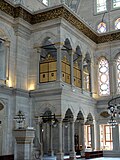 The hünkâr mahfili inside the 18th-century Nuruosmaniye Mosque in Istanbul
 The hünkâr mahfili preserved inside the Hagia Sophia today dates from a 19th-century renovation.[5]
.jpg)


.jpg)
See also
editReferences
edit- ↑ Sumner-Boyd, Hilary; Freely, John (2010). Strolling Through Istanbul: The Classic Guide to the City (Revised ed.). Tauris Parke Paperbacks. p. 22.
- ↑ Anderson, Benjamin; Neumeier, Emily (2024). Hagia Sophia in the Long Nineteenth Century. Edinburgh University Press. p. 215. ISBN 978-1-4744-6102-3.
- 1 2 3 4 5 Bloom, Jonathan M.; Blair, Sheila S., eds. (2009). "Maqsura". The Grove Encyclopedia of Islamic Art and Architecture. Vol. 2. Oxford University Press. pp. 461–462. ISBN 9780195309911.
- ↑ Çetinaslan, Mustafa (2013-02-01). "Hünkâr Mahfillerinin Ortaya Çıkışı, Gelişimi ve Osmanlı Dönemi Örnekleri". Selçuk Üniversitesi Sosyal Bilimler Enstitüsü Dergisi (in Turkish) (29): 61–74. ISSN 2667-4750.
- ↑ "Hünkâr Mahfili | Ayasofya Müzesi". ayasofyamuzesi.gov.tr. Archived from the original on 2018-12-29. Retrieved 2019-11-26.
External links
edit Media related to Hünkar mahfili at Wikimedia Commons
- Hünkar Mahfili Nedir? Fatih Camii Hünkâr Mahfili on youtube

 | This mosque or other Islamic place of worship article is a stub. You can help Wikipedia by adding missing information. |
 | This architecture-related article is a stub. You can help Wikipedia by adding missing information. |