
Handan is a prefecture-level city located in the southwest of Hebei province, China. The southernmost prefecture-level city of the province, it borders Xingtai on the north, and the provinces of Shanxi on the west, Henan on the south and Shandong on the east. At the 2010 census, its population was 9,174,683 inhabitants of whom 2,845,790 lived in the built-up (or metro) area made of 5 urban districts.By the end of 2024, the total resident population of the city is 9,182,100, and the urbanization rate of the resident population is 62.10%.[4] Yongnian District in Handan and Shahe City in Xingtai have largely formed into a single conurbation.
Handan
邯郸市 Hantan | |
|---|---|
Longhu Park lake and pavilions Downtown Handan | |
| Nickname: Dream City (梦城) | |
 Interactive map of Handan | |
| Coordinates (Shanxi–Hebei–Shandong–Henan Revolution Memorial Park / (晋冀鲁豫革命纪念园): 36°36′04″N 114°29′13″E / 36.601°N 114.487°E | |
| Country | People's Republic of China |
| Province | Hebei |
| Settled | 6500 BC |
| Established | November 15, 1983 |
| Municipal Seat | Congtai District |
| Area | |
| 12,068 km2 (4,659 sq mi) | |
| • Urban | 556.00 km2 (214.67 sq mi) |
| • Districts[1] | 2,649.1 km2 (1,022.8 sq mi) |
| Population (2020[2]) | |
| 9,433,000 | |
| • Density | 781.7/km2 (2,024/sq mi) |
| • Urban | 2,845,790 |
| • Urban density | 5,100/km2 (13,000/sq mi) |
| • Districts[1] | 4,012,000 |
| GDP[3] | |
| • Prefecture-level city | CN¥ 315 billion US$ 50.5 billion |
| • Per capita | CN¥ 33,450 US$5,371 |
| Time zone | UTC+8 (China Standard) |
| ISO 3166 code | CN-HE-04 |
| Vehicle registration | 冀D |
| Website | hd |


| Handan | |||||||||||||||||||||||||||
|---|---|---|---|---|---|---|---|---|---|---|---|---|---|---|---|---|---|---|---|---|---|---|---|---|---|---|---|
.svg) "Handan" in Simplified (top) and Traditional (bottom) Chinese characters | |||||||||||||||||||||||||||
| Traditional Chinese | 邯鄲 | ||||||||||||||||||||||||||
| Simplified Chinese | 邯郸 | ||||||||||||||||||||||||||
| Postal | Hantan | ||||||||||||||||||||||||||
| Literal meaning | "the city at the terminus of Mount Han" | ||||||||||||||||||||||||||
| |||||||||||||||||||||||||||
Handan is one of the oldest cities in China, first settled around 6500 BC by the Cishan culture. Throughout the city's long history, it contributed significantly to Chinese culture, serving as the capital of State of Zhao, was northern China's political, economic and cultural center, and home to Tai chi and the first compass, made from stones collected in the nearby Mount Ci (magnet mountain). Handan is designated as one of China's National Famous Historical and Cultural Cities.[5][6][7][8]
Etymology
editThe city's name, Handan (Chinese: 邯郸), has remained unchanged for over 3,000 years. The name first appeared during the reign of King Zhou of Shang, in the chronicle Bamboo Annals.[9]
A dictionary from the Tang dynasty explained that "Han" (Chinese: 邯) is the name of a nearby mountain (Hanshan), and "Dan" (Chinese: 单) meant "the terminus of a mountain" with an added radical (Chinese: 阝) denoting a city. Together, "Handan" means "the city at the terminus of Mount Han". This explanation has been widely accepted until the discoveries of jade writings in Houma, Shanxi in 1965, where the "Dan" in Handan was spelt "丹", meaning red. This then lead to another explanation that Handan was named so because Mount Han appeared reddish-purple in color.[9]
The different spellings of the city's name consolidated into the modern spelling in Qin dynasty.[9]
History
edit
Ancient China
editAccording to the Bamboo Annals, during the late Shang dynasty, the kings constructed palaces in the Handan area, with a time span of 3,050 to 3,100 years ago. In the early Western Zhou period, during the reign of King Cheng of Zhou, Handan was part of the Bei state and was inhabited by Wu Geng, the son of the last king of Shang. Later, it came under the control of the state of Wey. In 661 BCE, the Di people conquered Handan and ruled it for over 40 years after destroying Wey. In 588 BCE, the Jin state defeated the Di, and Handan was incorporated into Jin. In 546 BCE, after Wey's restoration, a rebellion forced members of the Wey royal family to flee to Handan for refuge. This event is recorded in The Spring and Autumn Annals (Guliang Commentary).
During the Warring States period (5th–3rd centuries BCE), Handan was an important city of the state of Zhao. In 386 BCE, Marquess Jing of Zhao officially relocated the capital to Handan and initiated large-scale construction. It was their second capital, after Zhongmu. It remained the capital for 158 years, until Zhao was conquered by the Qin. King Wuling of Zhao turned Zhao into one of the Qin state's most stalwart foes, pioneering the use of walls to secure new frontiers (which would inspire the eventual construction of the Great Wall of China). The city was conquered by the State of Qin after the virtual annexation of Zhao by Qin in 228 BCE, except for the Dai Commandery.
Imperial China
editDuring the imperial period, the history of what is now Handan was not centered on one city alone. Political and economic weight shifted among Handan proper, Ye in present-day Linzhang County, Guangfu in Yongnian, Cizhou in the west, and Daming in the east.
According to Sima Qian's Records of the Grand Historian, the future Qin Shi Huang was born in Handan while his father, the future King Zhuangxiang of Qin, was living there as a Qin hostage in Zhao.[10] After Qin conquered Zhao in 228 BCE, Handan became a commandery city; under the Han dynasty, it became the seat of a Zhao kingdom.[11] Early in the Han, Liu Bang was at Handan during the campaign against Chen Xi's rebellion.[12] By the late Western Han, Handan was remembered as one of the era's great metropolitan centres, with developed commerce, handicrafts, and iron working.[13] Its decline is often associated with the conflict between Wang Lang and Liu Xiu: after Liu Xiu captured Handan, the city was reduced from a regional capital to a county seat.[13]
After the Han, Ye gradually overshadowed Handan proper. Located in present-day Linzhang, Ye served at different times as a capital or major political centre for Cao Wei, Later Zhao, Ran Wei, Former Yan, Eastern Wei, and Northern Qi.[14] Its northern and southern cities, central-axis planning, and famous terraces such as the Bronze Bird Terrace made it one of the important experiments in early Chinese capital design.[15] In 580, after Yuchi Jiong rebelled against Yang Jian, Ye was destroyed, ending its long role as the region's leading city.[14]
The Northern Qi period also left one of the area's most important artistic legacies at the Xiangtangshan Caves, near modern Fengfeng. The caves are a major Buddhist cave-temple complex of the sixth century, and many of their sculptures later entered museum collections outside China.[16][17]
In the late Sui dynasty, the region again became politically important during the rebellions against Sui rule. Dou Jiande captured Mingzhou in 619 and made Guangfu, in present-day Yongnian, the capital of his short-lived Xia regime.[18] Under the Tang dynasty, Handan proper was a county town subordinate to Mingzhou and later Cizhou, while other towns in the modern prefecture carried more regional weight.[11]
The An Lushan rebellion again drew attention to Ye: An Qingxu held the city before Shi Siming entered Ye and killed him in 759.[19] After the rebellion, the eastern part of present-day Handan became central to the history of Weibo, a powerful semi-autonomous military command based at Wei Prefecture, in the area of modern Daming. Weibo, later known as Tianxiong Circuit, shaped northern Chinese politics from the late Tang into the Five Dynasties and Ten Kingdoms period.[20] The shift from Ye to Weizhou, and later from Weibo to Daming, marked a broader change from a capital-centred military landscape to a Song-period commercial and strategic city system.[21] In 923, Li Cunxu proclaimed himself emperor at Wei Prefecture, founding the Later Tang.[22]
Daming reached another high point under the Northern Song. In 1042, Emperor Renzong of Song elevated Daming Prefecture to the status of Beijing, a companion capital intended to strengthen the dynasty's northern defence system against the Liao dynasty.[23] During the Song, Jin, and Yuan periods, the region was also known for Cizhou ware, produced around Ci County and Pengcheng in modern Fengfeng. Cizhou kilns became famous for sturdy northern stonewares, especially white-slipped vessels with black or brown painted decoration.[24][25]
Under the Yuan dynasty, the region remained administratively important even though it no longer held the capital-like status that Ye or Song-period Daming had once enjoyed. Daming continued as Daming Road (Chinese: 大名路; pinyin: Dàmíng Lù), a Yuan administrative circuit directly under the Central Secretariat.[26] Farther west, Mingzhou was reorganized as Guangping Road (Chinese: 广平路; pinyin: Guǎngpíng Lù), with its seat still at Guangfu; local accounts describe the Yuan official Wang Wei as enlarging Guangfu's walls and building four gates.[27] The Yuan period also helps explain the later urban geography of the area: towns such as Guangfu and Daming benefited from rivers and canals, but they also lived with the danger of flooding. In 1401, early in the Ming dynasty, the Zhang and Wei rivers flooded old Daming, destroying the city and sealing much of the Song-Yuan urban site under silt.[23]
In the Ming dynasty, Daming Road became Daming Prefecture, while Guangping Road became Guangping Prefecture.[26][27] Handan County itself was under Guangping Prefecture, and Guangfu served as a prefectural seat through the Ming and Qing periods.[11][27] The new Ming city of Daming was built near the flooded old city, while Guangfu's walls and water defenses helped it remain a durable administrative town.[23][27] Under the Qing dynasty, the administrative pattern of Guangping and Daming prefectures largely continued. River transport on the Fuyang River helped revive trade in the region, linking Handan with downstream markets toward Tianjin; small cargo boats still used the route into the twentieth century.[13] Daming also briefly had supra-regional importance in early Qing administration: the Zhili-Shandong-Henan governor-general was stationed there in 1666, before Baoding became the capital of Zhili in 1669.[28]
Modern China
editHandan's modern history was shaped by a shift from river trade to rail transport, wartime institutions, heavy industry, and heritage tourism. Before the railway age, the Fuyang River still linked the area with markets downstream toward Tianjin, carrying coal, ceramics, and other local goods; small cargo boats continued to use the route into the mid-twentieth century.[13] The opening of the Jinghan railway and Handan railway station in 1906 gave the old county town a new position on a national north-south route, helping it re-emerge as a centre of southern Hebei.[13]
During the Second Sino-Japanese War, the mountainous western part of present-day Handan became an important Communist base area. The headquarters of the Eighth Route Army's 129th Division was located at Chi'an village in She County from 1940 to 1945, where Liu Bocheng and Deng Xiaoping directed operations in the Taihang region.[29] After Japan's surrender in 1945, Handan was established as a city for the first time.[13]
The city soon became a battlefield in the renewed Chinese Civil War. The Handan Campaign, also known as the Pinghan Campaign, was fought from 24 October to 2 November 1945, when forces of the Jin-Ji-Lu-Yu Military Region opposed Nationalist troops moving north along the Pinghan railway.[30]
Handan and its surrounding counties also became wartime media centres. On 15 May 1946, the Jin-Ji-Lu-Yu People's Daily held its founding ceremony in Handan; the paper's office moved from Handan to Wu'an in late June 1946.[31] In She County, Handan Xinhua Radio began broadcasting in 1946; in 1947, after the Communist evacuation from northern Shaanxi, facilities there were used to continue Xinhua radio broadcasts.[32]
After the founding of the People's Republic of China, Handan was restored as a city in 1952 and became a province-administered city in 1954; Fengfeng was merged into Handan in 1956.[33] Its post-1949 growth depended on rail connections and nearby coal and iron resources, especially the coalfields of Fengfeng and industrial links with Wu'an.[11] Handan developed iron and steel, textiles, petrochemicals, machinery, and other industries, while the surrounding area remained known for ceramics.[11]
Modern Handan's public identity has continued to draw on its older history. The city is closely associated with Chinese idioms and allusions; scholars have attributed more than 1,500 idioms to Handan, including "learning to walk in Handan" (Chinese: 邯郸学步; pinyin: Hándān xué bù).[34] In Yongnian, Guangfu is promoted as a centre of tai chi culture; Yang-style tai chi is listed as a national intangible cultural heritage item and is associated with Yang Luchan of Guangfu.[35]
The modern history of Handan's antiquities has also had an international dimension. Sculptures from the Xiangtangshan Caves were removed in the first half of the twentieth century and entered the international art market; since 2003, researchers have used 3-D imaging to match displaced fragments to their original locations and digitally reconstruct parts of the caves.[17]
In 2007, Handan drew national attention for the Agricultural Bank of China robbery, an inside theft involving 50.95 million yuan that Xinhua described as China's largest-ever bank theft.[36]
Administration
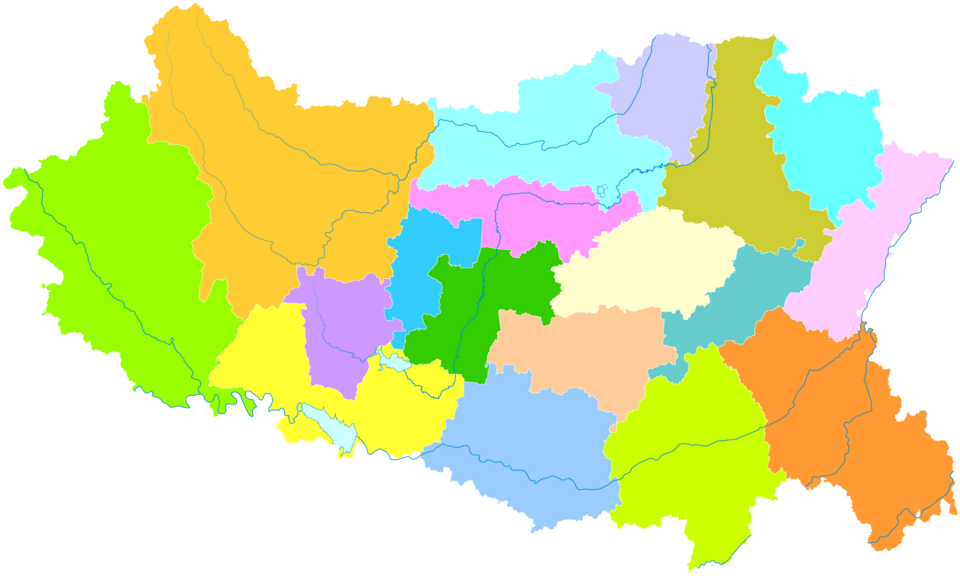
editThe population at the 2010 census was 941,427 for the 3 urban districts, 2,845,790 for the built up area and 9,174,683 for the entire Prefecture-level city area of 12,068 km2 (4,659 sq mi).
The municipal executive, legislative and judiciary are situated in Congtai District (丛台区, Cóngtái Qū), as well as the CPC and Public Security bureaux.
| Map | ||||||
|---|---|---|---|---|---|---|
| Name | Chinese | Pinyin | Population (2004 est.) | Area (km2) | Density (/km2) | |
| Congtai District | 丛台区 | Cóngtái Qū | 330,000 | 28[citation needed] | 11,786 | |
| Hanshan District | 邯山区 | Hánshān Qū | 310,000 | 32[citation needed] | 9,688 | |
| Fuxing District | 复兴区 | Fùxīng Qū | 250,000 | 37[citation needed] | 6,757 | |
| Fengfeng Mining District | 峰峰矿区 | Fēngfēng Kuàngqū | 500,000 | 353 | 1,416 | |
| Feixiang District | 肥乡区 | Féixiāng Qū | 310,000 | 496 | 625 | |
| Yongnian District | 永年区 | Yǒngnián Qū | 860,000 | 898 | 958 | |
| Wu'an City | 武安市 | Wǔ'ān Shì | 720,000 | 1,806 | 399 | |
| 邯郸县 | Hándān Xiàn | 400,000 | 522 | 766 | ||
| Linzhang County | 临漳县 | Línzhāng Xiàn | 590,000 | 744 | 793 | |
| Cheng'an County | 成安县 | Chéng'ān Xiàn | 370,000 | 485 | 763 | |
| Daming County | 大名县 | Dàmíng Xiàn | 750,000 | 1,052 | 713 | |
| She County | 涉县 | Shè Xiàn | 390,000 | 1,509 | 258 | |
| Ci County | 磁县 | Cí Xiàn | 640,000 | 1,035 | 618 | |
| Qiu County | 邱县 | Qiū Xiàn | 200,000 | 448 | 446 | |
| Jize County | 鸡泽县 | Jīzé Xiàn | 250,000 | 337 | 742 | |
| Guangping County | 广平县 | Guǎngpíng Xiàn | 250,000 | 320 | 781 | |
| Guantao County | 馆陶县 | Guǎntáo Xiàn | 290,000 | 456 | 636 | |
| Wei County | 魏县 | Wèi Xiàn | 810,000 | 862 | 940 | |
| Quzhou County | 曲周县 | Qǔzhōu Xiàn | 410,000 | 667 | 615 | |
Climate
editHandan has a monsoon-influenced humid continental climate/semi-arid climate (Köppen Dwa/BSk), with strong monsoonal influence, typical of the North China Plain. The normal monthly daily mean temperature ranges from −0.9 °C (30.4 °F) in January to 27.3 °C (81.1 °F) in July, while the annual mean temperature is 14.3 °C (57.7 °F). A majority of the normal annual precipitation of 502 mm (19.8 in) occurs in July and August.
| Climate data for Handan, elevation 67 m (220 ft), (1991–2020 normals, extremes 1981–2010) | |||||||||||||
|---|---|---|---|---|---|---|---|---|---|---|---|---|---|
| Month | Jan | Feb | Mar | Apr | May | Jun | Jul | Aug | Sep | Oct | Nov | Dec | Year |
| Record high °C (°F) | 19.7 (67.5) |
25.3 (77.5) |
31.7 (89.1) |
37.9 (100.2) |
40.0 (104.0) |
43.6 (110.5) |
42.0 (107.6) |
37.2 (99.0) |
40.1 (104.2) |
33.5 (92.3) |
28.6 (83.5) |
28.4 (83.1) |
43.6 (110.5) |
| Mean daily maximum °C (°F) | 4.2 (39.6) |
8.7 (47.7) |
15.3 (59.5) |
22.1 (71.8) |
27.7 (81.9) |
32.5 (90.5) |
32.5 (90.5) |
30.8 (87.4) |
27.3 (81.1) |
21.4 (70.5) |
12.8 (55.0) |
6.0 (42.8) |
20.1 (68.2) |
| Daily mean °C (°F) | −0.7 (30.7) |
3.1 (37.6) |
9.5 (49.1) |
16.1 (61.0) |
22.0 (71.6) |
26.6 (79.9) |
27.8 (82.0) |
26.2 (79.2) |
21.8 (71.2) |
15.5 (59.9) |
7.3 (45.1) |
1.1 (34.0) |
14.7 (58.4) |
| Mean daily minimum °C (°F) | −4.5 (23.9) |
−1.3 (29.7) |
4.3 (39.7) |
10.5 (50.9) |
16.2 (61.2) |
21.1 (70.0) |
23.6 (74.5) |
22.4 (72.3) |
17.3 (63.1) |
10.7 (51.3) |
3.0 (37.4) |
−2.8 (27.0) |
10.0 (50.1) |
| Record low °C (°F) | −15.0 (5.0) |
−14.4 (6.1) |
−6.1 (21.0) |
0.0 (32.0) |
7.7 (45.9) |
11.5 (52.7) |
16.5 (61.7) |
13.7 (56.7) |
5.4 (41.7) |
−1.0 (30.2) |
−11.4 (11.5) |
−12.7 (9.1) |
−15.0 (5.0) |
| Average precipitation mm (inches) | 3.2 (0.13) |
7.6 (0.30) |
9.8 (0.39) |
27.1 (1.07) |
40.8 (1.61) |
50.7 (2.00) |
147.0 (5.79) |
122.7 (4.83) |
46.5 (1.83) |
26.3 (1.04) |
14.9 (0.59) |
3.5 (0.14) |
500.1 (19.72) |
| Average precipitation days (≥ 0.1 mm) | 2.4 | 3.1 | 2.8 | 5.2 | 6.5 | 8.2 | 10.8 | 9.6 | 7.0 | 5.4 | 3.8 | 2.3 | 67.1 |
| Average snowy days | 3.7 | 3.0 | 1.1 | 0.2 | 0 | 0 | 0 | 0 | 0 | 0 | 1.3 | 2.7 | 12 |
| Average relative humidity (%) | 57 | 53 | 50 | 54 | 56 | 56 | 72 | 76 | 69 | 64 | 64 | 60 | 61 |
| Mean monthly sunshine hours | 133.1 | 149.2 | 198.5 | 222.3 | 252.7 | 228.4 | 192.1 | 193.7 | 179.5 | 177.0 | 144.3 | 138.0 | 2,208.8 |
| Percentage possible sunshine | 43 | 48 | 53 | 56 | 58 | 52 | 43 | 47 | 49 | 51 | 48 | 46 | 50 |
| Source: China Meteorological Administration[37][38] | |||||||||||||
Economy
edit
Handan has witnessed rapid growth over the past 20 years. Industrial growth in the city has focused on communication and transport activities. Handan is a major producer of coal and steel, with Coal mines at Fengfeng providing power for Handan's iron, steel and textile mills. Chemical and cement plants along with other industries also benefit. Local agriculture produces maize, pomegranates and eggs.[39] Handan also has a growing services sector, with retail, banking and trading making up 40% of the economy.[40] The GDP per capita in Renminbi was estimated at ¥13,449 in 2005. In 2015, the figure was ¥33,554.87 Archived 2017-11-07 at the Wayback Machine.
Air pollution
editAccording to a survey by "Global voices China" in February 2013, Handan was one of China's most polluted cities due to heavy industrial outputs.[41]
However the government has made a significant effort to make the city cleaner, which involved closing down many polluting power plants. It is no longer the most polluted city, and, according to a 2016 government survey, the number of good air quality days is 189 Archived 2017-11-07 at the Wayback Machine days, an increase of 135 days compared with 2013.[42]
Tourism
editHandan Prefecture is home to the AAAAA tourist attractions Guangfu Ancient City and the Nüwa Imperial Palace. Handan Prefecture is also home to the Xiangtangshan Caves.
Transportation
editHandan is served by Handan Airport. Handan has two main train stations: one is Handan railway station which serves for the normal speed train, the other is named Handandong railway station, which serves for the high speed train.
Demographics
editEthnic minorities
editAccording to Handan government in 2007, 40 ethnic groups were present in Handan. Ethnic minorities represent 50,000 people, among which 48,000 Hui. There are 22 Hui schools and 5 Hui junior high schools in Handan.[43]
Religion
editThe most widespread religion in Handan is Chinese folk religion, including Taoism and Buddhism.
In 2013, there were more than 150,000 Catholics in Handan according to the Catholic Church, in the Roman Catholic Diocese of Yongnian.[44] Mother of Grace Cathedral in Daming County was built in 1918. The most recent church was built in 2007.[45]
There are also 300,000 Protestants. The largest Protestant church is on Qianjin Avenue (邯郸市西堂) and was built in 1997.[46] The oldest church was on Congtai Street and was built in 1920. The church was destroyed in 2009 by the local government.[47] A new church was built in 2011.[48]
According to the local government 30,000 Hui Muslims live in the prefecture of Handan.[49]
Culture
editIdioms
editHandan is hailed as the capital of Chinese idioms.[50] As a prosperous city and cultural center during the Warring States period, Handan attracted many scholars. Over 1,500 idioms and proverbs are attributed to the city.[51] The following are some of the most well known idioms.
- 邯鄲學步 (literally: "to study the walking method of Handan"), meaning to badly imitate others, and lose one's individuality in the process.
- 黃粱一夢 (literally: "millet dream"), meaning a pipe dream.
- 頂天立地 (literally: "stand upright on one's two legs between heaven and earth"), meaning to be fiercely independent.
- 圍魏救趙 (literally: "to besiege the State of Wei to rescue the State of Zhao"), meaning to relieve a besieged ally by attacking the besiegers.
- 不可同日而語 (literally: "musn't speak of the two things on the same day"), meaning incomparable.
- 驚弓之鳥 (literally: "a bird frightened by the mere sound of shooting arrows"), a panic-stricken person.
- 鷸蚌相爭,漁翁得利 (literally: "when the snipe and the oyster fight, it is the fisherman that wins"), when two parties fight, it is always the third one who wins. King of Yan sent a representative to King Hui of Zhao to relay this message in order for him to rethink his plans of war.
- 曠日持久 (literally: "drawn out and protracted"), meaning to be protracted.
- 完璧歸趙 (literally: "returning the Jade to Zhao"), meaning to return something to its owner in good condition.
- 价值连城 (literally: "to be worth numerous contiguous cities"), meaning priceless.
- 怒髮衝冠 (literally: "one's hair raised to the hat in anger"), meaning to be furious.
- 負荊請罪 (literally: "carrying thorned grass and pleading guilt"), meaning to offer someone a humble apology.
- 紙上談兵 (literally: "to discuss military tactics on paper"), meaning to be an armchair strategist.
- 青出於藍,而勝於藍 (literally: "green is born of blue, but beats blue"), meaning to outmaster the teacher.
Notable people
edit- Lian Po, a military general of Zhao. Regarded one of the four greatest generals of the Warring States period.
- Lin Xiangru, politician of the Warring States period. He's featured in two idioms, "Returning the Jade to Zhao" and "Carrying Thorned Grass and Pleading Guilt".
- Xun Kuang, Confucianism philosopher.
- Xu Huaizhong, novelist.
- Qin Shi Huang, founder of the Qin dynasty and was the first Emperor of China.
- Cao Cao, Han chancellor, poet, and warlord. One of the central figures of the Three Kingdoms period.
- Huang Hua, senior Communist Chinese revolutionary. The county-level city of Huanghua, Cangzhou, was named after him.
- Feng Jianming, literature scholar.
- Fang Lijun, an artist based in Beijing.
- Yang Luchan, martial arts teacher.
- Sun Qingmei, football player.
- Zhao Shi, football player.
- Zhang Weili, mixed martial artist, ring name "Magnum". She is the first ever Chinese and East Asian champion in UFC history.
- Chang Yongxiang, wrestler.
Sister cities
edit Kryvyi Rih, Dnipropetrovsk, Ukraine[52][53]
 Padua, Veneto, Italy (1988)[citation needed]
 Saiki, Ōita, Japan (1994)[citation needed]
 Dubuque, Iowa, United States (1995)[citation needed]
 Miryang, South Gyeongsang, South Korea (2004)[citation needed]
 Ust-Ilimsk, Irkutsk Oblast, Russia[citation needed]
 Inari, Finland[54]
References
edit- 1 2 3 4 Ministry of Housing and Urban-Rural Development, ed. (2019). China Urban Construction Statistical Yearbook 2017. Beijing: China Statistics Press. p. 46. Archived from the original on 18 June 2019. Retrieved 11 January 2020.
- ↑ 河北11市最新人口排名出炉 唐山排第四 - 政策 -唐山乐居网. ts.leju.com. Archived from the original on 2018-07-22. Retrieved 22 July 2018.
- ↑ 河北省统计局、国家统计局河北调查总队 (2016). 《河北经济年鉴-2018》. China Statistics Press. ISBN 978-7-5356-7824-9. Archived from the original on 2020-03-26. Retrieved 2019-07-11.
- ↑ "(河北省)邯郸市2024年国民经济和社会发展统计公报-红黑统计公报库". tjgb.hongheiku.com. Retrieved 2025-11-27.
- ↑ "Handan, China". City of Dubuque. Retrieved 2020-03-15.
- ↑ "磁山——指南针的故乡". Handan Cultural Net. Retrieved 2020-03-15.
- ↑ "永年:太极之乡文化"醉人"". Wenming.cn. Archived from the original on 2020-10-22. Retrieved 2020-03-15.
- ↑ "河北最内敛的城市, 河北南大门, 2016年GDP列河北第五". 温柔小胖虎. 18 April 2018. Retrieved 2020-03-15.
- 1 2 3 "河北邯郸市:一座盛产成语典故的千年古都". 河北日报. Retrieved 2020-03-20.
- ↑ Sima, Qian. 史記·秦始皇本紀 [Records of the Grand Historian: Basic Annals of Qin Shi Huang]. Chinese Text Project (in Chinese). Retrieved 11 June 2026.
- 1 2 3 4 5 "Handan". Encyclopaedia Britannica. Retrieved 11 June 2026.
- ↑ Sima, Qian. 史記·高祖本紀 [Records of the Grand Historian: Basic Annals of Emperor Gaozu]. Chinese Text Project (in Chinese). Retrieved 11 June 2026.
- 1 2 3 4 5 6 王思达 (31 July 2017). 一座盛产成语典故的千年古都 [A thousand-year ancient capital rich in idioms and allusions]. 中国城市报 (in Chinese). People's Daily Online. Retrieved 11 June 2026.
- 1 2 王文华; 范世辉; 赵鸿宇 (17 June 2024). 寻迹邺城 [Tracing Ye City]. 瞭望新闻周刊 (in Chinese). Xinhua News Agency. Retrieved 11 June 2026.
{{cite news}}: CS1 maint: multiple names: authors list (link) - ↑ 牛琳; 王天译 (7 December 2023). 寻找最早“中轴线”,邺城考古的“幸运”与未解之谜 [Searching for the earliest central axis: the luck and mysteries of Ye City archaeology] (in Chinese). CCTV.com. China News Service. Retrieved 11 June 2026.
{{cite news}}: CS1 maint: multiple names: authors list (link) - ↑ "Xiangtangshan Caves". Xiangtangshan Caves Project. University of Chicago. Retrieved 11 June 2026.
- 1 2 "Echoes of the Past: The Buddhist Cave Temples of Xiangtangshan". National Museum of Asian Art. Smithsonian Institution. Retrieved 11 June 2026.
- ↑ 广府古城风景美 魅力永年成旅游休闲区 [Beautiful Guangfu Ancient City, charming Yongnian as a tourism and leisure area] (in Chinese). China Daily. Guangming Online. 12 August 2019. Retrieved 11 June 2026.
- ↑ Sima, Guang. Zizhi Tongjian (in Chinese). Vol. 221. Retrieved 11 June 2026 – via Chinese Wikisource.
- ↑ Mao, Han-kuang (1979). 唐末五代政治社會之研究(魏博二百年史論) [Political and social research on late Tang and Five Dynasties: a two-hundred-year historical study of Weibo]. Bulletin of the Institute of History and Philology, Academia Sinica (in Chinese). 50 (2): 301–360. Retrieved 11 June 2026.
- ↑ Zhou, Zhongxiang (2020). 從鄴城到大名:唐末五代魏博「城市體系」變遷 [From Ye to Daming: “Cities System” Changes among Weibo during Late-Tang and Five Dynasties] (MA thesis thesis) (in Chinese). National Chengchi University. Retrieved 11 June 2026.
- ↑ Sima, Guang. Zizhi Tongjian (in Chinese). Vol. 272. Retrieved 11 June 2026 – via Chinese Wikisource.
- 1 2 3 浩荡古风大名府 [Ancient grandeur of Daming Prefecture]. Hebei Daily (in Chinese). Hebei Provincial Department of Culture and Tourism. 20 July 2022. Retrieved 11 June 2026.
- ↑ 磁州窑 [Cizhou kiln]. 故宫博物院 (in Chinese). Palace Museum. Retrieved 11 June 2026.
- ↑ "Cizhou kiln". Encyclopaedia Britannica. Retrieved 11 June 2026.
- 1 2 Zhang, Tingyu. 明史·地理一 [History of Ming: Geography I] (in Chinese). Vol. 40. Retrieved 11 June 2026 – via Chinese Wikisource.
- 1 2 3 4 水筑千年韵,太极一城春——不一样的广府古城 [Water-built ancient charm and a springtime city of tai chi: a different Guangfu Ancient City] (in Chinese). Xinhua News Agency. 4 July 2025. Retrieved 11 June 2026.
- ↑ 清朝时保定为直隶省会 与北京城建设为同一设计师 [In the Qing dynasty, Baoding was the provincial capital of Zhili]. Beijing Daily (in Chinese). China News Service. 22 February 2016. Retrieved 11 June 2026.
- ↑ "The Eighth Route Army 129th Division Memorial Hall, Hebei province". China Daily. China Services Info. 1 November 2019. Retrieved 11 June 2026.
- ↑ 张二卫 (11 September 2023). 邯郸战役:大规模歼灭战的典范 [The Handan Campaign: a model of large-scale annihilation warfare]. Study Times (in Chinese). People's Daily Online. Retrieved 11 June 2026.
- ↑ 《人民日报》的创刊发行 [The founding and publication of People's Daily]. 邯郸党史网 (in Chinese). Party History Research Office of the Handan Municipal Committee of the Chinese Communist Party. 24 February 2022. Retrieved 11 June 2026.
- ↑ 涉县西戌镇沙河村邯郸、陕北新华广播电台旧址 [Former site of Handan and Shaanbei Xinhua radio stations in Shahe village, Shexian]. 邯郸党史网 (in Chinese). Party History Research Office of the Handan Municipal Committee of the Chinese Communist Party. 3 January 2023. Retrieved 11 June 2026.
- ↑ 历史沿革 [Historical evolution]. 邯郸市人民政府 (in Chinese). Handan Municipal People's Government. Retrieved 11 June 2026.
- ↑ Liu, Xiaozhuo (14 October 2011). "City of the idiom". China Daily. Retrieved 11 June 2026.
- ↑ 太极拳(杨氏太极拳) [Taijiquan (Yang-style Taijiquan)]. 中国非物质文化遗产网 (in Chinese). China Intangible Cultural Heritage Network. Retrieved 11 June 2026.
- ↑ "Bank workers sentenced to death for record heist". China Daily. Xinhua. 9 August 2007. Retrieved 11 June 2026.
- ↑ 中国气象数据网 – WeatherBk Data (in Simplified Chinese). China Meteorological Administration. Retrieved 25 August 2023.
- ↑ "Experience Template" 中国气象数据网 (in Simplified Chinese). China Meteorological Administration. Retrieved 25 August 2023.
- ↑ Patton, Dominique. "China's chickens need to lay a billion eggs a day. Here's how..." U.K. Archived from the original on July 9, 2018. Retrieved 2018-08-30.
- ↑ "Handan (Hebei) City Information | HKTDC". china-trade-research.hktdc.com. Retrieved 2018-08-30.
- ↑ Bildner, Eli (February 27, 2013). "Interactive Maps of China's Most–and Least–Polluted Places". Global Voices China. newsmotion.org. Archived from the original on 3 September 2014. Retrieved 1 September 2014.
- ↑ Xu, Hui (徐辉). 【治霾·京津冀在行动】邯郸六大战役推动大气污染深度治理. CCTV-NEWS (in Simplified Chinese).
- ↑ 邯郸概貌 (in Chinese (China)). Handan People's Government.
- ↑ Fides, Agenzia. 亚洲/中国 - 河北邯郸(永年)教区六位执事晋铎 - Agenzia Fides. www.fides.org (in Simplified Chinese). Retrieved 22 July 2018.
- ↑ "邯郸市南门里天主教堂". Archived from the original on 2014-08-26. Retrieved 2014-08-26.
- ↑ 基督教 (in Chinese (China)). Ethnic Affairs Commission of Hebei Province. Archived from the original on 10 November 2016. Retrieved 22 July 2018.
- ↑ 杜树杰同志在全区三年大变样"百日攻坚大会战"动员大会上的讲话 (in Chinese (China)). Handan People's Government. Archived from the original on 3 September 2014. Retrieved 22 July 2018.
- ↑ 邯郸市基督教北关教堂简史_河北省-邯郸市-基督教会-北堂 -邯郸基督教北堂 (in Chinese (China)). Christian Church of Handan. Archived from the original on 13 October 2014. Retrieved 22 July 2018.
- ↑ Chinanews.com Hebei 邯郸建成千人回族幼儿园 服务流动少数民族 (in Chinese (China)). 2011-11-29. Archived from the original on 2021-05-18. Retrieved 2014-08-27.
- ↑ 海纳百闻 "中国成语典故之都"在哪里? (in Chinese (China)). 2019-12-27.
- ↑ "City of the idiom". 2011-10-14.
- ↑ Города-побратимы. Нижний Тагил. Администрация Нижнего Тагила.
- ↑ Перелік державних та муніципальних сайтів. Kryvyi Rih City. Archived from the original on 2014-11-29.
- ↑ 驻芬兰大使陈立访问伊纳里市. 中华人民共和国驻芬兰共和国大使馆. Archived from the original on 2020-06-10.
External links
edit

- City of Handan, Official site Archived 2012-08-05 at the Wayback Machine