
Frankfurt Airport Terminal 1
Terminal 1 (earlier called Terminal Middle) is the oldest and biggest of the currently three Main-Terminals at Frankfurt Airport.
| Terminal 1 | |
|---|---|
 View into Departure Hall B in the Terminal | |
 Interactive map of the Terminal 1 area | |
| General information | |
| Location | Frankfurt International Airport, Frankfurt, 60547, Hessen, Germany |
| Coordinates | 50°03′00″N 8°34′14″E / 50.0499°N 08.5706°E |
| Years built | 1955 (Control Tower), 1965–1972 (Terminal Building), 2000–2012 (Extentions) |
| Cost | 1 billion DM (Deutsche Mark), equivalent to 580–600 million USD |
| Client | Flughafen Aktiengesellschaft Frankfurt/Main |
| Technical details | |
| Grounds | 930.000m² |
| Design and construction | |
| Architects | Alois Giefer, Hermann Mäckler, Heinrich Kosina |
History
editPlanning
editAfter Frankfurt Airport came under the operation of the Verkehrs-Aktiengesellschaft Rhein-Main (formerly Südwestdeutsche Flugbetriebs AG, now Fraport) once again in 1950, and as it became evident that passenger numbers would continue to rise and that the capacity of the existing 1935 terminal building would soon prove insufficient, the operator decided to hold an architectural competition for a new terminal.[1]
The competition was won by the Frankfurt-based architectural firm of Alois Giefer and Hermann Mäckler.[2] The design remained unchanged. An important aspect of the new terminal was not only increased capacity but also rapid passenger processing times, as well as efficient connections.[3][4]
The Rhein-Main Planning Office, established for the planning phase, consisted of the competition winners—Giefer and Mäckler—as well as the architect Heinrich Kosina.[5] Initially, the focus was on the construction of a new control tower.
Construction began on 1 July 1955, marking the first phase of the new terminal.[6] The control tower was initially built on supports, as it was intended to be integrated into the new terminal at a later stage.
For the time being, further planning was suspended. Instead, the existing terminal building—which had already been expanded to three storeys in 1952—was extended with the addition of a front-facing annex, forming the East Terminal complex. Planning did not resume until 1961.
In total, the new terminal complex was designed to handle up to 15 million passengers—a figure roughly seven times higher than the passenger volume recorded that year.
The project’s working title was initially "New Western Reception Facility", as it was to be located west of the existing reception facility.[7]
Building and Opening
editThe cornerstone was laid on 16 June 1965 by the Hessian Minister of Economic Affairs Rudi Arndt.[8][9] With this, the largest construction site in Europe at that was established.[10]
In 1967, during the construction phase, the plans for the terminal complex underwent a fundamental revision. The halls for sections A and C—originally planned as a future expansion—were now to be built as part of the initial construction. Furthermore, the number of gates was increased, and the facility was designed to accommodate larger aircraft. The reason for this change in plans was an upward revision of passenger forecasts and the anticipated arrival of the Boeing 747 (Jumbo-Jet).[6]
During construction, the site of the receiving facility was the largest in Europe. For the structural shell alone, 200,000 cubic meters of concrete were used.[6] Contemporary accounts compared this volume to the contents of a freight train spanning the distance between Frankfurt and Paris.
Even before the airport's official opening, "Clipper Red Jacket"—a Boeing Boeing 747–100—landed at Frankfurt Airport on 28 January 1970, during its Maiden Flight.[11] The Pan Am flight from John F. Kennedy International Airport to London Heathrow was diverted to Frankfurt due to fog and was able to utilize one of the Passenger Jet Bridges at the new terminal facility.[11]
Construction costs rose from the 300 million DM planned in 1965 (649 million EUR in today's inflation-adjusted terms) to 1 billion DM in 1972 (1.766 billion EUR in today's inflation-adjusted terms).[12]
On 14 March 1972, President of Germany Gustav Heinemann ceremonially inaugurated the new terminal building, now designated as Terminal Mitte.[13] The name was selected following a public appeal by the FAG for name suggestions, prevailing over proposals such as World Airport, Germania Airport, Eurowest Airport, Höhenflug Weltstation, Porta Europa, and Goethe Airport.[6]
The Federal President's opening remarks were:
I wish Frankfurt Airport safe takeoffs and safe landings at all times. With this wish, I now officially put the new reception facility into operation with the push of a button. Good luck!
— Gustav Heinemann, [14]
It is also reported that Heinemann described the terminal as a suit that was two sizes too big. He was presumably referring to the new terminal's maximum capacity—30 million passengers—which was nearly three times the current passenger volume (approx. 11.6 million).[15]
At the time of its opening, Terminal Mitte was unique in many respects. It was the largest airport terminal in Europe[16] and featured the world's largest underground parking garage, with a capacity of 6,000 cars.[7] Furthermore, it was one of the first facilities of its kind worldwide to put a fully automated Baggage handling system into operation.[17] The world's first airport clinic was another unique feature.[18]
- Condition shortly after opening
 Departure Hall
 Arrivals Hall
 Departure Board
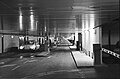 Parking Garage
 Restaurant Graf Zeppelin


Shortly after the opening, the airport chaplaincy also followed, housed in its own chapel.[19]
Former Facilities
editWith the opening of Terminal Mitte, the new visitors' terrace on Level 3 of the building also opened. Visitors could access the roof of Pier B via two exits located in sections A and C, respectively. From the ends of the Y-shaped pier, views were possible in almost every direction. At the time of its opening, the visitors' terrace featured several restaurants and a Japanese garden.[20] The visitors' terrace was temporarily closed following 9/11, and has been permanently out of service since 2006. Since then, the airport's only visitors' terrace has been located at Terminal 2.[21]
In 1973, a Jumbo supermarket opened; this was followed in 1977 by three cinemas, and finally, in 1978, by the Dorian Gray nightclub. The nightclub was forced to close on 31 December 2000.[22] The Jumbo supermarket and the cinemas also no longer exist today.
Bomb Attack
editOn 19 June 1985, at 2:42 p.m., a bomb exploded inside a waste bin in Departure Hall B of Terminal 1. Three people were killed in the blast, and 42 others sustained injuries—some of them severe. Another person died a few days later from injuries sustained in the attack. To date, it remains the largest attack ever carried out against a German airport. In the days following the incident, authorities received the highest number of distinct claims of responsibility ever recorded up to that time. As of January 2019, the perpetrators or those responsible for the attack have yet to be conclusively identified. The police attribute the attack to the Abu Nidal Organization (ANO), a terrorist splinter group of the PLO. Abu Nidal and Khaled Ibrahim Mahmood—who served a lengthy prison sentence for his involvement in the December 1985 attack on Rome-Fiumicino Airport—are considered to be the masterminds behind the plot. The three other suspected perpetrators remain wanted under active arrest warrants to this day.
Later Changes
edit
With the opening of Terminal 2, the name "Terminal 1" was applied to the original facility for the first time. Furthermore, a station for the SkyLine people mover was initially opened within Terminal 1: Station B/C is situated above the rear section of Departure Hall B. Since then, the SkyLine has connected Terminal 1 with Terminal 2. A second station, A/Z, followed a few years later and is located at the beginning of Pier A.[23]
Starting in 2006, the B-West and B-East gates were redesigned to comply with regulatory requirements (fire safety regulations and the implementation of EU directives regarding the spatial separation of arriving and departing passengers). Additional stands for the Airbus A380 were also constructed in this area.[24] The observation deck was also sacrificed during these renovations, as the gate structure was expanded vertically.
Major changes have also been implemented at Pier A since 2000. On 29 March 2000, a 500-square-meter-long, angled extension of the pier was opened.[16] In 2006, construction began on the expansion known as Pier A-Plus. A new distribution hall was erected at the base of the existing pier, adjacent to Departure Hall A. From this distribution hall, Pier A-Plus branches off from the original Pier A and follows the alignment of the Departure Hall westward for 600 meters. This pier, also, was designed to accommodate Airbus A380 operations. It increases the airport's annual capacity by an additional 6 million passengers. Pier A-Plus was opened on 10 October 2012.[25] To make way for this extension, Maintenance Hangar 3—designed by Hannsgeorg Beckert and known as the "Butterfly Hangar"—had to be demolished by controlled explosion in 2007, as it was situated within the Terminal-Ramp area.[26]
Furthermore, new areas for dining and shopping were created in all three terminal halls. An extension to Hall A was also constructed to accommodate additional security lanes. This measure aims to alleviate the strain on the existing, overburdened security checkpoints.[27]
In 2016, the façade of the departure area was renovated and has since featured distinctive LED light strips.[28]
In 2021, Fraport's new visitor center was opened in the area of Departure Hall C.[29]
On 23 February 2026, a second Skyline line commenced operations at the bus station in front of the terminal building. Since April 2026, this line was connected to the new Terminal 3.[30]
Architecture
edit
Terminal 1 is horizontally divided into three sections, from west to east: A/Z, B, and C.[31] Each section is vertically divided into arrivals and departures facilities, as well as distribution levels, each with its own entrances, exits, and connecting passages. In depth, the terminal is divided into a northern landside section and a southern airside section.
At the center of the complex rises the 250-square-meter, seven-story office tower, which—together with the old control tower dating from 1955 and the connecting structure spanning Gate B—resembles a "T" when viewed from the air.
Operation
editFlight Operations
edit.jpg)
Terminal 1—comprising the four passenger areas A, B, C, and Z—handles all flights operated by Lufthansa and its subsidiaries (Lufthansa CityLine, SWISS, Austrian Airlines, Brussels Airlines, Discover Airlines), as well as its partner airlines within the Star Alliance network (including Aegean Airlines, Air Canada, Air China, All Nippon Airways, EgyptAir, Singapore Airlines, South African Airways, Thai Airways International, Turkish Airlines, and United Airlines). Airlines with no affiliation to Lufthansa or the Star Alliance are also processed in Terminal 1, including El Al and—since the merger—LATAM Airlines.[32]
| Airline | Departure Hall |
|---|---|
| Aegean Airlines | B |
| Air Canada | B/C |
| Air China | C |
| Air Dolomiti | B |
| Air India | B/C |
| airBaltic | B/C |
| AJet | C |
| All Nippon Airways | B |
| Asiana Airlines | C |
| Austrian Airlines | B |
| Brussels Airlines | B |
| Condor Flugdienst | C |
| Croatia Airlines | C |
| DAT | A/B |
| Discover Airlines | B |
| Egypt Air | B |
| El Al | C |
| Ethiopian Airlines | C |
| Eurowings | C |
| ITA Airways | B |
| LATAM Airlines | C |
| Polskie Linie Lotnicze LOT | B/C |
| Lufthansa | A/B |
| Lufthansa City | A/B |
| Singapore Airlines | B/C |
| SunExpress | C |
| Swiss | B |
| TAP Air Portugal | B/C |
| Thai Airways International | C |
| Turkish Airlines | C |
| United Airlines | B |
Operationally, the terminal is divided into a public area and a security area. The security area is accessible to passengers only upon presentation of a boarding pass and completion of a security check. The security checkpoints are located in sections A/Z and B, situated at the transitions between the departure halls and the boarding gates. Additionally, a checkpoint is located at the SkyLine station in section A/Z. Processing is conducted according to travel class. It is also possible to reserve a specific time slot. In section C, security screening takes place directly at the gate.[33]
A further operational distinction is made between the Schengen and non-Schengen areas. For flights departing the Schengen Area (non-Schengen), it is necessary to verify passengers' passports. In Section A/Z, this distinction is implemented at the gates: Gate A (Schengen) is located on Level 2, while Gate Z (non-Schengen) is situated on Level 3. In Section B, the front portion of the gate—facing the departure hall—is reserved for Schengen flights; passport control takes place in the area facing the apron, as well as on the upper level (Level 3). This operational division has been in place since the terminal’s commissioning and explains the spacious open area located at the end of the main stem of the Y-shaped gate structure—an area originally designated as the "International Waiting Hall." In contrast, the gate is reserved exclusively for non-Schengen flights. Passport control is conducted immediately upon entering the gate area.[34]
Baggage Handling
edit
Given its exceptionally high volume of transit traffic, the baggage handling system at Frankfurt faces unique demands. With a current network length of 70 kilometers, the facility remains unparalleled globally to this day in terms of size, capacity, performance, and a reliability rate of 99.6 percent. Operating at conveyor speeds of up to five meters per second, approximately 18,000 pieces of luggage per hour travel via an underground network to one of 78 designated offloading points. Each year, approximately 38.5 million pieces of luggage are transported—carried within baggage trays—across a system comprising over 6,000 belt conveyors, 6,700 roller conveyors, 2,420 curves, and 1,100 switches. Located along the conveyor lines, 650 decoders (scanning stations) identify the destination-coded baggage trays, thereby ensuring punctual and seamless operations.[35][36]
Public Transportation
edit
The airport's regional railway station is located beneath the entrance area situated to the north of the terminal. It opened together with the terminal building in 1972 and has been connected to the Rhine-Main S-Bahn network since 1980.[37]
Upon its opening, all bus lines that had previously served the former terminal building were rerouted to the new terminal. These included the short-lived express bus line 41—which became redundant with the opening of the train station—as well as lines 62 and 73 (which still exist today), serving Schwanheim and Kelsterbach respectively, and line 61, serving Sachsenhausen.[38]
Today, 16 regional and city bus lines operate from ten bus bays at the bus station.[39][40]
Source:[41]
| Bay | Line Nr. | destinations |
|---|---|---|
| 14 | AIR | Darmstadt |
| 15 | Terminal-Shuttle | |
| 16 | 61 | Frankfurt South Train Station |
| 17 | X17 | Hofheim Train Station ↔ Neu-Isenburg |
| X19 | Obertshausen Train Station | |
| 18 | 62 | Schwanheim |
| X61 | Frankfurt South Train Station | |
| 19 | X53 | Bolongaropalast |
| n72 | Gate 32 ↔ Dietzenbach-Mitte Station (Night service only) | |
| 20 | OF-64 | Sprendlingen |
| 21 | X58 | Höchst Train Station |
| 58 | Eschborn | |
| 22 | 72 | Bischofsheim |
| 73 | Höchst industrial park / Kelsterbach | |
| 23 | Internal airport traffic | |
| 24 | 67 | Rüsselsheim |
| 82 | Raunheim | |
| X15 | Darmstadt | |
| 25 | Internal airport traffic |
Connection with other Buildings
editTerminal 1 features numerous direct connections to other buildings that can be used by passengers and visitors without having to utilize the public road network.
The most important and well-known of these connections is the SkyLine elevated railway. It features three stations—located in sections A/Z, B/C, and C—within Terminal 1, connecting them to Terminal 2. With the exception of the station in Section C, the elevated railway facilitates the segregation of visitors (or passengers traveling within the Schengen Area) from passengers in transit. The station in Section C is accessible exclusively to transit passengers. The SkyLine stations are situated on the third upper floor (Level 4). A fourth station at Terminal 1 is located on the landside, directly in front of the terminal building, positioned above the Arrivals Arch and other public transport facilities. This station is served by a second SkyLine line, which connects Terminal 2 to Terminal 3.[42]
On the second upper floor (Level 3), there is a pedestrian bridge connecting the terminal to the buildings situated to the north. From a distribution hall located above—and positioned between—the Arrivals Arch and the bus station, the flow of visitors is channeled either toward the pedestrian bridge leading to the Frankfurt Airport Center, or toward the pedestrian bridge leading to the Long-Distance Railway Station, the Sheraton Frankfurt Airport Hotel, and the station for the second Skyline line. This distribution hall also houses an elevator providing access to the bus station (Level 0) and to Tracks 2/3 of the Regional Railway Station.[43]
The underground distribution level 0 also provides access to the regional train station and the underground garage.[44]
The connecting tunnel between Gates A and B is for the exclusive use of transit passengers. This 300-square-meter tunnel runs 12 meters beneath the terminal ramp and reduces transfer times.[45]
Literature
edit- Markus Kutscher: Geschichte der Luftfahrt in Frankfurt am Main. Von Aeronauten und Jumbo-Jets. Frankfurt am Main 1995, ISBN 3-524-69110-2.
- Airport der Zukunft: Müller, Karlhans, [and] Milan Skaryd; (Airport) of the future. Terminal Mitte. Rummel. 1972. ISBN 978-3-9800015-0-2.
References
edit- ↑ "50 Jahre Terminal 1". Fraport AG (in German). 11 March 2022. Retrieved 25 May 2026.
- ↑ "BAUWELT – Fliegen lernen". www.bauwelt.de (in German). Retrieved 25 May 2026.
- ↑ "PHOTOS: Frankfurt's Terminal 1 celebrates 50 years". A Visual History of the World's Great Airports. 26 March 2022. Retrieved 25 May 2026.
- ↑ "Frankfurt Airport Marks 50th Anniversary of Terminal 1". Fraport AG. 11 March 2022. Retrieved 25 May 2026.
- ↑ Saurier unserer Zeit. 2 April 1972. ISSN 2195-1349.
- 1 2 3 4 "Flughafen Frankfurt". Frankfurt baut auf (Terminal Mitte, größte Baustelle Europas). Archived from the original on 26 April 2012. Retrieved 22 November 2025.
- 1 2 "Flughafen Frankfurt/Main AG". Frankfurt baut auf (Berichte). Archived from the original on 15 June 2007. Retrieved 22 November 2025.
- ↑ "FRA-history". Fraport AG (in German). 16 December 2025. Retrieved 25 May 2026.
- ↑ "Lagis". LAGIS (in German). Retrieved 25 May 2026.
- ↑ Schlagenhaufer, Stefan (27 July 2012). "Flughafen Frankurt: 40 Jahre Terminal 1". bild.de (in German). Retrieved 25 May 2026.
- 1 2 "The first 747 to FRA was a complete surprise". A Visual History of the World's Great Airports. 28 January 1970. Retrieved 25 May 2026.
- ↑ "Flughafen Frankfurt: Terminal 1 wird 50 Jahre alt". airportzentrale.de (in German). 19 March 2022. Retrieved 25 May 2026.
- ↑ "Glänzender Anzug". FR.de (in German). 3 February 2019. Retrieved 25 May 2026.
- ↑ Hessischer Rundfunk (28 June 2024). "100 Jahre Flughafen – Vom Propellerflugzeug zum A380 (2/2) | Mittendrin Flughafen Frankfurt 70". Retrieved 28 November 2025.
- ↑ "Frankfurter Flughafen eröffnet neues Milliarden-Terminal". bild.de (in German). 22 April 2026. Retrieved 25 May 2026.
- 1 2 "Frankfurter Stadtchronik" (in German). Institut für Stadtgeschichte. 23 February 2015. Retrieved 29 November 2025.
- ↑ "Flughafen Frankfurt — Airport der Zukunft?". Watchtower ONLINE LIBRARY (in German). Retrieved 25 May 2026.
- ↑ "Medical Center". Fraport AG (in German). 1 February 2021. Retrieved 25 May 2026.
- ↑ "Prayer Rooms at Frankfurt Airport". Frankfurt Airport. 16 April 2026. Retrieved 25 May 2026.
- ↑ Airport der Zukunft: Müller, Karlhans, [u.] Milan Skaryd; (Airport) of the future. Terminal Mitte. Rummel. 1972. ISBN 978-3-9800015-0-2.
- ↑ "Flughafenflair im Freien: Flughafen Frankfurt eröffnet Dachterrasse im Transitbereich von Terminal 1". Fraport AG (in German). 15 May 2020. Retrieved 25 May 2026.
- ↑ Fischer, Julian (4 June 2024). "Frankfurt: Flughafen feiert 100-jähriges Bestehen mit Dorian-Gray-DJs". Groove. Retrieved 25 May 2026.
- ↑ Sebayang, Andreas (7 November 2024). "Frankfurt: Details zur Einbindung der neuen Skyline-Station in Terminal 1". airliners.de (in German). Retrieved 25 May 2026.
- ↑ Hamer, Ingrid (May 2010), Wiederspahn, Michael (ed.), "Modernisierung und Erweiterung des Flughafens Frankfurt" (PDF), Umrisse: Zeitschrift für Baukultur, 10. Jahrgang (4/5 2010), Wiesbaden: Verlagsgruppe Wiederspahn: 18–21, ISSN 1437-2533
- ↑ Isabelle Lomholt (2 October 2012). "Frankfurt Airport Gate A Building, Germany". e-architect. Retrieved 29 December 2025.
- ↑ "Lufthansa Wartungshalle 3 (Frankfurt am Main, 1961)" (in German). Retrieved 29 December 2025.
- ↑ "Neues Gebäude für Sicherheitskontrollen in Frankfurt eröffnet". Retrieved 21 December 2019.
- ↑ "Frankfurt Airport with modern LED illumination // Leuchten + Metall Technik GmbH". Leuchten + Metall Technik GmbH. 16 July 2016. Retrieved 25 May 2026.
- ↑ "Fraport-Besucherzentrum". #visitfrankfurt (in German). Retrieved 25 May 2026.
- ↑ "Neue Skyline-Bahn: So kommt ihr zu Terminal 3 am Flughafen". HIT RADIO FFH (in German). 23 February 2026. Retrieved 25 May 2026.
- ↑ "Airport Map". Frankfurt Airport. 6 May 2026. Retrieved 25 May 2026.
- ↑ "Frankfurt Flughafen Airlines". Flughafen Parken und Flughafen Hotels (in German). Retrieved 26 May 2026.
- ↑ "Personen- und Handgepäckkontrolle am Flughafen Frankfurt" (in German). Archived from the original on 30 September 2025. Retrieved 21 December 2025.
- ↑ "Frankfurt Airport Guide". Sleeping in Airports. 11 May 2026. Retrieved 26 May 2026.
- ↑ "Visualisierung der Gepäckförderanlage bei Fraport". zenon by COPA-DATA (in German). 5 November 2025. Retrieved 26 May 2026.
- ↑ "Seit 50 Jahren in Bewegung". Fraport AG (in German). 22 February 2024. Retrieved 26 May 2026.
- ↑ Kyrieleis, Stephan. "S-Bahn". Trampage Frankfurt am Main (in German). Retrieved 26 May 2026.
- ↑ Wehr, Stefanie (25 January 2022). "Gute Noten für die Expressbus-Linien". fnp.de (in German). Retrieved 26 May 2026.
- ↑ "Mit dem Bus zum Flughafen Frankfurt". Frankfurt Airport (in German). 8 May 2026. Retrieved 26 May 2026.
- ↑ "Linienübersicht städtische Bus-Linien". ÖPNV online Frankfurt am Main (in German). 13 December 2021. Retrieved 26 May 2026.
- ↑ "Liniennetzplan Frankfurt-Flughafen" (PDF). Retrieved 26 May 2026.
- ↑ "Airport and City Info". ANA Official Website. 12 October 2025. Retrieved 26 May 2026.
- ↑ "Airport Map". Frankfurt Airport (in German). Retrieved 26 May 2026.
- ↑ "Airport Map". Frankfurt Airport (in German). Retrieved 26 May 2026.
- ↑ "Umsteigen". Frankfurt Airport (in German). 6 May 2026. Retrieved 26 May 2026.
External links
edit

- "Airport Map". Frankfurt Airport (in German). Retrieved 26 May 2026.