


Commons is a freely licensed media file repository. You can help.
Summary
| Description |
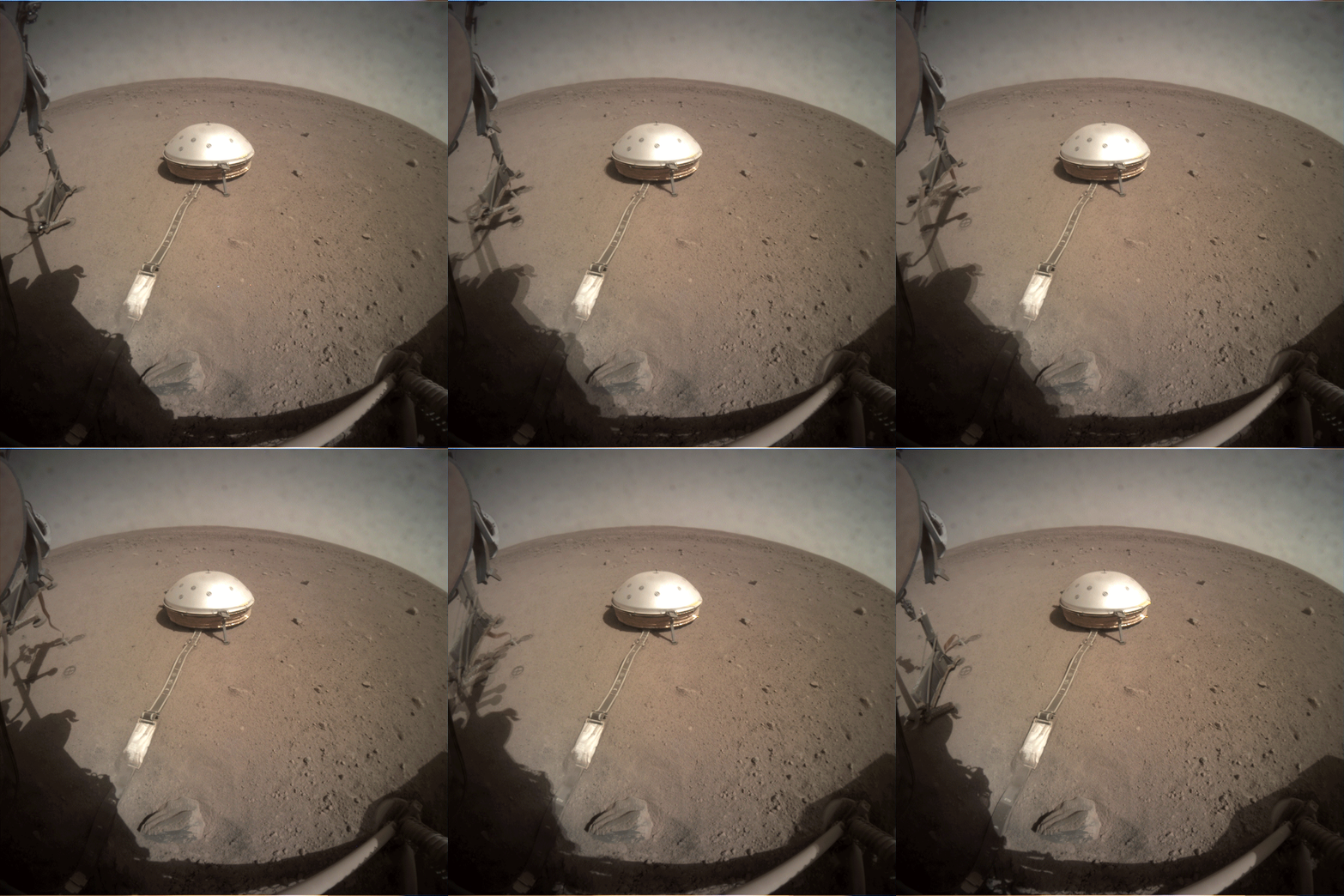
English: Fisheye Camera: InSight Lifts the Mole's Support Structure
Behold the "mole": The heat-sensing spike that NASA's InSight lander deployed on the Martian surface is now visible. Last week, the spacecraft's robotic arm successfully removed the support structure of the mole, which has been unable to dig, and placed it to the side. Getting the structure out of the way gives the mission team a view of the mole - and maybe a way to help it dig. "We've completed the first step in our plan to save the mole," said Troy Hudson of a scientist and engineer with the InSight mission at NASA's Jet Propulsion Laboratory in Pasadena, California. "We're not done yet. But for the moment, the entire team is elated because we're that much closer to getting the mole moving again." Part of an instrument called the Heat Flow and Physical Properties Package (HP3), the self-hammering mole is designed to dig down as much as 16 feet (5 meters) and take Mars' temperature. But the mole hasn't been able to dig deeper than about 12 inches (30 centimeters), so on Feb. 28, 2019 the team commanded the instrument to stop hammering so that they could determine a path forward. Scientists and engineers have been conducting tests to save the mole at JPL, which leads the InSight mission, as well as at the German Aerospace Center (DLR), which provided HP3. Based on DLR testing, the soil may not provide the kind of friction the mole was designed for. Without friction to balance the recoil from the self-hammering motion, the mole would simply bounce in place rather than dig. One sign of this unexpected soil type is apparent in images taken by a camera on the robotic arm: A small pit has formed around the mole as it's been hammering in place. "The images coming back from Mars confirm what we've seen in our testing here on Earth," said HP3 Project Scientist Mattias Grott of DLR. "Our calculations were correct: This cohesive soil is compacting into walls as the mole hammers." The team wants to press on the soil near this pit using a small scoop on the end of the robotic arm. The hope is that this might collapse the pit and provide the necessary friction for the mole to dig. It's also still possible that the mole has hit a rock. While the mole is designed to push small rocks out of the way or deflect around them, larger ones will prevent the spike's forward progress. That's why the mission carefully selected a landing site that would likely have both fewer rocks in general and smaller ones near the surface. The robotic arm's grapple isn't designed to lift the mole once it's out of its support structure, so it won't be able to relocate the mole if a rock is blocking it. The team will be discussing what next steps to take based on careful analysis. Later this month, after releasing the arm's grapple from the support structure, they'll bring a camera in for some detailed images of the mole. |
| Date | Taken on 28 June 2019 |
| Source | https://mars.nasa.gov/resources/22590/fisheye-camera-insight-lifts-the-moles-support-structure (image link); see also https://www.jpl.nasa.gov/news/news.php?feature=7441 |
| Author | NASA/JPL-Caltech |

|
This image or video was catalogued by Jet Propulsion Laboratory of the United States National Aeronautics and Space Administration (NASA) under Photo ID: PIA23308. This tag does not indicate the copyright status of the attached work. A normal copyright tag is still required. See Commons:Licensing. Other languages:
|
Licensing

|
The copyright holder of this file, NASA/JPL-Caltech, allows anyone to use it for any purpose, provided that the copyright holder is properly attributed. Redistribution, derivative work, commercial use, and all other use is permitted. |
|
|
 
|
According to JPL's image use policy additional restriction is that no endorsement of any product or service by Caltech, JPL or NASA is claimed or implied.
Caltech's disclaimer: Caltech makes no representations or warranties with respect to ownership of copyrights in the images, and does not represent others who may claim to be authors or owners of copyright of any of the images, and makes no warranties as to the quality of the images. Caltech shall not be responsible for any loss or expenses resulting from the use of the images, and you release and hold Caltech harmless from all liability arising from such use. Usage on the English Wikipedia: On the English Wikipedia you can use the {{JPL Image}} template to display the copyright notice. (See w:Wikipedia:Using JPL images for details) |
File history
Click on a date/time to view the file as it appeared at that time.
| Date/Time | Thumbnail | Dimensions | User | Comment | |
|---|---|---|---|---|---|
| current | 01:18, 2 July 2019 | | 1,024 × 1,024 (15.32 MB) | Drbogdan | User created page with UploadWizard |
File usage
The following page uses this file:
