


Commons is a freely licensed media file repository. You can help.
Summary
| Description |
English: 08.17.2012
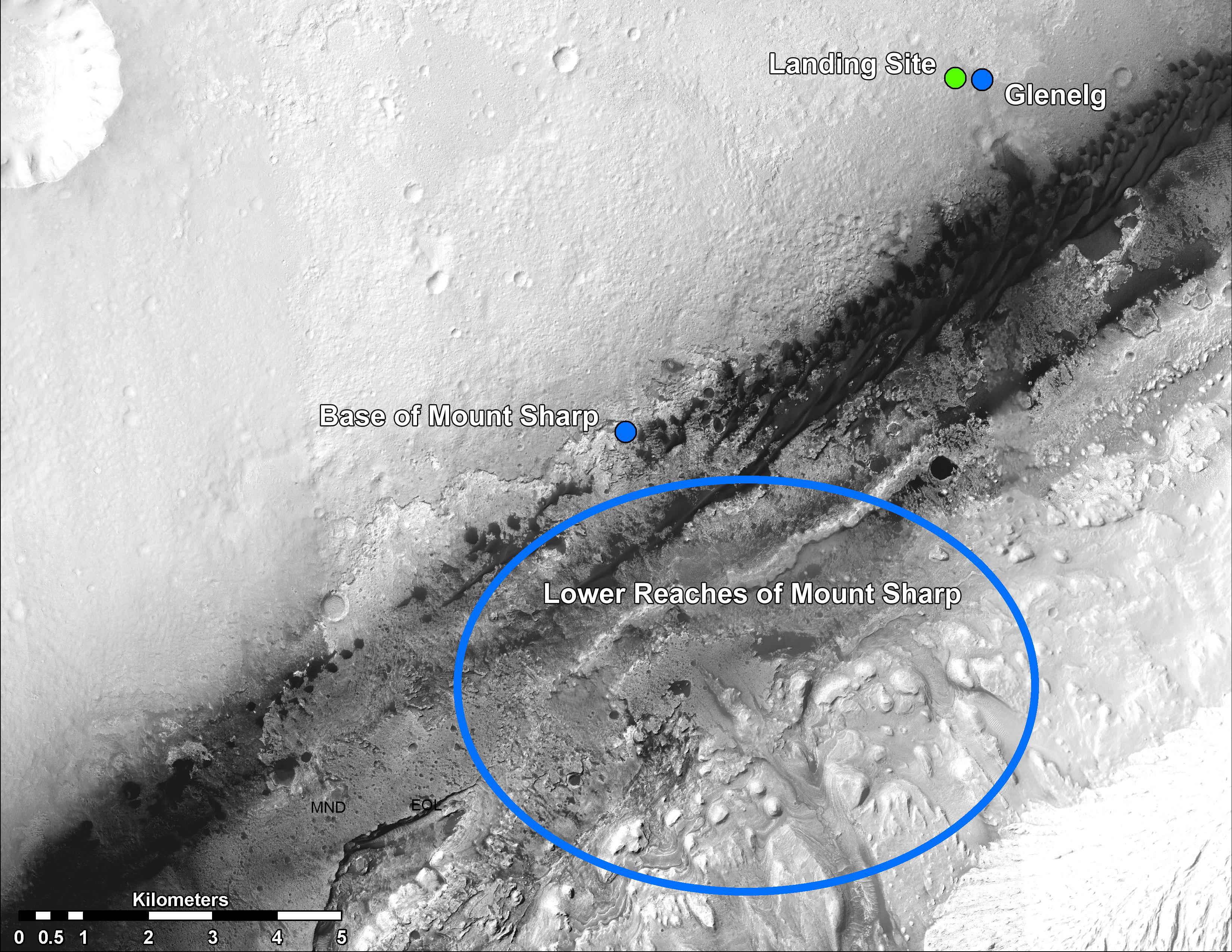
Martian Treasure Map This image shows the landing site of NASA's Curiosity rover and destinations scientists want to investigate. Curiosity landed inside Gale Crater on Mars on Aug. 5 PDT (Aug. 6 EDT) at the green dot, within the Yellowknife quadrangle. The team has chosen for it to move toward the region marked by a blue dot that is nicknamed Glenelg. That area marks the intersection of three kinds of terrain. The science team thought the name Glenelg was appropriate because, if Curiosity traveled there, it would visit it twice -- both coming and going -- and the word Glenelg is a palindrome. Then, the rover will aim to drive to the blue spot marked "Base of Mt. Sharp", which is a natural break in the dunes that will allow Curiosity to begin scaling the lower reaches of Mount Sharp. At the base of Mt. Sharp are layered buttes and mesas that scientists hope will reveal the area's geological history. These annotations have been made on top of an image acquired by the High Resolution Imaging Science Experiment (HiRISE) camera on NASA's Mars Reconnaissance Orbiter. Polski: Trasa przemarszu łazika Curiosity pokazuje lądowisko i docelowe miejsca badań naukowców NASA . Curiosity wylądował wewnątrz krateru Gale (Bradbury Landing) 5 sierpnia PDT (06 sierpnia EDT) w miejscu oznaczonym zieloną kropką, w czworoboku Yellowknife. Zespół postanowił , aby poruszać się w kierunku regionu oznaczonego niebieską kropką, jest nazywanego Glenelg. Obszar ten wyznacza punkt przecięcia trzech rodzajach terenu. Naukowy zespół uznał, że nazwa Glenelg była właściwa, ponieważ Curiosity podczas podróży odwiedziłby to miejsce dwa razy - zarówno przychodząc jak i odchodząc, a słowo Glenelg jest palindromem. Następnie, łazik będzie poruszać się do miejsca oznaczonego niebieskim owalem "Baza Mt. Sharpa", która jest naturalną przerwą w wydmach, które pozwolą rozpocząć poruszanie się łazika w kierunku dolnego odcinka Mount Sharp (Aeolis Mona). U podnóża Mount Sharp są wzgórza warstwowe i płaskowyże, tak że naukowcy mają nadzieję ujawnić historię geologiczną tego obszaru.
Image Credit: NASA/JPL-Caltech/Univ. of Arizona |
| Date | |
| Source | http://photojournal.jpl.nasa.gov/jpeg/PIA16064.jpg |
| Author | NASA/JPL-Caltech/Univ. of Arizona |
| Other versions | http://photojournal.jpl.nasa.gov/catalog/PIA16064 |
Licensing

|
The copyright holder of this file, NASA/JPL-Caltech, allows anyone to use it for any purpose, provided that the copyright holder is properly attributed. Redistribution, derivative work, commercial use, and all other use is permitted. |
|
|
 
|
According to JPL's image use policy additional restriction is that no endorsement of any product or service by Caltech, JPL or NASA is claimed or implied.
Caltech's disclaimer: Caltech makes no representations or warranties with respect to ownership of copyrights in the images, and does not represent others who may claim to be authors or owners of copyright of any of the images, and makes no warranties as to the quality of the images. Caltech shall not be responsible for any loss or expenses resulting from the use of the images, and you release and hold Caltech harmless from all liability arising from such use. Usage on the English Wikipedia: On the English Wikipedia you can use the {{JPL Image}} template to display the copyright notice. (See w:Wikipedia:Using JPL images for details) |
| Annotations | This image is annotated: View the annotations at Commons |
File history
Click on a date/time to view the file as it appeared at that time.
| Date/Time | Thumbnail | Dimensions | User | Comment | |
|---|---|---|---|---|---|
| current | 21:45, 21 August 2012 | | 3,300 × 2,550 (1.63 MB) | Drbogdan |
File usage
The following 5 pages use this file:
Global file usage
The following other wikis use this file:
- Usage on bn.wikipedia.org
- Usage on ca.wikipedia.org
- Usage on es.wikipedia.org
- Usage on fa.wikipedia.org
- Usage on fr.wikipedia.org
- Usage on id.wikipedia.org
- Usage on it.wikipedia.org
- Usage on ja.wikipedia.org
- Usage on ko.wikipedia.org
- Usage on pl.wikipedia.org
- Usage on ru.wikipedia.org
- Usage on sr.wikipedia.org
- Usage on test.wikipedia.org
- Usage on tr.wikipedia.org
- Usage on uk.wikipedia.org
- Usage on zh.wikipedia.org
