

Size of this preview: 960 × 960 pixels. Other resolutions: 250 × 250 pixels | 500 × 500 pixels | 960 × 960 pixels | 1,280 × 1,280 pixels | 3,840 × 3,840 pixels.
Original file (8,412 × 8,412 pixels, file size: 23.64 MB, MIME type: image/jpeg)

This is a file from the Wikimedia Commons. Information from its description page there is shown below.
Commons is a freely licensed media file repository. You can help.
Commons is a freely licensed media file repository. You can help.
Summary
| Description |
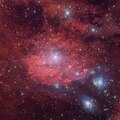
English: There are two different types of nebulae brought to you in this Picture of the Week. Each appears with a distinct colour in the visible sky and are captured here using the wide-field camera OmegaCAM on the VLT Survey Telescope (VST), hosted at ESO’s Paranal Observatory in the Chilean desert.The large, bright emission nebula at the centre, IC1284, is a star-forming region composed primarily of hydrogen. Its rosy glow comes from electrons within the hydrogen atoms: they’re excited by the radiation from young stars, but then they lose energy and emit a specific colour or wavelength of light. One of the filters on OmegaCAM lets through this particular reddish colour, hence the nebula’s look. Meanwhile, another colour filter highlights the blue reflection nebulae NGC6589 and NGC6590 in the lower right corner. The dust in a reflection nebula preferentially scatters shorter, bluer wavelengths of light from nearby stars, which is what gives these nebulae their eerie glow. It’s the same reason why the sky is blue!The frame of this image covers an area roughly equivalent in the sky to a full Moon. This image was captured as part of a large ESO public survey, the VST Photometric H alpha Survey of the Southern Galactic Plane and Bulge (VPHAS+), which observes nebulae and stars in visible light to help astronomers understand how stars are born, live and die. |
||
| Date | 2 October 2023 (upload date) | ||
| Source |
|
||
| Author | ESO/VPHAS+ team | ||
| Other versions |
|

_-_VST_-_Glowing_rosy_in_the_dark_(potw2340a).jpg)
_-_VST_-_Glowing_rosy_in_the_dark_(potw2340a).jpg&action=edit&redlink=1)


_-_VST_-_Glowing_rosy_in_the_dark_(potw2340a).jpg)
Licensing
_logo.svg) |
This media was created by the European Southern Observatory (ESO).
Their website states: "Unless specifically noted, the images, videos, and music distributed on the public ESO website, along with the texts of press releases, announcements, pictures of the week, blog posts and captions, are licensed under a Creative Commons Attribution 4.0 International License, and may on a non-exclusive basis be reproduced without fee provided the credit is clear and visible." To the uploader: You must provide a link (URL) to the original file and the authorship information if available. |
  This file is licensed under the Creative Commons Attribution 4.0 International license.
| |
File history
Click on a date/time to view the file as it appeared at that time.
| Date/Time | Thumbnail | Dimensions | User | Comment | |
|---|---|---|---|---|---|
| current | 07:16, 2 October 2023 | | 8,412 × 8,412 (23.64 MB) | OptimusPrimeBot | #Spacemedia - Upload of https://www.eso.org/public/archives/images/large/potw2340a.jpg via Commons:Spacemedia |
File usage
The following 4 pages use this file:
Global file usage
The following other wikis use this file:
_-_VST_-_Glowing_rosy_in_the_dark_(potw2340a).jpg)