


- To illustrate the subject in question
- Where no free equivalent is available or could be created that would adequately give the same information
- On the English-language Wikipedia, hosted on servers in the United States by the non-profit Wikimedia Foundation,
qualifies as fair use under United States copyright law. Any other uses of this image, on Wikipedia or elsewhere, may be copyright infringement. See Wikipedia:Non-free content and Wikipedia:Copyrights.

- Please add a detailed non-free use rationale for each article the image is used in, which must also declare compliance with the other parts of the non-free content criteria, as well as the source of the work and copyright information.
- For example non-free use rationales, see Wikipedia:Use rationale examples.
- Template:Non-free use rationale may be helpful for stating the rationale.
- This tag is not a sufficient claim of fair use.
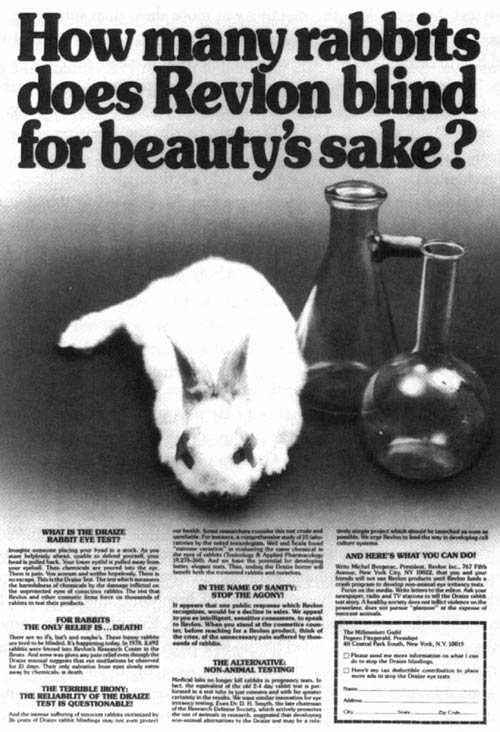
|image has rationale=yes as a parameter to the license template.Description: Ad taken out by animal rights advocate Henry Spira (1927-1998) in The New York Times on April 15, 1980, leading Revlon to begin a search for cruelty-free alternatives. See Spira, Henry and Singer, Peter. "Ten Points for Activists" in Singer, Peter (ed.). In Defense of Animals: The Second Wave. Blackwell, 2006, introductory note by Peter Singer, pp. 214-215.
Source: https://www.cahiers-antispecistes.org/wp-content/uploads/IMG/squelettes/documents/SpiraRevlon500.jpg
Copyright: Henry Spira and his group Animal Rights International
Rationale for use in Henry Spira
edit
Though this image is subject to copyright, its use is covered by the U.S. fair use laws, and the stricter requirements of Wikipedia's non-free content policies, because:
- It is a historically significant image, the subject of significant academic commentary because of the effect it had.
- It is of much lower resolution than the original. Copies made from it will be of very inferior quality.
- It is only being used for informational purposes.
- Its inclusion in the article adds significantly to the article because the image and its historical significance are part of the object of discussion in the article.
File history
Click on a date/time to view the file as it appeared at that time.
| Date/Time | Thumbnail | Dimensions | User | Comment | |
|---|---|---|---|---|---|
| current | 11:13, 22 September 2022 | | 246 × 360 (24 KB) | Sentience Scholar (talk | contribs) | Higher quality version |
| 06:11, 5 January 2018 | No thumbnail | 276 × 360 (20 KB) | Theo's Little Bot (talk | contribs) | Reduce size of non-free image (BOT - disable) | |
| 03:22, 5 July 2010 | No thumbnail | 300 × 392 (13 KB) | SlimVirgin (talk | contribs) | {{non-free fair use|Henry Spira}} Description: Ad taken out by animal rights advocate Henry Spira (1927-1998) in ''The New York Times'' on April 15, 1980, leading Revlon to begin a search for cruelty-free alternatives. See Spira, Henry and Singer, Pe |
You cannot overwrite this file.
File usage
The following page uses this file:
