
This article has multiple issues. Please help improve it or discuss these issues on the talk page. (Learn how and when to remove these messages)
|
The history of Europe is traditionally divided into four time periods: prehistoric Europe (prior to about 800 BC), classical antiquity (800 BC to AD 500), the Middle Ages (AD 500–1500), and the modern era (since AD 1500).
The first early European modern humans appear in the fossil record about 48,000 years ago, during the Paleolithic era. Settled agriculture marked the Neolithic era, which spread slowly across Europe from southeast to the north and west. The later Neolithic period saw the introduction of early metallurgy and the use of copper-based tools and weapons, and the building of megalithic structures, as exemplified by Stonehenge. During the Indo-European migrations, Europe saw migrations from the east and southeast. The period known as classical antiquity began with the emergence of the city-states of ancient Greece. From 336 to 323 BC, Alexander the Great of Macedon created one of the largest empires in history, stretching from Greece to northwestern India, inaugurating the era known as the Hellenistic Period. Later, the Roman Empire came to dominate the entire Mediterranean Basin. The Migration Period of the Germanic people began in the late 4th century AD.
The fall of the Western Roman Empire in AD 476 traditionally marks the start of the Middle Ages. While the Eastern Roman Empire continued for another 1000 years, the former lands of the Western Empire fragmented into the barbarian kingdoms. The Umayyads conquered Iberia and established Al-Andalus. In 800, Pope Leo III crowned the King of the Franks, Charlemagne, as Holy Roman Emperor. During the Viking Age, Norsemen undertook large-scale raiding and conquest throughout Europe. The oldest university currently in continuous operation in the world was established during the High Middle Ages, which also saw two centuries of Crusades to try to retake the Levant from the Muslim states that occupied it. Despite a decline in population caused by the Great Famine of 1315–1317 and Black Death (1346 to 1353), Europe experienced a cultural Renaissance in the 15th century.

Early modern Europe began with 15th-century revolutions in both printing and navigation. Gunpowder changed how warfare was conducted and printing changed how knowledge was created, preserved and disseminated. The Age of Discovery led to extensive colonization, the Atlantic slave trade and the Columbian exchange. The 16th-century Reformation challenged the hegemony of the Catholic Church and precipitated over a century of religious wars. Modern science emerged during the Scientific Revolution of the 17th century. The Age of Revolution saw long-established political systems overturned. After 1800, the Industrial Revolution brought capital accumulation and rapid urbanization to Western Europe, while several countries transitioned away from absolutist rule to parliamentary regimes.
The five great powers of the Concert of Europe dominated the long nineteenth century but eventually divided into two rival military alliances that fought World War I (1914-1918), which ended with multi-ethnic empires fragmented into nation states. Nazi Germany's invasion of Poland launched World War II (1939-1945), and as its armies overran Europe the regime systematically perpetrated the Holocaust. During the Cold War, Europe was divided by the Iron Curtain into capitalist and communist states, as well as the military alliances of NATO and the Warsaw Pact, led by the United States and the Soviet Union. Colonial empires were dismantled and Western Europe's remaining military dictatorships transitioned to democracies. After Soviet leader Mikhail Gorbachev refused to intervene militarily against democratic reforms in Poland and elsewhere, the Revolutions of 1989 led to all European communist states transitioning to capitalism and then the Soviet Union itself dissolving. The European Union ("EU") was established in 1993. In the 21st century, most of the former communist states joined the EU and Europe faced the Euro area crisis, the 2015 migrant crisis, and the Russian invasion of Ukraine (2022-).
Prehistoric period
editPaleolithic
editHomo erectus migrated from Africa to Europe before the emergence of modern humans. The earliest appearance of anatomically modern people in Europe has been dated to 45,000 BC, referred to as the Early European modern humans. Some locally developed transitional cultures, Uluzzian in Italy and Greece, Altmühlian in Germany, Szeletian in Central Europe and Châtelperronian in the southwest, use clearly Upper Paleolithic technologies at early dates.
BisonsPoursuivisParDesLions.jpg)
Nevertheless, the definitive advance of these technologies is made by the Aurignacian culture, originating in the Levant (Ahmarian) and Hungary (first full Aurignacian). By 35,000 BC, the Aurignacian culture and its technology had extended through most of Europe. The last Neanderthals seem to have been forced to retreat to the southern half of the Iberian Peninsula. Around 29,000 BC a new technology/culture appeared in the western region of Europe: the Gravettian. This culture has been theorised to have come with migrations of people from the Balkans: see the Kozarnika cave.[1][2]
Around 16,000 BC, Europe witnessed the appearance of the Magdalenian culture, possibly rooted in the old Gravettian. This culture soon superseded the Solutrean area and the Gravettian of mainly France, Spain, Germany, Italy, Poland, Portugal and Ukraine. The Hamburg culture prevailed in Northern Europe in the 14th and the 13th millennium BC as the Creswellian did shortly after in the British Isles. Around 12,500 BC, the Würm glaciation ended. Magdalenian culture persisted until c. 10,000 BC, when it quickly evolved into two microlithist cultures: Azilian (Federmesser), in Spain and southern France, and then Sauveterrian, in southern France and Tardenoisian in Central Europe, while in Northern Europe the Lyngby complex succeeded the Hamburg culture with the influence of the Federmesser group as well.
Neolithic and Copper Age
editEvidence of permanent settlement dates from the 8th millennium BC in the Balkans. The Neolithic reached Central Europe in the 6th millennium BC and parts of Northern Europe in the 5th and 4th millenniums BC. The modern indigenous populations of Europe are largely descended from three distinct lineages: Mesolithic hunter-gatherers, a derivative of the Cro-Magnon population, Early European Farmers who migrated from Anatolia during the Neolithic Revolution, and Yamnaya pastoralists who expanded into Europe in the context of the Indo-European expansion.[3] The Indo-European migrations started in Southeast Europe at around c. 4200 BC through the areas around the Black sea and the Balkan peninsula. In the next 3000 years the Indo-European languages expanded through Europe.
Around this time, in the 5th millennium BC the Varna culture evolved. In 4700 – 4200 BC, the Solnitsata town, believed to be the oldest prehistoric town in Europe, flourished.[4][5]
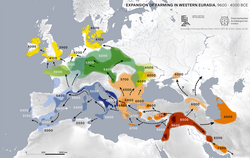 Neolithic expansion in Europe, 7000-4000 BC
 Late Neolithic Europe, c. 5000-3500 BC
 Building remains at Sesklo, Greece, c. 5900 BC
 Linear Pottery culture settlement, Germany, c. 4700 BC
 Varna necropolis artefacts, Bulgaria, c. 4500 BC
 Menga Dolmen, Spain, c. 3700 BC
 Stonehenge, Britain, c. 2500 BC


Ancient period
editBronze Age
edit
The first well-known literate civilization in Europe was the Minoan civilization that arose on the island of Crete and flourished from approximately the 27th century BC to the 15th century BC.[6]
The Minoans were replaced by the Mycenaean civilization which flourished during the period roughly between 1600 BC, when Helladic culture in mainland Greece was transformed under influences from Minoan Crete, and 1100 BC. The major Mycenaean cities were Mycenae and Tiryns in Argolis, Pylos in Messenia, Athens in Attica, Thebes and Orchomenus in Boeotia, and Iolkos in Thessaly. In Crete, the Mycenaeans occupied Knossos. Mycenaean settlement sites also appeared in Epirus,[7][8] Macedonia,[9][10] on islands in the Aegean Sea, on the coast of Asia Minor, the Levant,[11] Cyprus[12] and Italy.[13][14] Mycenaean artefacts have been found well outside the limits of the Mycenean world.

Quite unlike the Minoans, whose society benefited from trade, the Mycenaeans advanced through conquest. Mycenaean civilization was dominated by a warrior aristocracy. Around 1400 BC, the Mycenaeans extended their control to Crete, the centre of the Minoan civilization. The Mycenaean civilization perished with the collapse of Bronze-Age civilization on the eastern shores of the Mediterranean Sea. The collapse has been variously attributed to Dorian invasion, natural disasters and/or climate change.[15] Whatever the causes, the Mycenaean civilization had disappeared after LH III C, when the sites of Mycenae and Tiryns were again destroyed. This end, during the last years of the 12th century BC, occurred after a slow decline of the Mycenaean civilization, which lasted many years before dying out. The beginning of the 11th century BC opened a new context, that of the protogeometric, the beginning of the geometric period, the Greek Dark Ages of traditional historiography.
The Bronze Age collapse may be seen in the context of technological history that saw the slow spread of ironworking technology from present-day Bulgaria and Romania in the 13th and the 12th centuries BC.[16]
The Tumulus culture and the following Urnfield culture of central Europe were part of the origin of the Roman and Greek cultures.[17]
Iron Age
editClassical Antiquity: Ancient Greece
edit
Classical antiquity, also known as the classical era, classical period, classical age, or simply antiquity,[18] is the period of cultural history between the 8th century BC and the 5th century AD comprising the interwoven civilizations of ancient Greece and ancient Rome known together as the Greco-Roman world, centered on the Mediterranean Basin. It is the period during which Greece and Rome flourished and had major influence throughout much of Europe, North Africa, and West Asia.[19][20]
.svg)
Ancient Greece (also "Hellenic civilisation") was a loose collection of culturally and linguistically related city-states ("poleis") - including Athens, Sparta, Thebes, Corinth, and Syracuse - that achieved notable developments in philosophy, mathematics, sports, theatre and music. Athens governed itself with a form of direct democracy and by the late 4th century BC as many as half of the over one thousand existing Greek cities might have been democracies.[21] Athens was the home of Socrates,[22] Plato, the Platonic Academy, Aristotle and the Peripatetic school. The Hellenic city-states established colonies on the shores of the Black Sea and the Mediterranean Sea (Asia Minor, Sicily, and Southern Italy in Magna Graecia) and also fought a half century of wars with the Persian Empire.[23]

Hellenic infighting left Greek city states vulnerable, and Philip II of Macedon united the Greek city states under his control. His son, Alexander the Great, conquered Egypt and Persia and going as far off as India. After the death of Alexander, his empire split into multiple kingdoms ruled by his generals, the Diadochi, who fought against each other in a series of conflicts. In the beginning of the 2nd century BC, only three major kingdoms remained: Ptolemaic Egypt, the Seleucid Empire and Macedonia. During the Hellenistic period, these kingdoms spread Greek culture to regions as far away as Bactria.[24]
Classical Antiquity: Ancient Rome
editThis section needs additional citations for verification. (April 2026) |

Much of Greek learning was assimilated by the nascent Roman state as it expanded outward from Italy, taking advantage of its enemies' inability to unite: the only challenge to Roman ascent came from the Phoenician colony of Carthage, and its defeats in the three Punic Wars marked the start of Roman hegemony. First governed by kings, then as a senatorial republic (the Roman Republic), Rome became an empire at the end of the 1st century BC, under Augustus and his authoritarian successors.

The Roman Empire had its centre in the Mediterranean, controlling all the countries on its shores; the northern border was marked by the Rhine and Danube rivers. Under the emperor Trajan (2nd century AD) the empire reached its maximum expansion, controlling approximately 5,900,000 km2 (2,300,000 sq mi) of land surface, including Italia, Gallia, Dalmatia, Aquitania, Britannia, Baetica, Hispania, Thrace, Macedonia, Greece, Moesia, Dacia, Pannonia, Egypt, Asia Minor, Cappadocia, Armenia, Caucasus, North Africa, Levant and parts of Mesopotamia. Pax Romana, a period of peace, civilisation and an efficient centralised government in the subject territories ended in the 3rd century, when a series of civil wars undermined Rome's economic and social strength.

In the 4th century, the emperors Diocletian and Constantine were able to slow down the process of decline by splitting the empire into a Western part with a capital in Rome and an Eastern part with the capital in the Greek city of Byzantium, which was renamed Nova Roma and then renamed again as Constantinople ("City of Constantine"). Whereas Diocletian severely persecuted Christianity, however, Constantine declared an official end to state-sponsored persecution of Christians in 313 with the Edict of Milan. Theodosius I made Nicene Christianity the official religion of the Roman Empire in 381.

The Roman Empire was repeatedly attacked by Hunnic, Germanic, Slavic and other "barbarian" tribes (see: Migration Period), and in 476 the Western part fell when Romulus Augustus, the last emperor of the Western Roman Empire, surrendered to the Heruli chieftain Odoacer.
 Europe in the year 301 BC
 The Roman Republic and its neighbours in 58 BC
 The Roman Empire at its greatest extent in 117 AD, under the emperor Trajan


Post-classical and medieval Europe
editByzantine Empire
editThe foundation of Constantinople in 330 AD by Emperor Constantine I (reigned 306–337) marks the conventional start of the Byzantine Empire. The change in the character of the Constantinople-based empire was gradual but by the 7th century Latin titles and usages had been officially replaced with Greek versions.[25] During most of its existence, the Byzantine Empire was one of the most powerful economic, cultural, and military forces in Europe and during the Early Middle Ages, Constantinople was Europe's largest and wealthiest city.[26]

From the 7th to 11th centuries, the Empire fought successive Islamic caliphates, losing Syria in 639, Egypt by 642 and all of North Africa by 709. The Umayyad Caliphate twice placed Constantinople under siege, from 674 to 678 and again from 717 to 718, but ultimately failed to seize the Empire's heavily fortified capital. From the 650s onward, Arab naval forces began entering the Mediterranean Sea, which subsequently became a major battleground, with both sides launching raids and counterraids against islands and coastal settlements and engaging in a naval arms race.[27] In the latter part of the conflict, the Republic of Venice emerged as an important ally of the Byzantines.[28]
The Byzantine Empire lasted for more than a millennium longer than the Western Roman Empire, only finally ending with the fall of Constantinople to the Ottoman Turks in 1453.
Early Middle Ages
edit

After the fall of Rome, much of Greco-Roman art, literature, science and technology was all but lost in the western part of the old empire. Europe fell into a period of warring kingdoms and principalities[29][30] now known as the Early Middle Ages (500–1000),[31] marked by a continuation, or even intensification, of the destructive trends of late antiquity: depopulation, deurbanization,[32] and barbarian invasions.[33]. From the 7th until the 11th centuries, Muslims,[34] Vikings[35] and Magyars[36] all raided and invaded the European peninsula from the south, north, and east.
As the remnants of Roman governance disappeared and the supply of Egyptian papyrus diminished, parchment became the dominant writing material.[37] Its vastly higher cost reinforced an already advanced clerical monopoly on literacy, the lay decline of which had begun earlier with the collapse of Roman municipal schools and the civic structures that had economically rewarded literate administrators. The Catholic Church accordingly became the primary source of institutional continuity, legal memory, and administrative expertise for the turbulent post-Roman kingdoms of Western Europe, which were contending with internecine warfare, barbarian raids and invasions, and prolonged economic contraction.[38] The Visigoths, Anglo-Saxons, Lombards, Frisians, Thuringians, and Bavarians all converted to Catholicism between 550 and 750 AD but the Umayyad conquest of the Visigothic Kingdom in Iberia (711–720s) — the most organized and legally sophisticated Germanic-Catholic kingdom of the era — left the Kingdom of the Franks ("Francia"), Kingdom of the Lombards (on the Italian Peninsula) and petty Anglo-Saxon kingdoms as the only remaining Catholic realms of any significance at the end of that period. Among the other long-term effects of this era of Church cultural dominance was the dissolution of traditional European kinship networks.[39]

In 800, Pope Leo III crowned Charlemagne, the King of the Franks, as the first "Roman" emperor in over 300 years. Charlemagne's Holy Roman Empire was based in modern France, the Low Countries and Germany but expanded into modern Hungary, Italy, Bohemia, Lower Saxony and Spain.[40]
The First Bulgarian Empire, the first Slavic country,[citation needed] was established in 681 and became the main rival of the Byzantine Empire for control of the Balkans. The Early Cyrillic alphabet was developed during the 9th century AD at the Preslav Literary School during the Golden Age of medieval Bulgarian culture. Two other Slavic states, Great Moravia and Kievan Rus', emerged in the 9th century. In the 10th century independent kingdoms were established in Central Europe including Poland and the newly settled Kingdom of Hungary. The Kingdom of Croatia also appeared in the Balkans.
Slavery in the early medieval period had mostly died out in western Europe by about the year 1000 AD, replaced by serfdom. It lingered longer in England and in peripheral areas linked to the Muslim world, where slavery continued to flourish. Church rules suppressed slavery of Christians. Most historians argue the transition was quite abrupt around 1000, but some see a gradual transition from about 300 to 1000.[41]
High Middle Ages
edit.png)


With the exception of the Mongol invasion of 1236-1242, barbarian incursions into Europe had largely ended by 1000 AD and Magyars (Hungarians), Scandinavians (Denmark, Norway and Sweden) and Poles had all converted to Catholicism.
The second half of the 11th century saw a rapid and radical transformation in the character of the Catholic Church. In 1046 the Holy Roman Emperor Henry III and the Council of Sutri deposed Pope Gregory VI — who had purchased the papacy[42] — along with two other claimants, beginning the process of freeing the papacy from the control of the local Roman nobility. In 1054, the East–West Schism (also "Great Schism") split the Catholic Church of the Latin West from the Eastern Orthodox Church of the Byzantine Empire during the tenure of Pope Leo IX.[43] To further the Church's independence from secular influence, Pope Nicholas II issued the papal bull In nomine Domini (1059), which stripped the Holy Roman Emperor of his traditional role in appointing popes and established the College of Cardinals as the sole electors.[44] The transformation of the Church culminated in the reign of the greatest of the 11th century reformist popes, Pope Gregory VII (reigned 1073–1085). Gregory worked to improve the moral integrity and independence of Church clergy (including making celibacy mandatory)[45] and to establish the "freedom of the church" ("libertas ecclesiae") as a completely autonomous and unshackled power by launching a challenge to the Holy Roman Emperor Henry IV's right to appoint church officials, which sparked the Investiture Controversy, a struggle for supremacy that led to nearly 50 years of conflict between the Church and the secular monarchies of Europe.[46]
In 1095 the Byzantine emperor Alexios I Komnenos requested military support in his Empire's conflict with the Seljuk Empire.[47] In response, Pope Urban II spread a message of holy war across Europe.[48][49][50] The ensuing Crusades led to the foundation of small Catholic states in the Levant, which lasted for two centuries until their final outpost, Acre, fell to the Mamluk Sultanate.[51] Even as the later Crusades in the Levant were failing,[52] however, the "Reconquista" - a series of military campaigns by northern Iberian Christian polities against Muslim-ruled al-Andalus - was slowly reversing the 8th century Muslim conquest of the Visigothic Kingdom.[53][54]
Historical demographers estimate that sustained growth during the High Middle Ages pushed Europe’s population beyond the peak levels reached during the era of the Roman Empire.[55] Along with the existing Republic of Venice,[56] new Italian city-state maritime republics like Genoa and Pisa (from c. 1000), and Florence (from 1115), thrived on expanding trade and made northern Italy the richest region of Europe.[57] After the Battle of Legnano (1176), the vigorous and expansive northern Italian city-states won effective independence from the Holy Roman Empire in the Peace of Constance (1183).[58] By 1250, the robust population increase greatly benefited the economy, reaching levels it would not see again in some areas until the 19th century.[59] Beginning in the 13th century, the Hanseatic League, a commercial and defensive network of merchant guilds and market towns in Central and Northern Europe, dominated maritime trade in the North and Baltic seas in the following century.
The oldest university currently in continuous operation in the world[60][61] appeared in the late 12th century in Italy (the University of Bologna[62]) and two more were established in the early 13th century in France (the University of Paris) and England (the University of Oxford). These new institutions were a foundation for many of Europe's future achievements, especially in science.[63][64] Initially, they were key participants in the rediscovery of the works of Aristotle, which led Thomas Aquinas (1225-1274) and other thinkers to develop the philosophy of scholasticism.[65]

In the 13th century, the Mongol Empire - the largest contiguous empire in human history - conquered both Kievan Rus' and the Kipchak-Cuman Confederation before invading Europe. In 1241, Mongol armies defeated a Polish-Moravian force at the Battle of Legnica and crushed the Hungarians at the Battle of Mohi[66] but further invasion halted abruptly upon the death of Great Khan Ögedei.[67] The conquered regions became known as the Golden Horde (also "Kipchak Khanate").[68] The adjacent Russian principalities had a vassalage relationship with the Khanate for the next 200 years.[69][70]
Late Middle Ages
edit
Around 1300, centuries of European prosperity and growth came to a halt. A series of famines and plagues, including the Great Famine of 1315–1317 and the Black Death, killed people in a matter of days, reducing the population of some areas by half as many survivors fled. Mark Kishlansky reports:
- The Black Death touched every aspect of life, hastening a process of social, economic, and cultural transformation already underway.... Fields were abandoned, workplaces stood idle, international trade was suspended. Traditional bonds of kinship, village, and even religion were broken amid the horrors of death, flight, and failed expectations. "People cared no more for dead men than we care for dead goats," wrote one survivor.[71]
France and England were both shook by popular uprisings, including the Jacquerie (1358) and the Peasants' Revolt (1381), and the unity of the Catholic Church was shattered by the Western Schism (1378-1417). Collectively, historians have characterized these multiple disasters and conflicts as the crisis of the late Middle Ages.[72]
_1352_150cm,_treviso,_ex_convento_di_san_niccolò,_sala_del_capitolo_(cropped).jpg)
Despite all these crises, however, the 14th century nevertheless saw the beginnings of the Renaissance, a rediscovery and revival of the cultural achievements of classical antiquity. Associated with great change in art, architecture, and literature, the Renaissance was first centered in the Republic of Florence, then spread to the rest of Italy and later throughout Europe. Renaissance humanists saw their repossession of a lost past as a rebirth of civilization.[73] There were several 15th-century and early 16th-century humanist popes.[74]

Early modern Europe
edit
Early modern Europe spans the centuries between the Middle Ages and the Industrial Revolution. Commonly cited breaks with the medieval period between 1450 and 1500 include the fall of Constantinople to the Ottoman Empire, the spread of printing and European voyages of discovery to America and along the African coast.[75] Capitalist economies emerged, initially in the northern Italian republics, mercantilist practices were widely pursued, feudalism and serfdom declined, and the power of the Catholic Church was sharply challenged. The period includes the late Renaissance, the Age of Discovery, the Protestant Reformation, the European colonisation of the Americas, the Scientific Revolution, the disastrous Thirty Years' War and the emergence of the five great European powers.
Printing
edit
From a single print shop in Mainz, Germany around 1440, printing had spread to no less than around 270 cities in Central, Western and Eastern Europe and had already produced more than 20 million volumes by the end of the 15th century.[78][79] The new technology ended the manuscript culture of the Middle Ages, replaced it with a printing culture and changed how knowledge was created, preserved and disseminated.[80]
Exploration, trade and colonies
edit
.jpg)
Under the leadership of Prince Henry the Navigator (1394-1460), the Kingdom of Portugal explored the coast of Africa in search of a maritime route to India, followed by Spain. In 1494 the two divided the world between them in the Treaty of Tordesillas.[81] Amerigo Vespucci's Mundus Novus letter, published in 1503 and repeatedly reprinted, provided the first explicit articulation in print that the lands discovered by European navigators to the West were not the edges of Asia, but rather an entirely different continent (a "New World").[82]
The two Iberian kingdoms were the first European states to establish trading posts (factories) along the shores of Africa and Asia, and the first to open direct diplomatic contacts with Southeast Asian states (1511), China (1513) and Japan (1542). Portugal forged the first global empire in the 15th and 16th century, while during the 16th and early 17th centuries the Crown of Castile (and the wider Hispanic Monarchy, which included Portugal from 1580 to 1640) became the world's most powerful empire. In the 17th and 18th centuries, Spanish dominance was increasingly challenged by British, French, Dutch and Swedish ventures. The Dutch reached Australia in 1606[83] and New Zealand in 1642. Spain had control of a large part of North America, all of Central America and a great part of South America, the Caribbean and the Philippines but Britain took the whole of Australia and New Zealand, most of India, and large parts of Africa and North America. France held parts of Canada and India (nearly all of which was lost to Britain in 1763), Indochina, and large parts of Africa and the Caribbean, while the Netherlands gained the East Indies (now Indonesia) and Caribbean islands.

By the late 16th century, American silver accounted for one-fifth of Spain's total budget.[84][85] With a plantation economy fueled by slave labor, Saint-Domingue - the "Pearl of the Antilles" – was the richest colony in the 18th-century French empire, producing about 40 percent of all the sugar and 60 percent of all the coffee consumed in Europe, more than all of Britain's West Indian colonies combined.[86] Colonial plantation economies were sustained by the Atlantic slave trade, which forcibly transported 12 million enslaved Africans to the Americas between the 16th and 19th centuries.[87][88]
The diffusion of New World crops during the Columbian Exchange reshaped Europe. Over the 18th and into the 19th century, the potato in northern Europe and maize across the Mediterranean and the Balkans offered a higher and more reliable caloric yield per acre, gradually altering the peasant diet and contributing to the retreat of recurrent famine and to European population growth and urbanization.[89][90]
Reformation
edit
Sparked by Martin Luther’s Ninety-five Theses (1517)[91] and spread by the new movable type printing press in vernacular languages (i.e. not Latin),[92] the Protestant Reformation was a religious and political challenge to the papacy and the authority of the Catholic Church hierarchy. As the movement branched into Lutheranism, Calvinism, and Anglicanism, it triggered the Catholic Counter-Reformation, reshaped Europe’s political landscape and exploded into nearly two centuries of religious wars. States were torn apart internally by religious strife, avidly fostered by their external enemies. France suffered this fate in the 16th century in the series of conflicts known as the French Wars of Religion, which ended in the triumph of the Bourbon Dynasty.

By far the most destructive of the religious wars, however - the most devastating European conflict until the 20th century - was the Thirty Years' War, fought between 1618 and 1648 across Germany and neighbouring areas and involving most of the major European powers except England and Russia.[93] The war devastated entire regions that were scavenged bare by the foraging armies. Episodes of widespread famine and disease, and the breakup of family life, devastated the population of the German states and, to a lesser extent, the Low Countries, the Crown of Bohemia and northern parts of Italy, while bankrupting many of the regional powers involved. Between one-fourth and one-third of the German population perished from direct military causes or from disease and starvation.[94][95][96] Between 4 and 8 million people died due to the war, the vast majority being civilians.[97][98]

The Thirty Years War was ended by the Peace of Westphalia, which guaranteed the right to practice any of the recognized denominations: Catholicism, Lutheranism, and Calvinism. The independence of the Dutch Republic, which practiced religious tolerance, also provided a safe haven for European Jews.[99]
Scientific Revolution
edit.png)
Galileo Galilei’s early 17th-century telescopic observations began the transformation of what had been a narrowly technical revision of classical astronomy by Copernicus[100] into an increasingly aggressive challenge to traditional cosmology and the long-standing synthesis of Aristotelian physics and Christian theology. The upheaval of the Scientific Revolution ended the medieval view of natural philosophy as the servant (or "handmaiden") of theology.[101][102] As natural philosophy continued to grow in power, self-confidence and independence during the 17th century, European society around it began to undergo a tectonic shift in intellectual attitude — from fides quaerens intellectum to a new mode of understanding that was, increasingly, completely uncoupled from religion.[103] The "New Science" that ultimately emerged by the end of the century broke sharply with the natural philosophy that had preceded it,[104][105][106] departed from previous Greek conceptions and traditions,[107][108][109][110] was more mechanistic in its worldview and more integrated with mathematics,[108][111][112] and was obsessed with the acquisition and interpretation of new evidence.[113]
Emergence of the great powers
editThe decades of the 1640s and 1650 saw England descend into civil war (1642–1651), the Spanish Empire fracture under simultaneous revolts in Portugal (1640-1668) and Catalonia (1640-1659) and the Polish–Lithuanian Commonwealth facing near-extinction from a Cossack rebellion (1648-1657), the Polish–Russian War (1654–1667) and Swedish invasion (1655–1660).[114][115][116][117]


The decline of the previously powerful Kingdom of Sweden, Polish-Lithuanian Commonwealth and Ottoman Empire was mirrored by the ascent of three centralized, absolutist monarchies: the Habsburg monarchy ("Austria"), the Tsardom of Russia (Russian Empire after 1721) and Brandenburg–Prussia (Kingdom of Prussia after 1701). Following the administrative and military models of rulers like Louis XIV (ruled France 1643–1715),[118] and Peter the Great (ruled Russia 1682–1725),[119] these centralized states with strong armies and large bureaucracies[120] expanded at the expense of their neighbors through aggressive territorial acquisition. Significant shifts included the Ottoman loss of Hungary to Austria (1699), Sweden’s territorial concessions to Russia (1721), and the carving up of the Polish-Lithuanian Commonwealth between all three (1772–1795).
The War of the Spanish Succession (1701–1715) was a major war with France opposed by a coalition of England, the Netherlands, the Habsburg monarchy, and Prussia that ended with a treaty that awarded Gibraltar and Minorca to Great Britain, heralding an era of British "maritime, commercial, and financial supremacy."[121]
Frederick the Great (ruled Prussia 1740–1786) modernized the Prussian army, introduced new tactical and strategic concepts, fought mostly successful wars (Silesian Wars, Seven Years' War) and doubled the size of Prussia.[122][123][124]
.jpg)
Russia conquered the Kazan (1552), Astrakhan (1556) and Sibir (1598) khanates and then, over the next 200 years, the rest of Siberia. Catherine the Great's (ruled 1762-1796) reforms caused the Russian Empire to develop into a major European power.[125] Russia fought 12 Russo-Turkish wars that had a significant impact on the Balkans, Caucasus, and their peoples. Russia boasted a large and powerful army and a large and complex bureaucracy but throughout the 18th century it remained "a poor, backward, overwhelmingly agricultural, and illiterate country."[126]
The five great powers of Europe that emerged in the 18th century - Austria, France, Prussia, Russia, and the United Kingdom - formed the Concert of Europe that dominated European politics in the 19th century and up to World War I.
Enlightenment
editThe Age of Enlightenment (also "Age of Reason" or simply "the Enlightenment") was a period of intellectual and cultural flourishing in Europe and Western civilization, emerging in the late 17th century in Western Europe.[127][128] It reached its peak in the 18th century as its ideas spread more widely across Europe.[129] Characterized by an emphasis on reason, empirical evidence, and the scientific method, the Enlightenment promoted ideals of individual liberty, religious tolerance, progress, and natural rights. Its thinkers advocated for constitutional government, the separation of church and state, and the application of rational principles to social and political reform.[130][131][132]
The movement was characterized by the widespread circulation of ideas through new institutions: scientific academies, literary salons, coffeehouses, Masonic lodges, and an expanding print culture of books, journals, and pamphlets. The ideas of the Enlightenment undermined the authority of the monarchy and religious officials and paved the way for the political revolutions of the 18th and 19th centuries. A variety of 19th-century movements, including liberalism, socialism,[133] and neoclassicism, trace their intellectual heritage to the Enlightenment.[134]
Long nineteenth century
editThe "long 19th century", from 1789 to 1914 saw the drastic social, political and economic changes initiated by the Industrial Revolution, the French Revolution and the Napoleonic Wars. Following the reorganisation of the political map of Europe at the Congress of Vienna in 1815, Europe experienced the rise of nationalism, German unification and the emergence of two rival military alliances: the Triple Alliance and the Triple Entente.
French Revolution
edit
The French Revolution was a decade of extreme political and social upheaval in France and Europe at the end of the 18th century. After France's costly intervention in the American Revolutionary War and repeated failed attempts, in 1789 King Louis XVI summoned the Estates-General - a representative body comprising the "estates" of the clergy, nobility and commoners - to help solve France's fiscal crisis. The third estate, joined by some members of the other two, declared itself a National Assembly. When the King used soldiers to lock them out of their meeting place, they instead met in a nearby indoor tennis court and swore the Tennis Court Oath to stay united until a constitution was established. After the storming of the Bastille on July 14, the Assembly (now renamed the National Constituent Assembly) passed the Declaration of the Rights of Man and of the Citizen (initially drafted by Marquis de Lafayette with assistance from Thomas Jefferson) and abolished feudalism. In the next two years, the Assembly sought complete control over the Catholic Church in France (1790) and approved France's first written constitution (1791), turning France into a constitutional monarchy. During the War of the First Coalition, the French Revolutionary Army won an unexpected victory in the Battle of Valmy (1792) against invading Prussian and Austrian forces. The victory emboldened the newly assembled National Convention to declare the end of monarchy and make France a republic. The National Convention created the Committee of Public Safety, which executed tens of thousands of people in Paris during the Reign of Terror.


▸ Second Coalition (1798–1802): 2 Battle of the Pyramids (1798) & 3 Coup of 18 Brumaire & 4 Battle of Marengo (1800)
▸ Third Coalition (1803–06): 5 Battle of Trafalgar (1805) & 6 Battle of Austerlitz (1805)
▸ Fourth Coalition (1806–07): 7 Fall of Berlin (1806)
▸ Peninsular War: 8 Battle of Bailén (1808)
▸ Fifth Coalition (1809): 9 Battle of Aspern–Essling (1809)
▸ French invasion of Russia (1812): 10 Fire of Moscow (1812)
▸ Sixth Coalition (1812–14): 11 Battle of Leipzig (1813) & 3 Fall of Paris (1814)
▸ Seventh Coalition (1815): 12 Battle of Waterloo (1815)


Following the French general Napoleon Bonaparte’s 1796 invasion of Italy and the 1798 French invasion of Switzerland, a network of satellite states — including the Cisalpine, Ligurian, Roman, Neapolitan, and Helvetic republics — replaced previous regimes. In 1799 during the War of the Second Coalition, Napoleon abandoned a French army in Egypt, returned to Paris, overthrew the leadership of the Republic[135][136][137] and then crowned himself Emperor in 1804. Despite crushing victories at Austerlitz (1805) and Jena (1806) ending both the third and fourth coalitions, however, his empire later collapsed following an invasion of Russia, a disastrous retreat from Moscow (1812) and a decisive defeat at the Battle of Leipzig (1813). Though he briefly returned to power, his final defeat at Waterloo (1815) by combined Anglo-allied and Prussian armies resulted in his permanent exile.
French politics were permanently polarized after the Revolution – new names were given, "left" and "right", for the supporters and opponents of the principles of the Revolution. In addition to dissolving the thousand-year-old Holy Roman Empire, Napoleon's organization of the Confederation of the Rhine fueled German nationalism.[138][139] French-controlled areas abolished feudal privileges and seigneurial dues, liberalised property laws, ended the guilds of merchants and craftsmen to facilitate entrepreneurship, reduced trade barriers, legalised divorce, closed the Jewish ghettos and emancipated Jewish populations, and introduced the metric system.[140][141] The popular historian Andrew Roberts argues that "meritocracy, equality before the law, property rights, religious toleration, modern secular education, sound finances, and so on-were protected, consolidated, codified, and geographically extended by Napoleon during his 16 years of power"[142] with Italy[143] and Switzerland[144] experiencing some of the most extensive transformations of political, economic and social life.
Concert of Europe
edit
At the Congress of Vienna (1814-1815), the great European powers agreed to massive territorial changes in Central and Eastern Europe. The Congress produced a balance of power among the European empires that was, initially, maintained through regular meetings of the great powers (the "Congress System").


Influenced by the French Revolution, Europe's growing middle classes promoted liberalism, free trade, and capitalism,[145] often clashing with both a conservative aristocracy - concentrated in the military, the church, and government service[146] - and with radical intellectuals inspired by the Communist Manifesto (1848).[147] These class conflicts exploded in the revolutions of 1848, a series of uprisings that sought to replace absolute monarchy with constitutional nation-states founded on popular sovereignty.[148][149] In France, the resulting chaos allowed Charles-Louis Napoléon Bonaparte[150], the nephew of Napoleon I, to be elected president of the Second French Republic and, like his uncle, later maneuver himself into becoming Emperor of the Second French Empire (1852-1870). "Napoleon III"[151] suppressed dissent, censored media, beautified Paris, modernized infrastructure and his Empire quickly collapsed after being defeated in the Franco-Prussian War (1870-1871),[152][153][154] after which France became a republic for the third time (the French Third Republic).

The years between the end of the Franco-Prussian War (1871) and the beginning of World War I (1914) - sometimes known as the Belle Époque - were characterised by unusual political stability in Western and Central Europe. Most European states had become constitutional monarchies. An upper-class gentleman could travel through much of Western Europe without a passport and even reside abroad with minimal bureaucratic regulation. For many Europeans transnational, class-based affiliations were as important as national identities, particularly among aristocrats.[155]
Governments increasingly took control of both education and marriage away from the churches, abolished taxes and tithes for the support of established religions, and excluded bishops from the upper houses. In France, hostility to the Catholic Church became a major issue and in Germany in the 1870s there was a fierce Kulturkampf (culture war) against Catholics.[156]
Great Britain combined naval supremacy and economic and other influence to build a global empire - the largest empire in human history - on which "the sun never set".[157]

After German unification, the German Empire (1871-1918) under its chancellor Otto von Bismarck industrialized rapidly, increasingly dominated the continent and challenged Britain for the economic leadership of Europe. Tensions between France and Germany persisted as a result of the French loss of Alsace-Lorraine to Germany in 1871. Bismarck formed the Triple Alliance (a military alliance of Germany, Austria-Hungary and Italy) in 1882. Britain, France and Russia formed the Triple Entente in 1907. These rival military alliances went to war with each other in 1914.[158][159]
Industrial Revolution
edit
The Industrial Revolution saw major changes in agriculture, manufacturing, and transport that impacted Britain, and subsequently spread to Western Europe. Technological advancements, most notably the utilization of the steam engine, were major catalysts in the industrialisation process. It started in England and Scotland in the mid-18th century with the mechanisation of the textile industries, the development of iron-making techniques and the increased use of coal as the main fuel. Trade expansion was enabled by the introduction of canals, improved roads, and railways. The introduction of steam power (fuelled primarily by coal) and powered machinery (mainly in textile manufacturing) underpinned the dramatic increases in production capacity.[161]
The development of all-metal machine tools in the first two decades of the 19th century facilitated the manufacture of more production machines for manufacturing in other industries. The effects spread throughout Western Europe and North America during the 19th century, eventually affecting most of the world.[162]

The Industrial Revolution was the first time there was a simultaneous increase in population and per person income.[163] Europe's population increased from 100 million in 1700 to 400 million by 1900.[164] Pushed by both poverty and the displacement of peasant farming and artisan manufacturing, 20% of Europe's rapidly growing population - 65 million people - emigrated between 1815 and 1939, primarily to the United States, Argentina, Canada and Brazil:[165][166]
| Destination | Years | Arrivals | Ref(s) |
|---|---|---|---|
 United States United States |
1821–1932 | 32,244,000 | [165] |
 Argentina Argentina |
1856–1932 | 6,405,000 | [165] |
 Canada Canada |
1831–1932 | 5,206,000 | [165] |
 Brazil Brazil |
1818–1932 | 4,431,000 | [165] |
This mass migration had large demographic effects. In 1800, less than 1% of the world population consisted of overseas Europeans and their descendants but by the eve of World War I 38% of the world's total population was of European ancestry.[167]
The Second Industrial Revolution[168] was a phase of rapid scientific discovery, standardization, mass production and industrialization that is generally dated between 1870 and 1914.[169]
During and after the Industrial Revolution pervasive poverty existed throughout Europe but at the same time, as the Nineteenth Century progressed, living standards for lower-class Europeans steadily rose, with improvements in wages, housing and diets while working hours fell.[170]
Nationalism
editThe political development of nationalism and the push for popular sovereignty culminated with the ethnic/national revolutions of Europe. During the 19th century nationalism became one of the most significant political and social forces in history; it is typically listed among the top causes of World War I.[171][172]

The Greek drive for independence from the Ottoman Empire inspired supporters across Christian Europe, especially in Britain. France, Russia and Britain intervened to make this nationalist dream become reality with the Greek War of Independence (1821-1829/1830).[173]
Italian nationalism was the driving force for Italian unification (also known as the "Risorgimento"), which succeeded in consolidating the states of the Italian Peninsula into the single state of the Kingdom of Italy in 1860.[174]
Russia took the Duchy of Warsaw over in 1815 as Congress Poland with the Tsar as King of Poland. Large-scale nationalist revolts erupted in 1830 and 1863–64 but were harshly crushed by Russia, which tried to Russify the Polish language, culture and religion.
Napoleon's conquests of the German and Italian states around 1800–1806 played a major role in stimulating nationalism and demand for national unity.[175] From his base in Prussia, Otto von Bismarck in the 1860s leveraged German nationalism to engineer a series of short, decisive wars and create the powerful German Empire.

The Austro-Hungarian Empire had the advantage of size and a large army but rising nationalism acted as a powerful centrifugal force that strained the multi-ethnic fabric of the Empire, fostering internal dissent and demands for self-determination that progressively undermined the stability of Habsburg rule.[176]
Bulgarian nationalism emerged under Ottoman rule in the late 18th and early 19th centuries, gaining institutional expression in an autonomous Bulgarian church (1870). The April Uprising of 1876, and the Russo-Turkish War that followed, led to the re-establishment of Bulgaria in 1878.
The success of the Serbian revolution (1804–1817) against Ottoman rule marked the foundation of the modern Principality of Serbia, which won de facto independence (1867) and then international recognition (1878). The Serbs also advocated for Slavic nationalism and sought to pull the other Slavs out of the Austro-Hungarian Empire.[177][178]
Under the influence of Spanish nationalism, Spain's 18th century Castilian-centric assimilation policies towards Catalan-speaking territories (Catalonia, Valencia, the Balearic Islands, part of Aragon) and other national minorities[179][180][181] accelerated in the 19th century.[182][183][184][185]
An important component of nationalism was the study of the nation's heritage, emphasizing the national language and literary culture. This stimulated, and was in turn strongly supported by, the emergence of national educational systems. Latin gave way to the national language, and compulsory education became standard in Germany and eventually other West European nations. Every country developed a sense of national origins – the historical accuracy was less important than the motivation toward patriotism. Universal compulsory education was extended to girls at the elementary level. By the 1890s, strong movements emerged in some countries, including France and Germany, to extend compulsory education to the secondary level.[186][187]

New Imperialism
editThe Scramble for Africa was the invasion, conquest, and colonisation of most of Africa by seven Western European powers (Belgium, France, Germany, Italy, Portugal, Spain and the United Kingdom) enabled by rapid advances in technologies during the Second Industrial Revolution, including steamships, railways and telegraphs.
World wars
editWorld War I
edit
At the beginning of the 20th century two rival alliances of European powers - the Triple Alliance of Germany, Austria-Hungary and Italy and the Triple Entente of France, Britain and Russia - opposed each other and were committed to come to the aid of their alliance partners. In 1914, Austria-Hungary threatened the Kingdom of Serbia. In response, Russia mobilized to threaten Austria.[188] Germany then mobilized to threaten Russia and preemptively strike France while Britain mobilized after Germany violated Belgian neutrality.[189]
The Western Front of the war - mostly located in France - involved especially brutal combat between lines of fortified trenches without any territorial gains by either side. Single battles like Verdun and the Somme killed hundreds of thousands. Czarist Russia collapsed in the February Revolution of 1917 and Germany claimed victory on the Eastern Front. After eight months of liberal rule, the October Revolution brought Vladimir Lenin and the Bolsheviks to power, leading to the creation of the Soviet Union. With American entry into the war in 1917, and the failure of Germany's spring 1918 offensive, Germany had run out of manpower. Germany's allies, Austria-Hungary and the Ottoman Empire, surrendered and dissolved, followed by Germany.[190][191] Over 65 million European soldiers were mobilised from 1914 to 1918; 20 million soldiers and civilians died.[192]

The world war was settled by the victors at the Paris Peace Conference, 1919. The Treaty of Versailles signficantly reduced Germany’s military power and required the nation to accept responsibility for the conflict and pay extensive financial reparations. The conference also created the League of Nations and transferred German and Ottoman territories to the control of Allied powers, chiefly Britain and France, as "mandates".[193][194] The collapse of the Russian Empire in the First World War enabled the major powers to reestablish an independent Second Polish Republic, which survived until 1939, as well as an independent Finland, Latvia, Lithuania, Estonia and, briefly, independent Ukraine, Armenia, Georgia, and Azerbaijan.[195] Independent nations of Czechoslovakia, Hungary and Yugoslavia were also created in central Europe from the defunct Austro-Hungarian and German empires. Multiple nations were required to sign minority rights treaties.[196]
Interwar period
editThe Allied victory in the First World War seemed to mark the triumph of liberalism. Historian Martin Blinkhorn argues that the liberal themes were ascendant in terms of "cultural pluralism, religious and ethnic toleration, national self-determination, free-market economics, representative and responsible government, free trade, unionism, and the peaceful settlement of international disputes through a new body, the League of Nations."[197] However, as early as 1917, the emerging liberal order was being challenged by the new communist movement. Communist revolts were beaten back everywhere else, but succeeded in Russia.[198] Italy adopted an authoritarian ideology known as fascism in 1922.

After the Wall Street crash of 1929, most of the world sank into a Great Depression; prices and profits fell and unemployment soared. The worst hit sectors included heavy industry, export-oriented agriculture, mining and lumbering, and construction. World trade fell by two-thirds.[199][200]
Authoritarian regimes replaced democracy in the 1930s in Nazi Germany, Portugal, Austria, Poland, Greece and the Baltic countries. The most momentous change of government came with Adolf Hitler's rise to power in 1933. The main institution that was meant to bring stability was the League of Nations but it failed to resolve any major crises, undermined by the bellicosity of Nazi Germany, the Empire of Japan, the Soviet Union and Fascist Italy, as well as the lack of participation by the United States. By 1937 it was largely ignored.[201] Supported by Nazi Germany and Fascist Italy, Nationalist rebels overthrew the Second Spanish Republic in the Spanish Civil War (1936–1939).[202] By 1940, there were only four liberal democracies left on the European continent: France, Finland, Switzerland and Sweden.[203]
World War II
edit

In 1938 Adolf Hitler annexed the Sudetenland. In the Munich Agreement, Britain and France adopted a policy of appeasement, but Germany subsequently took over the rest of Czechoslovakia. After allying with Japan in the Anti-Comintern Pact and then also with Benito Mussolini's Italy in the "Pact of Steel", Germany also committed to a non-aggression treaty with the Soviet Union. Hitler launched the Second World War with invasions of Poland (1939), Denmark (1940), Norway (1940), the Netherlands (1940), and France (1940). Britain defeated Germany's air attacks in the Battle of Britain. The invasion of the Soviet Union began in June 1941. The German Wehrmacht was stopped close to Moscow in December 1941.[204]
Over the next year the Germans started to suffer a series of defeats. War raged between the Axis Powers (Germany, Italy, and Japan) and the Allied Forces (British Empire, Soviet Union, and the United States). The Allied Forces won in North Africa, invaded Italy in 1943, and recaptured France in 1944. In 1945 Germany itself was invaded from the east by the Soviet Union and from the west by the other Allies. As the Red Army conquered the Reichstag in the Battle of Berlin, Hitler committed suicide and Germany surrendered.[205] World War II was the deadliest conflict in human history, causing between 60 and 75 million deaths, the majority of whom were civilians (approximately 38 to 55 million).[206]
This period was also marked by systematic genocide. In 1942–45, separately from the war-related deaths, the Nazis killed over 11 million civilians identified through IBM-enabled censuses, including the majority of the Jews and Gypsies of Europe, millions of Polish and Soviet Slavs, homosexuals, Jehovah's Witnesses, disabled people, and political enemies. Meanwhile, in the 1930s the Soviet system of forced labour, expulsions and allegedly engineered famine had a similar death toll. Millions of civilians were affected by forced population transfers.[207]
Recent history
editThe world wars ended the pre-eminent position of Britain, France and Germany in Europe and the world.[208]
Cold War
editEurope was divided into spheres of influence between the victors of World War II, and soon became the principal arena of the Cold War between the Western Bloc and the Communist Bloc.

The United States gave away about $20 billion in Marshall Plan grants and other funding to Western Europe, 1945 to 1951. Historian Michael J. Hogan argues that American aid was critical in stabilizing European economies and preventing communist invasions or political takeovers[209] while economic historians Bradford De Long and Barry Eichengreen argue that is was more significant for long-term growth than short-term recovery.[210]

The Soviet Union concentrated on its own recovery. It seized and transferred most of Germany's industrial plants and exacted war reparations from, and imposed unfair trading arrangements on, eastern European countries under its control.[211]
The United States and the majority of European liberal democracies established the NATO military alliance in 1949. With the aim of uniting and defending Western Europe, first steps toward economic and political integration began with the Council of Europe (1949-), the European Coal and Steel Community (1952–2002) and European Economic Community (1958–1993). The Soviet Union and its satellites established the Warsaw Pact in 1955. The Warsaw Pact had a much larger ground force, but the American-French-British nuclear umbrellas protected NATO.
The peak period of European decolonization occurred in the two decades following World War II. During this window, European colonial powers began a rapid withdrawal from their overseas territories, starting with major Asian nations like India (1947) and Indonesia (1949). In the "Year of Africa" (1960), 17 African nations gained independence in a single year.
While the post-war period witnessed a significant rise in the standard of living of the Western European working class,[212] industrialized areas in the 1970s were hit by a global economic crisis. Causes included obsolescent heavy industry, sudden high energy prices which caused sharp inflation, inefficient nationalized railways and heavy industries, lagging computer technology, high government deficits and growing unrest led by militant labour unions. Germany and Sweden sought to create a social consensus behind a gradual restructuring. Germany's efforts proved highly successful. In Britain, the solution was shock therapy, high interest rates, austerity, and selling off inefficient corporations as well as the public housing.[213]
Western Europe's remaining military dictatorships all collapsed in quick succession in the 1970s. In Portugal's 1974 Carnation Revolution, military officers overthrew the decades-old Estado Novo regime, beginning a transition to democracy. Later that year, Greece's military junta collapsed over its role in the Cyprus crisis, restoring civilian rule in the period known as the Metapolitefsi. The death of Spain's caudillo in 1975 set off a top-down transition in Spain led by reformist politicians and King Juan Carlos I that replaced the old regime with a constitutional monarchy.
Post–Cold War era
edit


Soviet leader Mikhail Gorbachev repudiated the Brezhnev Doctrine in the late 1980s and refused to intervene militarily against Solidarność-led democratic reforms in Poland, which led to fall of the Berlin Wall, the collpase of Communist governments outside the Soviet Union and the end of the Iron Curtain that had divided Europe since the end of World War II. In 1990 the Federal Republic of Germany absorbed East Germany. In 1991, the Soviet Union itself split into fifteen independent states. The most violent dissolution occurred in Yugoslavia.
In 1993, the Maastricht Treaty established the European Union, succeeding the EEC. The neutral countries of Austria, Finland and Sweden joined the EU in 1995, and those that did not join were tied into the EU's economic market via the European Economic Area. These countries also entered the Schengen Agreement which lifted border controls between member states.[214] The euro was created in 1999 and replaced all previous currencies in participating states in 2002, forming the eurozone. In 2004, the EU gained 10 new members. (Estonia, Latvia, and Lithuania, which had been part of the Soviet Union; Czech Republic, Hungary, Poland, Slovakia, and Slovenia, five former-communist countries; Malta, and the divided island of Cyprus.) These were followed by Bulgaria and Romania in 2007. Public opinion in the EU turned against further enlargement,[215] partially due to what was seen as over-eager expansion including Turkey gaining candidate status. A European Constitution was rejected by voters in France and the Netherlands in 2005.
Russia engaged in a war with Georgia in 2008.
European governments responded to the 2008 financial crisis and the Great Recession with austerity. The inability of smaller EU nations (most notably Greece) to pay or refinance their debts caused the European sovereign-debt crisis and social unrest including the anti-austerity movement, government liquidation, and financial insolvency. In a referendum in the United Kingdom on the country's membership in the European Union in 2016, 52% of voters voted to leave the EU, leading to the complex Brexit separation process and negotiations, which led to political and economic changes for both the UK and the remaining European Union countries. After the UK left the EU in 2020 and the spread of the COVID-19 pandemic, the aspirations of a geographically and economically diminished European Union to act as a third global superpower appeared increasingly unrealistic.[216] Albania, Moldova, Montenegro, North Macedonia, Serbia, and Ukraine are in accession negotiations to join the European Union, while Bosnia and Herzegovina and Georgia is a candidate country and Kosovo is a potential candidate country. In Turkey, although it has candidate country status, accession negotiations have been frozen.
Beginning the largest and deadliest war in Europe since World War II, Russia invaded Ukraine on 24 February 2022, vastly escalating an ongoing conflict that had started with the 2014 Russian annexation of Crimea and separatist fighting in Donbas.[217][218][219] In response, Finland and Sweden became members of NATO in 2023 and in 2024.[220][221]
Chronology
edit- 7000 BC: Neolithic in Europe begins.
- 4600 – 4200 BC: First European proto-civilisation, first golden artefacts and first fortified stone town – the Varna culture.[5][222][223][224][225][226]
- 5000 – 3500 BC: First European proto-script – the Old European script (Danubian script).[227][228][229]
- 3850 – 3600 BC: Malta's Temple period begins.
- 3500 BC: First European civilization, Minoan civilization, begins on Crete.
- 3000 BC: Indo-Europeans begin a large-scale settlement of the continent.
- 2500 BC: Stonehenge is constructed.
- 2100 BC: First European script, Cretan hieroglyphs, is invented by Minoans.
- 1750 BC: Mycenaean civilization begins.
- 1600 BC: Thera eruption occurs on the island of Santorini, destructing the Minoan city of Thera.
- 1450 BC: Crete is conquered by Mycenaeans.
- 1200 BC: Late Bronze Age collapse begins, that may be seen in the context of a technological history that saw the slow spread of ironworking technology from present-day Bulgaria and Romania in the 13th and the 12th centuries BC.[16]
- 1100 BC: Minoan civilization falls.
- 1050 BC: Mycenaean civilization falls after a period of palace destruction, marking the beginning of Greek Dark Ages.
- 900 BC: Etruscan civilization begins.
- 800 BC: Greek Dark Ages end, marking the beginning of classical antiquity.
- 753 BC: Traditional year of founding of Rome.
- 700 BC: Homer composes The Iliad, an epic poem that represents the first extended work of European literature.
- 509 BC: Roman Republic is created.
- 499 BC: Greco-Persian Wars begin.
- c. 480 BC: The Thracian Odrysian kingdom was founded as the most important Daco-Thracian state union.[230]
- 449 BC: End of Greco-Persian Wars with Greeks defeating Achaemid Empire.
- 440 BC: Herodotus defends Athenian political freedom in the Histories.
- 404 BC: Sparta wins the Peloponnesian War.
- 323 BC: Alexander the Great dies and his Macedonian Empire (reaching far into Asia) fragments.
- 264 BC: Punic Wars begin.
- 146 BC: Punic Wars end with destruction of Carthage.
- 48 BC: Julius Caesar crosses the Rubicon river, marking the beginning of a civil war.
- 44 BC: Julius Caesar is murdered. The Roman Republic enters its terminal crisis.
- 27 BC: Establishment of the Roman Empire under Octavian.
AD
- 14 AD: Octavian dies.
- 30 or 33 AD: Jesus, a popular religious leader, is crucified.
- 45–55 (ca): First Christian congregations in mainland Greece and in Rome.
- 68: First Roman imperial dynasty, Julio-Claudian, ends with suicide of Nero.
- 79: Eruption of Vesuvius occurs, burying the cities of Pompeii, Herculaneum and Stabiae under the ashes.
- 117: Roman Empire reaches its territorial peak.
- 166: Antonine Plague begins.
- 293: Diocletian reorganizes the Empire by creating the Tetrarchy.
- 313: Constantine officially recognises Christianity, marking the end of the persecution of Christians.
- 330: Constantine makes Constantinople into his capital, a new Rome.
- 370: Huns first enter Europe.
- 395: Following the death of Theodosius I, the Empire is permanently split into the Eastern Roman Empire (later Byzantium) and the Western Roman Empire.
- 476: Odoacer captures Ravenna and deposes the last Roman emperor in the west: traditionally seen as the end date of the Western Roman Empire.
- 527: Justinian I is crowned emperor of Byzantium. Orders the editing of Corpus Juris Civilis, Digest (Roman law).
- 597: Beginning of Roman Catholic Christianization of Anglo-Saxon England (missions and churches had been in existence well before this date, but their contacts with Rome had been loose or nonexistent)
- 600: Saint Columbanus uses the term "Europe" in a letter.
- 655: Jus patronatus.
- 681: Khan Asparukh leads the Bulgars and in a union with the numerous local Slavs invades the Byzantine Empire in the Battle of Ongal, creating Bulgaria.
- 711: Beginning of the Muslim conquest of the Iberian Peninsula.
- 718: Tervel of Bulgaria helps the Byzantine Empire stop the Arabic invasion of Europe, and breaks the siege of Constantinople.
- 722: Battle of Covadonga in the Iberian Peninsula. Pelayo, a noble Visigoth, defeats a Muslim army that tried to conquer the Cantabrian coast. This helps establish the Christian Kingdom of Asturias, and marks the beginning of the Reconquista.
- 732: At the Battle of Tours, the Franks stop the advance of the Arabs into Europe.
- 800: Coronation of Charlemagne as Holy Roman Emperor.
- 813: Third Council of Tours: Priests are ordered to preach in the native language of the population.
- 843: Treaty of Verdun.
- 863: Saints Cyril and Methodius arrive in Great Moravia, initiating Christian mission among the Slav peoples.
- 864: Boris I of Bulgaria officially baptises the whole nation, converting the non-Christian population from Tengrism, Slavic and other paganism to Christianity, and officially founding the Bulgarian Church
- 872: Unification of Norway.
- 886: Bulgarian students of Cyril and Methodius – Saint Sava, Kliment, Naum, Gorazd and Angelar– arrive back to Bulgaria, creating the Preslav and Ohrid Literary Schools.
- 893: The Cyrillic alphabet, developed during the 9th century AD at the Preslav Literary School in the First Bulgarian Empire, becomes the official Bulgarian alphabet.
- 895: Hungarian people led by Árpád start to settle in the Carpathian Basin.
- 917: In the Battle of Achelous (917) Bulgaria defeats the Byzantine Empire, and Simeon I of Bulgaria is proclaimed as emperor, thus Bulgaria becomes an empire.
- 962: Otto I of East Francia is crowned as "Emperor" by the Pope, beginning the Holy Roman Empire.
- 988 Kievan Rus adopts Christianity, often seen as the origin of the Orthodox Church of Ukraine, the Ukrainian Greek Catholic Church, and the Russian Orthodox Church.
- 1054: Start of the East–West Schism, which divides the Christian church for centuries.
- 1059: The papal bull In nomine Domini strips the Holy Roman Emperor of his traditional role in appointing popes.
- 1066: Successful Norman Invasion of England by William the Conqueror.
- 1071: Decisive defeat of the Byzantine army by the Seljuk Empire at the Battle of Manzikert.
- 1095: Pope Urban II calls for the First Crusade.
- 12th century: The 12th century in literature saw an increase in the number of texts. The Renaissance of the 12th century occurs.
- 1128: Battle of São Mamede, formation of Portuguese sovereignty.
- 1131: Birth of the Kingdom of Sicily
- 1176: Lombard League defeats Holy Roman Empire at the Battle of Legnano
- 1183: Northern Italian city states win autonomy from Holy Roman Empire in the Peace of Constance
- 1180s: The oldest university currently in continuous operation in the world is founded in Bologna.
- 1185: Bulgarian sovereignty was reestablished with the anti-Byzantine uprising of the Bulgarians and Vlachs
- 1202: Fibonacci (Leonardo Bonacci of Pisa) produces Liber Abaci, introducing both base-10 positional notation and the symbols known as Arabic numerals in Europe.
- 1250: Death of emperor Frederick II; end of effective ability of emperors to exercise control in Italy.
- 1303: The period of the Crusades is over.
- 1309–1378: The Avignon Papacy
- 1315–1317: The Great Famine of 1315–1317 in Northern Europe
- 1341: Petrarch, the "Father of Humanism", becomes the first poet laureate since antiquity.
- 1337–1453: The Hundred Years' War between England and France.
- 1348–1351: Black Death kills about one-third of Europe's population.
- 1439: Johannes Gutenberg invents first movable type and the first printing press for books, starting the Printing Revolution.
- 1453: Fall of Constantinople to the Ottoman Turks.
- 1487: The Wars of the Roses end.
- 1492: The Reconquista ends in the Iberian Peninsula. A Spanish expeditionary group, commanded by Christopher Columbus, lands in the New World.
- 1497: Vasco da Gama departs to India starting direct trade with Asia.
- 1498: Leonardo da Vinci paints The Last Supper in Milan as the Renaissance flourishes.
- 1503: Amerigo Vespucci's Mundus Novus letter is published.
- 1508: Maximilian I the last ruling "King of the Romans" and the first "elected Emperor of the Romans".
- 1517: Martin Luther nails his 95 theses on indulgences to the door of the church in Wittenberg, triggering discussions which would soon lead to the Reformation
- 1519: Ferdinand Magellan and Juan Sebastián Elcano begin first global circumnavigation. Their expedition returns in 1522.
- 1519: Hernán Cortés begins conquest of Mexico for Spain.
- 1527: Sack of Rome by the mutinous troops of the Holy Roman Emperor Charles V.
- 1532: Francisco Pizarro begins the conquest of Peru (the Inca Empire) for Spain.
- 1532: Niccolò Machiavelli's The Prince is published.
- 1543: Nicolaus Copernicus publishes De revolutionibus orbium coelestium (On the Revolutions of the Celestial Spheres).
- 1547: The Grand Duchy of Moscow becomes the Tsardom of Russia.
- 1568-1570: The first of twelve Russo-Turkish wars.
- 1572: Tycho Brahe witnesses a supernova.
- 1582: The introduction of the Gregorian calendar; Russia refuses to adopt it until 1918.
- 1609: Johannes Kepler's Astronomia nova includes the first mention of elliptical planetary orbits.
- 1610: Galileo Galilei uses his telescope to discover the moons of Jupiter and publishes the Starry Messenger.
- 1618: The Thirty Years' War brings massive devastation to central Europe.
- 1648: The Peace of Westphalia ends the Thirty Years' War, and introduces the principle of the integrity of the nation state.
- 1687: Isaac Newton publishes Principia Mathematica, having a profound impact on The Enlightenment.
- 1699: Treaty of Karlowitz concludes the Austro-Ottoman War. This marks the end of Ottoman control of Central Europe and the beginning of Ottoman stagnation, establishing the Habsburg monarchy as the dominant power in Central and Southeastern Europe.
- 1700: Outbreak of the War of the Spanish Succession and the Great Northern War. The first would check the aspirations of Louis XIV, king of France to dominate European affairs; the second would lead to Russia's emergence as a great power and a recognizably European state.
- 18th century: Age of Enlightenment spurs an intellectual renaissance across Europe.
- 1707: The Kingdom of Great Britain is formed by the union of the Kingdom of England and the Kingdom of Scotland.
- 1712: Thomas Newcomen invents first practical steam engine which begins Industrial Revolution in Britain.
- 1721: Treaty of Nystad and foundation of the Russian Empire.
- 1772-1795: Three partitions of the Polish–Lithuanian Commonwealth.
- 1775: James Watt invents a new efficient steam engine accelerating the Industrial Revolution in Britain.
- 1776: Adam Smith publishes The Wealth of Nations.
- 1784: Immanuel Kant publishes Answering the Question: What Is Enlightenment?.
- 1789: Beginning of the French Revolution.
- 1793-1794: Reign of Terror.
- 1799: Napoleon's coup d'état.
- 1806: Dissolution of the Holy Roman Empire.
- 1815: Battle of Waterloo and permanent exile of Napoleon.
- 1814–1815: Congress of Vienna; Treaty of Vienna; France is reduced to 1789 boundaries; Reactionary forces dominate across Europe.
- 1825: George Stephenson opens the Stockton and Darlington Railway the first steam train railway for passenger traffic in the world.
- 1830: The southern provinces secede from the United Kingdom of the Netherlands in the Belgian Revolution.
- 1836: Louis Daguerre invents first practical photographic method, in effect the first camera.
- 1838: SS Great Western, the first steamship built for regularly scheduled transatlantic crossings enters service.
- 1848: Revolutions of 1848 and publication of The Communist Manifesto.
- 1853: Start of the Crimean War, which ends in 1856 in a defeat for Russia.
- 1859: Charles Darwin publishes On the Origin of Species.
- 1861: Unification of Italy after victories by Giuseppe Garibaldi.
- 1866: First commercially successful transatlantic telegraph cable is completed.
- 1860s: Russia emancipates its serfs and Karl Marx completes the first volume of Das Kapital.
- 1870: Franco-Prussian War and the fall of the Second French Empire.
- 1871: Unification of Germany under the direction of Otto von Bismarck.
- 1873: Panic of 1873 occurs. The Long Depression begins.
- 1878: Re-establishment of Bulgaria, independence of Serbia, Montenegro and Romania
- 1882: Triple Alliance formed between Germany, Austria-Hungary and Italy.
- 1884: First permanent citywide electrical tram system in Europe (in Brighton).
- 1885: Karl Benz invents Benz Patent-Motorwagen, the world's first automobile.
- 1895: Auguste and Louis Lumière begin exhibitions of projected films before the paying public with their cinematograph, a portable camera, printer, and projector.
- 1902: Guglielmo Marconi sends first transatlantic radio transmission.
- 1905: Albert Einstein's annus mirabilis.
- 1914: Archduke Franz Ferdinand of Austria is assassinated in Sarajevo; World War I begins a month later.
- 1917: Vladimir Lenin and the Bolsheviks seize power in the Russian Revolution. The ensuing Russian Civil War lasts until 1922.
- 1918: World War I ends with the defeat of Germany and the Central Powers. Ten million soldiers killed; collapse of Russian, German, Austrian, and Ottoman empires.
- 1918: Collapse of the German Empire and monarchic system; founding of Weimar Republic.
- 1918: Worldwide Spanish flu epidemic kills millions in Europe.
- 1918: Austro-Hungarian Empire dissolves.
- 1919: Versailles Treaty strips Germany of its colonies, several provinces and its navy and air force; limits army; Allies occupy western areas; reparations ordered.
- 1920: League of Nations begins operations; largely ineffective; defunct by 1939.
- 1921–22: Ireland divided; Irish Free State becomes independent and civil war erupts.
- 1922: Benito Mussolini and the Fascists take power in Italy.
- 1929: Worldwide Great Depression begins with stock market crash in New York City.
- 1933: Adolf Hitler and the Nazis take power in Germany.
- 1935: Italy conquers Ethiopia; League sanctions are ineffective.
- 1936: Start of the Spanish Civil War; ends in 1939 with victory of Nationalists who are aided by Germany and Italy.
- 1938: Germany escalates the persecution of Jews with Kristallnacht.
- 1938: Appeasement of Germany by Britain and France; Munich Agreement splits Czechoslovakia; Germany seized the remainder in 1939.
- 1939: Britain and France hurriedly rearm; failed to arrange treaty with USSR.
- 1939: Adolf Hitler and Joseph Stalin agree partition of Eastern Europe in Molotov–Ribbentrop Pact.
- 1939: Nazi Germany invades Poland, starting the Second World War.
- 1940: Great Britain under Winston Churchill becomes the last nation to hold out against the Nazis after winning the Battle of Britain.
- 1941: U.S. begins large-scale lend-lease aid to Britain, Free France, the USSR and other Allies; Canada also provides financial aid.
- 1941: Germany invades the Soviet Union in Operation Barbarossa; fails to capture Moscow or Leningrad.
- 1941: Adolf Hitler and Nazi Germany begin the systematic murder of Jews with mass shootings during the invasion of the Soviet Union.
- 1943: After Stalingrad and Kursk, Soviet forces begin recapturing Nazi-occupied territory in the East.
- 1944: U.S., British and Canadian armed forces invade Nazi-occupied France at Normandy.
- 1945: Hitler commits suicide, Mussolini is executed. World War II ends with Europe in ruins and Germany defeated.
- 1945: United Nations formed.
- 1947: The British Empire begins a process of voluntarily dismantling with the granting of independence to India and Pakistan.
- 1947: Cold War begins as Europe is polarized East versus West.
- 1948–1951: U.S. provides large sums to rebuild Western Europe through the Marshall Plan; stimulates large-scale modernization of European industries and reduction of trade restrictions.
- 1949: The NATO alliance and the Council of Europe are founded.
- 1950: The Schuman Declaration begins the process of European integration.
- 1954: The French Empire begins to be dismantled; Withdraws from Vietnam.
- 1955: USSR creates a rival military coalition to the NATO, the Warsaw Pact.
- 1956: Suez Crisis signals the end of the effective power of the British Empire.
- 1956: Hungarian Uprising defeated by Soviet military forces.
- 1957: Treaties of Rome establish the European Economic Community from 1958.
- 1962: The Second Vatican Council opens and begins a period of reform in the Catholic Church
- 1968: The May 1968 events in France lead France to the brink of revolution.
- 1968: The Prague Spring is defeated by Warsaw Pact military forces. The Club of Rome is founded.
- 1973: Denmark, Ireland and the United Kingdom join the European Communities.
- 1980: The Solidarność movement under Lech Wałęsa begins open, overground opposition to the Communist rule in Poland.
- 1981: Greece joins the European Communities.
- 1985: Mikhail Gorbachev becomes leader of the Soviet Union and begins reforms which inadvertently leads to the fall of Communism and the Soviet Union.
- 1986: Portugal and Spain join the European Communities.
- 1986: Chernobyl disaster occurs, the worst nuclear disaster in history.
- 1989: Soviet leader Mikhail Gorbachev refuses to use military force when a free Polish election is overwhelmingly won by non-Communist candidates. Communism overthrown in all the Warsaw Pact countries except the Soviet Union. Fall of the Berlin Wall (opening of unrestrained border crossings between east and west, which effectively deprived the wall of any relevance).
- 1990: Reunification of Germany.
- 1991: Breakup of Yugoslavia and the beginning of the Yugoslav Wars.
- 1991: Dissolution of the Soviet Union and the creation of the Commonwealth of Independent States.
- 1993: Maastricht Treaty establishes the European Union.
- 1995: Austria, Finland and Sweden join the European Union.
- 1997–99: End of European colonial empires in Asia with the handover of Hong Kong and Macau to China.
- 2004: Slovenia, Hungary, the Czech Republic, Slovakia, Poland, Lithuania, Latvia, Estonia, Cyprus and Malta join the European Union.
- 2007: Bulgaria and Romania join the European Union.
- 2008: The Great Recession begins. Unemployment rises in some parts of Europe.
- 2013: Croatia joins the European Union.
- 2014: Revolution of Dignity in Ukraine and the beginning of the Russo-Ukrainian War.
- 2015: European migrant crisis starts.
- 2020: The United Kingdom leaves the European Union.
- 2020-2023: COVID-19 pandemic in Europe, countries with the most cases are Russia, the United Kingdom, France, Spain, and Italy.
- 2022: Russian invasion of Ukraine opens with some of the most intense combat operations in Europe since the end of the Cold War.
- 2023: Finland joins NATO.
- 2024: Sweden joins NATO.
See also
edit- Genetic history of Europe
- History of the Balkans
- History of the Mediterranean region
- History of the Romani people
- History of Western civilization
- List of history journals § Europe
- List of largest European cities in history
- List of predecessors of sovereign states in Europe
- List of sovereign states by date of formation § Europe
- Major explorations after the Age of Discovery
- Timeline of European Union history
References
edit- ↑ ""Kozarnika" cave". VDCCI BG. Archived from the original on 15 September 2016. Retrieved 5 September 2016.
- ↑ "Early human marks are "symbols"". BBC News. 16 March 2004. Retrieved 5 September 2016.
- ↑ "When the First Farmers Arrived in Europe, Inequality Evolved". Scientific American. 1 July 2020. Archived from the original on 25 May 2022. Retrieved 17 September 2022.
- ↑ Squires, Nick (31 October 2012). "Archaeologists find Europe's most prehistoric town". The Daily Telegraph. Archived from the original on 12 January 2022. Retrieved 1 November 2012.
- 1 2 Maugh, Thomas H. II (1 November 2012). "Bulgarians find oldest European town, a salt production center". Los Angeles Times. Archived from the original on 4 May 2019. Retrieved 1 November 2012.
- ↑ "Ancient Crete". Oxfordbibliographiesonline.com. 15 February 2010. Archived from the original on 30 May 2020. Retrieved 17 May 2012.
- ↑ Hammond, N.G.L. (1976). Migrations and invasions in Greece and adjacent areas. Park Ridge, NJ: Noyes P. p. 139. ISBN 978-0-8155-5047-1. Archived from the original on 27 April 2023. Retrieved 6 November 2020.
- ↑ Tandy, p. xii. "Figure 1: Map of Epirus showing the locations of known sites with Mycenaean remains"; Tandy, p. 2. "The strongest evidence for Mycenaean presence in Epirus is found in the coastal zone of the lower Acheron River, which in antiquity emptied into a bay on the Ionian coast known from ancient sources as Glykys Limin (Figure 2-A)."
- ↑ Borza, Eugene N. (1990). In the shadow of Olympus : the emergence of Macedon ([Nachdr.] ed.). Princeton, NJ: Princeton University Press. p. 64. ISBN 978-0-691-00880-6. Archived from the original on 27 April 2023. Retrieved 6 November 2020.
- ↑ "Aegeobalkan Prehistory – Mycenaean Sites". Archived from the original on 3 September 2015. Retrieved 17 May 2012.
- ↑ The Synchronisation of Civilisations in the eastern Mediterranean in the Second Millennium BC III, Proceedings of the SCIEM 2000 – 2nd EuroConference, Vienna, 28 May – 1 June 2003
- ↑ Use and appreciation of Mycenaean pottery in the Levant, Cyprus and Italy Archived 27 April 2023 at the Wayback Machine, Gert Jan van Wijngaarden, Amsterdam Archaeological Studies
- ↑ The Mycenaeans and Italy: the archaeological and archaeometric ceramic evidence, University of Glasgow, Department of Archaeology
- ↑ Emilio Peruzzi, Mycenaeans in early Latium, (Incunabula Graeca 75), Edizioni dell'Ateneo & Bizzarri, Roma, 1980
- ↑ Cline, Eric H. (2014). 1177 B.C.: The Year Civilization Collapsed. Princeton University Press. pp. xx + 237. ISBN 978-0-691-14089-6.
- 1 2 See A. Stoia and the other essays in M.L. Stig Sørensen and R. Thomas, eds., The Bronze Age: Iron Age Transition in Europe (Oxford) 1989, and T.A. Wertime and J.D. Muhly, The Coming of the Age of Iron (New Haven) 1980.
- ↑ "Barbarian Europe and Early Iron Age Greece".
- ↑ Gruen, E. (2010). Rethinking the Other in Antiquity. Princeton University Press. doi:10.1515/9781400836550. ISBN 9781400836550.
- ↑ McLaughlin, Raoul (11 September 2014). The Roman Empire and the Indian Ocean: The Ancient World Economy and the Kingdoms of Africa, Arabia and India. Pen & Sword. ISBN 9781473840959.
- ↑ McLaughlin, Raoul (11 November 2016). The Roman Empire and the Silk Routes: The Ancient World Economy & the Empires of Parthia, Central Asia & Han China. Pen & Sword. ISBN 9781473889811.
- ↑ Josiah Ober, The Rise and Fall of Classical Greece (2015) Princeton University Press.[page needed][ISBN missing]
- ↑ Ober, Josiah (2010). "Socrates and Democratic Athens". In Donald R. Morrison (ed.). The Cambridge Companion to Socrates. Cambridge University Press. pp. 138–178. doi:10.1017/CCOL9780521833424.007. ISBN 978-0-521-83342-4.
- ↑ Brian Todd Carey, Joshua Allfree, John Cairns (2006). Warfare in the Ancient World Archived 29 December 2022 at the Wayback Machine Pen and Sword, ISBN 1-84884-630-4
- ↑ "The Diadochi and the Hellenistic Age". Historical Atlas of the Mediterranean. Archived from the original on 23 December 2015. Retrieved 23 August 2018.
- ↑ Treadgold, Warren (2002). "The Struggle for Survival (610–867)". In Mango, Cyril (ed.). The Oxford History of Byzantium. Oxford: Oxford University Press. p. 142. ISBN 978-0-19-814098-6.
- ↑ Laiou & Morisson 2007, pp. 130–131; Pounds 1979, p. 124.
- ↑ Nicolle, David (2009). The Great Islamic Conquests AD 632–750. Osprey Publishing. p. 57. ISBN 978-1-84603-273-8.
- ↑ Herrin, Judith (2008). Byzantium: The Surprising Life of a Medieval Empire. Princeton University Press. p. 206. ISBN 978-0-691-13151-1.
...the Venetian navy was designed to serve military as well as commercial purposes and proved an essential ally in Byzantine efforts to protect its territories in southern Italy.
- ↑ Croke, Brian (2003). "Latin Historiography and the Barbarian Kingdoms". Greek and Roman Historiography in Late Antiquity: Fourth to Sixth Century A.D. Leiden: Brill. ISBN 90-04-11275-8.
- ↑ Ghosh, Shami (2009). The Barbarian Past in Early Medieval Historical Narrative (PDF) (Doctoral thesis). University of Toronto.
- ↑ Events used to mark the period's beginning include the sack of Rome by the Goths (410), the deposition of the last western Roman emperor (476), the Battle of Tolbiac (496) and the Gothic War (535–552). Particular events taken to mark its end include the founding of the Holy Roman Empire by Otto I the Great (962), the Great Schism (1054) and the Norman conquest of England (1066).
- ↑ Cameron, Averil (1993). "Urban changes and the end of Antiquity: The changing city". The Mediterranean World in Late Antiquity, AD 395–600. Routledge. pp. 159ff. ISBN 978-0415014212.
- ↑ Gilian Clark, Late Antiquity: A Very Short Introduction (Oxford 2011), pp. 1–2.
- ↑ Ballan, Mohammad (2010). "Fraxinetum: An Islamic Frontier State in Tenth-Century Provence". Comitatus: A Journal of Medieval and Renaissance Studies. 41: 23–76. doi:10.1353/cjm.2010.0053. S2CID 144048972.
By 939 the Andalusis had managed to cross the Alps and raided what is today northern Italy as well as southern Switzerland, where they attacked the renowned monastery of St. Gall. They established numerous fortresses—which Latin chroniclers in the raided regions all called Fraxinetum or some variation of the name (Frassineto, Frascendello, etc.) - thus facilitating their domination of Provence and the Rhone Valley. From their principal base at Fraxinetum, the Muslims extended their raids into Alemannia and Rhaetia in the North, Grenoble in the West, and Lombardy in the East...It was during the period of its control of the Alpine passes that Fraxinetum reached its peak, and the raids by the Andalusis became the most destructive and deadly; according to Latin chroniclers, the Muslims sacked numerous monasteries and indiscriminately killed hundreds of pilgrims on their way to Rome.
- ↑ Haywood, John (1995). The Penguin Historical Atlas of the Vikings. Penguin Books. p. 8. ISBN 0140513280.
The term "Viking" has come to be applied to all Scandinavians of the period, but in the Viking Age itself the term víkingr applied only to someone who went í víking, that is plundering."
- ↑ McEvedy, Colin (1980) [1961]. The Penguin Atlas of Medieval History. Harmondsworth: Penguin Books. p. 50. ISBN 0-14-070822-7.
The Viking and Moslem marauders had already been active for a century when the Maygars arrived in Europe, but it was only then that the misery of Christendom became complete. Forced out of Russia by the Patzinaks (893), the Maygars occupied Hungary...Then their horsemen turned to raiding that was as rapid, widespread and savage as that of the sea-borne pirates. The unhappy condition of the West at that time is well shown in the history of Burgundy, a state which would appear to be comparatively inaccessible, but which within half a century was raped by Viking, Moslem, and Magyar in turn.
- ↑ "History of publishing → Medieval, Manuscripts, Scriptoria". Encyclopædia Britannica. Retrieved 22 December 2023.
- ↑ Koch, Carl (1994). The Catholic Church: Journey, Wisdom, and Mission. Early Middle Ages: St. Mary's Press. ISBN 978-0-88489-298-4.
- ↑ Henrich, Joseph Patrick (2020). The WEIRDest People in the World: How the West Became Psychologically Peculiar and Particularly Prosperous (First ed.). New York: Farrar, Straus and Giroux. p. 57. ISBN 978-0-374-17322-7.
... the medieval Catholic Church inadvertently altered people's psychology by promoting a peculiar set of prohibitions and prescriptions about marriage and the family that dissolved the densely interconnected clans and kindreds in western Europe into small, weak and disparate nuclear families. The social and psychological shifts induced by this transformation fueled the proliferation of voluntary associations, including guilds, charter towns, and universities, drove the expansion of impersonal markets, and spurred the rapid growth of cities. By the High Middle Ages, catalyzed by these ongoing changes, WEIRDer ways of thinking, reasoning, and feeling propelled the emergence of novel forms of law, government, and religion while accelerating innovation and the emergence of Western science.
- ↑ Michael Frassetto, Early Medieval World, The: From the Fall of Rome to the Time of Charlemagne (2013)
- ↑ Seymour Drescher and Stanley L. Engerman, eds. A Historical Guide to World Slavery (1998) pp. 197–200
- ↑ Oestreich, Thomas (1909). . In Herbermann, Charles (ed.). Catholic Encyclopedia. Vol. 6. New York: Robert Appleton Company.
- ↑ Cross, Frank Leslie; Livingstone, Elizabeth A. (2005). "Great Schism". The Oxford Dictionary of the Christian Church. Oxford: University Press. ISBN 978-0-19-280290-3.
- ↑ McEvedy, Colin (1980) [1961]. The Penguin Atlas of Medieval History. Harmondsworth: Penguin Books. p. 70. ISBN 0-14-070822-7.
Previously the Papal headship of the Western Church has been passive...Now Rome actively interfered with provincial affairs, extending its authority through the ramifications of the Church. The first phase of this incredibly rapid rejuvenation ended when the Roman laity was excluded from Papal elections, a move which was more than an attempt to place the Papacy out of reach of the turbulent local nobility. By limiting the right to vote to Cardinals, it denied the Emperor any part in the election and proclaimed the independence of Pope from State.
- ↑ Chadwick, Henry (1993) [1967]. The Early Church. The Penguin History of the Church. Vol. 1 (Revised ed.). London: Penguin Books. ISBN 978-0-14-023199-1.
- ↑ Grzymala-Busse, Anna (2020). "Beyond War and Contracts: The Medieval and Religious Roots of the European State". Annual Review of Political Science. 23: 19–36. doi:10.1146/annurev-polisci-050718-032628.
"...the Investiture Controversy was a sharp assertion of Church autonomy...and an emancipation of the Church from the authority of the Holy Roman Emperor...The conflict between the papacy and the monarchs persisted well beyond the Investiture Controversy. The Church continually pitted monarchs against each other and precluded the consolidation of any larger territorial or authority claims.
- ↑ Jaspert, Nikolas (2006) [2003]. The Crusades. Routledge. p. 11. ISBN 978-0-4153-5968-9.
- ↑ Peters, Edward, ed. (1971). The First Crusade. Philadelphia: University of Pennsylvania Press. pp. xiv, xvi, 1–15. ISBN 978-0812210170.
- ↑ McEvedy, Colin (1980) [1961]. The Penguin Atlas of Medieval History. Harmondsworth: Penguin Books. p. 62. ISBN 0-14-070822-7.
The Crusaders' blend of cupidity and fanaticism made them dangerous allies; their enthusiasm did not stem from sympathy for the hard-pressed Byzantines whom they regarded with suspicion, but from a desire to free the Holy Places from the Turks whose conversion to Islam was too recent for them to allow Christian pilgrimage as had the tolerant Fatimids.
- ↑ Asbridge, Thomas (2004). The First Crusade: A New History. Oxford. p. 46-49. ISBN 0-19-517823-8.
- ↑ Crowley, Roger (2019). The Accursed Tower: The Fall of Acre and the End of the Crusades. Basic Books. ISBN 978-1541697348.
- ↑ McEvedy, Colin (1980) [1961]. The Penguin Atlas of Medieval History. Harmondsworth: Penguin Books. p. 66. ISBN 0-14-070822-7.
...the general ill success of later Crusades followed the assumption of Crusading leadership by the Kings of Europe, who could spend but little time in the East and were no substitute for the land-hungry, nothing-to-lose baronage of the first Crusade.
- ↑ "Reconquista". Britannica. 23 November 2022.
- ↑ Caraccioli, Mauro José (2021), "Narratives of Conquest and the Conquest of Narrative", Writing the New World, The Politics of Natural History in the Early Spanish Empire, University Press of Florida, pp. 14–38, ISBN 978-1-68340-170-4, JSTOR j.ctv1gt9419.6, retrieved 11 September 2024,
La Reconquista: a 700-year military and cultural campaign against the Moorish Caliphates of Southern Iberia that culminated in the joint reign of Ferdinand of Aragon and Isabella of Castile as Reyes Católicos.
{{citation}}: CS1 maint: work parameter with ISBN (link) - ↑ Seidel, Walter (2007). The Cambridge Economic History of the Greco-Roman World. Cambridge University Press. ISBN 9780521780537.
- ↑ McEvedy, Colin (1980) [1961]. The Penguin Atlas of Medieval History. Harmondsworth: Penguin Books. p. 58. ISBN 0-14-070822-7.
Venice owed its rise to its political independence, the gift of its island sites; and to its shrewd acceptance of a formal Byzantine suzerainty under cover of which it was able to monopolize the East-West trade.
- ↑ McEvedy, Colin (1980) [1961]. The Penguin Atlas of Medieval History. Harmondsworth: Penguin Books. p. 72. ISBN 0-14-070822-7.
Among Western exports to the East, woolen goods predominated. These derived only in minor degree from the northern centres, most of them being produced in north Italy, where Florence and Milan supplied the eastern and southern markets. Their increasing capacity soon outran the local wool supplies, which had to be got from as far as England. By the twelfth century, silk production had begun in northern Italy. All the large towns had a wide range of supplementary manufactures, particularly Milan, famous for its metalwork. In the booming cities of Italy Western capitalism was reborn and a full money economy revived. The use of coinage spread to the country as the urban population demanded more grain and wealthy merchants bought estates. The feudal system disintegrated.
- ↑ McEvedy, Colin (1980) [1961]. The Penguin Atlas of Medieval History. Harmondsworth: Penguin Books. p. 68. ISBN 0-14-070822-7.
After half a century's struggle, north Italy successfully repudiated all control, and became a mosaic of city-states that only a legal fiction kept within the Empiure.
- ↑ John H. Mundy, Europe in the high Middle Ages, 1150–1309 (1973) online
- ↑ Jacques Verger (16 October 2003). "Patterns". In Hilde de Ridder-Symoens; Walter Rüegg (eds.). A History of the University in Europe. Vol. 1, Universities in the Middle Ages. Cambridge University Press. p. 35. ISBN 9780521541138.
It is no doubt true that other civilizations, prior to, or wholly alien to, the medieval West, such as the Roman Empire, Byzantium, Islam, or China, were familiar with forms of higher education which a number of historians, for the sake of convenience, have sometimes described as universities. Yet a closer look makes it plain that the institutional reality was altogether different and, no matter what has been said on the subject, there is no real link such as would justify us in associating them with medieval universities in the West. Until there is definite proof to the contrary, these latter must be regarded as the sole source of the model which gradually spread through the whole of Europe and then to the whole world.
- ↑ Grant, Edward (2007). "Natural Philosophy after the Translations". A History of Natural Philosophy. New York: Cambridge University Press. p. 144. ISBN 978-052-1-68957-1.
The key event that made the new intellectual life of Western Europe different than anything that had gone before is the emergence of the university as a unique and vital institution. Not only was it unique in the history of Western Europe, but it also was unique in the history of the world.
- ↑ Paul L. Gaston (2010). The Challenge of Bologna. Stylus. p. 18. ISBN 978-1-57922-366-3.
- ↑ Grant, Edward (1971). Physical Science in the Middle Ages. Cambridge University Press. p. 21. ISBN 9780521292948.
The required program of study at the universities of Paris and Oxford was not, as those unfamiliar with the Middle Ages may suppose, top-heavy with courses in theology and metaphysics. Rather, it was...essentially a program in logic and science. Never before, and not since, have logic and science formed the basis of higher education for all arts students.
- ↑ Brooke, John H.; Numbers, Ronald L., eds. (2011). Science and Religion Around the World. New York: Oxford University Press. p. 75. ISBN 978-0-195-32819-6.
If the Christian Middle Ages truly possessed a scientific tradition, what did it accomplish scientifically?...for the first time in history a culture supported universities...permanent institutions sharing common curricula, turning out hundreds of thousands of students equipped epistemologically, methodologically, and mathematically to investigate the nature of the cosmos in which they lived.
- ↑ Grant, Edward (1996). The Foundations of Modern Science in the Middle Ages: Their Religious, Institutional, and Intellectual Contexts. Cambridge: Cambridge University Press. ISBN 978-0-521-56762-6.
...the emergence of universities was intimately associated with the new learning that had been translated into Latin during the course of the twelfth century. Indeed, the university was the institutional means by which Western Europe organized, absorbed, and expanded the great volume of new knowledge, the instrument through which it molded and disseminated a common intellectual heritage for generations to come.
- ↑ Favereau, Marie (20 April 2021). The Horde: How the Mongols Changed the World. Harvard University Press. pp. 88–89. ISBN 978-0-674-24421-4.
- ↑ Deep ditches and well-built walls: a reappraisal of the Mongol withdrawal from Europe in 1242 by Lindsey Stephen Pow, 2012, University of Calgary, Calgary, AB. doi:10.11575/PRISM/25533.
- ↑ "Golden Horde Archived 29 May 2008 at the Wayback Machine", in Encyclopædia Britannica, 2007.
- ↑ Fennell, John (13 October 2014) [1983]. The Crisis of Medieval Russia 1200–1304. Routledge. p. 84. ISBN 978-1-317-87314-3.
- ↑ Favereau, Marie (20 April 2021). The Horde: How the Mongols Changed the World. Harvard University Press. p. 300. ISBN 978-0-674-24421-4.
- ↑ Mark Kishlansky et al. Civilization in the West: Volume 1 to 1715 (5th ed. 2003) p. 316
- ↑ Cantor, p. 480.
- ↑ Robert A. Nisbet (1980). History of the Idea of Progress. Transaction Publishers. p. 103. ISBN 978-1-4128-2548-1.
- ↑ They include Innocent VII, Nicholas V, Pius II, Sixtus IV, Alexander VI, Julius II and Leo X. Innocent VII, patron of Leonardo Bruni, is considered the first humanist Pope. See James Hankins, Plato in the Italian Renaissance (New York: Columbia Studies in the Classical Tradition, 1990), p. 49; for the others, see their respective entries in Sir John Hale's Concise Encyclopaedia of the Italian Renaissance (Oxford University Press, 1981).
- ↑ Wiesner-Hanks, Merry E. (2021). What is Early Modern History?. John Wiley & Sons. ISBN 978-1-5095-4058-7.
- ↑ Febvre, Lucien; Martin, Henri-Jean (1997). The Coming of the Book: The Impact of Printing 1450–1800. Verso. pp. 29–30. ISBN 1859841082. Archived from the original on 27 April 2023. Retrieved 21 December 2020.
- ↑ Buringh, Eltjo; van Zanden, Jan Luiten (2009), "Charting the "Rise of the West": Manuscripts and Printed Books in Europe, A Long-Term Perspective from the Sixth through Eighteenth Centuries", The Journal of Economic History, 69 (2): 409–445, doi:10.1017/s0022050709000837, S2CID 154362112
- ↑ Febvre, Lucien; Martin, Henri-Jean (1997). The Coming of the Book: The Impact of Printing 1450–1800. Verso. pp. 29–30. ISBN 1859841082. Archived from the original on 27 April 2023. Retrieved 21 December 2020.
- ↑ Buringh, Eltjo; van Zanden, Jan Luiten (2009), "Charting the "Rise of the West": Manuscripts and Printed Books in Europe, A Long-Term Perspective from the Sixth through Eighteenth Centuries", The Journal of Economic History, 69 (2): 409–445, doi:10.1017/s0022050709000837, S2CID 154362112
- ↑ Wootton, David (2015). The Invention of Science: A New History of the Scientific Revolution. New York: Harper, an imprint of HarperCollins Publishers. p. 282. ISBN 978-0-06-175952-9.
...a manuscript culture, in which experience is unspecific, indirect, and amorphous...a print culture, in which experience is specific, direct, documented and retrievable...In comparison to the world of print, manuscript culture is one of rumour and gossip. The printing press represents an information revolution, and secure facts are its consequence.
- ↑ "kwabs.com". Archived from the original on 3 March 2016.
- ↑ Varnhagen, Amerígo Vespucci (1865: pp. 13–26) provides side-by-side reproductions of both the 1503 Latin version Mundus Novus, and the 1507 Italian re-translation "El Nuovo Mondo de Lengue Spagnole interpretato in Idioma Ro. Libro Quinto" (from Paesi Nuovamente retrovati). The Latin version of Mundus Novus was reprinted many times (see Varnhagen, 1865: p. 9 for a list of early reprints).
- ↑ MacKnight, CC (1976). The Voyage to Marege: Macassan Trepangers in Northern Australia. Melbourne University Press.
- ↑ Conquest in the Americas. Archived from the original on 28 October 2009.
- ↑ Herbert S, Klein, The American Finances of the Spanish Empire : Royal Income and Expenditures in Colonial Mexico, Peru, and Bolivia, 1680–1809 (1998) p. 92 online Archived 14 June 2021 at the Wayback Machine
- ↑ McLellan, James May (2010). Colonialism and Science: Saint Domingue and the Old Regime (reprint ed.). University of Chicago Press. p. 63. ISBN 978-0-226-51467-3. Archived from the original on 27 April 2023. Retrieved 22 November 2010.
[...] French Saint Domingue at its height in the 1780s had become the single richest and most productive colony in the world.
- ↑ Manning, Patrick (1992). "The Slave Trade: The Formal Demographics of a Global System". In Inikori, Joseph E.; Engerman, Stanley L. (eds.). The Atlantic Slave Trade: Effects on Economies, Societies and Peoples in Africa, the Americas, and Europe. Duke University Press. pp. 119–120. ISBN 0-8223-8237-7.
- ↑ Segal, Ronald (1995). The Black Diaspora: Five Centuries of the Black Experience Outside Africa. New York: Farrar, Straus and Giroux. p. 4. ISBN 0-374-11396-3.
It is now estimated that 11,863,000 slaves were shipped across the Atlantic
, citing Lovejoy, Paul E. (1989). "The Impact of the Atlantic Slave Trade on Africa: A Review of the Literature". Journal of African History. 30 (3): 368. doi:10.1017/S0021853700024439. - ↑ Langer, William L. (1975). "American Foods and Europe's Population Growth 1750–1850". Journal of Social History. 8 (2): 51–66. doi:10.1353/jsh/8.2.51. JSTOR 3786266.
- ↑ Nunn, Nathan; Qian, Nancy (2011). "The Potato's Contribution to Population and Urbanization: Evidence from a Historical Experiment" (PDF). Quarterly Journal of Economics. 126 (2): 593–650. doi:10.1093/qje/qjr009. PMID 22073408. S2CID 17631317. Archived from the original (PDF) on 5 July 2011. Retrieved 7 July 2012.
- ↑ Kaufmann, Thomas (2023). The Saved and the Damned: A History of the Reformation. Translated by Tony Crawford. Oxford University Press. p. 75. ISBN 978-0-19-884104-3.
- ↑ Becker, Sascha O.; Pfaff, Steven; Rubin, Jared (2016). "Causes and Consequences of the Protestant Reformation". ESI Working Paper 16–13: 18. ISSN 2572-1496.
- ↑ Peter H. Wilson, Europe's Tragedy: A History of the Thirty Years War (2009)
- ↑ Kamen, Henry (1968). "The Economic and Social Consequences of the Thirty Years' War". Past & Present (39): 44–61. doi:10.1093/past/39.1.44. JSTOR 649855.
- ↑ Onnekink, David (2013). War and Religion after Westphalia, 1648–1713. Ashgate Publishing. pp. 1–8. ISBN 9781409480211. Retrieved 26 May 2026.
- ↑ Pinker, Steven (2011). The Better Angels of Our Nature: Why Violence Has Declined. New York: Penguin Books. p. 142. ISBN 978-0143122012.
- ↑ Outram, Quentin (2002). "The Demographic impact of early modern warfare". Social Science History. 26 (2): 248. doi:10.1215/01455532-26-2-245 (inactive 22 September 2025).
{{cite journal}}: CS1 maint: DOI inactive as of September 2025 (link) - ↑ Wilson, Peter H. (2009). Europe's Tragedy: A History of the Thirty Years War. Allen Lane. pp. 4, 787. ISBN 978-0-7139-9592-3.
- ↑ "This day, Mary 15, in Jewish history". Cleveland Jewish News. Archived from the original on 19 May 2014. Retrieved 18 May 2014.
- ↑ Gingerich, Owen (2004). The Book Nobody Read: Chasing the Revolutions of Nicolaus Copernicus. New York: Walker & Company. p. 55. ISBN 978-0802714152.
Reinhold and his many followers admired Copernicus for a quite different aesthetic idea, the elimination of the equant. Copernicus devoted the great majority of De revolutionibus to showing how this could be done. While he had eliminated all of Ptolemy's major epicycles, merging them all into the Earth's orbit, he then introduced a series of little epicycles to replace the equant, one per planet. Because this made the motion uniform in each Copernican circle, the anti-equant aesthetic was satisfied. My Copernican census eventually helped to establish that the majority of sixteenth-century astronomers thought eliminating the equant was Copernicus' big achievement, because it satisfied the ancient aesthetic principle that eternal celestial motions should be uniform and circular or compounded of uniform and circular parts.
- ↑ Grant, Edward (2007). "The Relations between Natural Philosophy and Theology". A History of Natural Philosophy. New York: Cambridge University Press. p. 241. ISBN 978-052-1-68957-1.
...Christians developed the concept that philosophy and science are 'handmaids to theology'... Augustine strongly urged Christians not to seek secular knowledge for its own sake but to take only what is useful for a better understanding of scripture...The handmaiden theory of secular knowledge also tended to emphasize the role of authorities, from the divine Scriptures themselves to the church fathers who had interpreted Scripture. The handmaiden tradition remained strong in Western Europe up to the eleventh and twelfth centuries, during the period when natural philosophy was relatively weak.
- ↑ Applebaum, Wilbur (2005). The Scientific Revolution and the Foundations of Modern Science. Greenwood Guides to Historic Events, 1500–1900. Westport, CT: Greenwood Press. pp. 7, 113–114. ISBN 978-0-313-32314-0.
Natural philosophy had long been perceived as a handmaiden to theology, which was called the "queen of the sciences." It was now coming to be thought as independent of theological constraints, with its own methods, functions, and purposes different from those of religion...Traditional conceptions of natural philosophy as a handmaid to religion were transformed in the course of the seventeenth century. Some challenged the new scientific outlooks for...denying the truth of Scripture. The new natural philosophers answered by denying the validity of literal interpretations of certain passages in the Bible, which were written to appeal to the common understanding of ordinary people...Centuries earlier St. Augustine had said the function of the Bible was not to teach us about nature. Galileo, Kepler, and others held that the Book of Nature was not designed to prepare us for salvation. They urged that natural philosophy and theology should be seen as distinct areas with their own methods and criteria, and that their practitioners should not intervene in one another's provinces.
- ↑ Wootton, David (2015). The Invention of Science: A New History of the Scientific Revolution. New York: HarperCollins Publishers. pp. 6–11. ISBN 978-0-06-175952-9.
...let us take for a moment a typical well-educated European in 1600...He believes in witchcraft...He believes Circe really did turn Odysseus's crew into pigs. He believes mice are spontaneously generated in piles of straw...He believes that nature abhors a vacuum. He believes the rainbow is a sign from God and that comets portend evil...He believes, of course, that the earth stands still and the sun and stars turn around the earth once every twenty-four hours...But now let us jump far ahead [to 1733]...He does not know anyone (or at least not anyone educated and reasonably sophisticated) who believes in witches, magic, alchemy or astrology; he thinks the Odyssey is fiction, not fact....He knows that the rainbow is produced by refracted light and that comets have no significance for our lives on earth. He believes that the future cannot be predicted. He knows that the heart is a pump...He believes that science is going to transform the world and that the moderns have outstripped the ancients in every possible respect. He has trouble believing in miracles, even the ones in the Bible...Between 1600 and 1733...the intellectual world of the educated elite changed more rapidly than at any time in previous history...The only name we have for this great transformation is 'the Scientific Revolution'.
- ↑ Küskü, Elif Aslan (2022). "Examination of Scientific Revolution Medicine on the Human Body / Bilimsel Devrim Tıbbını İnsan Bedeni Üzerinden İncelemek". The Legends: Journal of European History Studies. Archived from the original on 12 January 2023. Retrieved 28 September 2022.
- ↑ Hendrix, Scott E. (2011). "Natural Philosophy or Science in Premodern Epistemic Regimes? The Case of the Astrology of Albert the Great and Galileo Galilei". Teorie Vědy / Theory of Science. 33 (1): 111–132. doi:10.46938/tv.2011.72. S2CID 258069710. Archived from the original on 18 November 2012. Retrieved 20 February 2012.
- ↑ Principe, Lawrence M. (2011). "Introduction". Scientific Revolution: A Very Short Introduction. New York: Oxford University Press. pp. 1–3. ISBN 978-0-199-56741-6.
- ↑ Lindberg, David C. (1990). "Conceptions of the Scientific Revolution from Baker to Butterfield: A preliminary sketch". In Lindberg, David C.; Westman, Robert S. (eds.). Reappraisals of the Scientific Revolution (First ed.). Chicago: Cambridge University Press. pp. 1–26. ISBN 978-0-521-34262-9.
- 1 2 Lindberg, David C. (2007). "The legacy of ancient and medieval science". The Beginnings of Western Science (2nd ed.). Chicago: University of Chicago Press. pp. 357–368. ISBN 978-0-226-48205-7.
- ↑ Del Soldato, Eva (2016). Zalta, Edward N. (ed.). The Stanford Encyclopedia of Philosophy (Fall 2016 ed.). Metaphysics Research Lab, Stanford University. Archived from the original on 11 December 2019. Retrieved 1 June 2018.
- ↑ Grant, Edward (2007). "Transformation of medieval natural philosophy from the early period modern period to the end of the nineteenth century". A History of Natural Philosophy. New York: Cambridge University Press. pp. 274–322. ISBN 978-052-1-68957-1.
- ↑ Gal, Ofer (2021). "The New Science". The Origins of Modern Science. New York: Cambridge University Press. pp. 308–349. ISBN 978-1316649701.
- ↑ Bowler, Peter J.; Morus, Iwan Rhys (2020). "The scientific revolution". Making Modern Science (2nd ed.). Chicago: University of Chicago Press. pp. 25–57. ISBN 978-0226365763.
- ↑ Wootton, David. The Invention of Science: A New History of the Scientific Revolution (Penguin, 2015). p.136. ISBN 0-06-175952-X
- ↑ Geoffrey Parker and Lesley M. Smith, ed. (1997). The General Crisis of the Seventeenth Century. Psychology Press. ISBN 978-0-203-99260-9.
- ↑ Trevor Aston, ed. Crisis in Europe 1560–1660: Essays from Past and Present (1965)
- ↑ De Vries, Jan (2009). "The Economic Crisis of the Seventeenth Century after Fifty Years". The Journal of Interdisciplinary History. 40 (2): 151–194. doi:10.1162/jinh.2009.40.2.151. JSTOR 40263652. S2CID 195826470.
- ↑ Burke, Peter (2009). "The Crisis in the Arts of the Seventeenth Century: A Crisis of Representation?". The Journal of Interdisciplinary History. 40 (2): 239–261. doi:10.1162/jinh.2009.40.2.239. JSTOR 40263655. S2CID 143713154.
- ↑ John B. Wolf, Louis XIV (1968)
- ↑ Lindsey Hughes, Russia in the Age of Peter the Great (1998).
- ↑ Max Beloff, The age of absolutism, 1660–1815 (1966).
- ↑ "That Treaty [of Utrecht], which ushered in the stable and characteristic period of Eighteenth-Century civilization, marked the end of danger to Europe from the old French monarchy, and it marked a change of no less significance to the world at large – the maritime, commercial and financial supremacy of Great Britain." G. M. Trevelyan, A shortened history of England (1942) p. 363.
- ↑ G.P. Gooch, Frederick the Great: The Ruler, the Writer, the Man (1947)
- ↑ Paul M. Kennedy, ed. (1991). Grand Strategies in War and Peace. Yale UP. p. 106. ISBN 978-0-300-05666-2.
- ↑ Dennis E. Showalter, The Wars of Frederick the Great (1996)
- ↑ Massie, Robert K. (2011). Catherine the Great: Portrait of a Woman. Random House. ISBN 978-1-5883-6044-1.
- ↑ Nicholas Riasanovsky, A History of Russia (4th ed. 1984), pp. 192–194, 284
- ↑ Padgett, Alan G. (2003). Science and the Study of God. Wm. B. Eerdmans. p. 49. ISBN 978-0-8028-3941-1.
...the Enlightenment was a Western phenomenon.
- ↑ McGrath, John (2024). "The Enlightenment". The Modernization of the Western World. p. 107. doi:10.4324/9781003467328-10. ISBN 978-1-003-46732-8.
The Enlightenment was a period of European intellectual and cultural development that began in the late seventeenth century and lasted through the eighteenth century.
- ↑ Mokyr, Joel (2011). The Enlightened Economy. Penguin. p. 99. ISBN 978-0-14-196910-7.
The Enlightenment was a Western European phenomenon, and after 1750 it reached into Central and Eastern Europe as well, even if it left the Ottoman world and much of southern Europe unaffected.
- ↑ Outram, Dorinda (2006). Panorama of the Enlightenment. p. 29. ISBN 978-0-89236-861-7.
- ↑ Zafirovski, Milan (2010). The Enlightenment and Its Effects on Modern Society. p. 144.
- ↑ Jacob, Margaret C. (2019). The Secular Enlightenment. Princeton: Princeton University Press. p. 1.
- ↑ Smaldone, William (2014). European socialism: a concise history with documents. Lanham: Rowman & Littlefield Publishers, Inc. pp. 3–4. ISBN 978-1-4422-0909-1.
- ↑ Weber, Eugen (1992). Movements, Currents, Trends: Aspects of European Thought in the Nineteenth and Twentieth Centuries.
- ↑ Steven T. Ross, European Diplomatic History, 1789–1815: France Against Europe (1969)
- ↑ William Doyle, The Oxford History of the French Revolution (1989) pp. 341–68
- ↑ Dwyer, Philip (2008a). Napoleon: The Path to Power. Yale University Press. p. 444. ISBN 978-0-3001-3754-5.
- ↑ Robert R. Palmer and Joel Colton, A History of the Modern World (New York: McGraw Hill, 1995), pp. 428–29.
- ↑ Alan Forrest and Peter H. Wilson, eds. The Bee and the Eagle: Napoleonic France and the End of the Holy Roman Empire (Palgrave Macmillan, 2009).
- ↑ A. Aulard in Arthur Tilley, ed. (1922). Modern France. A Companion to French Studies. Cambridge UP. p. 115.
From the social point of view, the Revolution consisted in the suppression of what was called the feudal system, in the emancipation of the individual, in greater division of landed property, the abolition of the privileges of noble birth, the establishment of equality, the simplification of life...
- ↑ Alexander Grab, Napoleon and the Transformation of Europe (2003) pp. 62–65, 78–79, 88–96, 115–17, 154–59
- ↑ Roberts, "Why Napoleon merits the title 'the Great," BBC History Magazine (1 November 2014)
- ↑ "For nearly two decades the Italians had excellent codes of law, a fair system of taxation, a better economic situation, and more religious and intellectual toleration than they had known for centuries.... Everywhere old physical, economic, and intellectual barriers had been thrown down and the Italians had begun to be aware of a common nationality."Frederick B. Artz, Reaction and Revolution: 1814–1832 (1934) pp. 142–43
- ↑ "It proclaimed the equality of citizens before the law, equality of languages, freedom of thought and faith; it created a Swiss citizenship, basis of our modern nationality, and the separation of powers, of which the old regime had no conception; it suppressed internal tariffs and other economic restraints; it unified weights and measures, reformed civil and penal law, authorized mixed marriages (between Catholics and Protestants), suppressed torture and improved justice; it developed education and public works." William Martin, Histoire de la Suisse (Paris, 1926), pp. 187–88, quoted in Crane Brinson, A Decade of Revolution: 1789–1799 (1934) p. 235
- ↑ Pamela Pilbeam (1990). The Middle Classes in Europe, 1789–1914: France, Germany, Italy, and Russia. Macmillan Education UK. p. 240. ISBN 978-1-349-20606-3.[permanent dead link]
- ↑ Peter Viereck (1978). Conservative Thinkers: From John Adams to Winston Churchill. Transaction Publishers. pp. 71–77. ISBN 978-1-4128-2026-4. Archived from the original on 27 April 2023. Retrieved 28 September 2018.
- ↑ Jonathan Sperber (2005). The European Revolutions, 1848—1851. Cambridge University Press. pp. 86–88. ISBN 978-0-521-83907-5. Archived from the original on 27 April 2023. Retrieved 28 September 2018.
- ↑ Sperber, Jonathan (1991). Rhineland Radicals: The Democratic Movement and the Revolution of 1848-1849. Princeton University Press. ISBN 978-0-691-23321-5.
- ↑ Rapport, Mike (2009). 1848: Year of Revolution. Basic Books. ISBN 978-0-465-01436-1.
- ↑ Napoleon II (1811–1832) was the son of Napoleon I but he never actually ruled.
- ↑ Napoleon II (1811–1832) was the son of Napoleon I but he never actually ruled.
- ↑ Hagen Schulze, The Course of German Nationalism: From Frederick the Great to Bismarck 1763–1867 (Cambridge UP, 1991).
- ↑ Napoleon III." in Anne Commire, ed. Historic World Leaders, (Gale, 1994) online Archived 29 December 2022 at the Wayback Machine.
- ↑ J.P.T. Bury, Napoleon III and the Second Empire (1968),
- ↑ A. J. P. Taylor, English History 1914–1945, and The Struggle for Mastery in Europe, 1848–1918
- ↑ Kenneth Scott Latourette, Christianity in a Revolutionary Age, Volume I: The Nineteenth Century in Europe: Background and the Roman Catholic Phase (1958) pp. 321–23, 370, 458–59, 464–66.
- ↑ Andrew Porter and William Roger Louis, eds. The Oxford History of the British Empire: Volume 3, The Nineteenth Century (1999).
- ↑ Katherine Ann Lerman, "Bismarck, Otto von." in Europe 1789–1914: Encyclopedia of the Age of Industry and Empire, edited by John Merriman and Jay Winter, (Charles Scribner's Sons, 2006) vol 1, pp. 233–242. online Archived 29 December 2022 at the Wayback Machine.
- ↑ Theodore S. Hamerow, ed., Otto von Bismarck and imperial Germany: a historical assessment (1994)
- ↑ ——— (2007), Contours of the World Economy, 1–2030 AD: Essays in Macro-Economic History, Oxford University Press, p. 382, ISBN 978-0-19-922721-1,
Table A.7
- ↑ Business and Economics. Leading Issues in Economic Development, Oxford University Press US. ISBN 0-19-511589-9 Google Books Archived 31 March 2023 at the Wayback Machine
- ↑ Robert C. Allen, "Why the industrial revolution was British: commerce, induced invention, and the scientific revolution" Economic History Review 64.2 (2011): 357–384 online Archived 5 August 2021 at the Wayback Machine.
- ↑ Hudson, Pat (1992). The Industrial Revolution. New York: Routledge, Chapman, and Hall, Inc. p. 3. ISBN 978-0-7131-6531-9.
- ↑ "Modernization – Population Change Archived 6 April 2009 at the Wayback Machine". Encyclopædia Britannica.
- 1 2 3 4 5 Samuel L. Baily; Eduardo José Míguez (2003). Mass Migration to Modern Latin America. Rowman & Littlefield. p. xiv. ISBN 978-0-8420-2831-8. Retrieved 20 December 2015.
- ↑ Altman, Ida; Horn, James (1991). "European Diaspora: The Magnitude and Pace of Emigration". 'To Make America': European Emigration in the Early Modern Period. University of California Press. pp. 3–6. ISBN 978-0-520-07233-6.
- ↑ "European Migration and Imperialism". historydoctor.net. Archived from the original on 22 November 2010. Retrieved 14 September 2013.
The population of Europe entered its third and decisive stage in the early eighteenth century. Birthrates declined, but death rates also declined as the standard of living and advances in medical science provided for longer life spans. The population of Europe including Russia more than doubled from 188 million in 1800 to 432 million in 1900. From 1815 through 1932, sixty million people left Europe, primarily to "areas of European settlement," in North and South America, Australia, New Zealand and Siberia. These populations also multiplied rapidly in their new habitat; much more so than the populations of Africa and Asia. As a result, on the eve of World War I (1914), 38 percent of the world's total population was of European ancestry. This growth in population provided further impetus for European expansion, and became the driving force behind emigration. Rising populations put pressure on land, and land hunger and led to "land hunger." Millions of people went abroad in search of work or economic opportunity. The Irish, who left for America during the great Potato famine, were an extreme but not unique example. Ultimately, one third of all European migrants came from the British Isles between 1840 and 1920. Italians also migrated in large numbers because of poor economic conditions in their home country. German migration also was steady until industrial conditions in Germany improved when the wave of migration slowed. Less than one half of all migrants went to the United States, although it absorbed the largest number of European migrants. Others went to Asiatic Russia, Canada, Argentina, Brazil, Australia and New Zealand.
- ↑ Muntone, Stephanie. "Second Industrial Revolution". Education.com. The McGraw-Hill Companies. Archived from the original on 22 October 2013. Retrieved 14 October 2013.
- ↑ Engelman, Ryan. "The Second Industrial Revolution, 1870–1914". US History Scene. Retrieved 10 October 2025.
- ↑ The Birth of a New Europe State and Society in the Nineteenth Century By Theodore S. Hamerow, 1983, P.142-146
- ↑ John Horne (2012). A Companion to World War I. John Wiley & Sons. pp. 21–22. ISBN 978-1-119-96870-2. Archived from the original on 27 April 2023. Retrieved 23 November 2016.
- ↑ Aaron Gillette, "Why Did They Fight the Great War? A Multi-Level Class Analysis of the Causes of the First World War." The History Teacher 40.1 (2006): 45–58.
- ↑ Alister E. McGrath (2012). Christian History: An Introduction. John Wiley & Sons. p. 270. ISBN 978-1-118-33783-7. Archived from the original on 27 April 2023. Retrieved 23 November 2016.
- ↑ Silvana Patriarca and Lucy Riall, eds., The Risorgimento Revisited: Nationalism and Culture in Nineteenth-century Italy (Palgrave Macmillan, 2011).
- ↑ Kohn, Hans (1950). "Napoleon and the Age of Nationalism". The Journal of Modern History. 22 (1): 21–37. doi:10.1086/237315. JSTOR 1875877. S2CID 3270766.
- ↑ A. Wess Mitchell (2018). The Grand Strategy of the Habsburg Empire. Princeton University Press. p. 307. ISBN 978-1-4008-8996-9. Archived from the original on 27 April 2023. Retrieved 22 July 2018.
- ↑ Levine, Louis (1914). "Pan-Slavism and European Politics". Political Science Quarterly. 29 (4): 664–686. doi:10.2307/2142012. JSTOR 2142012.
- ↑ Charles Jelavich, Tsarist Russia and Balkan nationalism: Russian influence in the internal affairs of Bulgaria and Serbia, 1879–1886 (1958).
- ↑ Mayans Balcells, Pere (2019). Cròniques Negres del Català A L'Escola (in Catalan) (del 1979 ed.). Edicions del 1979. p. 230. ISBN 978-84-947201-4-7.
- ↑ Lluís, García Sevilla (2021). Recopilació d'accions genocides contra la nació catalana (in Catalan). Base. p. 300. ISBN 9788418434983.
- ↑ Bea Seguí, Ignaci (2013). En cristiano! Policia i Guàrdia Civil contra la llengua catalana (in Catalan). Cossetània. p. 216. ISBN 9788490341339.
- ↑ Sobrequés Callicó, Jaume (29 January 2021). Repressió borbònica i resistència identitària a la Catalunya del segle XVIII (in Catalan). Departament de Justícia de la Generalitat de Catalunya. p. 410. ISBN 978-84-18601-20-0.
- ↑ Ferrer Gironès, Francesc (1985). La persecució política de la llengua catalana (in Catalan) (62 ed.). Edicions 62. p. 320. ISBN 978-8429723632.
- ↑ Benet, Josep (1995). L'intent franquista de genocidi cultural contra Catalunya (in Catalan). Publicacions de l'Abadia de Montserrat. ISBN 84-7826-620-8.
- ↑ Llaudó Avila, Eduard (2021). Racisme i supremacisme polítics a l'Espanya contemporània (7th ed.). Manresa: Parcir. ISBN 9788418849107.
- ↑ Ellwood Patterson Cubberley (1920). The History of Education: Educational Practice and Progress Considered as a Phase of the Development and Spread of Western Civilization. Houghton Mifflin. pp. 711–23.
- ↑ James Bowen, A history of western education: The modern west (1981) online
- ↑ Christopher Clark, The Sleepwalkers: How Europe Went to War in 1914 (2012)
- ↑ Brian Bond, "The First World War" in C.L. Mowat, ed. The New Cambridge Modern History: Vol. XII: The Shifting Balance of World Forces 1898–1945 (2nd ed. 1968) online pp. 171–208.
- ↑ Overviews include David Stevenson, Cataclysm: The First World War as Political Tragedy (2005) and Ian F. W. Beckett, The Great War: 1914–1918 (2nd ed. 2007)
- ↑ For reference see Martin Gilbert, Atlas of World War I (1995) and Spencer Tucker, ed., The European Powers in the First World War: An Encyclopedia (1996)
- ↑ Christopher Clark, The Sleepwalkers: How Europe Went to War in 1914 (2013) p xxiii
- ↑ Sally Marks, The Illusion of Peace: International Relations in Europe 1918–1933 (2nd ed. 2003)
- ↑ Zara Steiner, The Lights that Failed: European International History 1919–1933 (2007)
- ↑ Dominic Lieven, Empire: The Russian Empire and Its Rivals (2000) pp. 226–30, 278–80.
- ↑ Carole Fink, "The Paris Peace Conference and the Question of Minority Rights," Peace and Change: A journal of peace research (1996) 21#3 pp. 273–88
- ↑ Nicholas Atkin; Michael Biddiss (2008). Themes in Modern European History, 1890–1945. Routledge. pp. 243–44. ISBN 978-1-134-22257-5.
- ↑ Gregory M. Luebbert, Liberalism, fascism, or social democracy: Social classes and the political origins of regimes in interwar Europe (Oxford UP, 1991).
- ↑ Charles Kindleberger, The World in Depression, 1929–1939 (2nd ed. 1986) provides a broad survey by an economist,
- ↑ Piers Brendon, The Dark Valley: A Panorama of the 1930s (2000) 816pp covers far more details by a political historian.
- ↑ F.P. Walters, A History of the League of Nations (Oxford UP, 1965). online free Archived 21 May 2020 at the Wayback Machine.
- ↑ Stanley G. Payne, The Spanish Revolution (1970) pp. 262–76
- ↑ Blinkhorn, Martin (2011). "Chapter 20: The Fascist Challenge". In Martel, Gordon (ed.). A Companion to Europe: 1900–1945. p. 313.
- ↑ I.C.B. Dear and M.R.D. Foot, eds., The Oxford Companion to World War II (1995) covers every country and major campaign.
- ↑ Norman Davies, No Simple Victory: World War II in Europe, 1939–1945 (2008)
- ↑ "SecondSecond Source List and Detailed Death Tolls for the Twentieth Century Hemoclysm". Users.erols.com. Archived from the original on 7 March 2011. Retrieved 2 May 2012.
- ↑ Dinah Shelton, ed., Encyclopedia of Genocide and Crimes Against Humanity (3 vol. 2004)
- ↑ John Wheeler-Bennett, The Semblance of Peace: The Political Settlement After The Second World War (1972) thorough diplomatic coverage 1939–1952.
- ↑ Michael J. Hogan, The Marshall Plan: America, Britain and the Reconstruction of Western Europe, 1947–1952 (1989) pp. 26–28, 430–43.
- ↑ DeLong, J. Bradford; Eichengreen, Barry (1993). "The Marshall Plan: History's Most Successful Structural Adjustment Program". In Dornbusch, Rudiger; Nolling, Wilhelm; Layard, Richard (eds.). Postwar Economic Reconstruction and Lessons for the East Today. MIT Press. pp. 189–230. ISBN 978-0-262-04136-2. Archived from the original on 15 April 2023. Retrieved 21 March 2018.
It was not large enough to have significantly accelerated recovery by financing investment, aiding the reconstruction of damaged infrastructure, or easing commodity bottlenecks. We argue, however, that the Marshall Plan did play a major role in setting the stage for post-World War II Western Europe's rapid growth. The conditions attached to Marshall Plan aid pushed European political economy in a direction that left its post World War II "mixed economies" with more "market" and less "controls" in the mix.
- ↑ Mark Kramer, "The Soviet Bloc and the Cold War in Europe," Klaus Larresm, ed. (2014). A Companion to Europe Since 1945. Wiley. p. 79. ISBN 978-1-118-89024-0.
The net outflow of resources from eastern Europe to the Soviet Union was approximately $15 billion to $20 billion in the first decade after World War II, an amount roughly equal to the total aid provided by the United States to western Europe under the Marshall Plan.
- ↑ Hay, W.A.; Sicherman, H. (2007). Is There Still a West?: The Future of the Atlantic Alliance. University of Missouri Press. p. 107. ISBN 978-0-8262-6549-4. Retrieved 18 May 2015.
- ↑ David Priestland, "Margaret Thatcher?" BBC History Magazine 1 May 2013
- ↑ "A Europe without frontiers". Europa (web portal). Archived from the original on 17 March 2011. Retrieved 25 June 2007.
- ↑ Beyond Enlargement Fatigue? The Dutch debate on Turkish accession, European Security Initiative 2006
- ↑ Pancevski, Bojan (24 September 2021). "Merkel Says Auf Wiedersehen to a Diminished Europe: The long-serving German chancellor helped the EU survive a string of crises, but her caution and focus on her own country's interests have undermined the continent's once-grand aspirations". The Wall Street Journal. Retrieved 8 June 2026.
Ms. Merkel leaves in her wake a weakened Europe, a region whose aspirations to act as a third superpower have come to seem ever more unrealistic. When she became chancellor in 2005, the EU was at a high point: It had adopted the euro, which was meant to rival the dollar as a global currency, and had just expanded by absorbing former members of the Soviet bloc. Today's EU, by contrast, is geographically and economically diminished. Having lost the U.K. because of Brexit, it faces deep political and cultural divisions, lags behind in the global race for innovation and technology and is increasingly squeezed by the mounting U.S.-China strategic rivalry. Europe has endured thanks in part to Ms. Merkel's pragmatic stewardship, but it has been battered by crises during her entire time in office.
- ↑ Herb, Jeremy; Starr, Barbara; Kaufman, Ellie (24 February 2022). "US orders 7,000 more troops to Europe following Russia's invasion of Ukraine". Oren Liebermann and Michael Conte. CNN. Archived from the original on 27 February 2022. Retrieved 27 February 2022.
Russia's invasion of its neighbor in Ukraine is the largest conventional military attack that's been seen since World War II, the senior defense official said Thursday outlining United States observations of the unfolding conflict
- ↑ Karmanau, Yuras; Heintz, Jim; Isachenkov, Vladimir; Litvinova, Dasha (24 February 2022). "Russia presses invasion to outskirts of Ukrainian capital". Photograph by Evgeniy Maloletka (AP Photo). United States: ABC News. Associated Press. Archived from the original on 27 February 2022. Retrieved 26 February 2022.
... [a]mounts to the largest ground war in Europe since World War II.
- ↑ Tsvetkova, Maria; Vasovic, Aleksandar; Zinets, Natalia; Charlish, Alan; Grulovic, Fedja (27 February 2022). "Putin puts nuclear 'deterrence' forces on alert". Reuters. Writing by Robert Birsel and Frank Jack Daniel; Editing by William Mallard, Angus MacSwan and David Clarke. Kyiv. Archived from the original on 27 February 2022. Retrieved 27 February 2022.
... [t]he biggest assault on a European state since World War Two.
- ↑ "Finland becomes a Member of NATO on Tuesday 4 April" (Press release). Office of the President of the Republic of Finland. 3 April 2023. Archived from the original on 3 April 2023. Retrieved 3 April 2023.
- ↑ Lee, Matthew; Cook, Lorne (7 March 2024). "Sweden officially joins NATO, ending decades of post-World War II neutrality". The Los Angeles Times. Retrieved 25 January 2025.
- ↑ Survival of Information: the earliest prehistoric town in Europe
- ↑ Magazine, Smithsonian; Curry, Andrew. "Mystery of the Varna Gold: What Caused These Ancient Societies to Disappear?". Smithsonian Magazine.
- ↑ "Bulgaria Showcases World's Oldest Gold, Varna Chalcolithic Necropolis Treasure, in European Parliament in Brussels". 15 October 2015. Archived from the original on 24 March 2023. Retrieved 14 May 2023.
- ↑ Magazine, Smithsonian; Daley, Jason. "World's Oldest Gold Object May Have Just Been Unearthed in Bulgaria". Smithsonian Magazine.
- ↑ "Heritage :: World's oldest gold :: Europost". Archived from the original on 28 September 2019. Retrieved 14 May 2023.
- ↑ Kruk, Janusz; Milisauskas, Sarunas (2002). Milisauskas, Sarunas (ed.). European Prehistory: A Survey. Springer. p. 236. ISBN 978-0-306-46793-6.
- ↑ Owens, Gareth A. (1999). "Balkan Neolithic Scripts". Kadmos. 38 (1–2): 114–120. doi:10.1515/kadm.1999.38.1-2.114. S2CID 162088927.
- ↑ Lazarovici, Gheorghe and Merlini, Marco, "4 Tărtăria Tablets: The Latest Evidence in an Archaeological Thriller", Western-Pontic Culture Ambience and Pattern: In memory of Eugen Comsa, edited by Lolita Nikolova, Marco Merlini and Alexandra Comsa, Warsaw, Poland: De Gruyter Open Poland, pp. 53-142, 2016
- ↑ Rehm, Ellen (2010). "The Impact of the Achaemenids on Thrace: A Historical Review". In Nieling, Jens; Rehm, Ellen (eds.). Achaemenid Impact in the Black Sea: Communication of Powers. Black Sea Studies. Vol. 11. Aarhus University Press. p. 143. ISBN 978-8779344310.
In 470/469 BC, the strategist Kimon, mentioned above, defeated the Persian fleet at the mouth of the Eurymedon river. Subsequently, it seems that the royal house of the Odrysians in Thrace gained power and in about 465/464 BC emerged from the Persian shadow. The Odrysians became aware of the power vacuum resulting from the withdrawal of the Persians and claimed back supremacy over the region inhabited by several tribes. From this period onwards an indigenous ruling dynasty is comprehensible.


Sources
edit- Laiou, Angeliki E.; Morisson, Cécile (2007). The Byzantine Economy. Cambridge, England: Cambridge University Press. ISBN 978-0-521-84978-4.
- Pounds, Norman John Greville (1979). An Historical Geography of Europe, 1500–1840. Cambridge, England: Cambridge University Press. ISBN 978-0-521-22379-9.
Further reading
editExternal links
edit


- EurhistXX: The Network for the Contemporary History of Europe, edited in English from Berlin
- Contains information on historical trends in living standards in various European countries
- European History Primary Sources Online access to primary sources for historians
- New York Public Library. "History of Europe". Research Guides. New York.
- Vistorica – Timelines of European modern history