
Early English Gothic (also First Pointed, Lancet Gothic or Early Gothic, abbreviated to E.E.) was the first phase of English Gothic architecture, distinguished by pointed arches, lancet windows and rib vaults. It emerged from a combination of English Romanesque (Norman) and French Early Gothic (Primary Gothic) architecture, and was primarily used in churches. While it was related to contemporary French architecture, it had important differences that made it distinctively English, such as low interiors, flat (not apsidal) ends to churches and thick walls. The first notable buildings were constructed in the style in the 1170s and '80s, including Wells Cathedral and Lincoln Cathedral.[1] While the style was centred on England and the English-controlled parts of Wales, it was also used in Scotland.
| Early English Gothic | |
|---|---|
 | |
| Years active | c.1175-late 13th century |
| Location | England, Scotland |
| Major figures | William of Sens, William the Englishman, Geoffrey de Noiers, Alexander the Mason, Elias of Dereham |
| Influences | Early Gothic architecture, Norman architecture |
| Influenced | Decorated Gothic |
History
editInfluences
editSince the Norman Conquest, English buildings had been constructed in the Romanesque style, with rounded arches and thick walls, as were all masonry buildings in western Europe. However, shortly before 1100 two important and related changes occurred. The first was the introduction of the pointed arch, possibly derived from Arabic architecture and seen in the very influential abbey church of Cluny. The second was the invention of the ribbed vault. Previously churches had been covered by simple and heavy barrel or groin vaults, or by timber ceilings. The new ribbed vault allowed a lighter construction, with larger window, thinner walls, and buttresses taking the concentrated loads. The drawback was that a ribbed vault of round arches could only cover square bays. Combining the ribbed vault with the pointed arch, probably first done at Durham, allowed vaults to cover buildings of any shape.[2][3] At the same time, the quality of masonry was improving (as can be seen by comparing the transepts (1079–93) and tower (post-1107) of Winchester Cathedral), allowing more precise construction.
The potential of these changes was first realised in full at the Abbey of Saint Denis near Paris (1140–44), which combined pointed arches, ribbed vaults and thin walls of well-dressed stone to produce the first Gothic building.[4] The new style spread rapidly across northern France, being well established by the 1160s, but did not as yet cross over to England.[5]
.jpg)
Transitional architecture
editAs pointed arches and finer mouldings became more common across Europe, so English builders tried to combine them with their existing Romanesque repertoire. The result was the so-called Transitional style. It can be identified by surprising combinations of arches and mouldings, such as rounded arches with delicate mouldings, and pointed arches with vigorous zigzag (as at Cartmel Priory and the chapter house vestibule of Bristol Cathedral).
The Cistercians
edit
While England largely ignored the mid-12th century architecture of northern France, the Cistercian order of monks independently introduced a Burgundian form of austere Gothic, in keeping with their religious ideals.[6] This was characterised by the use of a blank wall instead of a triforium, the combination of pointed major arches with rounded windows, columns of eight shafts, fleshy waterleaf capitals (with upturned corners) and flat east ends. Examples include the abbeys of Byland, Fountains, Furness, Kirkstall and Roche.[7] By this mean the pointed arch was well established in northern England before the works at Canterbury were begun. One of the main non-Cistercian buildings to use these forms seems to have been Archbishop Roger's rebuilding of the east end of York Minster. This has now gone, but the surviving work of the 1160s at Ripon (choir, transepts and nave ends) gives an impression of its form.[7]

Canterbury Cathedral
editIn 1174, the east end of Canterbury cathedral was destroyed by fire. The monks gathered masons from France and England before entrusting the design to one William of Sens.[8] He oversaw the demolition of much of the burnt-out choir and the construction of a new choir within its shell, before he fell from the scaffolding and was replaced by William the Englishman. He may have been involved in the rebuilding of Sens Cathedral, though he was not (as was previously believed) its designer. From what was built at Canterbury, his influences seem to have been drawn from across northern France, perhaps especially from the destroyed cathedrals at Arras and Cambrai.[9] This meant that the new work at Canterbury was a synthesis of the previous three decades of French Gothic developments, as well as English tastes. The pointed arches, wide lancets, sexpartite vault and general elevation are French, from various sources, while the thick walls, the use of galleries and the lowness of the vault are more native features, conditioned by the constraints of the existing building and the tastes of the monastery. Some features, like the multi-coloured marble shafts, were occasionally used in France, but became very popular in England.[10] William the Englishman introduced references to more recent French buildings at Reims and Laon, with larger windows and flying buttresses, but also influential features not derived from France, like round abaci above capitals.[11] Canterbury changed English architecture, ushering in the Gothic and having close adherents in buildings like Rochester Cathedral, but no English church appeared quite as French until Westminster Abbey in 1245.

Early examples - Wells and Lincoln
editAfter Canterbury, all great church buildings would be Gothic in style, but designers' responses to the innovations and French features presented at Canterbury varied. At Lincoln, rebuilt from 1192 after an earthquake in 1185, many of the forms were initially derived from Canterbury (sexpartite vaults, paired triforium openings, wide lancets), but the emphasis was changed to create a broader and richer building. For example, the plain round columns seen at Canterbury were replaced by clustered piers, and the smooth dado below the windows was exchanged for a very complex syncopated blind arcade. The first phase, encompassing the east end of the building, was the work of Geoffrey de Noiers, while the nave was built by Alexander the Mason, who simplified the blind arcade, added more Purbeck marble and increased the bay widths. Additional elaboration was provided by the use of tierceron vaults, instead of the simple sexpartite or quadripartite vaults used in France. The result was a building with little resemblance to its ultimate French precedents.[12]
However, Lincoln is still much more French than the other major late 12th century project, Wells Cathedral. This was begun some time before 1186, and largely completed by 1215.[13] This makes it the earliest English building to use entirely pointed arches (as Canterbury had round ones in the aisles and triforium).[13] Its bay division is virtually absent, with no vaulting shafts in the nave and a horizontal band of triforium running straight to the crossing. The piers are also unusually complex, creating a contrast of ornate arcade and simple upper parts that has little obvious precedent in England or France. Wells also has the grandest Early English west front, covered in statuary and with deep buttresses, unlike the flat fronts of later work.

Mature Early English
editThe cool horizontality of Wells had few direct successors besides Salisbury (1220–84), the most complete and most austere Early English cathedral. This has the same low triforium and quadripartite vault, but simplifies the Wells pattern with bell capitals and plain Purbeck-shafted round piers. The outside is similarly plain, without sculpture or carving except on the towerless west front.[14]
The more ornate treatment at Lincoln, on the other hand, proved very influential. The most direct copy was Bishop Northwold's presbytery extension at Ely (completed 1252). This was perhaps the most elaborate English interior to date, applying dog-tooth, cusping, traceried cut-outs and foliage sprays to every feature to create an exceptionally rich elevation.[15] Lincoln also influenced the east end of Rievaulx Abbey - the Cistercians were moving away from their earlier austerity - which in turn was a source for much Scottish architecture.
A further centre emerged at York, where the transepts were rebuilt on a colossal scale from the 1220s. This was related to ongoing works at Hexham, and had extremely tall lancets and round arches over the triforium.[16] Whitby Abbey belongs to this school, as does the Chapel of the Nine Altars at Durham.
Thus by the mid-13th century Early English was ubiquitous across England, as parish churches were rebuilt by masons emerging from the cathedral workshops (seen e.g. in the unusual columns in Lincolnshire derived from that cathedral[17]), and the style could be used to rich or austere effect, with distinct regional variations.

Scotland
editThough Scotland was a separate kingdom, the 13th century was a period of peace and close ties with England. The only major architectural influence at this time was English. As in England, some of the earliest importers of Gothic forms were the Cistercians.[18] Unlike in England, Scotland did not see major Romanesque cathedral construction (except Kirkwall, then part of Norway), so the Early English work generally forms the primary fabric. Though Scotland had fewer large cathedrals than England, those that were built were of high quality, with important work surviving at Dunblane, Elgin (ruined), Kirkwall and especially Glasgow. The largest and grandest cathedral, St Andrews, was substantially rebuilt in the later middle ages and has been mostly destroyed. While St Andrews, begun in 1160-62, followed northern English Cistercian forms, with octofoil piers and waterleaf capitals, most of the 13th century buildings were derived from Lincoln, either directly or via northern English works such as the choir of Rievaulx.[18][19] This is especially the case at Glasgow Cathedral (as may be seen in the plate-traceried triforium).[20]
Replacement by Decorated
editIn 1245, Henry III began to rebuild the abbey at Westminster. This deliberately copied French buildings, and introduced features that were to radically change English architecture.[21] The most significant of these was bar tracery (though earlier examples may have existed at Binham Priory and Chepstow Castle). This allowed windows to be much larger, finally eradicating the long, thick expanses of wall inherited from Norman architecture. At the same time, carving changed, with stiff-leaf being replaced by naturalistic foliage. Mouldings became broader and less crisp, and the amount of ornamentation in general increased. These changes meant that by the late 13th century, Early English had been superseded by a new style, known as Decorated.[22]
Features
edit
Plan forms
editLarge English churches were very different in plan to French ones. Where a French cathedral like Notre Dame in Paris or Chartres is concentrated, with short nave and choir, barely-projecting transepts and an apsidal chevet behind the high altar, an English cathedral like Lincoln or Salisbury is long, thin and overwhelmingly right-angled.[23] East ends were, except for Canterbury (and formerly Lincoln) and the abbeys of Battle, Beaulieu and Hailes, invariably flat, with either a cliff-like gable end to house a composition of lancets (as at Ely), or with an ambulatory and series of rectangular chapels (as at Salisbury). Long east ends were required as shrines containing the relics of saints were normally sited in a feretory behind the high altar. The streams of pilgrims visiting such a shrine could disrupt the services in a small Norman east end, so large new extensions were built to allow the circulation of pilgrims.[24] In France, the semicircular chevet solved this problem, by in England, the feretory was generally a rectangular space behind the altar, as at Ely. Transepts were long to house side chapels and in the grandest cathedrals there could be two pairs. Durham and Fountains Abbey have a variation of this where the transept is pushed to the east end of the building, to make a T-shaped plan. The result of these eastern transepts and chapels was that the east end could be as long as the nave. Due to the unusual feature of many cathedrals being monastic, cloisters were common, even being taken up at secular cathedrals like Lincoln where they were not functionally necessary.
In parish churches, there was general expansion, due to increasing population and changes resulting from the Fourth Lateran Council. This defined transubstantiation, increasing the importance of the eucharist, and indirectly requiring churches to have longer chancels to accommodate the ceremony.[25] These chancels were, as in cathedrals, square-ended. Aisles were frequently added to earlier buildings. Though cruciform churches were still built, it was increasingly common to do away with transepts and have a tower at the west end of the nave.

Elevations and arches
editThe internal elevations of great churches were almost always of three storeys (exceptions include the choir of Southwell Minster and the nave of Dunblane Cathedral) - arcade, triforium or gallery and clerestory. If the church was vaulted, the shafts carrying the vault did not descend to the ground (Southwark Cathedral is an exception), instead springing from corbels at the base of the triforium (or even the clerestory at Wells). This made church interiors appear tunnel-like, a condition exacerbated by the long naves and low vaults.[26] The arcade invariably consisted of broad, pointed arches. The treatment of the triforium (a narrow passage) or gallery (a space above the aisle vaults) varied greatly. Canterbury and Lincoln have pairs of arches each in turn divided into two, Wells and Cartmel have a continuous run of small pointed arches, Salisbury has a single squat subdivided pointed arch, and a group in the north (York, Whitby, Hexham) have the same but with a rounded over-arch. The clerestory always had lancet windows, often combined with blind arches, but the composition varied depending on whether or not the building was vaulted.[20]
Arches were pointed, except for occasional round arches over pairs of pointed arches. The pitch of a pointed arch may be varied at will, but in the Early English period it was equilateral or occasionally lancet (steeper than equilateral; not to be confused with lancet windows, which may be covered by any arch). Minor arches, e.g. in blind arcading, could be trefoiled.
.jpg)
Windows
editWindows were generally based on the lancet, appearing singly, in pairs or in groups of three, five or (in two cases only) seven. In northern England, they were generally longer and thinner than in the south, most dramatically at Hexham Abbey and York (where they are 53 feet high).[27] When lancets were paired, they could be placed under a single relieving arch, and the spandrel above them made thinner. The next step was to pierce this thinner spandrel with a glazed shape, creating plate tracery. Rose windows were also used, though seldom, as at Lincoln. Glass was generally brightly coloured, with imagery of saints, miracles and biblical stories, as survives at Canterbury, but a new form was abstract grisaille, in which leaf patterns were made of greyish glass.[27]
 Wide French-style lancets in the Corona at Canterbury
 Narrow Northern lancets in the north transept at Hexham
 The Dean's Eye rose window at Lincoln
 Plate tracery at Glasgow Cathedral


Doors
editDoors were less significant than in French churches, with those at Wells and Peterborough being lost in the giant façades. However, they would be a focus for ornament, with more shafting, dog-tooth mouldings and more elaborate capitals. Notably prominent doors may be seen at Crowland Abbey and Elgin Cathedral. North porches were often more prominent than west doors in cathedrals, as at Wells and Salisbury.[28]
Columns
editWhereas the columns in French cathedrals had a round core with some detached shafting, English columns were generally formed of clusters of integrated shafts, giving a richer and more linear appearance (Salisbury is an exception). A cluster of eight shafts was the most common, derived from Cistercian forms. Wells Cathedral has some of the most complex columns, with eight groups of three shafts round the cruciform core of each pier.[29] Where shafts were fully detached, Purbeck marble was often used, as it was for the thinner shafts supporting blind arcading and the like. This use of coloured marbles was seen at Canterbury by 1181 at the latest, and was derived from developments in and around Tournai, and ultimately from Roman precedent.[30] Lesser churches generally had simpler round or octagonal columns.
Vaults and roofs
editThe standard vault was the quadripartite rib vault. In England the thin stones of the webbing were cut to meet in a saw-tooth pattern at the ridge. This seems to have been considered unsatisfactory, so a ridge rib was added to mask the joint. Additional, purely ornamental, ribs could be added to meet this ridge rib, forming a tierceron vault. This appears to have first been done in the 'crazy vaults' at Lincoln in the 1190s. The most notable Early English tierceron vaults are over the nave of Lincoln and the presbytery of Ely.
 Quadripartite vaults at Salisbury
 The 'crazy vault' over St Hugh's Choir at Lincoln
 Tierceron vaults over the presbytery of Ely Cathedral


Façades
editUnlike in France, the English did not fill façades with large rose windows, instead using groupings of lancets. The west fronts of cathedrals generally had two flanking towers, as at Wells and Ripon. English cathedrals were characterised by the flat screen front, wider than the church behind, and covered by rows of arcaded niches to house statuary. This is in contrast to French Gothic, where each part clearly corresponds to the building behind, and sculpture is concentrated on the doors. Wells, Peterborough and Lincoln have very wide screen fronts.
Towers and spires
editIn this period, church towers were always topped with spires, usually of timber covered with lead. Spires were usually of broach form, as survive at North Rauceby and Raunds.[31] Towers were decorated with superimposed tiers of blind arcading, usually with paired lancet windows to the bell stage. Occasionally parish church towers were separate from the main building so they would not collapse on to it, as at Long Sutton and West Walton.
 Detached belfry at St Mary's, West Walton
 Broach spire at St Peter's, Raunds
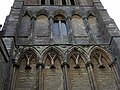 Arcaded tower decoration at Raunds


Carving and sculpture
editLittle major figure sculpture has survived from this period, except for the tiers of stiff, erect Biblical figures on the west front of Wells.[32] Water-leaf capitals were characteristic of early, Cistercian-influenced work, but the most elaborate churches used stiff-leaf, a type of abstract foliage. At Wells this was inhabited by narrative scenes, figures and animals, while in some later buildings it swayed to appear windblown.[33] Stiff-leaf could evenly cover the capital or could be concentrated in crockets at the corners, a feature more normal in France. Where funds did not allow for sculpture or more austerity was aesthetically desired, as at Salisbury, capitals could be simply moulded. Square abaci over capitals are generally a sign of early date, but were still used at Kirkwall around the 1240s or '50s.[34] Later abaci were generally rounded, with early examples in William the Englishman's eastern crypt at Canterbury Bases were often 'waterholding', with deep hollows and rolls. Arches were decorated with mouldings, small repeated pyramids called nailhead, or pyramidal four-petalled flowers called dog-tooth. Nailhead generally signifies earlier work, though dog-tooth can be seen as early as the 1170s on the vaults of Canterbury Cathedral.[35]
 A water-leaf capital
 A bell capital, ornamented with nailhead. The central shaft has a fillet (applied flat strip)
 A stiff-leaf capital at Northwold. The shafts are keeled (pointed).
 Dog-tooth moulding


.jpg)
.jpg)
Domestic architecture
editSome domestic architecture has survived from this period. This largely consists of greater houses, such as bishops' palaces and the domestic buildings within castles, as they were more likely to be built of stone. They also more closely followed architectural fashions, such that common details can be seen between the cathedral of Lincoln and the contemporary bishop's palace next door. Similarly, the influence of Canterbury is as clear in castles, like Oakham and Dover, as it is in churches. Houses were centred on a great hall, which at this time was often aisled in wood or stone, as roofing technology had not yet developed to allow wide aisleless spans.[36] The arcades of these aisles followed the pattern of church architecture, with Purbeck marble being used at Winchester, and waterleaf capitals at Auckland.[36] Windows were also simpler versions of those used in churches, generally of two lights, with the difference that often only the upper part was glazed (if at all), with the lower part having opening shutters.[37] These two registers were divided by a transom, as at Winchester Castle, a feature that would become significant in Perpendicular Gothic architecture.[38] Window seats may also have been a late 12th century development.[39] Houses condensed from a collection of separate buildings grouped round the hall to a single block containing the hall, chamber and services (though the kitchen was still separate as a fire precaution).

Military architecture
editCastle design of this period was characterised by two changes: the replacement of square towers with round ones (which may have better resisted bombardment and undermining), and the replacement of the central keep with an encircling stone curtain wall.[40] These two developments could happen separately, with Conisbrough Castle having a round keep and round towers, while Framlingham has no keep but square towers. These changes were influenced by similar developments in France under Philip Augustus, and potentially by the castles of the Crusades.[41] William Marshal appears to have been influential in introducing these new features after he married the heiress of Pembroke in 1189, building a great round tower at Pembroke, a quadrangle with round corner towers at Kilkenny and a gatehouse with twin round towers at Chepstow.[42] Regularly-planned castles with round towers were used by King John at Limerick and Dublin to reinforce English rule in Ireland.[43] They were inspired by Philip Augustus's use of regular round-towered castles to cement Capetian power in France, and were more regular than castles in England, partly due to their being built on fresh sites.
Examples
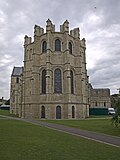
editNow a vast parish church, but formerly an outpost of the Archbishops of York. The nave and twin west towers are later medieval (but designed to harmonise with the earlier work, but the east end, with two pairs of transepts, is in the grandest Early English manner, three-storeyed and fully vaulted.
The east end was rebuilt after a fire in 1174 by William of Sens and William the Englishman, adapting French Gothic forms to English tastes and the constraints of the existing building. The general forms are French, taking inspiration from several buildings, but some of the details, such as the Purbeck marble shafting and rounded abaci, are more common to England. The odd plan, narrowing and then widening before finishing in a chevet with a single axial chapel-tower, resulted from the needs to retain two chapel-towers from the earlier building, while also providing a shrine for the remains of St Thomas Becket. William of Sens' work has alternating round and octagonal columns to the main arcade and paired round arches in the low gallery (the design of which was subject to several changes of plan), while the Englishman's work has more varied piers and a more Gothic triforium. The reconstruction took ten years, though decoration dragged on until 1220. The building retains much of its original stained glass.
Unusually for a cathedral, the building (c.1230s-1270s) lacks transepts, vaults and triforium, appearing more like a large parish church save for the high quality of the design. The elongated aisleless choir was also used at Dunkeld and Fortrose.[45] The nave has high arcades and unvaulted aisles, suggesting that a three-storeyed design was begun and soon abandoned.[46] The clerestory shows the transition from plate to bar tracery, while the choir with its vast (twice replaced) bar-traceried windows more properly belongs to Geometrical Decorated.
The see was transferred from Spynie in 1224, and the heavily-ruined cathedral shows two phases of 13th century construction (much altered after the cathedral was torched by the Wolf of Badenoch in 1390).[47] The south transept and western towers belong to the first phase, still with some round arches.[47] The rich two-storeyed east end is of the second phase, after a fire in 1270.[48] The eastern two bays project beyond the aisles, allowing greater light. The east wall has two tiers of five lancets, with a large rose in the gable, enabled (as at York) by the lack of vaulting.[49] The lancets had some bar tracery insets, suggesting awareness of recent fashions, though the general lines were derived from Southwell.[49]
Pointed arches begin to appear at the west end of the Norman church, in the blind arcading of the western transept and the great arches under the west tower. The restored west porch came next, with an unusually fine door and a triplet of lancets above. Following this, attention turn to the outmoded Norman east end (now destroyed by the collapse of the tower in 1322). The old apse was removed and a new presbytery added, perhaps the richest major Early English building. The design is an elaboration of the nave at Lincoln, adapted to suit the existing Norman proportions. The east wall has a rare surviving cluster of lancets, not replaced by a larger late medieval window.
The long nave is Cistercian late Romanesque, with fat round piers and slightly pointed arches. Many of the monastic buildings, including the refectory and the extremely long cellarium, are Early English, as is the slightly later east end of the church. This had a luxurious choir (largely destroyed in the 18th century) and a hammer-headed Chapel of the Nine Altars, a feature also seen at Durham.
The finest Early English work in Scotland, and one of the most inventive surviving in Britain. There was an abortive reconstruction in the 1180s or -90s, but the present cathedral was largely begun in the first third of the 13th century. Despite several changes of plan, the form is a simple rectangle, with non-projecting transepts in the French manner, and a straight retrochoir behind the high altar, while the elevations are elaborations on Rievaulx, though without the vault. However, the crypt is very complex, with the regular vaulting pattern being disrupted to create a 'canopy of honour' of four elaborated closely-spaced columns round St Kentigern's shrine, while further east the piers spread out to form a dome over the second focus of the Lady Chapel. The nave is more vertical, with narrower bays and an integrated gallery and clerestory responding to later 13th century Rayonnant developments in France and England. The two west towers were demolished in the 19th century.
Reconstruction of the Saxon and Norman monastery had reached the east end of the nave when it was halted by the Scottish wars, not to be completed until the 20th century. The gallery arches are still round, with pointed sub-arches. The north transept has astonishingly tall and thin lancets in the end wall, while the south transept contains the canons' night stair.
The largest of the Early English cathedrals, with rebuilding starting in 1192. Some unorthodox, even wilful forms are used, such as the 'crazy vaults' over the choir and the syncopated blind arcading in the aisles. The unusual polygonal chevet was replaced by the Angel Choir (1256–80). There are sexpartite vaults to the transepts, but a tierceron vault over the nave, giving a rich and much-copied effect. There are more unusual vaults in the west transept. The north rose window still has medieval glass. The aisles have two external bays to every one internal bay, an idea that was occasionally used elsewhere. The west front is built around the surviving Norman core, and is a very large and flat screen, now lacking statuary. The ruined bishop's palace and decagonal chapter house are contemporary.
William Marshal rebuilt the castle, adding an influential round great tower that challenges the idea that the keep was obsolete in this period. The tower is roofed by a dome and had three tiers of fighting platforms at the top, akin to the 14th century tower at Fort La Latte in Brittany. The restored outer walls and town wall were completed by the Marshal's successors later in the 13th century, with more round towers and a gatehouse with barbican.
The cathedral (only an abbey until the Reformation) is almost entirely Norman (work on the nave continued in the same style into the 13th century to ensure uniformity[52]), but the west front of c.1200 is an abrupt contrast. It forms a giant portico, with turrets flanking three great arches topped with gables, and a high vaulted space behind. Behind the portico are western transepts and two towers, only one of which was completed. The doors are small and oddly placed, as the shape of the front does not reflect the building behind.[53] The centre subtly bulges outwards and leans forwards, to create an optical illusion of greater size.
The destroyed nave was an early example of the Burgundian Cistercian style, with plain square piers and pointed barrel vaults. The east end of the church was rebuilt in the 1220s as a scaled-down version of Lincoln, with elegant paired triforium arches, six east lancets and a vault. The refectory is also a fine example of Early English work. As it had many daughter houses in Scotland, Rievaulx's new east end proved influential, though it bankrupted the abbey.
The archetypal Early English cathedral, built (with the exception of the tower, chapter house and cloisters) in one campaign (1220–58). The interior now appears somewhat bare, owing to the loss of the stained glass, furnishings and wall paintings. The plan has long double transepts, and an echelon of chapels behind the high altar, every one right angled. The church lacks carved capitals, or even any dog-tooth moulding, the only (replaced) statuary being on the west front. The vaulting shafts do not extend below the gallery, leaving a strong straight line between it and the arcades.
The Tower of London
editThe 11th century White Tower of William the Conqueror was gradually encircled by a series of stone walls in the 13th century. Richard I began works with the octagonal Bell Tower. Henry III built the Inmost Ward and domestic buildings (now mostly destroyed) and much of the Inner Ward, including the large round Wakefield Tower. He also built a new gate in around 1238 which, while it immediately collapsed, appears to have been influential.[55] Edward I replaced the ruined gate with the brick Beauchamp Tower and added the narrow Outer Ward to make the Tower the first true concentric castle (in which the soldiers on the inner wall could fire over the heads of those on the outer wall) in England.[56]
One of the earliest Early English works, without the French features seen at Canterbury. The east end was replaced in the 14th century. The building is low, with quadripartite vaults throughout. In the transepts, the vaulting shafts divide the triforium, but in the nave it runs straight from west front to crossing. The columns are complex, without Purbeck, and the inhabited stiff-leaf capitals are very fine, especially in the transepts.[13] The west front is a broad screen, with the towers projecting beyond the aisles, and about half its original statuary.[32]
The great hall is the only building to survive from this important royal castle. It was built by Henry III in 1222-36 and is aisled, with arcades of Purbeck marble.[57] The outer walls formerly rose to gablets over the plate traceried windows; the roof is a later reconstruction.
Archbishop Roger's 1160s rebuilding of the Norman east end has vanished, but was likely of Cistercian Transitional form. Rebuilding then moved to the surviving transepts. They are very high, with timber ceilings (that to the south destroyed by lightning in 1984) and round arches over the triforium. The south façade is very busy, with three gablets over the door and a rose (or 'marigold') window pushed up into the gable, while that to the north is an austere composition of five vast lancets, the Five Sisters Window, with original grisaille glass.[16]
Gallery
edit The east end of Beverley Minster, showing double transepts
 The interior of Beverley Minster
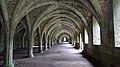 The cellarium at Fountains Abbey
 The Great Tower at Pembroke Castle
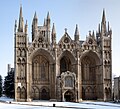 The west front of Peterborough Cathedral
 The nave of Wells Cathedral. The scissor arches at the far end are a 14th century insertion


See also
editReferences
edit- ↑ Clifton-Taylor, Alec (1968). The Cathedrals of England. London: Book Club Associates. p. 74.
- ↑ Pevsner, Nikolaus (1968). An Outline of European Architecture (7th ed.). Harmondsworth: Penguin. pp. 64–67.
- ↑ Clifton-Taylor 1968, p. 43
- ↑ Pevsner 1968, p 89
- ↑ Pevsner 1968, p. 97
- ↑ Pevsner 1968, p. 118
- 1 2 Fawcett, Richard (1997). Scottish Cathedrals. London: Batsford. p. 28.
- ↑ Woodman, Francis (1981). The Architectural History of Canterbury Cathedral. London: Routledge & Kegan Paul. pp. 87–89.
- ↑ Woodman 1981, pp. 109-114
- ↑ Woodman 1981, p. 115
- ↑ Woodman 1981, pp. 125-126
- 1 2 Pevsner, Nikolaus; Harris, John (1964). Lincolnshire. The Buildings of England. Harmondsworth: Penguin. pp. 85–105.
- 1 2 3 Clifton-Taylor 1968, p. 74
- 1 2 Clifton-Taylor 1968, pp. 99-104
- ↑ Clifton-Taylor 1968, pp. 114-116
- 1 2 Clifton-Taylor 1968, pp. 106-109
- ↑ Pevsner, Nikolaus; Harris, John (1964). Lincolnshire. The Buildings of England. Harmondsworth: Penguin. pp. 35–36.
- 1 2 Fawcett, Richard (1997). Scottish Cathedrals. London: Batsford. pp. 26–28.
- ↑ Fawcett 1997, p. 40
- 1 2 Fawcett 1997, p. 43
- ↑ Coldstream, Nicola (1999). The Decorated Style: Architecture and Ornament, 1240-1360. London: British Museum. p. 24.
- ↑ Pevsner 1968, p. 131
- ↑ Clifton-Taylor 1968, p. 88
- ↑ Coldstream, Nicola (1999). The Decorated Style: Architecture and Ornament, 1240-1360. London: British Museum. p. 87.
- ↑ McNeill, John (2011). "A Prehistory of the Chantry". Journal of the British Archaeological Association. 164: 3.
- ↑ Clifton-Taylor 1968, p. 78
- 1 2 Clifton-Taylor 1968, p. 109
- ↑ Pevsner 1968, pp. 119-121
- ↑ Clifton-Taylor 1968, p. 75
- ↑ Binski, Paul (2004). Becket's Crown: Art and Imagination in Gothic England, 1170-1300. New Haven: Yale University Press. p. 6.
- ↑ Flannery, Julian (2016). Fifty English Steeples. London: Thames & Hudson. pp. 36–37.
- 1 2 Clifton-Taylor 1968, p. 82
- ↑ Clifton-Taylor 1968, pp. 77-78
- ↑ Fawcett 1997, p. 54
- ↑ Binski 2004, p. 8
- 1 2 Wood, Margaret (1965). The English Mediaeval House. London: Phoenix House. p. 39.
- ↑ Wood 1965, pp. 347-350
- ↑ Wood 1965, p. 350
- ↑ Wood 1965, pp. 346-347
- ↑ Goodall, John (2011). The English Castle. New Haven: Yale University Press. p. 154.
- ↑ Goodall 2011, p. 153
- ↑ Turner, Rick (2010). Chepstow Castle. Cardiff: Cadw. pp. 10–12.
- ↑ Goodall 2011, pp. 167-168
- ↑ Woodman 1981, pp. 87-141
- ↑ Fawcett 1997, p. 52
- ↑ Fawcett 1997, p. 50
- 1 2 Fawcett 1997, p. 34
- ↑ Fawcett 1997, p. 58
- 1 2 Fawcett 1997, p. 59
- ↑ Bradley, Simon; Pevsner, Nikolaus (2014). Cambridgeshire. The Buildings of England (3rd ed.). New Haven: Yale University Press. pp. 488–489, 498–499.
- ↑ Fawcett 1997, pp. 36-45
- ↑ Clifton-Taylor 1968, p. 67
- ↑ Clifton-Taylor 1968, pp. 82-86
- ↑ "History of Rievaulx Abbey". English Heritage. Retrieved 25 May 2026.
- ↑ Goodall 2011, pp. 190-191
- ↑ Goodall 2011, pp. 201-203
- ↑ Goodall 2011, p. 24
Sources
edit- Binski, Paul. 2004. Becket's Crown: Art and Imagination in Gothic England, 1170-1300. New Haven: Yale University Press
- Bony, Jean. 1949. "French Influences on the Origins of English Gothic Architecture." Journal of the Warburg and Courtauld Institutes 12: 1-15
- Clifton-Taylor, Alec. 1968. The Cathedrals of England. London: Book Club Associates. pp. 67–119
- Fawcett, Richard. 1997. Scottish Cathedrals. London: Batsford. pp. 26–61
- Goodall, John. 2011. The English Castle. New Haven: Yale University Press. pp. 149–195
- Pevsner, Nikolaus. 1968. An Outline of European Architecture. 7th ed. Harmondsworth: Penguin. pp. 118–128
- Wood, Margaret. 1965. The English Mediaeval House. London: Phoenix House
- Woodman, Francis. 1981. The Architectural History of Canterbury Cathedral. London: Routledge & Kegan Paul. pp. 87–141