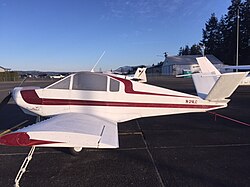
The Davis DA-2 is a light aircraft designed in the United States in the 1960s and was marketed for homebuilding.[1] While it is a low-wing monoplane of largely conventional design with fixed tricycle undercarriage, the DA-2 is given a distinctive appearance by its slab-like fuselage construction and its V-tail.[2] The pilot and a single passenger sit side-by-side. Construction of the aircraft is sheet aluminum throughout, with the sole compound curves formed a fiberglass cowling and fairings.[3]
The prototype made its first flight on May 21, 1966, and was exhibited at that year's Experimental Aircraft Association annual fly-in, where it won awards for "most outstanding design" and "most popular aircraft".[4]
A major design consideration was ease of assembly for a first time home aircraft builder. Examples of this include: few curved components, a V-tail is one less control surface to build, and each wing is made from two sheets of aluminum with no trimming involved.[5]
The DA-3 was a single DA-2 enlarged to accommodate four people. Work proceeded through 1973-74, but the aircraft was never completed.
Plans have been intermittently available over the years. They are as of August 2019, available from D2 Aircraft.
Examples of the DA-2 have been completed in the United States, Canada and the United Kingdom and are currently (2015) actively flying in those countries.